
The 2026 IRMAA brackets start above $109,000 of modified adjusted gross income (MAGI) for most single filers and above $218,000 for married couples filing jointly. Medicare uses your 2024 tax-return income to determine your 2026 income-related monthly adjustment amount, but it applies the 2026 IRMAA table—not the 2024 table.
That last distinction is where people get turned around. The income year looks back two years. The bracket year does not. Below are the official 2026 Part B premiums and Part D IRMAA amounts, plus the practical math for what crossing a tier can actually cost.
Show the key numbers
- First threshold: IRMAA begins above $109,000 of 2024 MAGI for most single filers and above $218,000 for married couples filing jointly.
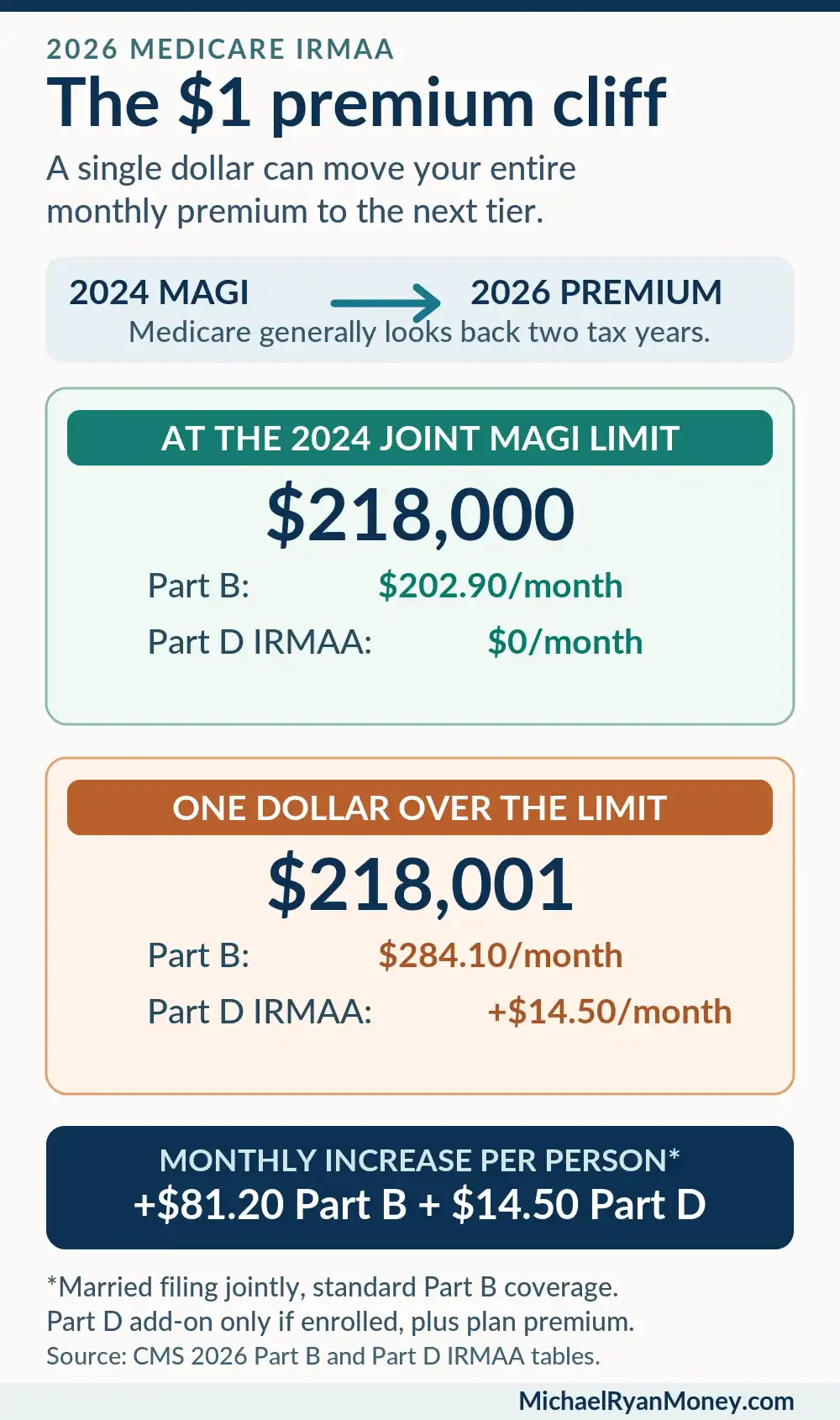
- Standard Part B: The standard 2026 Part B premium is $202.90 per month. The first IRMAA tier raises the total Part B premium to $284.10.
- Part D: Part D IRMAA is a separate monthly amount added to your prescription-drug coverage cost. The first 2026 tier adds $14.50 per month.
- Two-year lookback: For 2026 premiums, Social Security generally uses 2024 MAGI. It compares that income with the 2026 threshold table.
- Appeals: If a qualifying life-changing event reduced your income, SSA-44 currently lists eight events that may support a request to use more recent income information.
On This Page
- Key Takeaways Ahead
- 2026 IRMAA Brackets at a Glance
- Which Year Does IRMAA Use? 2024 Income, 2026 Brackets
- What Happens When You Cross an IRMAA Threshold?
- What Income Counts for IRMAA?
- Choose the IRMAA question that actually applies to you
- Can You Appeal a 2026 IRMAA Determination?
- Could a Life-Changing Event Lower Your IRMAA?
- Should You Always Stay Below the Next IRMAA Tier?
- The Bottom Line on the 2026 IRMAA Brackets
- How We Verified This
Key Takeaways Ahead
2026 IRMAA Brackets at a Glance
IRMAA is an extra amount added to Medicare Part B and Part D costs for higher-income beneficiaries. For 2026, the standard Part B premium is $202.90 per month. The official figures below come from the Centers for Medicare & Medicaid Services’ 2026 premium release.
Scroll horizontally to compare every 2026 IRMAA tier.
| 2024 MAGI — Single | 2024 MAGI — Married Filing Jointly | 2026 Total Part B Premium | 2026 Part D IRMAA |
|---|---|---|---|
| $109,000 or less | $218,000 or less | $202.90/month | $0 |
| $109,000.01–$137,000 | $218,000.01–$274,000 | $284.10/month | $14.50/month |
| $137,000.01–$171,000 | $274,000.01–$342,000 | $405.80/month | $37.50/month |
| $171,000.01–$205,000 | $342,000.01–$410,000 | $527.50/month | $60.40/month |
| $205,000.01–$499,999.99 | $410,000.01–$749,999.99 | $649.20/month | $83.30/month |
| $500,000 or more | $750,000 or more | $689.90/month | $91.00/month |
Important: The Part D column is the IRMAA add-on, not your drug plan’s base premium. Married filing separately can use a different, much more compressed threshold structure.
The easiest way to read the table is to find your filing status, locate your 2024 MAGI, and then read across to the 2026 premium amounts. If your MAGI is at or below the first threshold, you pay no IRMAA. Above it, Part B and—when you have Medicare prescription-drug coverage—Part D can both carry an income-related adjustment.
Which Year Does IRMAA Use? 2024 Income, 2026 Brackets
This comes up constantly because the phrase “two-year lookback” sounds like everything shifts backward two years. It doesn’t. Someone asking about 2028 Medicare premiums would generally be looking at 2026 income, but that income would be tested against the 2028 IRMAA thresholds once those thresholds are official.
For 2026, Social Security’s current guidance uses 2024 tax-return information when available. If that data is unavailable, SSA can use older available tax information and later make a new determination when updated IRS data arrives. The SSA IRMAA sliding-scale tables show the premium-year thresholds and adjustments.
Watch: The One Thing Everyone Gets Wrong About IRMAA
What Happens When You Cross an IRMAA Threshold?
IRMAA has a cliff-like structure. Once your MAGI moves into the next tier, the corresponding monthly adjustment applies; Medicare does not charge the higher amount only on the dollars above the threshold.
That is a real planning consequence. But it is more useful to call it a premium cliff than to describe it as a six-figure-percent “tax rate.” IRMAA is a Medicare premium adjustment, and the right question is whether the added premium changes the economics of the transaction that created the income.
What Income Counts for IRMAA?
For IRMAA, SSA generally defines MAGI as your adjusted gross income plus tax-exempt interest. On Form 1040, that means starting with AGI and adding tax-exempt interest such as municipal-bond interest.
That is enough MAGI detail for this bracket page. For the full inclusion/exclusion rules and examples, use my guide to what income counts toward IRMAA MAGI.
Can You Appeal a 2026 IRMAA Determination?
Sometimes. If your income went down because of a qualifying life-changing event, Social Security may let you request a new IRMAA determination using more recent income information. The current Form SSA-44 lists eight life-changing events: marriage, divorce or annulment, death of a spouse, work stoppage, work reduction, loss of income-producing property, loss of pension income, and an employer settlement payment.
A planning mistake by itself is not one of those eight events. If you are dealing with retirement, work reduction, divorce, a spouse’s death, or another listed event, my SSA-44 IRMAA appeal guide walks through the procedure and documentation without turning this bracket reference into a second appeal article.
Should You Always Stay Below the Next IRMAA Tier?
This matters most with decisions such as Roth conversions, large capital gains, retirement-account withdrawals, or other one-time income. The bracket table tells you the Medicare cost. It does not tell you whether avoiding that cost is worth giving up the transaction.
If the decision is whether to sell appreciated investments or borrow against them, compare the tax and Medicare tradeoffs in borrow against stocks before treating IRMAA as the only cost.
If a Roth conversion is the decision in front of you, compare the tax benefit against the added Medicare cost in the Roth conversion versus IRMAA tradeoff. If the bigger question is how to reduce future exposure across withdrawals, gains, charitable giving, conversions, and other income decisions, use my IRMAA planning strategies guide.
The Bottom Line on the 2026 IRMAA Brackets
For 2026, start with your 2024 MAGI and the 2026 threshold table. The first IRMAA tier begins above $109,000 for most single filers and above $218,000 for married couples filing jointly. The standard Part B premium is $202.90 per month, and both Part B and Part D costs can rise as you move through the income tiers.
The number I would keep in your head is not a dramatic “tax rate.” It is the annual dollar cost of the next tier for your household. Once you know that number, you can decide whether to avoid the threshold, accept it, or appeal an outdated determination for a qualifying life change.
How We Verified This
I checked the final 2026 premium amounts and thresholds against the agencies that administer Medicare IRMAA, then used SSA's current appeal form for the life-changing-event list.
