
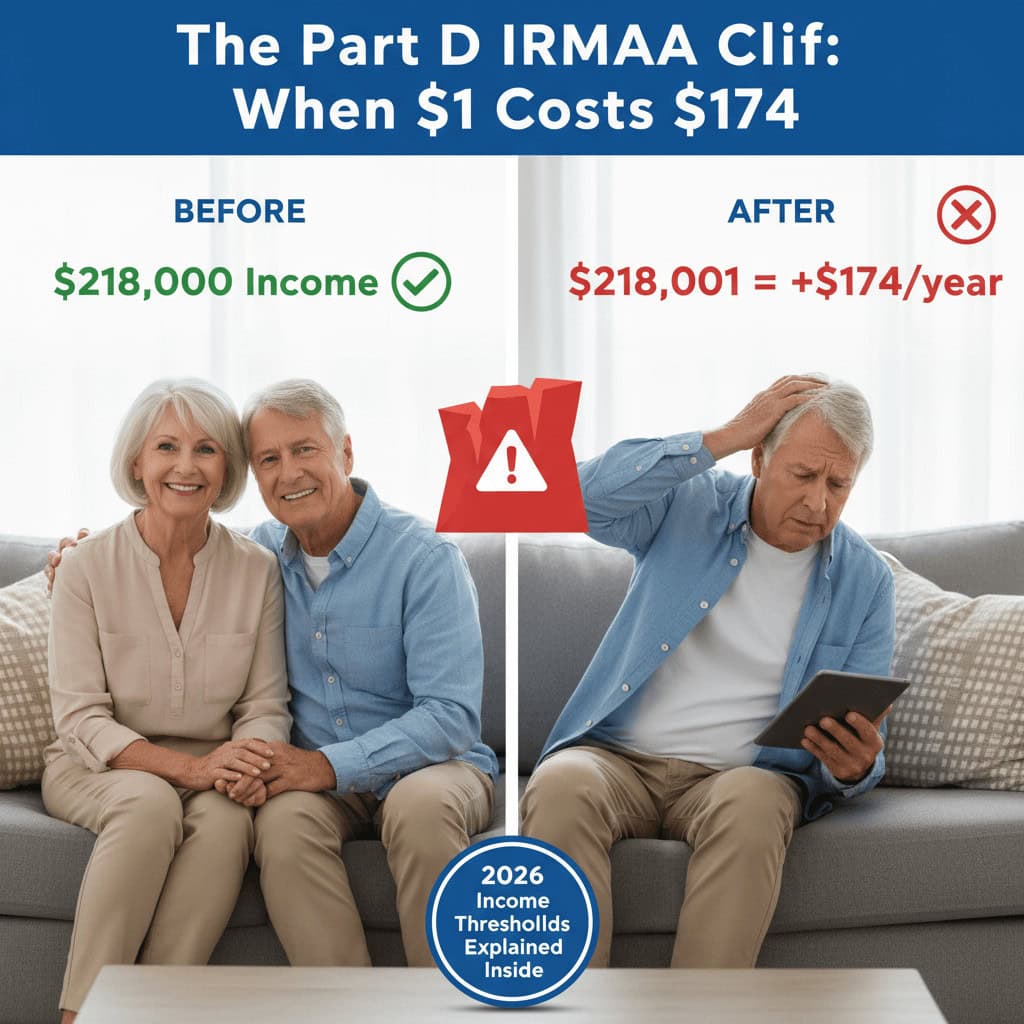
Part D IRMAA is an income-based amount added to your Medicare prescription drug coverage cost. For 2026, most beneficiaries with 2024 modified adjusted gross income (MAGI) above $109,000 as an individual or $218,000 as a married couple filing jointly pay an extra $14.50 to $91.00 per month, per Medicare beneficiary.
Here is the part that causes more confusion than the bracket table: your Part D plan premium and your Part D IRMAA are separate charges. A drug plan can advertise a $0 monthly premium and you can still owe Part D IRMAA. Social Security’s 2026 table states the relationship plainly: your prescription drug coverage premium is your plan premium plus the applicable Part D IRMAA amount.
For 2026, Medicare generally looks at your 2024 MAGI to determine Part D IRMAA. If your income crosses an IRMAA threshold, Medicare adds a fixed monthly amount to the premium set by your Part D or Medicare Advantage drug plan. The add-on ranges from $14.50 to $91.00 per month in 2026. The practical rule is simple: plan premium + Part D IRMAA = your income-adjusted Part D premium obligation, before any separate late-enrollment penalty or other applicable increase.
On This Page
- Key Takeaways Ahead
- How Part D IRMAA Changes What You Pay in 2026
- 2026 Part D IRMAA Amounts by Income
- Why Part D IRMAA May Not Appear on Your Drug Plan Bill
- How 2024 Income Determines Your 2026 Part D IRMAA
- Part D IRMAA vs. Part B IRMAA: Same Income Test, Different Charge
- What If Your Income Has Dropped Since 2024?
- Part D IRMAA Budget Checklist: Check These Numbers Separately
- Bottom Line: Part D IRMAA Is an Add-On, Not Your Drug Plan’s Price
- Sources
Key Takeaways Ahead
How Part D IRMAA Changes What You Pay in 2026
Think of Part D as having two price tags. Your insurance company sets the drug-plan premium. Medicare’s income rules determine whether you also owe Part D IRMAA. One does not cancel the other.
The federal rule is explicit: your total Medicare prescription drug coverage premium is the plan’s monthly premium, plus any applicable premium increase, plus the income-related monthly adjustment amount. The Social Security regulation governing Part D IRMAA also says the IRMAA amount is paid separately from the method you use to pay your drug plan.
A $0-premium Part D or Medicare Advantage drug plan does not make Part D IRMAA $0. If your income puts you in an IRMAA tier, you still owe the income-related amount. This is why someone can enroll in a plan advertised at $0 and later see a separate Medicare deduction or bill.
That distinction sounds small until you are budgeting. A $0 plan plus a $60.40 monthly Part D IRMAA is not a $0 prescription-drug premium obligation. It is $60.40 per month in Part D IRMAA, or $724.80 over 12 months, before any other applicable Part D increase.
2026 Part D IRMAA Amounts by Income
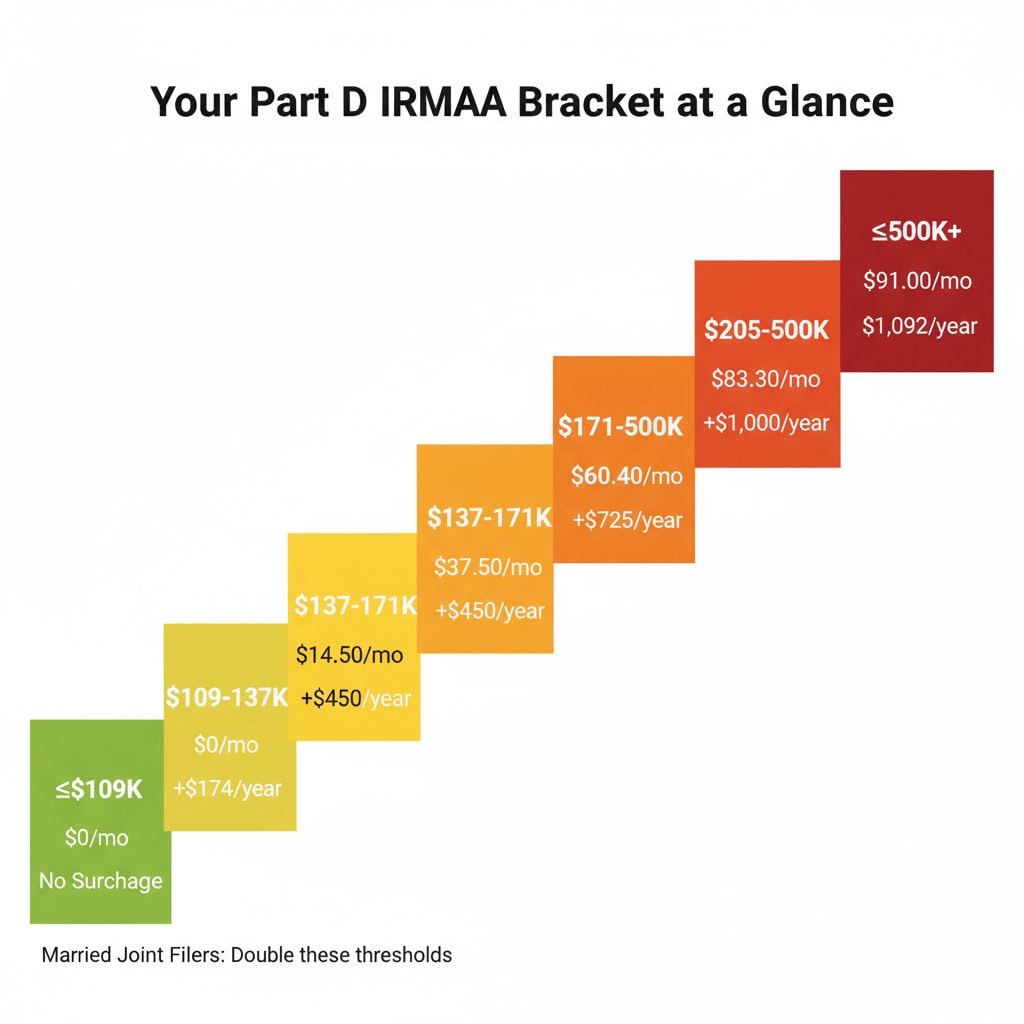
The Centers for Medicare & Medicaid Services’ official 2026 premium fact sheet lists five Part D IRMAA surcharge tiers above the no-IRMAA range. CMS says approximately 8% of people with Medicare Part D pay an income-related adjustment.
| 2024 MAGI — Individual | 2024 MAGI — Married Filing Jointly | 2026 Monthly Part D IRMAA | 12-Month Part D IRMAA |
|---|---|---|---|
| $109,000 or less | $218,000 or less | $0.00 | $0.00 |
| Above $109,000 through $137,000 | Above $218,000 through $274,000 | $14.50 | $174.00 |
| Above $137,000 through $171,000 | Above $274,000 through $342,000 | $37.50 | $450.00 |
| Above $171,000 through $205,000 | Above $342,000 through $410,000 | $60.40 | $724.80 |
| Above $205,000 and below $500,000 | Above $410,000 and below $750,000 | $83.30 | $999.60 |
| $500,000 or more | $750,000 or more | $91.00 | $1,092.00 |
The annual column simply multiplies the monthly adjustment by 12 so you can see the budget impact. Your actual drug-plan premium is still separate and varies by plan.
Married filing separately is different. If you were married and lived with your spouse at any time during the tax year but filed separately, the ordinary individual table above is not the right schedule. That edge case belongs on my Irmaa Married Filing Separately guide because the thresholds are much more compressed.
Why Part D IRMAA May Not Appear on Your Drug Plan Bill
This is where the system feels more complicated than the math. CMS says that regardless of how you pay your Part D plan premium, the Part D IRMAA amount is generally deducted from Social Security benefits or paid directly to Medicare. In other words, the insurance company may collect one part of your Part D cost while Medicare collects the income-related piece.
That separation explains several situations that otherwise look like mistakes: a $0-premium plan followed by an IRMAA deduction, an IRMAA amount that appears after the drug plan has already started, or a bill that seems larger than one month’s published IRMAA tier because more than one coverage month may be represented.
If a Part D IRMAA bill looks wrong, do not start by comparing it only with your drug plan’s premium. Check four separate things: the IRMAA tier on your Social Security notice, the coverage months shown on the bill, the plan premium charged by the insurer, and whether a Part D late-enrollment penalty or another adjustment is listed separately. Same drug coverage. Different lines of money.
That last distinction matters. A Part D late-enrollment penalty is not Part D IRMAA. The two can appear in the same overall prescription-drug cost picture, but they arise from different rules. If the number on a notice does not match the monthly IRMAA table, first check whether you are looking at one month, multiple months, or a different Part D charge.
If this distinction just saved you from budgeting the wrong number, that is exactly the kind of Medicare detail I flag in my weekly emails. I focus on the small rule differences—IRMAA, MAGI, timing, Social Security, Roth moves—that can turn into real retirement costs when they get lumped together.
- Know which number actually controls the Medicare charge.
- Catch timing and income traps before the calendar locks them in.
- Get plain-English retirement planning without a sales pitch.
Join below and I’ll keep translating the fine print into the number that matters.
How 2024 Income Determines Your 2026 Part D IRMAA
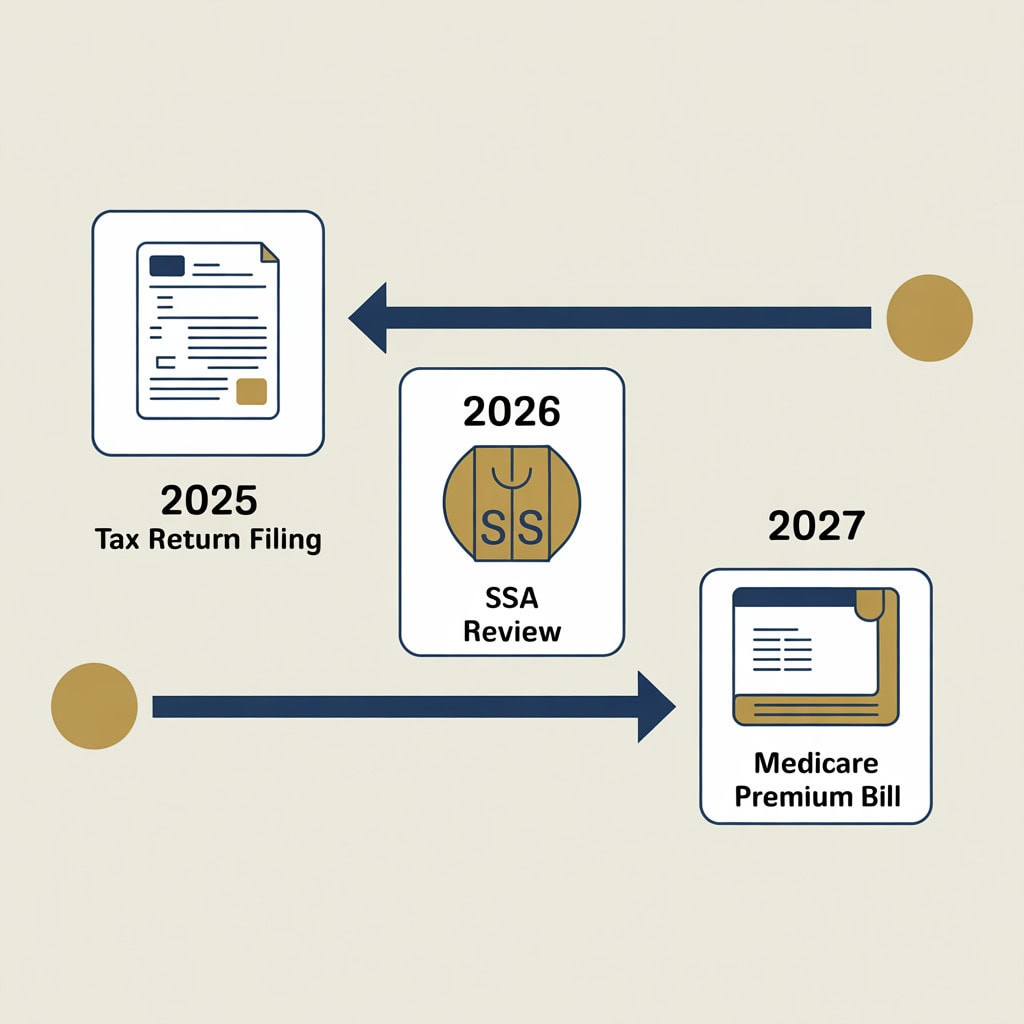
For 2026 premiums, Social Security generally uses MAGI from your 2024 federal tax return. For IRMAA purposes, MAGI is generally your adjusted gross income plus tax-exempt interest. The important point for this page is the timing: income in 2024 can change what you pay for Part D in 2026.
You do not need a second giant income list here. If you are trying to determine whether an IRA withdrawal, Roth conversion, capital gain, Social Security benefit, municipal-bond interest, home sale, or another item belongs in the MAGI number, use my IRMAA Income Checker. That page owns the income-source question; this page owns what the resulting income level does to your Part D cost.
Social Security can also use older tax information when the more recent return is not available. Its 2026 guidance notes that if SSA used an older return and you have a more recent filed return showing a different MAGI, you can contact Social Security about updating the determination.
Part D IRMAA vs. Part B IRMAA: Same Income Test, Different Charge
Part B IRMAA and Part D IRMAA generally use the same MAGI and filing-status framework, but they are separate Medicare charges. Part B starts with the standard Part B premium and adds its income-related amount. Part D starts with your specific drug plan’s premium and adds the Part D income-related amount.
| Question | Part B | Part D |
|---|---|---|
| Starting premium | Standard Part B premium | Your plan’s premium |
| Income-related amount | Part B IRMAA | Part D IRMAA |
| Can the plan premium be $0? | Not the same plan-premium structure | Yes, but IRMAA can still be due |
If you need the current Part B dollar schedule, use the separate Medicare Part B premium and IRMAA guide. Keeping the two pages separate makes the math easier to audit: one page for medical-premium cost, one for prescription-drug IRMAA.
What If Your Income Has Dropped Since 2024?
A lower income today does not automatically erase a 2026 IRMAA determination based on 2024 income. But Social Security has routes for using different income information in specific circumstances. For example, SSA may update a determination when IRS information was amended or corrected, and a qualifying life-changing event can support a request to use more recent income information.
This Part D page should not turn into an appeal manual. If your real question is When can I appeal my IRMAA surcharge?, use the SSA-44 specialist guide for the event, evidence, and filing steps.
Part D IRMAA Budget Checklist: Check These Numbers Separately
Before you decide that a Part D premium or Medicare bill is wrong, separate the pieces. This is the fastest way I know to turn a confusing notice into a checkable problem.
- Your drug-plan premium: the amount set by your Part D or Medicare Advantage drug plan.
- Your Part D IRMAA tier: the income-related monthly amount Social Security assigned for the premium year.
- Your income year: for 2026 IRMAA, generally 2024 MAGI.
- Your payment channel: the plan premium and IRMAA may be collected through different channels.
- Your coverage months: if a bill looks larger than one monthly tier, check the dates before assuming the tier itself is wrong.
- Other Part D charges: do not mistake a late-enrollment penalty or another applicable increase for IRMAA.
The big takeaway is not “avoid IRMAA at all costs.” It is more practical: know which lever you are looking at. Your plan controls the plan premium. Your income and filing status control the IRMAA determination. Mixing those two numbers is how a $0 plan turns into a surprise bill.
Bottom Line: Part D IRMAA Is an Add-On, Not Your Drug Plan’s Price
For 2026, Part D IRMAA adds $14.50 to $91.00 per month when your 2024 MAGI falls into one of the income-related tiers. That amount is added to the premium charged by your prescription-drug plan.
If you remember only one thing, remember the two-price-tag rule: a cheap or $0 drug plan can still come with Part D IRMAA. When the numbers on a bill look strange, separate the plan premium, the IRMAA amount, the coverage months, and any other Part D adjustment before you decide something is wrong.
Sources
- Centers for Medicare & Medicaid Services — 2026 Medicare premiums and Part D IRMAA amounts
- Social Security Administration — 2026 Medicare premiums by MAGI and filing status
- 20 CFR § 418.2125 — how Part D IRMAA affects the total prescription drug coverage premium
- SSA POMS HI 01101.020 — 2026 IRMAA sliding-scale tables
