
A Roth conversion can be worth doing even if it causes higher Medicare IRMAA premiums. The mistake is treating IRMAA as an automatic veto instead of one more marginal cost of the conversion. Add the extra federal and state income tax, add the extra Medicare Part B and Part D surcharge, then compare that cost with what the conversion may save or improve over the rest of your retirement.
I have seen retirement planning conversations get hijacked by one goal: never cross an IRMAA threshold. I understand the instinct. Nobody enjoys volunteering for a higher Medicare bill. But the cheapest Medicare year is not always the best lifetime tax plan.
Quick Answer
IRMAA belongs in the cost column, not the veto column. A taxable Roth conversion can raise the modified adjusted gross income (MAGI) Social Security uses for IRMAA, generally affecting Medicare premiums two years later. Crossing a tier by a small amount can make the marginal dollars unusually expensive, while a larger conversion may still make sense if the long-term tax and RMD benefits justify the added premium. The right comparison is usually convert, convert less, or wait, not simply “IRMAA or no IRMAA.”
If you need the mechanics of moving money from a traditional IRA to a Roth IRA, use my Roth IRA conversion roadmap. This page stays focused on the harder question: whether the IRMAA cost changes the decision.
On This Page
- Key Takeaways Ahead
- Is a Roth Conversion Still Worth It If It Triggers IRMAA?
- Calculate the Actual IRMAA Cost
- Compare That Cost With the Long-Term Tax Benefit
- One-Year IRMAA vs Multi-Year Tax Savings
- Decision Example: Convert Less or Pay IRMAA?
- When Paying IRMAA May Be Rational
- When Triggering IRMAA Is Probably a Bad Trade
- Other Costs That Can Change the Answer
- The Decision Rule: IRMAA Is a Cost, Not a Veto
- Frequently Asked Questions
- Sources
Key Takeaways Ahead
Is a Roth Conversion Still Worth It If It Triggers IRMAA?
Sometimes. Triggering IRMAA can still be rational when the surcharge is a limited near-term cost and the conversion materially improves lifetime taxes, future RMD exposure, survivor planning, or estate flexibility. It is a poor trade when the long-term benefit is thin or the conversion creates several other expensive income interactions at the same time.
A Roth conversion generally moves taxable pre-tax retirement money into a Roth IRA. The IRS explains that the taxable portion of a traditional IRA conversion is included in gross income for the year of the conversion. That additional income can raise the MAGI used for Medicare’s income-related monthly adjustment amount, or IRMAA.
For Medicare IRMAA, MAGI is generally adjusted gross income plus tax-exempt interest. Social Security normally uses tax-return information from two years before the Medicare premium year. In plain English, a Roth conversion completed in 2026 would generally affect 2028 Medicare premiums, not your 2026 premiums.
There is an important planning wrinkle: in September 2026, the official 2028 IRMAA thresholds and premium amounts do not exist yet. So you can estimate the effect of a 2026 conversion, but you cannot know the exact 2028 IRMAA bill today. Use current rules and reasonable estimates as planning inputs, then leave a buffer instead of pretending a future threshold is certain.
Calculate the Actual IRMAA Cost
The useful calculation is not “Will I pay IRMAA?” It is “What does the next block of conversion dollars cost me?”
For each conversion amount you are considering, add four pieces:
- incremental federal income tax from the conversion;
- incremental state income tax, if your state taxes the conversion;
- incremental Medicare Part B IRMAA; and
- incremental Medicare Part D IRMAA.
Then compare that immediate cost with the future taxes, forced taxable distributions, flexibility, and estate consequences that may change because the traditional IRA balance is smaller and the Roth IRA balance is larger.
Why $1 over an IRMAA threshold can be expensive
IRMAA uses tiers. That means a small amount of extra MAGI can move you into a higher premium tier for the year.
For the 2026 Medicare premium year, CMS set the first IRMAA threshold at more than $109,000 for most single filers and more than $218,000 for married couples filing jointly. The first tier adds $81.20 per month to Part B and $14.50 per month to Part D for each affected Medicare beneficiary.
The $1 cliff example
Assume a married couple filing jointly is already at $218,000 of MAGI for the tax year used to determine 2026 Medicare premiums, and both spouses are enrolled in Part B and Part D. If another $1 of MAGI puts them over the first threshold, their combined first-tier IRMAA would be $2,296.80 for the year: ($81.20 + $14.50) × 12 months × 2 people.
That does not mean a Roth conversion is automatically wrong. It means the first dollars that cross the threshold carry a fixed Medicare cost that must be included in the decision.
The official CMS 2026 IRMAA tables show the same step-up pattern through the higher Part B and Part D tiers.
Why every dollar above the threshold is not equally bad
Here is the part that gets lost when the advice stops at “avoid IRMAA.” The surcharge is tied to the tier, not charged separately on every conversion dollar.
If a couple crosses into a tier for a tiny conversion, the fixed surcharge can dominate the economics of that tiny conversion. If the couple intentionally converts a much larger amount while remaining in that same tier, the same tier’s surcharge is spread across more converted dollars. The tax cost still rises with the conversion, of course, but the IRMAA cost does not rise dollar-for-dollar inside the tier.
A $1 threshold crossing can be expensive. That does not mean every dollar beyond the threshold is equally bad.
Compare That Cost With the Long-Term Tax Benefit
Once the immediate cost is visible, compare it with the future problem the conversion is supposed to solve. That may include lower future RMDs, a lower expected tax rate on those dollars, more flexibility after the first spouse dies, or more tax-free assets available later. If the future benefit is vague, the case for deliberately paying IRMAA is weak.
One-Year IRMAA vs Multi-Year Tax Savings
This is the time-horizon question that keeps the decision honest. A one-year Medicare surcharge can be painful, but it should be compared with the number of future tax years the conversion may change. Conversely, paying IRMAA now is not automatically justified just because the benefit lasts longer. The expected multi-year savings still have to be large enough to compensate for the tax and premium cost you are taking on today.
Decision Example: Convert Less or Pay IRMAA?
Use this as a teaching example, not a 2028 forecast. Assume a married couple filing jointly has baseline MAGI of $210,000. Both spouses are enrolled in Medicare Part B and Part D. To isolate the tradeoff, assume the applicable IRMAA threshold and surcharge equal the 2026 first-tier figures, and assume each conversion dollar is subject to a 24% federal marginal rate plus a 5% state marginal rate. Your real tax rate, deductions, state rules, Medicare enrollment, and future IRMAA thresholds may be different.
| Choice | Conversion | Income tax at assumed 29% | Illustrative household IRMAA | Immediate added cost |
|---|---|---|---|---|
| Wait | $0 | $0 | $0 | $0 |
| Convert less | $8,000 | $2,320 | $0 | $2,320 |
| Convert more | $40,000 | $11,600 | $2,296.80 | $13,896.80 |
Moving from the $8,000 conversion to the $40,000 conversion shifts another $32,000 from the traditional IRA to the Roth IRA. Under these assumptions, that additional $32,000 creates $9,280 of additional income tax plus $2,296.80 of IRMAA, for an immediate incremental cost of $11,576.80.
Now the real decision begins. Is moving that additional $32,000 worth an $11,576.80 immediate cost when you model the future? The answer depends on your future marginal tax rates, time horizon, future RMDs, how you will pay the conversion tax, survivor planning, and what you expect to do with the money.
If your question is “How much can I convert before IRMAA becomes a constraint?”, use the dedicated guide on how much Roth conversion room you may have before IRMAA. This page begins after that sizing work: should you knowingly cross the line anyway?
When Paying IRMAA May Be Rational
I would be more willing to accept an IRMAA tier when the surcharge is buying something meaningful in the larger plan, not merely because “Roth is good.” These are the situations that make me look harder at the conversion rather than automatically trimming it back.
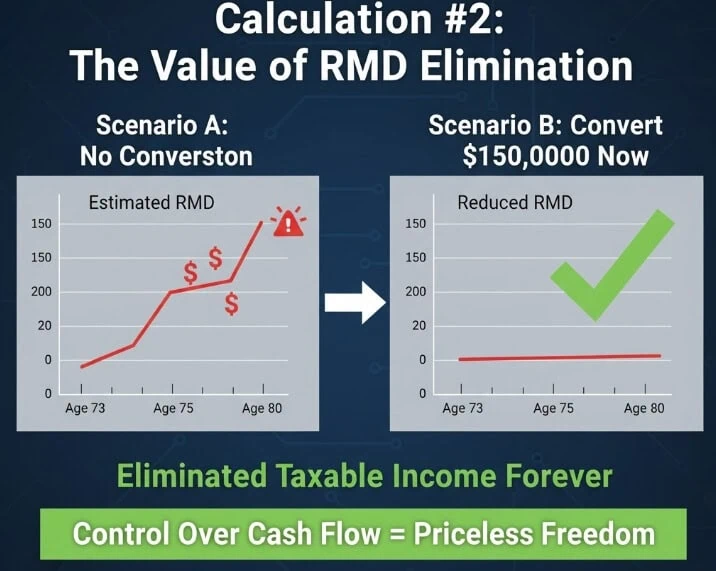
- You have a large pre-tax balance and meaningful future RMD exposure. The IRS generally requires traditional IRA owners to take RMDs beginning at the applicable starting age, while the original owner of a Roth IRA is not required to take lifetime RMDs. Converting now can reduce the balance exposed to future RMDs.
- Your current conversion tax rate is attractive relative to the rate you reasonably expect on those dollars later. This is a scenario to model, not a prediction that future tax rates must rise.
- You have enough outside cash to pay the tax and premium increase without weakening the retirement plan. A conversion that forces an unwanted distribution or strains near-term spending can solve one problem by creating another.
- You have a long enough horizon for the future flexibility to matter. A short-term premium increase is easier to justify when the conversion materially changes many future years of taxable income or estate planning.
- You are planning for the surviving spouse, not only today’s joint return. A married couple can eventually become a single taxpayer after the first spouse dies, changing both tax-bracket capacity and IRMAA thresholds. That future squeeze can make earlier tax diversification more valuable.
You can model that RMD side separately with the RMD calculator. The IRS RMD guidance is the controlling source for the general distribution rules.
When Triggering IRMAA Is Probably a Bad Trade
IRMAA becomes a stronger reason to trim or delay a conversion when the extra conversion dollars do not buy much long-term benefit.
- A small extra conversion barely crosses a tier. If you can move the same dollars next year without giving up a valuable tax window, paying a full annual surcharge for a tiny amount may be poor tradecraft.
- The conversion pushes you into a materially higher income-tax bracket at the same time. IRMAA is only one marginal cost. The tax bracket can matter more.
- Your future tax rate on the converted dollars is likely to be similar or lower. If the tax-rate advantage is weak, adding IRMAA can erase an already-thin case for converting.
- You expect to use other strategies that reduce future taxable IRA balances. Charitable planning, spending needs, or other distribution choices can change how much future RMD pressure you actually face.
- The conversion tax or Medicare surcharge would compromise liquidity. A mathematically elegant conversion is not elegant if it leaves you short of cash.
Michael’s decision rule
Do not ask, “Can I avoid IRMAA?” Ask, “What does this next block of converted dollars cost me, and what does it improve?” If the extra premium buys little future benefit, convert less. If it materially improves the lifetime plan, accepting IRMAA may be rational.
Other Costs That Can Change the Answer
IRMAA is only one marginal cost. Before deciding that a larger conversion is worth it, check whether the same dollars also create another expensive interaction:
- Federal tax bracket: a larger conversion can push additional dollars into a higher bracket.
- ACA premium tax credits: before Medicare, conversion income can reduce or eliminate marketplace subsidies.
- Capital-gain interactions: higher ordinary income can affect the rate applied to realized long-term gains and qualified dividends.
- State income tax: state treatment can materially change the immediate conversion cost.
- Future RMD exposure: reducing the traditional IRA balance may lower forced taxable distributions later.
- Household filing status: if both spouses are on Medicare, one threshold crossing can affect both beneficiaries; later, a surviving spouse may face single-filer tax and IRMAA thresholds.
That is why the correct comparison is rarely “Roth conversion tax versus IRMAA.” It is the full marginal cost today versus the expected multi-year benefit later.
The Decision Rule: IRMAA Is a Cost, Not a Veto
Here is the framework I would use before approving a Roth conversion that may trigger IRMAA:
- Build your projected MAGI before the conversion. Include the income sources that actually count for IRMAA.
- Model at least three conversion amounts. Compare no conversion, a smaller amount near the next meaningful threshold, and the larger amount you would choose if IRMAA did not exist.
- Add the full marginal cost. Include federal tax, state tax, and the estimated Part B and Part D IRMAA for each affected Medicare beneficiary.
- Compare lifetime outcomes. Look at future RMDs, expected future marginal tax rates, survivor taxes, liquidity, estate goals, and how long the Roth money can remain invested.
- Choose the conversion band with the best tradeoff. The answer may be zero, a smaller conversion that stays below a tier, or a larger conversion that knowingly accepts IRMAA.
That last step is where judgment matters. Avoiding IRMAA is a perfectly reasonable goal when the long-term conversion benefit is thin. It becomes a bad goal when it preserves a larger future taxable balance merely to save one year of Medicare surcharges. Understanding NUA, IRMAA and its implications can be crucial in making informed financial decisions. Failure to do so may lead to unexpected costs in the form of higher Medicare premiums.
Can you appeal IRMAA caused by a Roth conversion?
A voluntary Roth conversion by itself is not one of the life-changing events listed on Form SSA-44. SSA lists events such as marriage, divorce or annulment, death of a spouse, work stoppage or reduction, loss of income-producing property, loss of pension income, and certain employer settlement payments.
That does not erase your normal appeal rights if SSA used incorrect tax data or another permitted redetermination circumstance applies. It does mean you should not plan a voluntary conversion on the assumption that SSA will simply waive the resulting IRMAA. If you believe SSA used incorrect information or you experienced a qualifying life-changing event, see when you can appeal an IRMAA surcharge and how the SSA-44 route differs from reconsideration.
Make the Medicare Cost Part of the Plan
The most useful Roth decisions are rarely about one threshold in isolation. They are about choosing which taxes and premiums you are willing to pay now to create more control later.
- See when an IRMAA tier is worth accepting instead of automatically avoiding.
- Compare Roth conversion timing with future RMD and survivor-tax pressure.
- Catch Medicare and tax tradeoffs before they become expensive surprises.
One practical retirement-planning decision each week — including Roth conversion timing, IRMAA tradeoffs, and RMD mistakes that are easier to prevent than repair.
My bottom line: do not celebrate an IRMAA-free year if avoiding the surcharge makes the rest of your retirement plan worse. And do not trigger IRMAA casually just because Roth money sounds attractive. Price the next conversion dollars, compare the alternatives, and make the surcharge earn its place in the plan.
Frequently Asked Questions
Does a Roth conversion count as income for IRMAA?
The taxable portion of a Roth conversion is generally included in gross income for the conversion year, which can increase the MAGI Social Security uses for IRMAA. SSA generally uses tax-return information from two years before the Medicare premium year.
Is it worth crossing an IRMAA threshold by $1?
Usually you should test a smaller conversion first because the first dollar over a tier can trigger a fixed annual surcharge. But crossing a threshold is not automatically a mistake. A larger conversion may still make sense when its long-term tax, RMD, survivor, or estate benefits justify the added Medicare cost.
Can I appeal IRMAA caused by a Roth conversion?
A voluntary Roth conversion by itself is not one of the life-changing events listed on Form SSA-44. Other appeal or redetermination grounds can apply if SSA used incorrect tax information or another qualifying circumstance exists.
Sources
- Centers for Medicare & Medicaid Services: 2026 Medicare Parts A & B Premiums and Deductibles
- Social Security Administration: Modified Adjusted Gross Income (MAGI) for IRMAA
- Social Security Administration: Form SSA-44
- Internal Revenue Service: Publication 590-A
- Internal Revenue Service: Required Minimum Distributions
