

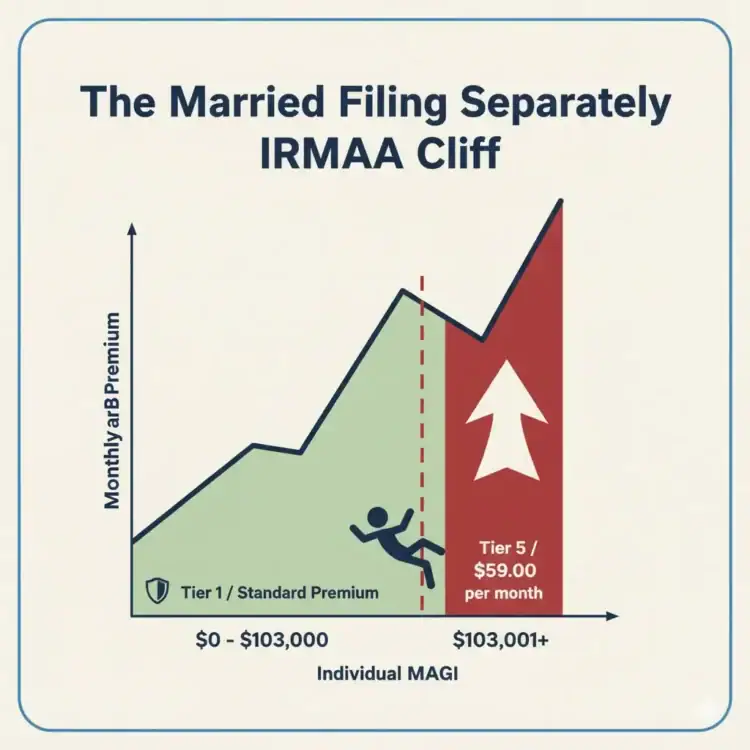
Married filing separately can make IRMAA dramatically more expensive—but there is an important exception. If you filed a separate return and lived with your spouse at any time during the tax year Social Security is using, Medicare applies a special, compressed IRMAA table. In 2026, once your individual MAGI is above $109,000, you jump straight to one of the two highest surcharge levels.
But if you filed married filing separately and lived apart from your spouse for the entire tax year being used for IRMAA, Social Security uses the normal individual IRMAA table instead. That one detail can change the answer by thousands of dollars.
This is why I would not start with “Is married filing separately good or bad?” Start with two questions: Which tax year is SSA using, and did you live with your spouse at any point during that year?
Quick Answer
For 2026 IRMAA, a married person who files separately and lived with a spouse at any time during the relevant tax year gets the special MFS table: MAGI above $109,000 but below $391,000 carries a $446.30 monthly Part B IRMAA plus an $83.30 Part D IRMAA; MAGI of $391,000 or more carries $487.00 plus $91.00. If you filed separately but lived apart from your spouse for the entire tax year, SSA generally applies the normal individual IRMAA thresholds instead.
On This Page
- Key Takeaways Ahead
- How Married Filing Separately Changes IRMAA in 2026
- The 2026 MFS IRMAA Numbers
- The Exception: Married Filing Separately but Living Apart All Year
- Can Filing Separately Ever Lower IRMAA?
- What If SSA Used the Wrong MFS Table?
- What Married Filing Separately Does Not Fix
- IRMAA Married Filing Separately FAQs
- The MFS Decision Is a Two-Ledger Decision
Key Takeaways Ahead
How Married Filing Separately Changes IRMAA in 2026
IRMAA uses modified adjusted gross income from an earlier tax return to determine the income-related surcharges on Medicare Part B and Part D. The full mechanics belong in my guide to how Medicare calculates IRMAA. The MFS wrinkle is narrower: Social Security does not always treat a married person filing separately like an ordinary individual filer.
For 2026, CMS sets the standard Part B premium at $202.90 per month. A person filing separately who lived with a spouse at any point during the relevant tax year can stay at that base amount through $109,000 of MAGI. Above $109,000, however, the special MFS schedule skips the lower IRMAA levels that an individual or joint filer would normally pass through.
The Detail That Controls the Table
The harsh MFS schedule applies when you filed married filing separately and lived with your spouse at some time during the tax year SSA is using. If you lived apart for the entire tax year, you fall under the normal individual IRMAA thresholds instead. “Married filing separately” is not one IRMAA category until you answer the living-arrangement question.
The 2026 MFS IRMAA Numbers
For a beneficiary who filed married filing separately and lived with a spouse at some point during the tax year, the 2026 schedule is unusually short:
| 2024 MAGI used for 2026 | Part B IRMAA | Total Part B premium | Part D IRMAA | Combined IRMAA surcharge* |
|---|---|---|---|---|
| $109,000 or less | $0 | $202.90 | $0 | $0 |
| More than $109,000 but less than $391,000 | $446.30 | $649.20 | $83.30 | $529.60/month |
| $391,000 or more | $487.00 | $689.90 | $91.00 | $578.00/month |
*Combined IRMAA surcharge means the Part B IRMAA plus Part D IRMAA for one Medicare beneficiary. The beneficiary’s actual Part D plan premium is separate and is still paid in addition to the Part D IRMAA.
The Social Security Administration’s current 2026 IRMAA tables describe this special MFS treatment as the 80% and 85% premium-adjustment levels. In plain English: once you are over $109,000, you do not move gradually through the lower surcharge tiers.
If you want the drug-premium side broken out rather than blended into this filing-status decision, use my Part D IRMAA guide. This page is about which filing-status table controls—not every Part D billing detail.

The Exception: Married Filing Separately but Living Apart All Year
This is the exception I would circle in red because it is both valuable and easy to miss.
SSA’s operating instructions say that when IRS data shows married filing separately, SSA initially assumes you lived with your spouse during some part of the tax year. That assumption puts you into the special MFS table.
If you actually lived apart from your spouse for the entire tax year SSA is using, you can tell SSA that the assumption is wrong. SSA can then use the normal individual IRMAA table rather than the special MFS table.
Why This Exception Is So Easy to Miss
Your tax return tells SSA that you filed married filing separately. It does not necessarily tell SSA whether you lived with your spouse during the year. So a completely correct tax return can still produce the wrong IRMAA table until you supply the missing living-arrangement fact.
SSA’s instructions say it may verify the situation from the tax return when the return itself contains the relevant indicator, or obtain your attestation under penalty of perjury that you lived apart for the whole tax year. SSA may also ask for your spouse’s last known address. The correction applies to the person who makes the request; the other spouse must separately establish the same facts if needed.
This is not the same as saying “we were basically separated.” The rule is tied to the entire tax year used for the IRMAA determination. A few months apart is not the same fact pattern.
Get the IRMAA Detail Before It Turns Into a Premium Surprise
The living-apart exception is a good example of why I focus on the small rule that changes the whole result—not just the headline bracket.
- Current IRMAA thresholds and filing-status changes
- SSA rules translated into practical next steps
- Income-planning mistakes that can show up in Medicare premiums two years later
Get practical Medicare-income checks and IRMAA updates in your inbox.
Can Filing Separately Ever Lower IRMAA?
Yes—sometimes. That is why the old “MFS is always an IRMAA trap” rule is too crude.
The special MFS schedule is harsh for the spouse whose MAGI is above $109,000. But filing separately also means IRMAA is calculated from each person’s separate return. When one spouse has much lower MAGI than the other, that income split can occasionally reduce the couple’s combined Medicare surcharge even though the higher-income spouse lands in the harsh MFS band.
Example 1: MFS Makes IRMAA Slightly Worse
Assume both spouses are on Medicare, they lived together during the tax year, and their separate-return MAGIs would be $90,000 and $200,000. Filing jointly at $290,000 of MAGI would put each spouse in the 2026 joint-filer level with $202.90 of Part B IRMAA plus $37.50 of Part D IRMAA—a combined couple surcharge of about $480.80 per month.
Under MFS, the $90,000 spouse has no IRMAA, but the $200,000 spouse jumps to $446.30 of Part B IRMAA plus $83.30 of Part D IRMAA: $529.60 per month. MFS is about $48.80 per month worse on IRMAA alone, before considering taxes.
Example 2: MFS Cuts the Couple’s IRMAA—But That Is Not the Whole Decision
Now assume separate-return MAGIs of $80,000 and $350,000. A joint return at $430,000 would put both Medicare beneficiaries into the level with $446.30 of Part B IRMAA plus $83.30 of Part D IRMAA, for a combined couple surcharge of $1,059.20 per month.
With MFS, the $80,000 spouse has no IRMAA and the $350,000 spouse pays $529.60 of combined Part B and Part D IRMAA. The couple’s IRMAA falls by $529.60 per month.
That does not prove MFS is the better tax filing status. It proves only that the Medicare side can favor MFS in some uneven-income cases.
This is the distinction I want you to keep: an IRMAA win is not automatically a household-money win. The IRS notes that married filing separately can change tax rates, deductions, credits, and other tax rules, and in many cases produces more combined federal income tax than filing jointly. IRS Publication 504 explains the federal MFS tradeoffs.
Michael’s Decision Rule
Do not compare IRMAA versus IRMAA and stop. Compare total federal and state tax + Part B IRMAA + Part D IRMAA under each filing status you are legally eligible to use. MFS only “wins” when the whole household ledger wins.
There is another wrinkle in community-property states: filing separately does not always mean each spouse simply reports the income that appears to be “theirs.” IRS Publication 555 explains how community-property rules can require income allocation between separate returns. If your MFS strategy depends on a particular income split, verify the tax return math before estimating the IRMAA result.
What If SSA Used the Wrong MFS Table?
If you filed MFS but lived apart from your spouse for the entire tax year SSA used, this is generally a new initial determination issue: you are giving SSA information that changes which IRMAA table applies.
- Check the IRMAA notice for the tax year SSA used.
- Confirm you lived apart from your spouse for that entire tax year.
- Contact SSA and explain that you filed separately but did not live with your spouse at any time during that year.
- Be prepared to provide the tax return or an attestation and spouse-address information SSA requests.
Do not automatically turn this into a generic Form SSA-44 exercise. The living-apart MFS correction has its own SSA instructions. A different issue—such as retirement, divorce, or spouse death lowering your income—may create a separate life-changing-event path. If that is the question you are actually trying to answer, use the IRMAA life-changing-event decision tool.
What Married Filing Separately Does Not Fix
- It does not change what counts in IRMAA MAGI. Taxable retirement distributions, capital gains, tax-exempt interest, and other items still follow the normal MAGI rules. Use my guide to what income counts toward IRMAA MAGI for that calculation.
- It does not create a life-changing event. Choosing MFS is not itself an SSA-44 event.
- It does not erase the lookback year. SSA still begins with the tax information it is legally required to use unless another rule allows newer information.
- Being separated is not the same as being divorced for the life-changing-event rules. Divorce or annulment is a recognized event; informal or legal separation by itself is not listed as one. If a divorce actually occurred, the specialist guide on IRMAA after divorce or death of a spouse owns that question.
IRMAA Married Filing Separately FAQs
Does married filing separately affect IRMAA?
Yes. If you file married filing separately and lived with your spouse at any time during the tax year SSA is using, a special compressed IRMAA table applies. In 2026, MAGI above $109,000 jumps directly to one of the two highest surcharge levels.
What if I filed separately but did not live with my spouse?
If you lived apart from your spouse for the entire tax year used for the IRMAA determination, SSA generally applies the normal individual IRMAA thresholds rather than the special MFS table. You may need to tell SSA because IRS filing-status data alone does not establish your living arrangement.
Can married filing separately ever reduce IRMAA?
Yes. When spouses have very uneven MAGI, separate returns can sometimes lower the couple’s combined IRMAA. But the tax consequences of MFS can offset or exceed the Medicare savings, so compare the whole tax-and-Medicare result.
Is separation a life-changing event for an IRMAA appeal?
Separation by itself is not one of SSA’s listed life-changing events. Divorce or annulment is. Separately, a person who filed MFS and lived apart from a spouse for the entire tax year may be able to correct which IRMAA table SSA used through a new initial determination.
Does the living-apart exception use the year I am paying Medicare premiums?
No. The key question is whether you lived apart for the entire tax year SSA is using to determine that premium year’s IRMAA. Check the determination notice for the tax year SSA used.
The MFS Decision Is a Two-Ledger Decision
Married filing separately is unusual because the Medicare answer and the tax answer can point in different directions. A lopsided-income couple can sometimes save real IRMAA dollars by filing separately. Another couple can pay more IRMAA immediately because one spouse crosses the special $109,000 MFS threshold.
So I would run two ledgers before changing filing status: the tax ledger and the Medicare ledger. If you only calculate one, you do not know whether you saved money—you only know which bill moved.
And if you already filed separately, do not miss the simplest question of all: Did you live with your spouse at any point during the tax year SSA is using? For IRMAA, that fact can matter more than the words “married filing separately” printed at the top of the return.
Sources
- Centers for Medicare & Medicaid Services — 2026 Medicare Parts A & B Premiums and IRMAA Amounts
- Social Security Administration POMS HI 01101.031 — IRMAA Tables for 2026
- Social Security Administration POMS HI 01120.060 — Married Filing Separately and Living Apart
- Social Security Act §1839 — Medicare Premium Rules
- Internal Revenue Service Publication 504 — Married Filing Separately Rules
- Internal Revenue Service Publication 555 — Community Property
