
Medicare generally determines IRMAA by looking back two years to your federal tax information, taking the IRMAA MAGI for that tax year, and comparing it with the income thresholds for the Medicare premium year. If your MAGI lands above the standard-premium threshold, an income-related surcharge can be added to Part B and, if you have Part D coverage, Part D.
For 2026 premiums, that usually means 2024 MAGI. The current 2026 standard Part B premium is $202.90 per month; the IRMAA amount is added on top when the applicable income tier is exceeded. Part D IRMAA is a separate monthly amount added to your drug-plan cost.
Not sure what belongs in your MAGI in the first place? Start with What Income Counts Toward IRMAA MAGI. This page assumes you already have the MAGI number and shows what happens next.
Show the short version
- Step 1: Start with the Medicare premium year you are trying to explain—for example, 2026.
- Step 2: SSA generally uses federal tax information from two years earlier—2024 for 2026 premiums. If that year is unavailable, older permitted tax data can sometimes be used and corrected later.
- Step 3: Use IRMAA MAGI: Form 1040 AGI plus tax-exempt interest. The detailed income-source rules belong on the MAGI page.
- Step 4: Compare that MAGI with the premium-year thresholds. Crossing a threshold places the beneficiary in the corresponding IRMAA tier for Part B and, when applicable, Part D.
- 2026: The standard Part B premium is $202.90 per month. Published 2026 IRMAA amounts are added according to the applicable tier and filing status.
On This Page
- Key Takeaways Ahead
- How Medicare Calculates IRMAA in 4 Steps
- Which Tax Year Does Medicare Use?
- How Medicare Uses Your MAGI
- How the IRMAA Brackets Work
- Where do you land on the Medicare staircase?
- Example: From Tax Return to Medicare Premium
- Why Your Medicare Premium Can Jump Even When Your Income Didn’t Change This Year
- What If the Income Medicare Used No Longer Reflects Your Situation?
- Where to go next
- Bottom Line
- How We Verified This
Key Takeaways Ahead
How Medicare Calculates IRMAA in 4 Steps
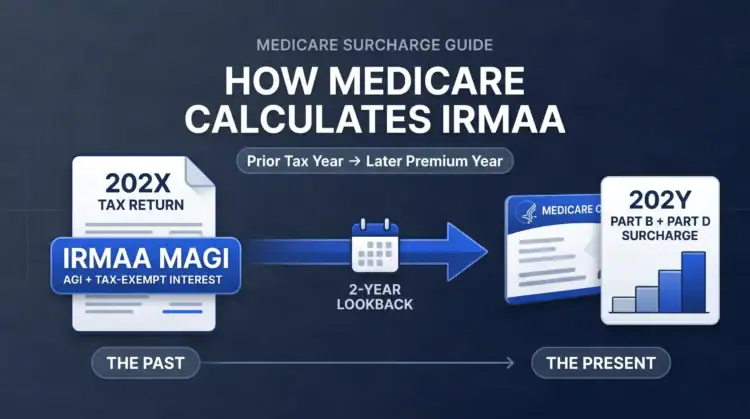
The easiest way to understand IRMAA is to stop treating it as one giant formula. It is a sequence.
- Identify the Medicare premium year. If you are explaining a 2026 Part B or Part D premium, 2026 is the premium year.
- Identify the tax-return year. SSA generally looks back two years, so 2026 usually points to 2024 tax information.
- Use the IRMAA MAGI for that tax year. For IRMAA, MAGI generally equals Form 1040 AGI plus tax-exempt interest.
- Apply the premium-year income tier. Compare the MAGI with the 2026 threshold for the beneficiary’s tax filing status. If MAGI exceeds the standard threshold, the published Part B and/or Part D IRMAA amount applies.
2026 Medicare premium → usually 2024 tax return → 2024 IRMAA MAGI → 2026 IRMAA tier → 2026 Part B / Part D surcharge
CMS publishes the Part B premium and IRMAA amounts. SSA uses tax information and makes the beneficiary’s IRMAA determination. Keeping those jobs separate makes the system much easier to follow.
CMS calculates and publishes the Medicare premium and IRMAA amounts. SSA uses the applicable tax information and filing status to make IRMAA determinations for beneficiaries. For Part D, CMS calculates the income-related adjustment amounts and SSA handles the determination/collection process described in its rules.
Printable 2026 Medicare guide
Your 2026 Medicare bill is reading your 2024 tax return.
Keep the four-step IRMAA calculation, the official 2026 premium example, and a fill-in MAGI check together on one printable page.
- Follow the two-year tax return lookback without mixing up dates
- See exactly how Part B and Part D surcharges add up
- Write down your own MAGI, filing status and IRMAA tier
Enter your email to open the PDF. Financial Clarity is optional; PDF-only does not subscribe you.
Which Tax Year Does Medicare Use?
Medicare IRMAA generally uses tax information from two years before the premium year. For 2026 premiums, SSA’s current rules generally use 2024 tax information. The social security impact on irmaa can lead to significant changes in an individual’s premium costs. As income levels fluctuate, the adjusted premiums may become a financial burden for some beneficiaries. Understanding these implications is crucial for planning and managing healthcare expenses in retirement.
There is an important operational wrinkle: SSA’s rules allow it to use certain older tax information when the normal two-year-prior data is not available. For 2026, SSA’s current tables explicitly contemplate 2023 information if 2024 is unavailable. The determination can later be corrected when the newer permitted tax data becomes available.
This is why IRMAA feels like a bill from your financial past. Your premium can jump in 2026 even if 2026 income looks perfectly ordinary, because Medicare is generally reading the 2024 tax story.
How Medicare Uses Your MAGI
Once SSA has the relevant tax year, it needs the IRMAA MAGI for that return. The short version is AGI plus tax-exempt interest. That is enough detail for this page.
If you are trying to decide whether an IRA distribution, Roth conversion, Social Security benefit, municipal-bond interest, capital gain, business income or deduction belongs in that number, use the MAGI page linked in the opening. Rebuilding that income taxonomy here is exactly what makes the two pages compete with each other.
How the IRMAA Brackets Work
IRMAA uses income tiers. For 2026, the standard-premium threshold is $109,000 for individual filers and $218,000 for married couples filing jointly. Higher tiers begin at higher MAGI levels, and married-filing-separately rules can be much more restrictive when spouses lived together during the tax year.
Crossing an IRMAA threshold can move the beneficiary to the next published monthly surcharge tier. Medicare does not apply the higher IRMAA amount only to the dollars above the threshold. That is why a small change in MAGI can create a noticeably larger change in annual Medicare premiums.
For the full current table—including every 2026 filing-status threshold and the exact Part B and Part D amounts—use the 2026 IRMAA brackets and Medicare surcharge guide. That page is the number-table owner; this page explains the calculation process.

If you want to test your own known MAGI against the current published table rather than doing the lookup manually, use the calculator below.
Where do you land on the Medicare staircase?
Medicare charges higher-income retirees extra, in steps. Slide your income and watch where you land, what it costs, and how much room you have before the next step.
Published 2026 premiums and thresholds. Enter 2024 MAGI for a 2026 estimate.
If spouses have different Medicare or drug coverage, run each person separately. This tool excludes plan premiums, late penalties, and other Medicare costs.
Staircase shows published 2026 rates. On a phone, swipe sideways to see every step. Select a step or use the slider to explore.
Try a what-if
Thinking about a Roth conversion, selling stock, or a big IRA withdrawal? Add it here.
Questions people ask
Why does it use income from two years ago?
Social Security uses the newest tax return the IRS gives them, usually from two years back. Your 2026 premiums are based on 2024 income. So a Roth conversion you do this year shows up in your premiums two years from now.
Does one dollar over the line really cost the full step?
Under the published 2026 table, crossing a threshold changes the monthly surcharge for the months it applies. The year figure assumes all 12 months at the same tier; a later determination or change can alter your actual bill.
We're married. Do we both pay?
Each spouse on Medicare pays their own surcharge, based on your joint income. Two people on Medicare means double the extra cost.
My income dropped. Can I get this lowered?
If it dropped because of a life-changing event like retirement, reduced work hours, death of a spouse, divorce, or loss of a pension, you can ask Social Security to use newer income with Form SSA-44. A Roth conversion or selling investments doesn't count as a life-changing event.
What about 2027 and 2028 numbers?
The Medicare & You 2027 handbook cites the 2026 IRMAA income thresholds and directs readers to Medicare.gov for later updates. Official 2027 IRMAA thresholds and premiums are pending. The staircase shown for 2025 or 2026 income remains a 2026 illustration, not a future premium quote.
Figures: 2026 Medicare premiums and IRMAA thresholds from CMS and Social Security, reviewed September 26, 2026. The 2027 Medicare handbook cites 2026 thresholds and refers readers to Medicare.gov for updated figures; it does not publish the complete 2027 IRMAA table. Your entries stay in your browser. Educational estimate, not an SSA decision or tax advice.
Example: From Tax Return to Medicare Premium
Assume a single Medicare beneficiary has $180,000 of 2024 IRMAA MAGI. Here is how that turns into a 2026 premium result.
1. Premium year: 2026.
2. Tax year: 2024, under the normal two-year lookback.
3. Known MAGI: $180,000.
4. 2026 tier: for an individual filer, $180,000 is above $171,000 and not more than $205,000, placing the beneficiary in IRMAA Level 3.
Part B: $202.90 standard premium + $324.60 Part B IRMAA = $527.50 per month.
Part D: the 2026 IRMAA is $60.40 per month, paid in addition to the person’s Part D plan premium.
Combined income-related adjustment: $324.60 + $60.40 = $385.00 per month, or $4,620 for 12 months, before the underlying Part D plan premium and assuming the same IRMAA tier applies throughout the year.
The example is deliberately mechanical. It does not say whether the 2024 income event was a good or bad decision. It shows how a known tax-return number becomes a Medicare premium result.
Why Your Medicare Premium Can Jump Even When Your Income Didn’t Change This Year
The two-year lookback creates the disconnect. A Roth conversion, large recognized capital gain, unusually high business income, retirement distribution or other taxable event in 2024 can affect 2026 premiums even when that event is long over.
That does not mean Medicare is calculating the premium from your current paycheck or current brokerage activity. It means the premium system is working from an earlier federal tax year. A one-time spike can therefore show up later as an IRMAA increase.
The income event and the Medicare bill can live in different calendar years. That is the mental model to keep. The transaction changes the tax return first; the tax return can change Medicare premiums later.
If the issue was a voluntary one-time income event, the IRMAA one-time income spike guide explains the timing problem in more depth.
What If the Income Medicare Used No Longer Reflects Your Situation?
If your household income dropped because of a qualifying life-changing event, Social Security allows you to request a lower IRMAA determination using Form SSA-44 and supporting evidence. The exact event, timing, income estimate and documentation matter.
A qualifying life-changing event and an amended tax return are not the same IRMAA path. SSA directs people with a qualifying income-reducing life event to the SSA-44 process. If the IRS tax return itself was amended, SSA tells beneficiaries to contact Social Security about the amended return rather than treating that as a substitute life-changing event.
For the actual appeal/redetermination process, use the IRMAA SSA-44 appeal guide. Keeping the form mechanics there prevents this calculation page from turning into a second appeal manual.
