
Having enough money to retire and having enough money you can actually spend are two different problems.
You can build a seven-figure retirement portfolio, run the numbers, decide work is optional, and then discover that most of your money sits inside accounts with withdrawal rules you have never needed to think about before.
That is the moment age 59½ starts to feel like a wall.
It usually isn’t.
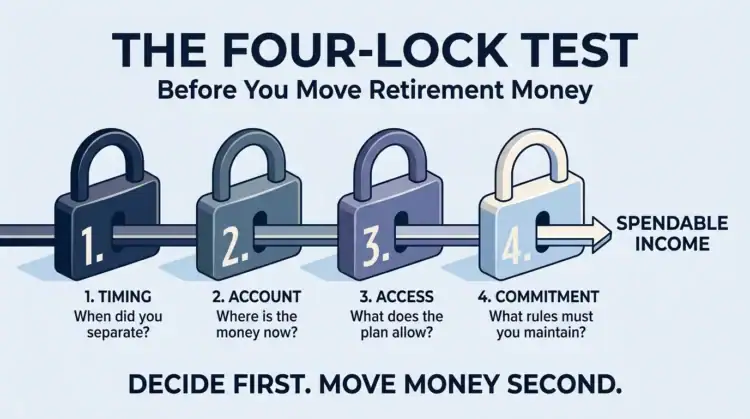
You may be able to create retirement income before age 59½ without paying the 10% additional tax on qualifying withdrawals. The right path depends on four things: when you leave work, which account holds the money, what the plan actually lets you withdraw, and how much long-term commitment the strategy requires.
I call these the Four Locks: Timing, Account, Access and Commitment.
Depending on your situation, spendable money can come from the Rule of 55, a governmental 457(b), a 72(t) substantially equal periodic payment plan, regular Roth IRA contributions, seasoned Roth conversions, taxable investments or some combination of them.
The expensive mistakes often happen before the first withdrawal. They happen when someone moves the money first and asks which rule they needed afterward.
My rule: decide first. Move money second.
Before you roll over a 401(k), start a 72(t) plan or decide which account should fund early retirement, map the decision first.
Download my printable Before-59½ Access Map. It includes:
- The Four-Lock retirement access worksheet
- An account-by-account access inventory
- The questions to ask your plan administrator before leaving work
- A rollover decision checklist
- A five-year retirement-income sequencing worksheet
Print it, write on it, and use it before you move retirement money.
Already have a copy? Keep reading below for the current rules, examples and deeper strategy guides.
What you’ll learn
- Lock 1: Timing
- Lock 2: Account
- Lock 3: Access
- Lock 4: Commitment
- How Roth and bridge assets fit
- Compare your early-retirement income paths
- Michael Ryan’s Take
If you are still asking whether you have enough money to retire early in the first place, start with my Early Retirement Calculator. This guide begins with the next problem: which dollars should pay the bills?
On This Page
- Lock 1: Timing Changes Which Early-Withdrawal Rules You Can Use
- Lock 2: Account Location Can Change the Rule
- Lock 3: The Tax Code Can Say Yes While Your Plan Says “Here’s What We Actually Offer”
- Lock 4: 72(t) Gives You Access in Exchange for Commitment
- Roth Money Can Solve Two Different Problems
- Compare the Main Ways to Create Spendable Money Before 59½
- Michael’s Take: Stop Looking for One Magic Withdrawal Strategy
- Frequently Asked Questions
- Primary Sources
Lock 1: Timing Changes Which Early-Withdrawal Rules You Can Use
Your separation date can determine whether withdrawals from an employer retirement plan qualify for a major exception to the 10% additional tax. For the standard Rule of 55, the critical line is the calendar year you reach age 55.
If you separate from the employer during or after that calendar year, qualifying distributions from that employer’s retirement plan may avoid the 10% additional tax. You do not have to wait until your actual 55th birthday. Pre-tax withdrawals can still create ordinary income tax.
The exception applies to qualifying employer-plan distributions. It does not turn every IRA you own into Rule of 55 money.
Qualified public-safety employees and private-sector firefighters can have an earlier path. Current rules can use the earlier of age 50 or 25 years of service under the plan when the requirements are satisfied.
For the federal exceptions themselves, see the IRS Form 5329 instructions.
Lock 2: Account Location Can Change the Rule
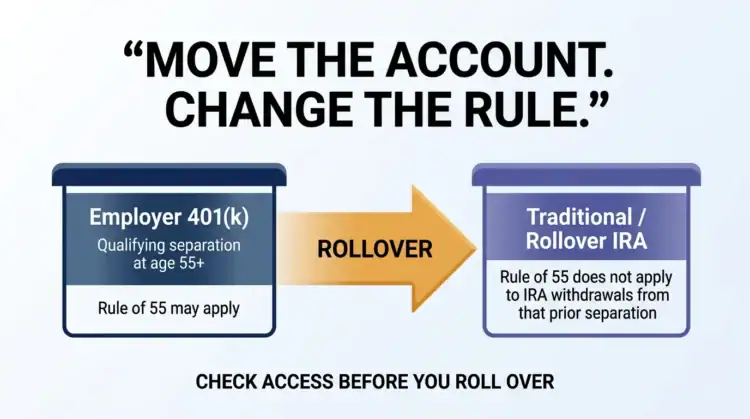
A dollar can qualify for one withdrawal rule while it sits in an employer plan and a different rule after you roll it into an IRA. Account location is part of the early-retirement strategy.
The rollover decision can change your Rule of 55 access
Imagine leaving work at 56 with $600,000 in the employer’s 401(k). Rolling everything into an IRA may give you more investment choices and simpler account administration.
It also changes the account holding the money.
Once those dollars are distributed from an IRA, the Rule of 55 exception connected to that prior employer separation does not apply to those IRA withdrawals.
That makes the account withdrawal sequence important:
- Confirm whether you qualify for the Rule of 55.
- Find out how the employer plan actually handles post-separation withdrawals.
- Estimate how much employer-plan access you may need.
- Then decide how much, if anything, should move to an IRA.
Do not treat the rollover as an administrative cleanup step. Moving qualifying employer-plan dollars into an IRA changes which account rules govern the next withdrawal.
If Rule of 55 access could matter, confirm your eligibility, your employer plan’s actual distribution options and how much money you may need from that plan before submitting the rollover paperwork.
Compare Rule of 55 vs. 72(t) and use the decision pathfinder →
The fifth door many early-retirement guides miss: governmental 457(b)
A governmental 457(b) can operate very differently from a 401(k), 403(b) or IRA when you leave work before 59½.
Eligible distributions from a governmental 457(b) generally are not subject to the 10% additional tax simply because you are under 59½. Money rolled into the 457(b) from certain other retirement accounts can retain different treatment.
If you have worked for a state, municipality, public school system or another qualifying government employer, put the 457(b) near the top of the account inventory. It may give you flexibility that changes how much pressure you need to place on every other account.
The IRS explains the treatment of governmental 457(b) distributions in Topic No. 558.
Lock 3: The Tax Code Can Say Yes While Your Plan Says “Here’s What We Actually Offer”
Federal law determines whether a withdrawal can qualify for an exception. Your employer’s plan determines whether, when and in what form the money can actually be distributed.
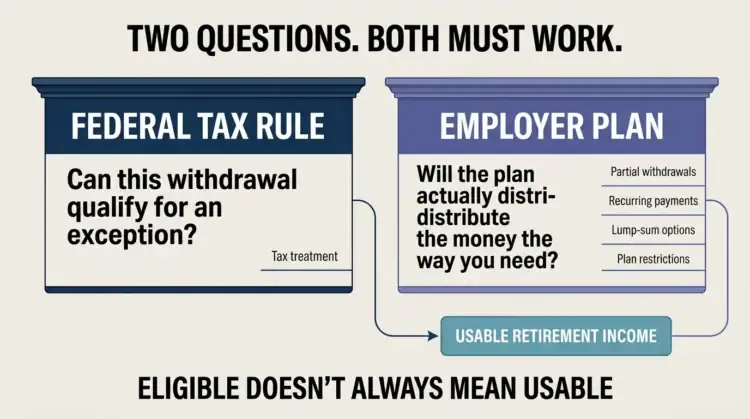
This is one of the biggest gaps I see in early-retirement planning.
I’ve seen people understand the Rule of 55 cold and still get blindsided by the plan itself. They knew the federal tax rule. They never asked what “withdrawal” meant inside their employer’s actual plan.
The IRS says a plan does not have to allow every distribution event or payment form federal law permits. The written plan and its disclosure documents control the options available to participants.
Get these answers before you separate or move the account. When possible, ask where the answer appears in the Summary Plan Description or other written plan document.
- Can I take partial distributions after leaving the employer?
- Can I establish recurring monthly or quarterly payments?
- Is a full lump-sum distribution the only practical option?
- Is there a minimum withdrawal amount?
- Does the plan limit how many withdrawals I can make each year?
- Does the plan accept incoming rollovers from older employer plans?
- How are incoming rollover dollars treated after my later separation?
- Where are these rules documented in the Summary Plan Description?
Write down the administrator’s answer, the date, and the document or plan section supporting it.
The IRS provides useful background on when retirement plans may distribute benefits and how to read your employer retirement-plan disclosure documents.
This lock is why a theoretically available strategy can still be a lousy cash-flow plan.
Lock 4: 72(t) Gives You Access in Exchange for Commitment
If the money you need is already in an IRA, or you plan to stop working years before the Rule of 55 can help, a 72(t) substantially equal periodic payment plan can create current income.
The tradeoff is commitment.
The IRS recognizes three SEPP calculation methods, and an impermissible modification can trigger recapture of earlier 10% additional tax plus interest. The payment series generally has to survive until the later of two dates: the fifth anniversary of the first payment or age 59½.
That last sentence causes more confusion than it should, so use the calculator instead of doing calendar math in your head:
72(t) Two-Clocks Explorer
Enter your birth date and planned first SEPP payment date. The schedule generally must continue until the later of age 59½ or the fifth anniversary of the first payment.
Planning illustration only. Confirm the exact schedule and payment dates before establishing a SEPP.
For the fixed amortization and fixed annuitization methods, IRS Notice 2022-6 says the selected interest rate cannot exceed the greater of 5% or the 120% federal mid-term rate for either of the two months immediately before the month the first SEPP payment begins.
If your first payment begins in September 2026: the relevant July and August 120% mid-term rates are both 5.23%, so 5.23% is the maximum rate under this rule.
If your first payment begins in October 2026: the relevant August rate is 5.23% and the September rate is 5.40%, so 5.40% is the maximum rate under this rule.
These rates change. Check the current IRS AFR / Section 7520 rate table when establishing a new series.
Thinking seriously about a 72(t) SEPP?
The three calculation methods, permitted rate, IRA-splitting strategy, payment timing, documentation and recapture risk deserve more room than they should receive in this hub.
Use the complete 72(t) Rule and SEPP guide →
Roth Money Can Solve Two Different Problems
A Roth IRA can contain dollars that are already accessible and dollars you are deliberately making accessible for future years. Keeping those jobs separate makes Roth planning much easier to understand.
Regular Roth contributions may already be available
For a nonqualified Roth IRA distribution, IRS ordering rules generally treat money as coming out in this order:
- regular contributions;
- conversion and rollover contributions, generally oldest first;
- earnings.
Regular contribution basis can generally come out without another round of income tax because those dollars were already taxed before they entered the Roth IRA.
Converted dollars require more attention. A separate five-year period generally applies to each conversion for purposes of the additional tax on certain early distributions of taxable converted amounts.
A Roth conversion ladder creates future access
A Roth conversion ladder takes traditional retirement money, converts portions to a Roth IRA over time, and creates a series of future-accessible conversion “rungs.”
The catch is obvious once you see the timeline: the ladder you start today does not pay today’s bills.
You still need something to fund the waiting period before the first conversion becomes usable under the applicable rules. That bridge can come from taxable savings, cash, Roth contribution basis, Rule of 55 withdrawals, governmental 457(b) money or another coordinated source.
Your Roth ladder depends on the first five years
Compare the Main Ways to Create Spendable Money Before 59½
The table is a starting point. Your best sequence can use more than one row.
| Path | When It Can Help | Money It Reaches | Flexibility | Main Thing to Check |
|---|---|---|---|---|
| Rule of 55 | After qualifying separation in or after the calendar year you turn 55; earlier rules can apply to qualified public-safety workers | Qualifying employer-plan money | No IRS-required fixed payment series; plan rules still matter | Separation timing, plan distribution options and rollover decisions |
| Governmental 457(b) | After a plan-permitted distributable event | Governmental 457(b) assets | Often high | Plan rules and whether part of the balance came from another plan or IRA |
| 72(t) SEPP | Potentially well before age 55 | IRA or other eligible retirement assets under the applicable rules | Low once the series begins | Payment amount, two clocks and modification risk |
| Roth contribution basis | Potentially at any age | Regular Roth IRA contributions | High | Accurate basis and withdrawal-ordering records |
| Roth conversion ladder | After the applicable conversion waiting period | Converted traditional retirement money | High while designing future rungs | How you fund the waiting period and conversion taxes |
| Taxable cash or brokerage | Any age | Non-retirement assets | Very high | Capital gains, taxable income and bridge depletion |
Michael’s Take: Stop Looking for One Magic Withdrawal Strategy
I’ve watched people spend months optimizing 401(k) fees and fund choices, then almost roll away the account access they were planning to live on.
The accumulation phase rewards saving and investing well.
The access phase rewards sequencing.
Here’s the order I would use:
- Inventory every account. Current employer plan, old plans, IRAs, Roth IRA, governmental 457(b), taxable brokerage and cash.
- Check Timing. Your separation date can create or eliminate an exception.
- Check Account. Know which rule applies before you move the money.
- Check Access. Read the plan document and verify what the administrator will actually let you do.
- Check Commitment. Use a rigid 72(t) series only after understanding the years of commitment.
- Build the sequence. Decide which dollars pay for year one, year two, year five and the years after 59½.
That last step is where this becomes retirement planning instead of a tax-code scavenger hunt.
A 56-year-old might use Rule of 55 withdrawals for current spending while making Roth conversions for later years. Someone retiring at 51 may use taxable assets alongside a carefully sized SEPP. A public employee may discover that the governmental 457(b) handles most of the bridge without requiring either strategy.
The real question is not “How do I get around age 59½?”
It’s “Which dollars should become spendable first, and what decision today could close a door I need tomorrow?”
About to move retirement money?
If the decision involves leaving money in an employer plan versus rolling it to an IRA, run through the Four-Lock decision before signing the paperwork.
Compare Rule of 55 vs. 72(t) and use the decision pathfinder →
The article ends. The planning doesn’t.
Join more than 12,000 readers getting Michael Ryan’s weekly retirement strategies, tax-planning ideas, new calculators, worksheets and important rule updates.
- Practical retirement-income strategies
- New calculators, worksheets and decision tools
- Important tax and retirement-rule changes
- Real-world planning situations and Michael’s take on what matters
Free. No sales pitch. Unsubscribe anytime.
Frequently Asked Questions
Can I access retirement money before age 59½?
Yes. Several federal exceptions and account-specific rules can permit access before 59½ without the 10% additional tax on qualifying amounts. The available path depends on your age and separation timing, the account holding the money, the employer plan’s distribution rules and the strategy’s requirements.
Which early-retirement withdrawal strategy should I investigate first?
Start with the accounts you already own and the exceptions already available. A qualifying employer plan or governmental 457(b) may provide more flexible access than creating a new 72(t) commitment. Roth contribution basis and taxable assets can also reduce how much retirement-plan income you need immediately.
What should I check before rolling a 401(k) into an IRA?
Determine whether the employer plan currently gives you an early-withdrawal exception or useful post-separation distribution option that the IRA will not preserve. For someone separating in or after the calendar year they turn 55, the Rule of 55 deserves particular attention before the rollover occurs.
Can I combine Rule of 55, Roth conversions, 72(t) and taxable savings?
Yes. Early-retirement income planning often works better as a sequence. One account can cover current spending, another can create future tax diversification, and a third can remain available for unexpected expenses. The goal is to coordinate the accounts rather than force one strategy to solve every year.
Primary Sources
- IRS: Exceptions to the additional tax on early retirement distributions
- IRS: Instructions for Form 5329
- IRS: When a retirement plan can distribute benefits
- IRS: Substantially equal periodic payments
- IRS Topic 558: Early distributions from retirement plans other than IRAs
- IRS Publication 590-B: IRA and Roth IRA distributions
This article explains general federal retirement-account and tax rules. Individual plan documents, state taxes and household circumstances can change the result. Verify employer-plan distribution options before separating or moving money, and review tax-sensitive strategies such as 72(t) payment series and Roth conversions with an appropriate qualified professional when needed.
