
A Roth conversion ladder can create a rolling source of Roth IRA principal before age 59½. It cannot pay next month’s bills.
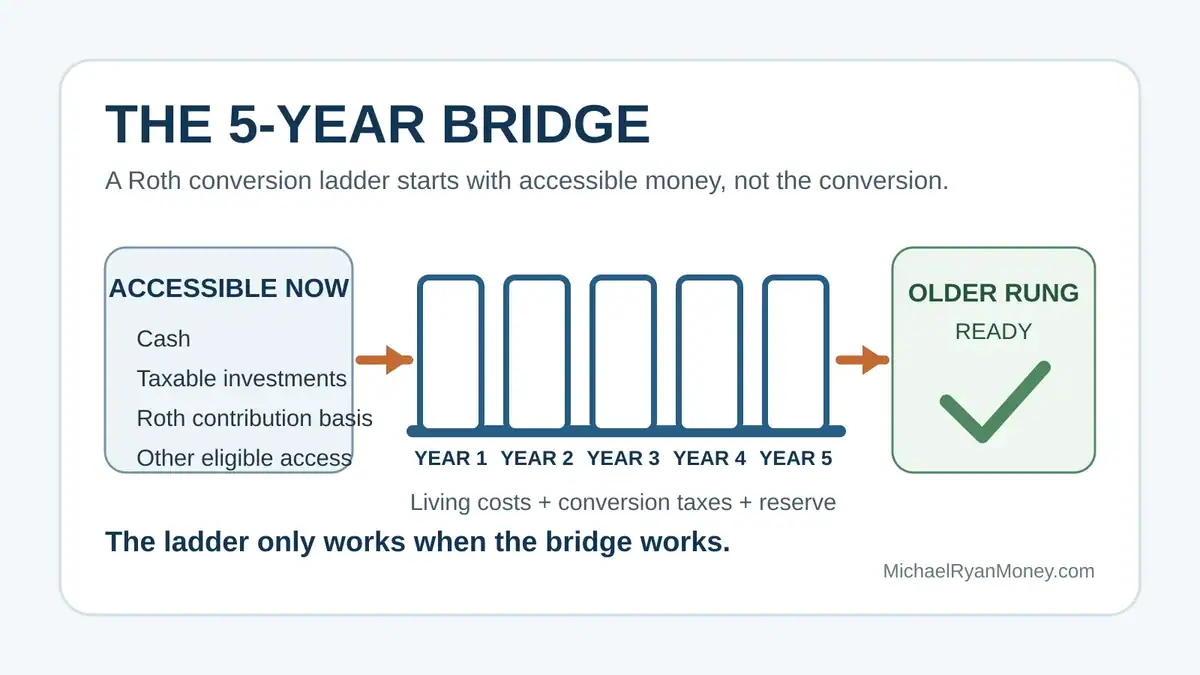
Each taxable conversion has its own five-tax-year period. While you wait, your living expenses, health insurance, and conversion taxes must come from cash, taxable investments, Roth contribution basis, earned income, or another penalty exception. That makes the five-year bridge the first decision.
In nearly three decades as a financial planner, I saw plans fail for a simple reason: the conversion schedule looked elegant, but the accessible cash was barely enough to support it. The ladder only works when the bridge works.
Quick Answer
A Roth conversion ladder moves pre-tax retirement money into a Roth IRA in annual conversions so older converted principal can become available before age 59½. Each conversion has its own five-tax-year period for the additional 10% tax, and the taxable amount is included in income for the conversion year. The catch is simple: the ladder does not fund its own first five years. Before choosing how much to convert, make sure accessible assets can cover spending, conversion taxes, health costs, and a reasonable reserve while the first rung waits.
On This Page
- Key Takeaways Ahead
- How a Roth Conversion Ladder Works
- The Five-Year Bridge Is the Feasibility Test
- Keep the Two Roth Five-Year Rules Separate
- Roth Withdrawal Ordering Controls What Comes Out
- Example: Dana’s Ladder Fails Before It Starts
- Test Your Five-Year Roth Conversion Bridge
- How Much Should You Convert Each Year?
- How ACA Coverage Changes the 2026 Conversion Decision
- When Another Early-Access Strategy May Fit Better
- How IRMAA and RMDs Affect Ladder Sizing
- Your Annual Roth Conversion Ladder Checklist
- Frequently Asked Questions
- Sources
Key Takeaways Ahead
How a Roth Conversion Ladder Works
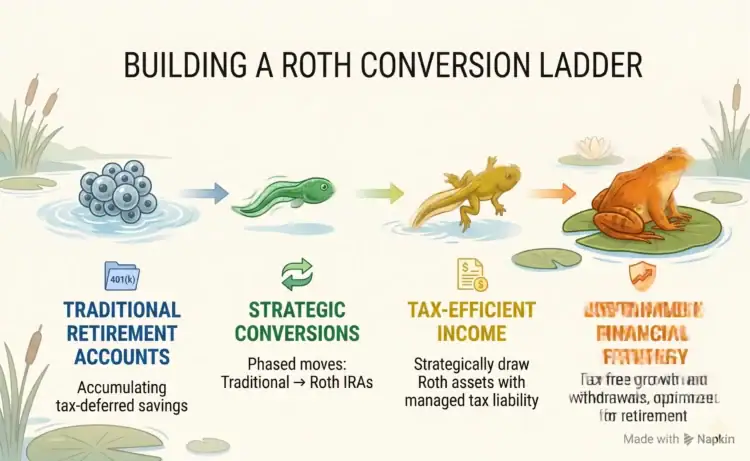
A Roth conversion ladder is a delayed pipeline. You move money into the Roth IRA now, pay the conversion tax now, and plan to use the converted principal later.
- Convert: Move an amount from a traditional IRA or eligible workplace plan into a Roth IRA.
- Pay the tax: Include the taxable portion of the conversion in that year’s ordinary income.
- Start the clock: The conversion’s five-tax-year period begins on January 1 of the conversion year, even when the transaction occurs later in the year.
- Fund the bridge: Use other accessible assets while that conversion is inside its five-year period.
- Repeat annually: Add a new conversion rung while an older rung moves closer to the end of its period.
For example, a conversion completed in December 2026 begins its five-year period on January 1, 2026. Its period generally ends before January 1, 2031. The IRS Roth IRA distribution rules also require you to apply the Roth ordering rules when money is withdrawn.[1]
2026 conversion
- Period begins
- January 1, 2026
- Generally past five-year period
- January 1, 2031
- Planning role
- First rung
2027 conversion
- Period begins
- January 1, 2027
- Generally past five-year period
- January 1, 2032
- Planning role
- Second rung
2028 conversion
- Period begins
- January 1, 2028
- Generally past five-year period
- January 1, 2033
- Planning role
- Third rung
2029 conversion
- Period begins
- January 1, 2029
- Generally past five-year period
- January 1, 2034
- Planning role
- Fourth rung
2030 conversion
- Period begins
- January 1, 2030
- Generally past five-year period
- January 1, 2035
- Planning role
- Fifth rung
The rung cards show the timing pipeline. It does not let you select one conversion as a separate bucket when you withdraw money. Roth IRA ordering rules still control which dollars are treated as distributed first.
The Five-Year Bridge Is the Feasibility Test
Your bridge is the money that remains accessible before the first conversion rung is ready or before another penalty exception makes the ladder unnecessary.
Count more than regular monthly spending. Your bridge may need to cover:
- Housing, food, transportation, and ordinary living costs
- Marketplace premiums and out-of-pocket health costs
- Federal and state taxes generated by the conversions
- Home repairs, vehicles, travel, and other irregular expenses
- A cash reserve for a bear market or an income interruption
Answer These Questions Before You Convert
- How many years must the bridge cover? Count the period until age 59½, the first completed conversion period, a pension, Social Security, employment income, or another accessible account takes over.
- How much will you actually spend? Include taxes, insurance, irregular expenses, and inflation rather than multiplying this year’s monthly budget by 60.
- Which assets are accessible now? Identify cash, taxable investments, documented Roth contribution basis, governmental 457(b) money, earned income, or a qualifying workplace-plan exception.
- Where will the conversion tax come from? Paying the tax from outside funds often allows more money to reach the Roth IRA, provided it does not weaken the bridge.
- What happens during a market decline? Decide which account will fund spending when selling investments would lock in a large loss.
- What is the backup plan? Identify spending that can be reduced, work that can be resumed, or retirement timing that can change.
Decision Rule
If five years of accessible spending, conversion taxes, and a reasonable reserve would consume nearly all of your bridge assets, the ladder is not ready. Improve the bridge before increasing the conversions.
Keep the Two Roth Five-Year Rules Separate
The phrase “Roth five-year rule” hides two different clocks that matter here.
The Per-Conversion Penalty Period
Each conversion and qualifying rollover has a separate five-tax-year period. If you withdraw the taxable portion while you are under age 59½ and the applicable period has not ended, the additional 10% tax may apply unless another exception covers the distribution.[1]
Reaching age 59½ generally provides an exception to the additional early-distribution tax. That is why a ladder started at age 55 may have limited value as an early-access strategy. The person may reach age 59½ before the first new rung completes five tax years.
The Qualified-Distribution Clock
A separate five-year period helps determine whether Roth IRA earnings can be distributed tax-free. A qualified distribution generally requires satisfaction of the Roth IRA participation period plus age 59½, death, disability, or a qualifying first-home distribution.
Completing a conversion’s separate five-year period does not automatically make every dollar of Roth earnings tax-free. For the complete treatment, read the Roth IRA five-year-rule guide.
Roth Withdrawal Ordering Controls What Comes Out
You cannot label a Roth IRA withdrawal and choose which bucket the IRS should treat as distributed.
For a nonqualified Roth IRA distribution, the ordering rules generally treat money as coming out in this sequence:
- Regular Roth IRA contributions
- Conversion and rollover contributions, first in, first out
- Earnings
Within a conversion, the taxable portion is generally treated as coming out before the nontaxable portion. The aggregation rules group all of your Roth IRAs for this purpose.[1] If you need to determine exactly which Roth dollars a withdrawal reaches first, use the Roth IRA withdrawal-rules guide.
Do You Need a Separate Roth IRA for Every Rung?
No. Separate accounts may help your personal recordkeeping, but they do not create separate IRS withdrawal queues. The ordering and aggregation rules still apply across your Roth IRAs.
Maintain a Conversion Ledger
Keep one record for each tax year that includes:
- Conversion date and tax year
- Gross amount converted
- Taxable and nontaxable portions
- Source account and Roth custodian
- Five-year starting date
- First year generally outside the conversion period
- Forms 1099-R, 5498, and 8606 when applicable
- Remaining documented regular Roth contribution basis
Do not assume a future custodian statement will reconstruct ten years of tax history for you.
Example: Dana’s Ladder Fails Before It Starts
Hypothetical Scenario
Dana retires at age 50 with $300,000 in cash and taxable investments, $900,000 in a traditional IRA, and planned spending of $60,000 per year. She wants to convert $50,000 annually. For illustration, assume the conversions create an average combined federal and state tax cost of $8,000 per year, and she wants a $30,000 contingency reserve. These figures illustrate the bridge test and are not a tax projection.
Dana’s five-year bridge drawdown
Year 1
- Starting bridge
- $300,000
- Living expenses
- $60,000
- Conversion taxes
- $8,000
- Remaining bridge
- $232,000
- Status
- On track
Year 2
- Starting bridge
- $232,000
- Living expenses
- $60,000
- Conversion taxes
- $8,000
- Remaining bridge
- $164,000
- Status
- On track
Year 3
- Starting bridge
- $164,000
- Living expenses
- $60,000
- Conversion taxes
- $8,000
- Remaining bridge
- $96,000
- Status
- On track
Year 4
- Starting bridge
- $96,000
- Living expenses
- $60,000
- Conversion taxes
- $8,000
- Remaining bridge
- $28,000
- Status
- Below the $30,000 reserve
Year 5
- Starting bridge
- $28,000
- Living expenses
- $60,000
- Conversion taxes
- $8,000
- Remaining bridge
- -$40,000
- Status
- Fails
Dana’s bridge falls below her desired reserve in Year 4 and drops below zero in Year 5. She needs $370,000 to fund the modeled spending, conversion taxes, and $30,000 ending reserve. Her $300,000 bridge is short by $70,000.
Test Your Five-Year Roth Conversion Bridge
Enter the accessible money available for the waiting period. This simplified test shows whether annual spending and estimated conversion taxes exhaust the bridge before the ladder is ready.
Your bridge result
- Estimated annual conversion tax
- $0
- Net annual drain on bridge assets
- $0
- Starting bridge needed, including reserve
- $0
- Modeled ending bridge balance
- $0
- Result versus reserve target
- $0
| Year | Starting bridge | Living expenses | Conversion tax | Other income | Ending bridge | Status |
|---|
Important: This simplified model assumes the same spending, conversion, tax rate, and other income each year. It does not model investment returns, inflation, ACA premium-tax-credit changes, capital-gain harvesting, IRMAA, tax-bracket interactions, or account-specific withdrawal rules. Confirm the strategy with current tax and health-insurance information before acting.
She could repair the plan by combining several changes:
- Work longer or earn part-time income during the bridge
- Reduce initial spending
- Use documented Roth contribution basis for part of the bridge
- Lower the annual conversion amount
- Build a larger taxable reserve before retiring
- Preserve access under the Rule of 55 when eligible
- Use another approved early-distribution strategy for part of the income need
The conversion amount and the spending amount solve different problems. Treating them as the same number is one of the easiest ways to overbuild the ladder.
How Much Should You Convert Each Year?
Your annual conversion amount should sit between two boundaries.
- The planning floor: The amount worth moving to reduce a credible future problem, such as large RMDs, compressed tax brackets after a spouse dies, or unfavorable beneficiary taxation.
- The current ceiling: The amount you can convert before current taxes, ACA costs, IRMAA exposure, state taxes, or bridge pressure become unattractive.
Some years, that workable range may be zero.
Is There an Annual Roth Conversion Ladder Limit?
The regular IRA contribution limit does not cap Roth conversions. IRS guidance allows all or part of eligible traditional IRA assets to be converted, subject to the rules for the source account. In practice, your useful limit is usually set by taxes, ACA costs, IRMAA exposure, state taxes, cash-flow needs, and the amount of tax you are willing and able to pay.[12]
Review all income that can use the same tax and MAGI space:
- Interest and dividends
- Realized capital gains
- Consulting or business income
- Pensions and Social Security
- Rental income
- Other retirement-account distributions
Roth Conversions Compete With 0% Capital-Gain Harvesting
Early retirement can create an opportunity to realize long-term capital gains at a 0% federal rate. That opportunity depends on overall taxable income. Ordinary income from a Roth conversion fills taxable-income space before the preferential capital-gain bands are applied.[8]
Within the relevant income range, another dollar of ordinary conversion income can push a dollar of long-term gain out of the 0% band and into the 15% band. The exact result depends on filing status, deductions, other income, and the amount of gain realized.
Michael Explains
Low-income years create valuable tax space. You may use that space for Roth conversions, capital-gain harvesting, or a combination. Decide which use creates the larger after-tax benefit before filling the bracket automatically.
State Tax and Relocation Can Change the Conversion Year
A large conversion before a move can create state income tax that might have been avoided after establishing residency elsewhere. A move can also affect capital gains, insurance pricing, and estate-planning rules.
Do not let taxes alone dictate a move, but include the timing in the conversion analysis. See the guide to moving to a state with no individual income tax.
Use the Roth conversion calculator to model the income-tax side, then separately add ACA, capital-gain, state-tax, IRMAA, and bridge effects. The broader Roth conversion planning guide covers the general question of whether and how much to convert.
How ACA Coverage Changes the 2026 Conversion Decision
Before Medicare, a Roth conversion generally increases household income used to determine the premium tax credit.
For 2026, premium-tax-credit eligibility generally requires household income of at least 100% and no more than 400% of the federal poverty line. The 2026 applicable-percentage table ranges from 2.10% to 9.96% of household income, depending on the household’s percentage of FPL.[4][5]
This means ACA costs can increase before you reach the 400% ceiling. A conversion can reduce the credit gradually as income rises, then eliminate eligibility when final household income moves above 400% FPL.
Watch Out: The Repayment Cap Is Gone for 2026
For tax years after 2025, there is no repayment cap on excess advance premium tax credits. If advance credits paid to the insurer exceed the credit allowed on the tax return, the full difference is added to the household’s tax liability. A late-year Roth conversion can therefore reduce the current credit and create a repayment bill for assistance already used during the year.[4]
Update the Marketplace estimate when income changes. A conversion, realized capital gain, business payment, or other income event can materially change the reconciliation on Form 8962.
The 2026 ACA Rules Could Still Change
H.R. 1834 passed the House on January 8, 2026, and would extend the enhanced premium-tax-credit rules through 2028, including eligibility above 400% FPL. GovInfo lists February 10, 2026, as the latest action, when the measure was placed on the Senate calendar. It had not become law as of September 25, 2026.[6]
Confirm the current law before a large fourth-quarter conversion. A retroactive change would require the ACA portion of the conversion analysis to be recalculated.
In Some States, Going Too Low Can Also Create a Coverage Problem
Marketplace premium-tax-credit eligibility generally begins at 100% FPL. In states that have not expanded Medicaid, some adults below that level can fall into a coverage gap depending on the state’s eligibility rules. Verify your state’s rules before deliberately targeting very low household income as part of a conversion strategy.[9][10]
When Another Early-Access Strategy May Fit Better
A Roth conversion ladder rewards patience. It does not solve an immediate cash shortage during the waiting period.
Need money from the employer plan now
Rule of 55
The money generally must remain in the qualifying employer plan, and the plan controls available distribution options.
Need scheduled IRA income now
Section 72(t) substantially equal periodic payments
The payment program is rigid, and an improper modification can create recapture consequences.[3]
Have an eligible governmental 457(b)
Governmental 457(b) distributions
The additional 10% tax generally does not apply, except to certain amounts rolled into the plan from another account.[2]
Five-year bridge is already funded
Roth conversion ladder
Taxes and MAGI rise now, while access to conversion principal is delayed.
No reliable bridge and no usable exception
Later retirement, lower spending, or additional earned income
The retirement date or lifestyle target may need to change.
The IRS early-distribution exception chart shows that the Rule of 55 applies to qualified employer plans rather than IRAs, while eligible governmental 457(b) distributions generally receive separate treatment.[2]
How IRMAA and RMDs Affect Ladder Sizing
ACA costs shape many pre-Medicare conversion years. Medicare IRMAA becomes more important as the two-year lookback approaches.
For 2026, Social Security generally uses 2024 tax-return information. IRMAA begins above $109,000 of MAGI for an individual return and $218,000 for a joint return. The standard 2026 Part B premium is $202.90 per month, and the first IRMAA tier raises the total Part B premium to $284.10.[7]
A conversion at age 63 can therefore affect Medicare premiums at age 65. Keep this section of the ladder analysis narrow and use the dedicated Roth conversion timing window guide for the full timing decision.
Reducing a traditional account can also reduce future required minimum distributions. Under current IRS guidance, the applicable age is generally 73 for people born from 1951 through 1958. Proposed regulations place people born in 1959 at age 73, resolving a statutory drafting ambiguity, and people born in 1960 or later generally have an applicable age of 75.[11]
RMD reduction can support larger conversions now, but it does not override current tax, ACA, IRMAA, state-tax, or bridge constraints.
Your Annual Roth Conversion Ladder Checklist
- Recalculate the bridge. Update spending, accessible assets, contribution basis, insurance, taxes, and the contingency reserve.
- Estimate income before converting. Include interest, dividends, gains, work, pensions, rental income, and other distributions.
- Compare competing uses of tax space. Decide how much room should go to Roth conversions and how much should remain available for capital-gain harvesting.
- Model ACA consequences. Estimate the current credit, applicable premium percentage, 400% FPL ceiling, and possible repayment of advance credits.
- Check the IRMAA lookback. Include Part B and Part D consequences when the relevant tax year can affect Medicare premiums.
- Set a conversion range. Identify the planning floor and current ceiling, then choose an amount inside the workable range.
- Confirm the transaction. Verify the source account, Roth destination, tax withholding election, custodian processing deadline, and completion date.
- Update the ledger. Save the confirmation and relevant tax forms, then record the new five-year date.
- Revisit the plan after major changes. Recalculate after a move, marriage, divorce, death, return to work, market decline, health-coverage change, or new tax law.
Frequently Asked Questions
Should I Start Roth Conversions While I Am Still Working?
Sometimes. Starting earlier begins the conversion periods sooner, but employment income can make each conversion more expensive. Compare the value of an earlier clock with the lower tax and ACA income that may become available after work ends.
Do I Need a New Roth IRA for Every Conversion?
No. Separate accounts can make personal tracking easier, but the IRS ordering rules generally aggregate your Roth IRAs. A new account for each rung does not let you choose a different tax ordering sequence.
What If I Retire at 55?
Check the Rule of 55 before rolling the employer plan into an IRA. A new conversion begun at 55 may not complete five tax years before you reach age 59½, so the ladder may serve tax planning more than early access.
What Happens If the Market Falls?
A decline can create an attractive opportunity to convert more shares for the same taxable amount. It can also weaken a bridge funded by taxable investments. Review the conversion opportunity and the spending reserve as separate decisions.
Can I Pay the Conversion Tax From the IRA?
You can withhold money from the distribution, but that amount does not reach the Roth IRA. When you are under age 59½, the withheld portion may also be subject to the additional 10% tax unless an exception applies. Review the mechanics in the Roth conversion rules guide.
How Long Should the Ladder Continue?
Continue only while the conversions solve a real access or tax-planning problem. The ladder may end when you reach age 59½, another income source begins, ACA or IRMAA costs rise, the traditional balance reaches its target, or your estate and retirement priorities change.
The Bottom Line
Begin with accessible bridge money. Confirm how many years it must cover, where the conversion taxes will come from, and how the plan survives a bad market. Then size each annual conversion after federal tax, capital gains, ACA, state tax, IRMAA, RMDs, and estate goals are considered.
The bridge comes first. The conversions come second.
Sources
- IRS Publication 590-B, Distributions from Individual Retirement Arrangements. Roth conversion five-year periods, qualified distributions, ordering rules, and aggregation rules.
- IRS: Exceptions to Tax on Early Distributions. Rule of 55, governmental 457(b), and other federal exceptions.
- IRS: Substantially Equal Periodic Payments. Section 72(t) payment requirements and restrictions.
- IRS: Questions and Answers on the Premium Tax Credit. 2026 income limits and removal of excess-APTC repayment caps after 2025.
- IRS Revenue Procedure 2025-25. 2026 premium-tax-credit applicable-percentage table.
- GovInfo: H.R. 1834, Placed on Calendar Senate. House-passed proposed extension of enhanced premium-tax-credit rules and latest listed Senate action.
- CMS: 2026 Medicare Parts A and B Premiums and Deductibles; see also SSA Medicare Premiums for Higher-Income Beneficiaries.
- IRS Topic 409, Capital Gains and Losses. Long-term capital-gain rates depend on overall taxable income.
- CMS Medicaid State Enrollment Dataset. Florida listed as not having expanded Medicaid in the latest state data reviewed.
- HealthCare.gov: Federal Poverty Level and Coverage Eligibility. Marketplace savings and Medicaid-expansion interaction.
- IRS Internal Revenue Bulletin 2024-33. Final and proposed RMD regulations, including the proposed age-73 treatment for people born in 1959.
- IRS Publication 590-A, Contributions to Individual Retirement Arrangements. Roth conversion methods and the distinction between annual IRA contribution limits and conversion amounts.
Point-in-time note: The ACA, Medicare, and proposed-legislation portions of this article were reviewed through September 25, 2026. Tax law, Marketplace rules, Medicare thresholds, and pending legislation can change. Confirm current rules before completing a large conversion.
