
You turn 55 in January. You’re laid off in December, a few weeks too early. That calendar year difference can eliminate the Rule of 55 for that separation.
There’s another trap. You separated in the right year, then rolled the 401(k) into an IRA before checking the rule. Those IRA dollars can’t use the age-55 exception for that separation.
That’s why a Rule of 55 vs. 72t comparison has to happen before requesting a rollover. Moving employer-plan money to an IRA can change which exception remains available for those dollars.
On This Page
- Which Early-Withdrawal Path Should You Investigate First?
- Key Takeaways Ahead
- Rule of 55 vs. 72(t): Start With the Four-Lock Test
- Lock 1: Did You Separate in the Qualifying Calendar Year?
- Lock 2: Where Is the Retirement Money Now?
- Lock 3: Will the Plan Let You Withdraw Money the Way You Need?
- Lock 4: Can Your Household Safely Maintain a SEPP?
- Use Cost and Investment Quality as the Tie-Breaker
- Which Strategy Fits Your Situation?
- What Can Go Wrong With Each Strategy?
- What Stays True Either Way: Decide First, Move Second
- Frequently Asked Questions
- Continue With the Strategy That Passed Your Test
- Sources
Which Early-Withdrawal Path Should You Investigate First?
Answer five questions. You’ll get a starting point and the section of this article to read next.
Question 1 of 5
Why you received this result
This tool gives you a starting point. It doesn’t confirm legal eligibility, calculate a SEPP, or recommend a rollover. Verify the plan document and your tax circumstances before moving money.
The Rule of 55 is the informal name for the separation-from-service exception in Internal Revenue Code Section 72(t)(2)(A)(v). A substantially equal periodic payment arrangement, usually called a SEPP, uses the exception in Section 72(t)(2)(A)(iv). [1]
This comparison answers the harder question: Which option remains available, works under your actual plan and gives your household enough flexibility?
By the end, you should be able to choose one of four paths: use the Rule of 55, establish a SEPP, preserve or divide accounts for a coordinated strategy, or fund the early-retirement bridge another way.
IRS early-distribution guidance confirms that both exceptions can remove the usual 10% additional tax on a qualifying early distribution. Taxable withdrawals from pre-tax retirement money generally remain subject to ordinary income tax. [2]
The four questions this article answers
- Timing: Did you separate from the employer during or after the calendar year you turned 55?
- Account: Is the money still in the qualifying employer plan, or is it already in an IRA?
- Access: Will the plan permit the partial or recurring withdrawals your household needs?
- Commitment: Can you safely maintain a SEPP without extra withdrawals or premature changes?

Start with the Rule of 55 when you clear the timing, account, and access locks. It usually preserves more control over when and how much you withdraw.
A 72(t) SEPP becomes more relevant when you left too early, the money is already in an IRA, or the employer plan won’t provide practical access.
The access lock is the one most people miss: you can qualify under federal tax law and still have a plan that won’t process the partial or recurring withdrawals you need.
This page owns the decision between the Rule of 55 and a 72(t) SEPP. Once the four-lock test shows which path fits, use the specialist guide for the implementation details.
Key Takeaways Ahead
If you have an eligible state or local governmental 457(b) plan, check it before comparing the Rule of 55 and a SEPP. Distributions from the plan generally aren’t subject to the 10% additional tax, although amounts rolled in from other retirement accounts can receive different treatment.
For teachers, firefighters, and other public employees, this account can make the rest of the comparison secondary. [2]
Rule of 55 vs. 72(t): Start With the Four-Lock Test
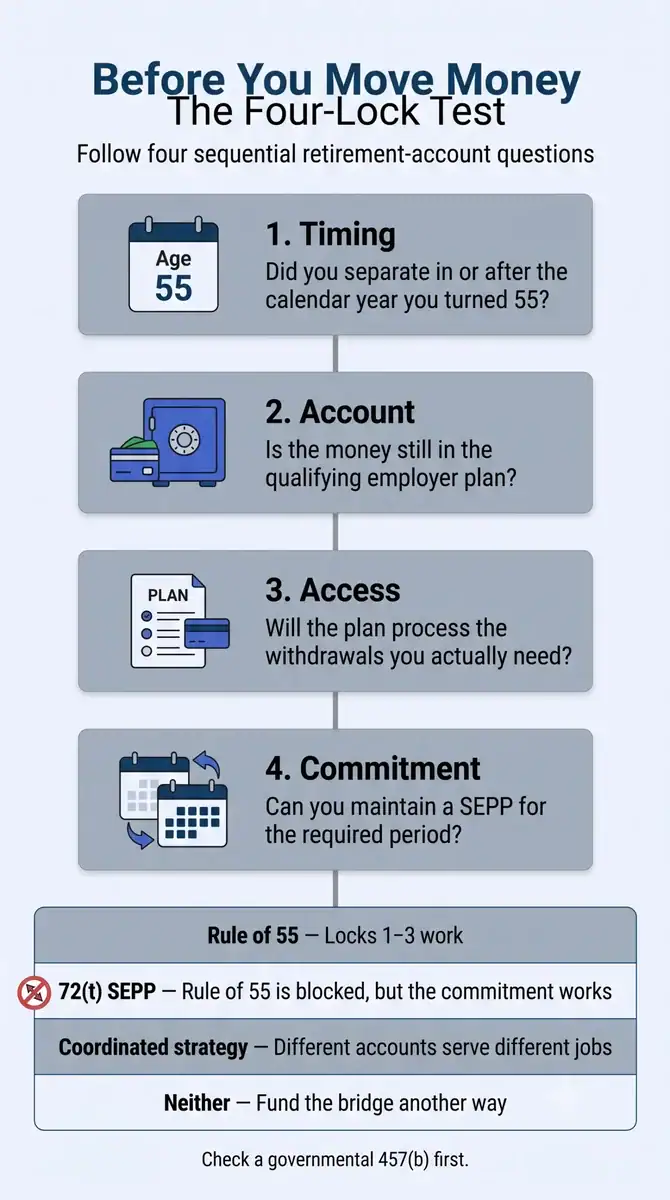
Work through each lock in order:
- Timing: Did your separation occur during or after the calendar year you turned 55?
- Account: Is the money still in the employer plan connected to that separation, or is it already in an IRA?
- Access: What distribution forms will the employer plan actually process?
- Commitment: Can your household safely maintain a SEPP for the required period?
After you work through all four locks, compare costs, investments, service, withholding, and tax-planning flexibility. Those factors break ties between strategies that already work.
| Decision factor | Rule of 55 | 72(t) SEPP |
|---|---|---|
| Earliest availability | After a qualifying separation, generally during or after the calendar year you turn 55 | Potentially at any age |
| Main account | Employer plan connected to the qualifying separation | One selected IRA or an eligible employer plan after separation |
| Main trigger | Separation timing and account location | A calculated payment series |
| Withdrawal amount | Flexible only to the extent the plan permits | Determined under the selected calculation method |
| Ability to change payments | Usually greater, subject to plan rules | Highly restricted |
| Extra withdrawals | May be available if the plan allows them | Generally prohibited from the SEPP account |
| Required duration | No separate federal payment-series requirement | Until the later of five years or age 59½ |
| Primary danger | Losing access through timing, rollover, or restrictive plan rules | Recapture tax and interest after an impermissible modification |
Lock 1: Did You Separate in the Qualifying Calendar Year?
The Rule of 55 focuses on the calendar year in which you leave the employer.
You generally satisfy the timing requirement when you separate from service during or after the calendar year in which you turn 55. Your birthday can occur after your last day of work, as long as both events fall in that qualifying calendar year. [2][5]
Suppose you turn 55 in January 2027 but lose your job in December 2026. You missed the calendar-year test by a few weeks.
Waiting until your birthday to request the money doesn’t fix it. IRS Publication 575 applies the same principle in its separation example. [5]
A SEPP has no minimum starting age. Someone who left work at 52, 53, or 54 may still be able to establish a SEPP from an IRA. A SEPP from an employer plan requires separation from the employer maintaining that plan before the payments begin. [3]
Use “qualifying employer plan” instead of relying on shorthand
Many explanations say the Rule of 55 applies only to your “most recent employer.” That phrase can hide the real test.
The distribution must come from a plan connected to an employer from which you had a qualifying separation. An old 401(k) from a job you left at 49 doesn’t become eligible merely because you later reach 55. If you have more than one separation after reaching the applicable age, each employer and plan relationship needs its own review. [1][5]
A consolidation decision may have a deadline
Your current plan may accept old 401(k) money. Roll those accounts in before you leave, if the plan allows it. More money in the qualifying plan can mean more money available under the Rule of 55.
IRS rollover guidance explains the available rollover methods, while the receiving plan determines whether it will accept the money. Confirm eligible source accounts, processing requirements, and the date the money must actually post to the receiving plan. [8]
Public-safety employees and certain firefighters may qualify under different age or service rules. The Rule of 55 eligibility guide covers those exceptions in greater depth.
Lock 2: Where Is the Retirement Money Now?
Account location can decide the issue before you compare payment amounts.
Money still in the employer plan
If you clear the timing lock and the money remains in the employer plan connected to the qualifying separation, the Rule of 55 may remain available.
The next question is whether the plan clears the access lock. Federal tax eligibility doesn’t force a plan to offer monthly withdrawals, unlimited partial distributions, or every payment form you may prefer. The IRS plan-distribution guidance explains that the plan document controls when and how benefits are paid. [6]
Money already in an IRA
An IRA distribution can’t use the age-55 separation exception. Section 72(t) excludes IRAs from that specific provision. [1]
A properly structured SEPP may still be available from the IRA. That makes 72(t) the more relevant exception when:
- You rolled over the employer plan before evaluating the Rule of 55.
- You left the employer before the qualifying calendar year.
- Most of your retirement assets were already held in IRAs.
- The employer plan requires an impractical distribution form.
You may be able to preserve more than one option
Federal rollover rules generally allow all or part of an eligible retirement-plan distribution to be rolled into another eligible plan or IRA. The employer plan still controls whether it will process the partial distribution or partial direct rollover you want. [8]
A retiree has $1 million in a qualifying 401(k). The plan permits partial direct rollovers and lets the remaining balance stay in the plan.
The retiree could leave $150,000 in the employer plan for potential Rule of 55 withdrawals and directly roll $850,000 into an IRA for broader investment control. Another household may need a very different split.
The plan has to permit every step. Confirm partial distributions, partial direct rollovers, minimum remaining balances, fees, and processing rules before choosing the amounts.
A coordinated plan may also place a deliberately selected amount into a separate IRA before a SEPP begins, while taxable savings cover emergencies and irregular expenses.
💡 Protect Your Retirement Options Before They Disappear
One clear financial move each week — straight from decades of seeing what goes wrong.
- → Catch rollover traps before money moves
- → Turn retirement rules into clear decisions
- → Avoid tax and plan-access surprises
Get early-retirement money moves delivered every week — before the costly mistakes happen.
📬 No spam. Unsubscribe anytime.
Lock 3: Will the Plan Let You Withdraw Money the Way You Need?
This is where legal access and usable access separate.
The federal tax code can provide the Rule of 55 exception while the employer plan offers a distribution schedule that doesn’t fit your household. The IRS explains that a plan isn’t required to allow every legally permitted distributable event, and the plan document must state when distributions are available. [6]
The Summary Plan Description, usually called the SPD, explains how the plan operates and when benefits are paid. ERISA-covered plans generally must provide it to participants. [7]
Ask the five questions that control cash flow
Don’t stop with, “Does the plan support the Rule of 55?” Ask:
- Are partial distributions allowed after separation?
- How many withdrawals can I take, and can they be monthly or quarterly?
- Can part of the balance stay in the plan, and are partial direct rollovers allowed?
- What fees and processing times apply?
- How will federal withholding be handled for the payment form I choose?
A phone representative can help you find the rule. The current Summary Plan Description and distribution packet tell you what you can actually elect.
The tax code can say yes while the plan document says no. That isn’t a contradiction. It means you qualify for the exception but not for the payment schedule you need.
I’d read the distribution section before comparing investment menus or moving a dollar.
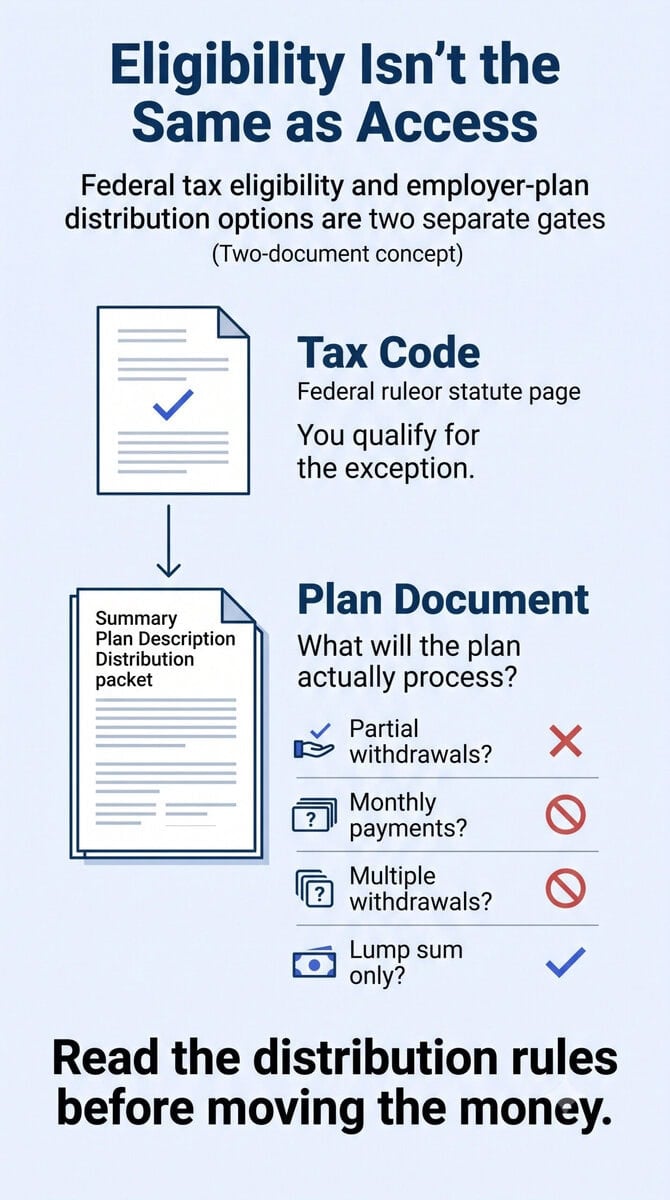
An eligible plan can still be impractical
A plan may clear the timing lock and still offer:
- One full lump-sum distribution
- A small number of withdrawals
- One withdrawal per year
- Recurring payments with limited adjustment options
- High transaction fees
- Slow manual processing
Those provisions can turn a flexible tax exception into an awkward income strategy.
Under IRS rollover withholding rules, a taxable eligible rollover distribution paid directly to you from an employer-sponsored plan is generally subject to 20% federal withholding. Other payment arrangements can receive different withholding treatment. Confirm the gross payment, withholding classification, and expected net deposit before relying on the money for monthly bills. [9]
Lock 4: Can Your Household Safely Maintain a SEPP?
A SEPP works when one account can do one job: produce a planned income stream without being tapped for surprises.
The IRS SEPP guidance applies each arrangement to one account. Payments generally must continue until the later of the fifth anniversary of the first payment or age 59½. Starting at 57 usually means five full years; starting at 50 can mean continuing until 59½. [1][3]
Keep the calculation mechanics on the SEPP guide
IRS Notice 2022-6 recognizes three calculation methods, and the method you choose determines the annual payment. The formulas, permitted interest rate, life-expectancy tables, one-time method switch, and documentation steps belong in the complete 72(t) SEPP guide. [3][4]
For this comparison, the question is simpler: does the required income fit your budget, and can you live with the commitment?
Right-size the account before the first payment
If you have a $1 million IRA but need only $25,000 a year, using the entire account may produce more income than you want under a fixed method.
A common planning approach is to finish the intended transfers first, place the amount meant to produce baseline income into a separate IRA, and leave the rest outside the arrangement. Once the SEPP begins, additions and extra participant withdrawals can create a modification problem. [3]
Marketplace health insurance can make flexibility worth real money
Most taxable IRA and 401(k) withdrawals count as Marketplace income. Marketplace savings are based on expected household income, so your withdrawal method can affect the premium tax credit before Medicare. [10]
A fixed-amortization or fixed-annuitization SEPP can make taxable income harder to throttle from year to year. A Rule of 55 plan that permits variable withdrawals may give you more room to manage modified adjusted gross income. The RMD method recalculates annually, so not every SEPP produces a fixed dollar amount.
For 2026, the IRS again limits Premium Tax Credit eligibility, in general, to households with income no more than 400% of the federal poverty line. The temporary rule that allowed some taxpayers above 400% of FPL to qualify applied through 2025. That makes income planning especially important for early retirees using Marketplace coverage. A taxable SEPP payment or Rule of 55 withdrawal can raise household income and may reduce or eliminate the credit. The actual dollar impact depends on family size, location, benchmark-plan cost, age, and other eligibility rules, so model your own Marketplace numbers rather than relying on a generic premium estimate. See the IRS 2026 Premium Tax Credit guidance.
Keep irregular spending outside the SEPP account
The annual amount can generally be paid in installments, and a limited one-time switch from a fixed method to the RMD method may be available. Those rules don’t turn a SEPP into a flexible spending account. Emergency money, home repairs, travel, and other irregular expenses should generally come from somewhere else. [3][4]
If you clear the timing, account, and access locks, the Rule of 55 usually deserves the first look because it can preserve more control.
A SEPP earns its place when the Rule of 55 is unavailable or unusable and the household can maintain the payment arrangement without dipping back into the SEPP account.
Use Cost and Investment Quality as the Tie-Breaker
The first four locks identify the strategies that can work. Now compare which workable choice is financially tolerable.
Review:
- Employer-plan administrative charges
- Investment expense ratios
- Quality and range of available investments
- IRA custody or advisory costs
- Distribution and transaction fees
- Payment-processing reliability
- Withholding procedures
- Need for variable withdrawals
- Ability to coordinate future Roth conversions
- Recordkeeping burden
Put percentage differences into dollars. A 0.80 percentage-point annual cost difference on $500,000 equals $4,000 in one year before compounding.
A low-cost employer plan with poor withdrawal options may fail the access test. A flexible IRA with strong investments can still be a poor SEPP account if the payment commitment doesn’t fit the household. Plan cost is a tie-breaker. It doesn’t change federal eligibility.
Which Strategy Fits Your Situation?
The Rule of 55 is likely the stronger fit when
- You separated during or after the calendar year you turned 55.
- The money remains in the employer plan tied to that separation.
- The plan permits useful partial or recurring withdrawals.
- Your income needs may change from year to year.
- You want access without committing to a calculated annual series.
- Plan costs and investments are acceptable.
The Rule of 55 is usually the simpler path when every lock works.
A 72t SEPP is likely the stronger fit when
- You separated before the qualifying Rule of 55 year.
- The retirement money is already in an IRA.
- The employer plan requires an impractical distribution form.
- You need predictable baseline income.
- You can isolate the SEPP account from emergency spending.
- You can maintain the arrangement until the required ending date.
- You’re prepared to document the calculation and every distribution.
A SEPP is a commitment strategy. The calculated payment should fit the household plan before the first dollar leaves the account.
A coordinated strategy may fit when
- The plan permits part of the balance to remain.
- You want flexible Rule of 55 access for several years.
- Other money belongs in a lower-cost or more flexible IRA.
- A separate IRA can be sized for SEPP income.
- Taxable savings can cover emergencies and irregular expenses.
- You want to preserve future Roth conversion opportunities.
Each account and transaction must independently satisfy the rules that apply to it.
Neither strategy may be the right bridge when
- Taxable savings can fund the gap without creating an unacceptable tax bill.
- You can wait for a Roth conversion ladder to mature.
- The required SEPP payment is too high or too low.
- The employer plan’s costs or distribution rules are unacceptable.
- The retirement portfolio can’t yet support the required spending.
- Additional work or part-time income materially improves the plan.
A tax exception can’t make an unaffordable retirement sustainable. Use the early-retirement calculator to test the spending plan. Then compare the withdrawal options with an early-retirement Roth conversion strategy.
What Can Go Wrong With Each Strategy?
The two strategies fail in different ways.
A Rule of 55 mistake often removes an option, restricts access, or creates an unexpectedly large taxable distribution. A SEPP modification can reach backward and create additional tax on earlier payments.
| Strategy | Failure | Possible consequence |
|---|---|---|
| Rule of 55 | Separating one calendar year too early | The age-55 exception is unavailable for that separation |
| Rule of 55 | Rolling the full balance into an IRA first | The transferred dollars can’t use the Rule of 55 |
| Rule of 55 | Assuming partial withdrawals are available | The plan may require a lump sum or an unusable schedule |
| Rule of 55 | Ignoring withholding mechanics | The net payment is lower than expected |
| Rule of 55 | Treating the exception as tax-free income | An unexpected ordinary income tax bill |
| 72(t) SEPP | Using incorrect calculation inputs | The annual payment is wrong |
| 72(t) SEPP | Taking an extra participant distribution | The arrangement may be treated as modified |
| 72(t) SEPP | Adding or transferring money after starting | The arrangement may be treated as modified |
| 72(t) SEPP | Stopping or changing payments too soon | Current tax, recapture tax, and interest |
| 72(t) SEPP | Losing calculation and distribution records | Compliance becomes harder to establish |
If a SEPP is impermissibly modified during the required period, the current-year distributions can become subject to the 10% additional tax. The taxpayer can also owe recapture equal to the additional tax that would have applied to prior SEPP distributions, plus interest for the deferral period. [1][3]
Death and disability are different. Section 72(t)(4) says a change caused by death or disability isn’t treated as the kind of modification that triggers recapture. That doesn’t make other changes safe, but it answers one of the biggest fears about a long SEPP commitment. [1][3]
Keep the calculation, starting account value, custodian instructions, every distribution statement, Forms 1099-R, and the related tax records. The complete SEPP guide owns the full documentation checklist.
What Stays True Either Way: Decide First, Move Second
The order of operations matters more than the label on the strategy.
- Write down the exact separation date and the calendar year you turned 55.
- Map every employer plan, IRA, and governmental 457(b), including money that has already moved.
- Get the current plan’s distribution and rollover rules in writing.
- Model required income, emergency spending, withholding, taxes, and Marketplace health-insurance effects.
Then choose the Rule of 55, a SEPP, a coordinated approach, or neither. Don’t let the rollover form make the decision for you.
Have you completed the four-lock test before moving the money?
If the answer is no, pause. A rollover completed today can remove an option you expected to use next year.
💡 Protect Your Retirement Options Before They Disappear
One clear financial move each week — straight from decades of seeing what goes wrong.
- → Catch rollover traps before money moves
- → Turn retirement rules into clear decisions
- → Avoid tax and plan-access surprises
Get early-retirement money moves delivered every week — before the costly mistakes happen.
📬 No spam. Unsubscribe anytime.
Frequently Asked Questions
Which is better, the Rule of 55 or 72(t)?
The Rule of 55 is usually better when you qualify and the plan gives you usable withdrawals. A SEPP is the fallback when timing, account location, or plan rules block it.
Use the four-lock test: timing, account, access, and commitment. Then use cost and investment quality as the tie-breaker.
Are 72(t) and SEPP the same thing?
In common retirement-planning language, people often use them as if they are the same.
Section 72(t) contains several exceptions to the 10% additional tax. In this comparison, “72(t)” refers to the substantially equal periodic payment exception under Section 72(t)(2)(A)(iv). [1]
Can I use the Rule of 55 and a SEPP at the same time?
Potentially, using separate accounts. A qualifying employer plan might provide Rule of 55 access while a separately established IRA supports a SEPP. The employer plan must permit the desired transactions, and the SEPP account must independently follow its payment rules. [3][8]
Can I stop a 72(t) SEPP after five years?
Only when the five-year requirement is the later endpoint.
The arrangement generally must continue until the later of the fifth anniversary of the first payment or age 59½. Someone who starts at 57 generally can’t stop at 59½ because five years have not passed. [1][3]
Can a SEPP be paid monthly?
Yes. The annual calculated amount can generally be divided into monthly or quarterly installments, subject to the custodian’s or trustee’s procedures. The total paid during the year must match the required annual amount. [3]
What happens to a SEPP after death or disability?
A change caused by death or disability isn’t treated as an impermissible SEPP modification for recapture purposes. Other changes still need to satisfy the applicable rules. [1][3]
What if my 401(k) won’t allow useful partial withdrawals?
Your available paths may include the distribution form the plan permits, a partial direct rollover if available, leaving a defined amount in the plan, moving eligible money to an IRA and establishing a SEPP, or using taxable savings as another bridge.
Confirm every transaction with the plan administrator before relying on it.
Continue With the Strategy That Passed Your Test
Your next step depends on the result of the four-lock test.
The decision needs to be made while your options are still open. Once the money moves, the available answer can change.
Sources
- 26 U.S.C. Section 72: Annuities and early-distribution exceptions, Office of the Law Revision Counsel.
- Topic No. 558: Additional Tax on Early Distributions From Retirement Plans Other Than IRAs, Internal Revenue Service.
- Substantially Equal Periodic Payments, Internal Revenue Service, reviewed July 23, 2026.
- Notice 2022-6: Determination of Substantially Equal Periodic Payments, Internal Revenue Service.
- Publication 575: Pension and Annuity Income, Internal Revenue Service, 2025 edition.
- When Can a Retirement Plan Distribute Benefits?, Internal Revenue Service.
- Plan Information and Summary Plan Descriptions, U.S. Department of Labor.
- Rollovers of Retirement Plan and IRA Distributions, Internal Revenue Service.
- Topic No. 413: Rollovers From Retirement Plans, Internal Revenue Service.
- What’s Included as Marketplace Income, HealthCare.gov.
- Premium Tax Credit Overview, Internal Revenue Service.
