
Yes, you can retire at 55… If your money can support the years ahead, you can actually reach enough of it before age 59½, and you have a realistic healthcare plan until Medicare. A seven-figure portfolio by itself cannot answer those questions.
Picture two 55-year-olds with the same $1 million saved. One has cash and investments available outside retirement accounts, usable withdrawals from the plan of the employer they are leaving, and coverage through a working spouse.
The other has nearly everything in an IRA, no separate cash cushion, and no estimate of health insurance costs. Their account totals match. Their ability to leave work next month does not.
I would start with three clocks: Money, Access and Healthcare.
All three must work together. If one fails, the question is not necessarily “Can I ever retire?” It may be “What needs to change before I can retire safely?”
On This Page
- The three clock test: what retiring at 55 actually requires
- Clock 1: Will the money fund your life, not just look good on a statement?
- Clock 2: Can you get to the money before 59½?
- Clock 3: Can you cover healthcare until Medicare?
- The dates that matter after 55 do not arrive together
- Two households, two very different retirement answers
- Retire at 55 Bridge Test: a practical worksheet
- Would working one more year materially change the answer?
- Before giving notice, do these five things
- Frequently asked questions
- What to do when one of your three clocks fails
- Sources and useful next steps
- How We Verified This
The three clock test: what retiring at 55 actually requires
1. Money
Will spending, taxes, inflation and a poor early market still leave enough to support a long retirement?
Continue only when: the full-horizon plan survives a stress test.
2. Access
Can the right accounts actually pay the bills before 59½, under the real plan’s distribution rules?
Continue only when: an accessible, tax-aware cash-flow bridge is documented.
3. Healthcare
Is everyone covered to Medicare age, with premiums, out-of-pocket costs and Marketplace income modeled?
Continue only when: coverage and its true cost are verified.
Decision rule: A known gap in any clock = NOT YET. An important unverified fact = CONDITIONAL. All three supported by real numbers and documents = READY FOR A FINAL REVIEW, not a guaranteed retirement outcome.
If we were looking at your retirement date together, I’d want to see three things before calling it workable: the actual cash-flow schedule, the plan administrator’s written distribution rules and a real insurance quote. A healthy-looking 401(k) balance can’t replace any of them.
Clock 1: Will the money fund your life, not just look good on a statement?
Start with what leaving work will cost. Include essentials, travel, housing, income taxes, health premiums, deductibles and large irregular expenses. Subtract reliable income you will actually receive—not Social Security you might choose to claim seven years from now or part-time wages you have not arranged.
Then model two periods separately: the first few years when early-withdrawal access matters most, and the longer retirement when inflation, investment returns, taxes and surviving-spouse circumstances matter.
A familiar withdrawal percentage can be a useful stress-test input, but it is not a personalized permission slip to retire at 55. The 4% rule guide explains the benchmark and its limitations.
Example: $1 million saved, $72,000 to spend
Suppose you need $72,000 a year for regular expenses. Add an illustrative $12,000 for healthcare and $6,000 for income taxes and other costs not already included. Your planning cash need is $90,000 a year—before any additional reserve for irregular costs. That’s 9% of the starting $1 million portfolio in the first year if no other income covers any of it.
That is a substantial withdrawal burden to stress-test over a long retirement, not an automatic green light. Those figures are assumptions, not estimates of what your insurance or taxes will really be.
At that rate, roughly 4½ years between your 55th and 59½ birthdays would require $405,000 in withdrawals before investment returns, inflation or changes in income. The first question is whether that money is accessible on usable terms.
The second is whether taking it would leave enough for the next 30 years or more. A $1 million balance alone does not settle either question.
Now try the same exercise with an unexpected roof replacement, several years of higher insurance costs and a market decline in the first two years. If you need to sell more investments after a decline just to cover fixed bills, the retirement plan has a sequence-of-returns problem—not simply a budgeting problem. Test a poor start, not only an average return. Our retirement bucket strategy guide explains one way people organize near-term spending money—and the risks it does not remove.
Build an annual bridge instead of relying on one number
For each year from 55 to 65, write down: starting accessible balances; expected after-tax spending; healthcare costs; planned withdrawals by account; earned or guaranteed income; and the ending reserve. Add a second scenario with lower returns and higher costs.
If the plan depends on investment gains arriving on schedule, it needs more work.
Our early retirement calculator can help you model the longer horizon. Use it alongside—not instead of—the access and healthcare tests below.
Clock 2: Can you get to the money before 59½?
A retirement account statement shows ownership. It does not tell you how, when or at what tax cost that money can become a checking-account deposit. This distinction matters most in the first years after you stop working.
Ordinary cash and taxable brokerage assets are generally easier to access, although selling investments can create capital gains or other tax effects. Retirement accounts need account-specific analysis. Traditional IRA withdrawals before 59½ generally face the 10% additional early-distribution tax unless a separate exception applies.
Roth IRA contribution and conversion ordering rules can matter; don’t treat an entire Roth balance as automatically available tax- and penalty-free. Some governmental 457(b) plans have different additional-tax treatment. The right bridge depends on what you own.
The Rule of 55: a tax exception is not a withdrawal service
Under the IRS separation-from-service exception, qualifying distributions from an employer retirement plan may avoid the 10% early-distribution tax when you separate from that employer during or after the calendar year in which you reach 55. This particular exception applies to qualifying employer plans, not IRAs. It does not make a taxable distribution income-tax-free.
The calendar-year detail surprises people. Someone who will turn 55 in December might separate earlier in that same year and potentially meet the age-year condition. Someone who left that employer in the preceding calendar year does not make the earlier separation qualify simply by having a 55th birthday later. Other exceptions can apply, so do not turn either example into a universal answer.
There is a second hurdle. The IRS can permit favorable tax treatment, but the employer’s plan document determines which distributions the plan actually offers. Your plan might allow a lump sum but not the monthly or partial withdrawals your budget needs. The IRS specifically directs participants to consult the plan document and summary plan description for distributable events and forms of payment.
Read the IRS early-distribution exceptions and the IRS plan-distribution guidance, then verify your own plan terms. Our separate Rule of 55 guide covers the eligibility mechanics and exceptions in depth.
Before you resign, get answers to these seven plan questions
- If I separate during the calendar year I turn 55, will this plan allow a distribution after I leave?
- Can I take partial or periodic withdrawals, or is only a lump sum available?
- What minimum amounts, withdrawal frequency limits, fees and processing times apply?
- Do the answers differ for employee deferrals, employer contributions, Roth money or amounts rolled into the plan?
- What are the vesting, withholding and rollover options, and how will distributions be reported?
- Who can confirm the answer in the plan document or summary plan description (SPD), and where is the relevant provision?
- What changes if I wait, take a distribution first, roll the account out or leave the plan balance in place?
Ask for the relevant written plan provisions and the administrator’s process. A customer-service phone conversation is a starting point, not the final documentation on which to risk your retirement date.
The rollover mistake you cannot easily take back
A rollover to an IRA can simplify investments and account management. But moving money out of the qualifying employer plan generally means you cannot later use that plan’s age-55 separation exception for distributions from the IRA. The IRA has its own rules. Before rolling over the money you expect to live on at 55, compare the available paths and confirm the plan’s actual distribution options.
If the Rule of 55 route does not work, there may be alternatives, including accessible taxable assets or a carefully evaluated substantially equal periodic payment approach under section 72(t). Those alternatives have their own conditions and tradeoffs. Start with our access-before-59½ overview, then consult the Rule of 55 versus 72(t) comparison if you actually need to choose a method. A Roth conversion ladder is a separate multi-year strategy, not an instant fix.
Clock 3: Can you cover healthcare until Medicare?
Retiring at 55 can mean roughly a decade before ordinary Medicare eligibility at 65. You need a coverage path for every family member, not a placeholder that says “I’ll buy insurance.” Depending on your circumstances, that path might involve a working spouse’s employer plan, COBRA for a limited period, Marketplace coverage, certain veterans’ or military programs, or another qualifying arrangement.
Budget the full cost: premiums, deductibles, copays, coinsurance, medications, out-of-pocket maximum exposure and the chance you need different doctors or coverage in a later year. The least expensive premium is not automatically the least expensive care.
Your withdrawal plan can change your insurance cost
Marketplace savings are generally based on expected household modified adjusted gross income (MAGI) for the coverage year. HealthCare.gov says most traditional IRA and 401(k) withdrawals count as income, while qualified distributions from designated Roth accounts are excluded. Capital gains, interest, dividends and other income can matter too. Household size and coverage year also change the result.
That means funding your retirement from one account rather than another can affect both taxes and eligibility for Marketplace savings. A large taxable withdrawal or Roth conversion might raise your projected MAGI; simply assuming last year’s wages or a fixed subsidy is a mistake. Report income changes and model the actual coverage year’s rules before making a large move.
For a concrete example, see how paying off a mortgage from a 401(k) can change taxes and Marketplace coverage costs before Medicare.
2027 Marketplace income cutoff (checked November 1, 2026): The temporary federal expansion that allowed premium tax credits above 400% of the federal poverty level ended after 2025. For 2027 Marketplace coverage, federal premium tax credits generally are not available when household MAGI is above 400% of the applicable poverty guideline. Based on the 2026 HHS guidelines used for 2027 eligibility, 400% is $63,840 for a one-person tax household or $86,560 for two people in the contiguous 48 states and Washington, D.C. Alaska and Hawaii use higher amounts. Being at or below the threshold does not guarantee a credit; other eligibility rules and plan costs still matter. Check the IRS premium tax credit eligibility rules and the HHS poverty guidelines before assuming a subsidy.
The repayment risk is greater, too. For tax years beginning in 2026, the former caps on repaying excess advance premium tax credits no longer apply: if the advance credit exceeds the final credit allowed on the tax return, the difference must be repaid in full. Report changes in income rather than waiting until tax filing. See the IRS repayment explanation.
In Household A, a $100,000 annual cash need is not automatically $100,000 of Marketplace MAGI. But funding that amount primarily through taxable pretax 401(k) distributions could push a two-person household above the $86,560 federal credit cutoff. Using cash or selling taxable investments can produce a different MAGI result because investment sales generally count realized gains, not a return of the original cost basis. The right question is how each funding source changes income reported for the coverage year, not simply how much cash enters the checking account.
2027 enrollment timing: HealthCare.gov currently lists December 15, 2026 as the deadline for federal Marketplace coverage to start January 1 and January 15, 2027 as the end of its open enrollment period, with February 1 starts for eligible later enrollments. State Marketplace dates can differ; confirm the current official deadlines for your coverage area.
Use HealthCare.gov’s income guidance and a current plan-specific coverage estimate. Here, the decision is whether a credible coverage budget exists at all.
The dates that matter after 55 do not arrive together
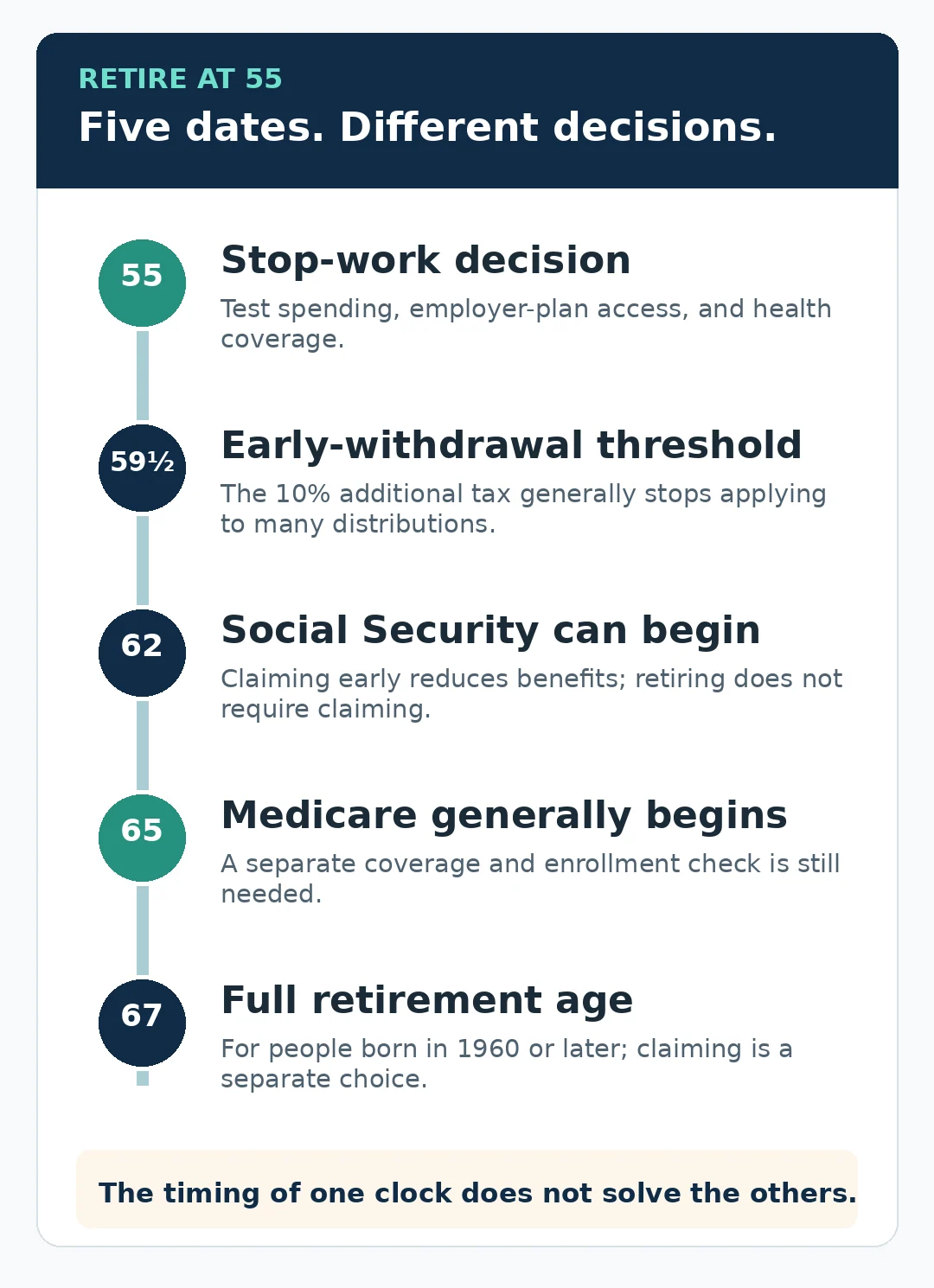
- Age 55: Your stop-work date and, if applicable, the qualifying separation year for an employer plan’s age-55 exception. Leaving work and having usable plan withdrawals are separate facts.
- Age 59½: The ordinary age at which the 10% early-distribution tax no longer applies to many retirement-account withdrawals. Income tax can still apply.
- Age 62: The earliest age for most people to start Social Security retirement benefits, with a permanent reduction compared with their full-retirement-age benefit. You can stop working at 55 without claiming Social Security at 62.
- Age 65: Medicare eligibility generally begins. Enrollment timing deserves its own check, especially when employment and other coverage end at different times.
- Age 67: Full Social Security retirement age for people born in 1960 or later; delaying up to 70 can increase monthly benefits. These are claiming decisions, not a reason to assume income starts automatically.
The practical point: getting from 55 to 59½ may solve your immediate access problem but not the healthcare problem through 65, and neither tells you when to claim Social Security.
Stopping work at 55 can also affect future Social Security. Benefits are based on your highest 35 years of earnings, so leaving work early may forgo high-earning replacement years or leave some zero-earning years in the calculation. Use the SSA benefit estimator with future earnings adjusted to your actual expected stop-work date rather than assuming your current paycheck continues to 62 or 67.
Two households, two very different retirement answers
Household A: A big 401(k), but the bridge is short
A hypothetical 55-year-old has $720,000 in a current employer 401(k), $180,000 in taxable brokerage investments and $60,000 in cash—a total of $960,000. Their combined spending, taxes and healthcare planning need is $100,000 a year. Assuming no outside income and ignoring returns, inflation and market changes, $240,000 outside the 401(k) would cover about 2.4 years. The roughly 4½-year bridge to 59½ needs about $450,000. That leaves a $210,000 access gap. In a simplified zero-return illustration, their $240,000 of cash and brokerage assets falls to $140,000 after Year 1 and $40,000 after Year 2; Year 3 then needs another $60,000 beyond those assets. That is a timing problem even before modeling markets, withholding or inflation.
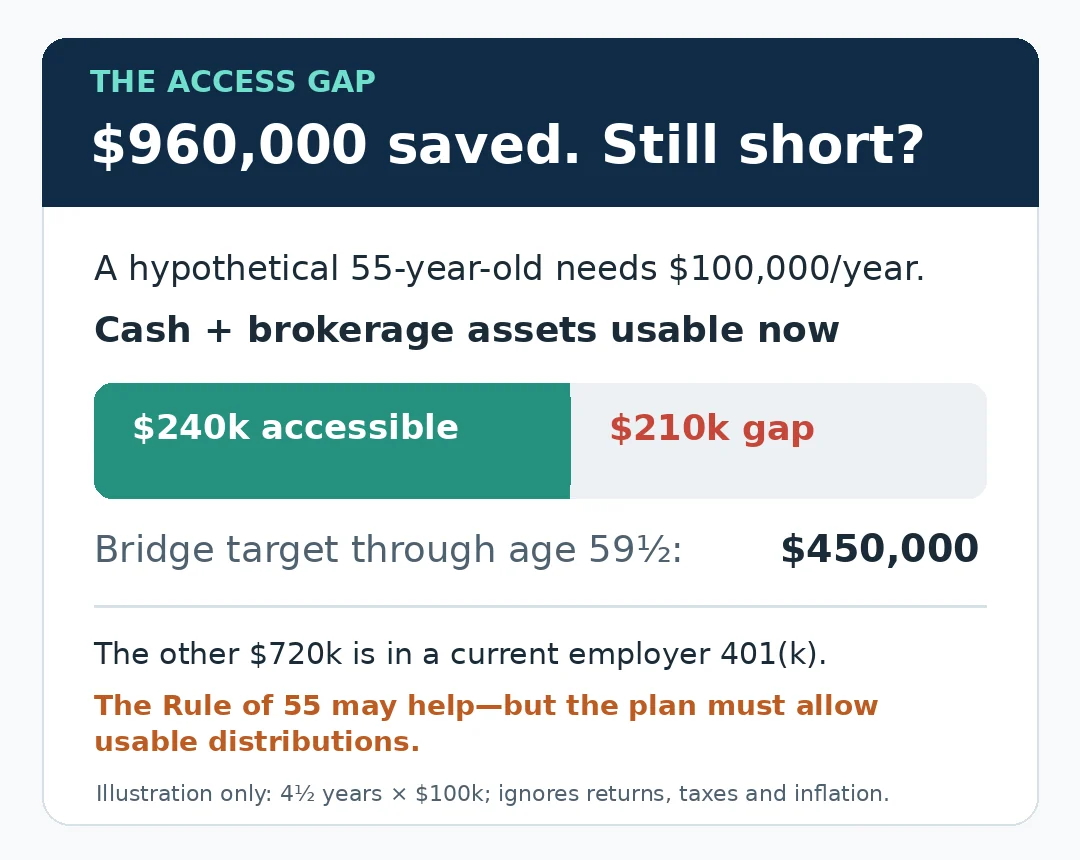
The $720,000 in the 401(k) may help close the gap if the separation timing qualifies and the actual plan permits usable withdrawals. If the plan offers only an inconvenient lump sum, the household could face significant tax or Marketplace-income consequences. So the answer is CONDITIONAL until the administrator confirms the distribution options and the withdrawal/tax schedule works.
Household B: Lower costs, but no healthcare commitment
Another hypothetical 55-year-old has $400,000 in accessible cash and investments and an affordable long-term spending plan. Their bridge math may look comfortable. But they have not checked whether a spouse can add them to employer coverage or what Marketplace insurance, deductibles and medications would cost. They also plan a large pretax IRA withdrawal without modeling its MAGI effect.
This household does not earn a “PASS” simply because the investments cover expenses. The healthcare clock is still unverified. Getting quotes and running a realistic MAGI estimate may solve it; ignoring the unknown does not.
Retire at 55 Bridge Test: a practical worksheet
Use this before setting a resignation date. It is a planning worksheet, not a calculator or a personalized recommendation. Write real numbers and mark each clock PASS, CONDITIONAL or NOT YET. “Unknown” is not a pass.
Step 1 — Write down your inputs
- Current age and proposed separation month/year: __________________________
- Annual household spending excluding income taxes and healthcare: $__________
- Estimated annual taxes and healthcare cost, including out-of-pocket exposure: $__________
- Debt payments not already included above, large irregular costs and contingency reserve: $__________
- Cash and taxable assets available for spending: $__________
- Current employer plan balance and exact permitted distribution types: $__________ / __________
- Old employer plans, traditional IRAs and Roth assets (separate account types and tax treatment): __________
- Reliable earned, pension or other income, with its start date: $__________ / __________
- Healthcare coverage source, start/end dates and current estimated household MAGI: __________
- Social Security claiming assumption, Medicare eligibility date and stress-test assumptions: __________
Step 2 — Test the three clocks
Score each clock separately. Use the numbers and documents you gathered above; unknown is never PASS.
Money: can this last?
Annual planned spending plus taxes and healthcare, less reliable income. Model each year to 59½ and a conservative long-run outcome with inflation, debt and a reserve.
- PASS
- Full horizon and poor-start case both workable.
- CONDITIONAL
- A material spending, income or return assumption remains untested.
- NOT YET
- Projected withdrawals cannot credibly sustain the plan.
Access: can you use it?
Map usable after-tax cash through 59½. Check the actual plan’s summary plan description, withdrawal forms, frequency, timing and taxes before a rollover.
- PASS
- Every bridge year is funded using permitted transactions.
- CONDITIONAL
- Distribution forms or tax withholding remain unverified.
- NOT YET
- A genuine accessible-cash shortfall remains.
Healthcare: are you covered?
Identify insurance for each person through Medicare and price premiums, deductibles, medication, out-of-pocket exposure and Marketplace MAGI effects.
- PASS
- Coverage, cost and contingency are verified.
- CONDITIONAL
- An insurance quote or income estimate is missing.
- NOT YET
- Coverage is unavailable or projected costs cannot be funded.
The weakest clock sets the result. No universal withdrawal order or guaranteed subsidy is assumed.
Step 3 — Give yourself an honest result
PASS: All three clocks pass under your stated assumptions, including the adverse case, and the important plan and insurance facts are verified. This is a readiness signal, not a promise that markets or costs will cooperate.
CONDITIONAL: The idea may be workable, but at least one material fact, transaction path, insurance quote or stress-test assumption needs resolving before you commit.
NOT YET: At least one clock has a concrete gap—unfunded spending, insufficient usable bridge assets or unaffordable/unavailable coverage—that needs a change in timing, expenses, income or plan design.
- Circle the weakest clock: MONEY / ACCESS / HEALTHCARE. Write the next fact you need: ____________________. Write the person or document that can confirm it: ____________________.
Would working one more year materially change the answer?
Sometimes it does, but not because one more year has magic investment returns. It can mean another year of wages and contributions, one less year of withdrawals, an employer healthcare bridge, or a separation date that changes access eligibility. It also costs a year of free time, and continuing to work may not be worth it if a solid plan already passes.
Compare retiring now versus waiting 6 or 12 months using the same spending, access, coverage and market assumptions. If waiting closes a verified gap, it has a real purpose. If the only reason is fear of seeing the investment balance decline, a better stress test may be more useful than an arbitrary delay.
Before giving notice, do these five things
- Price a full year of retirement as you would actually live it—including taxes, healthcare and irregular expenses.
- Build a year-by-year cash-flow bridge through 59½ and 65. Use the early retirement calculator for long-range scenarios, then map the account-by-account sources of cash.
- Get the summary plan description and written distribution rules for your exact employer plan. Verify your separation year before rolling over money or resigning.
- Get real health-insurance quotes and model expected household MAGI, including planned traditional-account withdrawals and conversions.
- Review the plan with the right professionals before executing irreversible account or employment decisions. The tax return and the withdrawal plan need to agree.
The better question is not “Is $1 million enough to retire at 55?” It’s “Can my household pay for the life we want, using money we can actually reach, while keeping healthcare covered?” Once you can answer that with numbers and documents, the decision gets much clearer.
Frequently asked questions
Can I retire at 55 with $1 million?
Possibly. Spending, other income, healthcare costs, taxes, how assets are held and your tolerance for a long retirement matter more than a universal account-balance threshold. A $1 million portfolio with $72,000 in living expenses can look very different once taxes and pre-Medicare healthcare are included.
Can I withdraw from my 401(k) at 55 without the 10% tax?
A qualifying separation from service during or after the calendar year you turn 55 can allow distributions from the relevant employer plan without the additional 10% early-distribution tax, subject to plan and tax rules. The exception does not carry over to an IRA merely because you rolled the money there. Taxable distributions generally still owe income tax.
What if I leave my job at 54?
The calendar year matters. Separating in the calendar year you turn 55 can meet the age-year part of the exception even if your birthday comes later that year. Separating in an earlier calendar year generally does not qualify under that particular age-55 separation exception. Other access routes may apply.
How do I get health insurance from 55 to 65?
Compare spouse or employer-related coverage, COBRA where applicable, Marketplace plans and other coverage for which you qualify. Budget premiums and out-of-pocket risk and estimate the household income that Marketplace rules use for savings. Do not assume Medicare will cover you at 55.
Should I claim Social Security as soon as I turn 62?
Not automatically. Claiming at 62 generally reduces the monthly retirement benefit relative to full retirement age. Model the effect of starting earlier versus later in your overall household plan, alongside longevity and survivor considerations.
What to do when one of your three clocks fails
If your Money clock passes but Access doesn’t, resolve the employer-plan or account bridge first. If Access works but Healthcare doesn’t, get the coverage and MAGI answer before you commit. If all three pass, you finally have something more persuasive than an account balance: a retirement plan you can explain, verify and stress-test.
Sources and useful next steps
IRS: When can a retirement plan distribute benefits?
HealthCare.gov: What counts as Marketplace income
Medicare.gov: When can I sign up for Medicare?
Social Security Administration: Starting retirement benefits early
How We Verified This
These are the authorities and references used to verify the material facts in this article.
