
Paying off $180,000 mortgage before retiring can take roughly $217,000 to $247,000 from a traditional 401(k). Here is how to tell whether the trade is worth making, and when to do it in pieces.
Walking into retirement with no mortgage payment sounds like the finish line. If you’re thinking about using your 401(k) to pay off your mortgage to get there, my short answer is this: for most people, doing it all at once from a traditional 401(k) is the wrong default. It can work.
But only when three things check out: enough cash stays outside the account, the withdrawal lands in a year when the extra income is cheap to absorb, and your plan actually allows the kind of withdrawal you’re counting on. Otherwise, paying down part of the loan in a low-income year, or simply keeping it, usually protects more.
The cost hides in a number most people never see. Paying off a $180,000 mortgage doesn’t take $180,000 out of a traditional 401(k). Every dollar you withdraw is taxable income first, so the account has to give up more than the payoff. In the example below it’s about $217,000 in one year and about $231,000 in another.
Add a 5% state tax and it reaches about $247,000. Same house, same loan, a gap of about $30,000 between the best case and the worst, and none of it shows up on the mortgage statement.
On This Page
- Before You Use a 401(k) to Pay Off a Mortgage, Identify the Transaction
- How Much Must Leave the 401(k) to Net the Mortgage Payoff?
- The Facts You Need Before Comparing the Options
- A Paid-Off Mortgage Lowers One Risk but Can Raise Another
- Example: What a $180,000 Mortgage Payoff Could Require
- Could a Large 401(k) Withdrawal Raise Medicare Premiums Later?
- Before Medicare, Your 401(k) Withdrawal Can Erase a Marketplace Subsidy
- Full Payoff, Partial Paydown, or Keep the Mortgage?
- What to Gather Before You Act
Before You Use a 401(k) to Pay Off a Mortgage, Identify the Transaction
“Use my 401(k)” can mean three different things. Each has its own rules for who qualifies, how much you can take and what it costs. People get into trouble when they plan around the one their plan doesn’t offer.

Normal 401(k) distribution
This is the withdrawal that can do the whole job. From a traditional 401(k), it’s ordinary taxable income. If you’re past 59½, as both people in our example are, the 10% additional tax for early withdrawals generally isn’t the issue. The question is whether your plan lets you take money while you’re still working. Some plans allow in-service withdrawals at 59½.
Others only pay out after you leave the employer. Your plan document decides that, not the tax code.
Younger readers face a different rule. Before 59½ the 10% additional tax generally applies, with exceptions the IRS lists. One is separating from your employer in or after the year you turn 55, and it applies to that employer’s plan, not to an IRA you rolled it into.
What if the money is in a Roth 401(k)?
The big tax gross-up in this article assumes pre-tax traditional 401(k) money. A fully qualified Roth 401(k) distribution is generally tax-free and does not add to adjusted gross income, so it generally avoids the federal income-tax, ACA-income and IRMAA effects described here. A distribution usually must satisfy the five-tax-year requirement and an eligible event, such as reaching age 59½.
If the Roth distribution is not qualified, the earnings portion can be taxable. Confirm which balance the plan will distribute before applying the table.
Hardship distribution
A hardship withdrawal is a narrow tool, not a shortcut for a large balance. The plan has to offer it, you have to show an immediate and heavy financial need, and the amount is limited to what that need requires. The IRS safe-harbor reasons include costs of buying a principal residence, excluding mortgage payments, and payments needed to stop an eviction or a foreclosure.
Wanting to be debt-free at retirement isn’t on that list. A hardship distribution is taxable and can’t be repaid to the plan or rolled over.
Don’t assume a big mortgage counts as a hardship
The size of the balance isn’t the test. Facing foreclosure might be. Choosing to eliminate a payment you can currently make generally isn’t. Ask your plan administrator before building a plan around it.
401(k) plan loan
A plan loan is not a withdrawal. You borrow from your own balance, repay yourself with interest, and none of it is taxable if you follow the rules. The limit is the lesser of $50,000 or the greater of $10,000 or half your vested balance. With $900,000 in the plan, that’s $50,000, so a loan can’t fund a $180,000 payoff.
It could fund part of one. Repayment is generally within five years through level payments. The longer repayment period applies to buying a principal residence, and I haven’t found support for stretching it to paying off an existing one, so I’d plan on five years.
Here’s the trap for someone retiring in 18 months. If you leave the employer with a loan outstanding, the plan may offset your balance by the unpaid amount. That offset is treated as a distribution that can be rolled over by your tax return due date, including extensions, if it results from leaving your job.
A loan that simply defaults while you’re still employed is different. It becomes a deemed distribution, which is taxable and cannot be rolled over. Either way, a loan taken right before your paycheck stops is the kind of thing that works on paper and fails on the calendar.
How Much Must Leave the 401(k) to Net the Mortgage Payoff?
Picture the 401(k) as a cup. It holds your money, but the money hasn’t been taxed yet. The tax shows up when you tip it. Tip out a little each month and you spill in a low bracket. Tip out $217,000 in one pour and the pour itself pushes you up through the brackets. The tax follows how much comes out and when. It doesn’t care what you spend it on.
That makes the payoff a gross-up question: how much has to come out so that $180,000 is left after tax?
Start with the mortgage payoff quote, not the statement balance
Your statement shows principal. Your lender’s written payoff quote adds interest accrued and any fees or prepayment penalty, and it expires. Ask for it in writing with a good-through date and size the withdrawal to that number. A few hundred dollars short means the payoff doesn’t clear and you’re making a payment next month.
Separate the gross distribution, withholding, and final tax cost
Three numbers get blurred together, and they’re not the same:
- The gross distribution is what leaves the 401(k).
- The withholding is what the plan sends the IRS for you. An eligible rollover distribution paid to you from a 401(k) is generally subject to mandatory 20% federal withholding. Other payments, including required minimum distributions and certain periodic payments, have different withholding rules; confirm the distribution type with the plan.
- The final tax is what you actually owe when you file. It depends on all your income that year.
Myth: the 20% withheld on an eligible rollover distribution is the final tax
It’s a down payment. If the real tax on the withdrawal is higher, you owe the difference in April. If it’s lower, you get it back. Either way, the cash that lands in your account is not the amount you can safely send to the lender.
If 20% withholding applies, a common shortcut is $180,000 ÷ 0.80 = $225,000. It’s too high in one year of our example and too low in the other:
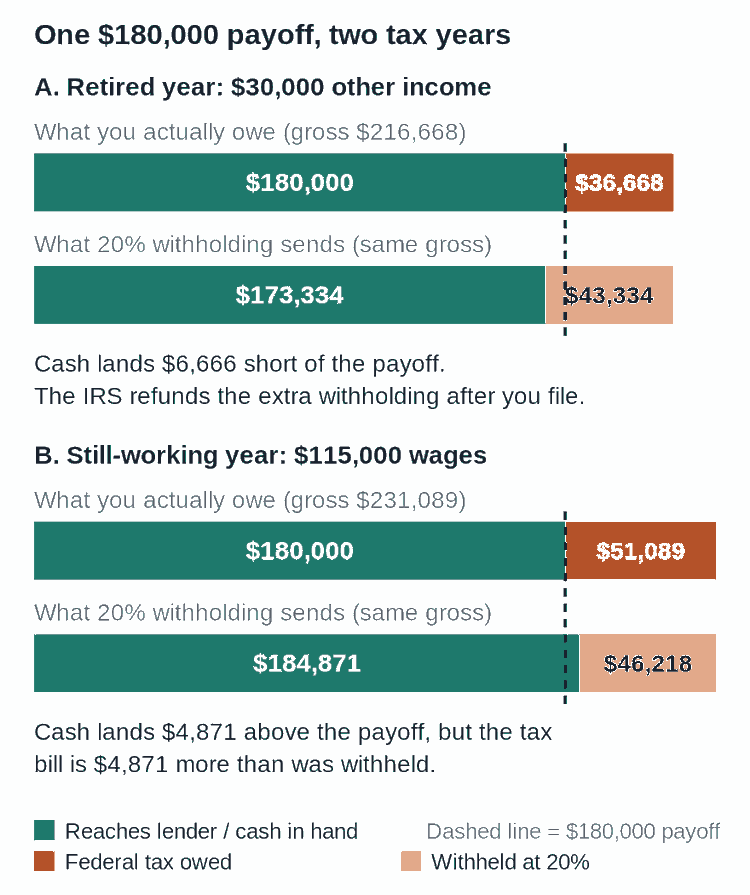
The reason is the bracket stack. A withdrawal sits on top of your other income, so its first dollars are taxed at whatever rate your other income has already reached. With $115,000 of wages and the 2026 married-filing-jointly $32,200 standard deduction, the couple’s baseline taxable income is $82,800. Only $18,000 of the withdrawal fits in the 12% bracket.
The next $110,600 is taxed at 22%, and the rest at 24%. With only $30,000 of other income, much more of the withdrawal is taxed at 10% and 12%.
The Facts You Need Before Comparing the Options
Get these on paper first. Each can change the answer, and several aren’t on any statement you receive:
- The payoff quote, rate and remaining term. A 3% loan and a 7% loan are different decisions with the same balance.
- What the $1,450 actually contains. If it includes escrow for property tax and insurance, only the principal and interest part disappears at payoff.
- What your plan allows. In-service withdrawals, loans, hardship rules, installments. It’s in the summary plan description.
- Your taxable income in the withdrawal year, from every source, including the withdrawals you’d take anyway to live on.
- Your state’s tax treatment.
- Cash outside the 401(k). This pays for the roof, the surprise bill and a rough first year of retirement.
- Everyone’s birthday and first Medicare month. That sets which tax year Medicare will look at.
- Health coverage before 65. If you expect Marketplace insurance, check your projected household MAGI against that coverage year’s premium-credit rules before taking a large taxable withdrawal.
A Paid-Off Mortgage Lowers One Risk but Can Raise Another
A paid-off mortgage makes you less dependent on income. It also makes you more dependent on whatever cash you have left. Both are true, and which one matters more depends on your household.
What improves when the mortgage payment disappears
The payment is a fixed bill that doesn’t care what the market did this year. In this example I treat the $1,450 as principal and interest to keep the math visible. Removing it removes $17,400 a year of after-tax spending you’d have to fund.
Because 401(k) withdrawals are taxable, funding that payment takes about $19,800 a year if the draws are taxed at 12% and about $22,300 if they’re taxed at 22%. That’s the real annual cost of keeping the loan, and it’s the reward for paying it off.
There’s a second benefit people miss. Lower required withdrawals in later years can mean lower taxable income, which can also help with Medicare premiums.
What becomes less flexible when retirement money becomes home equity
You can’t spend a house you live in. To use that equity again you’d sell, downsize or borrow against it, and borrowing as a retiree isn’t always easy. Property tax, insurance and repairs stay on the bill. And a withdrawal is hard to undo. Even if you roll some of it back within 60 days, you’d have to replace the withheld 20% from other money to make it whole.
A paid-off house is safe against the lender. It isn’t safe against a roof, a hospital bill, or a down market year that forces you to sell something else at a bad time. If you want a way to protect near-term spending without paying off the loan, the retirement bucket strategy is a related liquidity approach.
Where the mortgage rate and expected return fit
The usual debate is “4% mortgage versus what the market might earn.” That leaves out the tax, which is why it misleads. In our retired-year example, you can pay off the loan now with one $216,668 withdrawal, or keep it and draw about $1,859 a month from the 401(k) to cover the payment if those draws are taxed at 22% (about $1,648 a month at 12%) for the remaining 13 years.
On paper, keeping the mortgage comes out ahead if what’s left in the account earns more than roughly 5.0% a year when draws are taxed at 22%, or roughly 3.1% a year when they’re taxed at 12%. Those break-even numbers aren’t the mortgage rate. They move with how the tax lands, and they treat future returns as certain, which they never are. Use them to see the shape of the tradeoff, not to forecast.
Example: What a $180,000 Mortgage Payoff Could Require
The example
A couple, ages 61 and 60, plans to retire in about 18 months. They owe $180,000 on a mortgage with a $1,450 payment. They have $900,000 in a traditional 401(k) and $75,000 in savings.
Assumptions, all illustrative: married filing jointly, 2026 federal brackets and the $32,200 standard deduction, a 4% mortgage rate (about 13 years and $232,700 in payments left), and the $1,450 treated as principal and interest. Federal tax only unless a 5% state tax is noted. “Other income” is $115,000 of wages in a still-working year or $30,000 in a retired year. This is a mechanism, not a prediction.
Here is what different choices cost in the year they’re made:
| Scenario | Gross withdrawal | Federal tax | Total income | Medicare premium effect, if this is the lookback year |
|---|---|---|---|---|
| Full payoff, retired year | $216,668 | $36,668 | $246,668 | First tier |
| Same, plus 5% state tax | $231,927 | $40,330 (state $11,596) | $261,927 | First tier |
| Full payoff, still-working year | $231,089 | $51,089 | $346,089 | Third tier |
| Same, plus 5% state tax | $247,363 | $54,995 (state $12,368) | $362,363 | Third tier |
| $60,000 paydown, retired year | $67,318 | $7,318 | $97,318 | None |
| $60,000 paydown, working year | $74,615 | $14,615 | $189,615 | None |
A few things stand out. The full payoff needs between about $216,700 and $247,400 out of the account, even though the loan is $180,000. The same payoff costs about $14,400 more in federal tax if it lands while the couple is still earning $115,000. And the working-year payoff is only about $4,100 beyond the third 2026 Medicare income threshold.
That illustrates how a small change in income can change a premium tier if the withdrawal year becomes a Medicare lookback year.
The withholding problem shows up too. In the retired year, 20% withholding on the full payoff sends $43,334 to the IRS and leaves $173,334 in hand, $6,666 short of the payoff. That excess withholding becomes a tax refund or offsets other tax due when they file, but the lender wants its money now, so they’d bridge it from savings.
In the working year, withholding leaves $184,871, which is $4,871 more than the payoff needs and exactly what they’d owe at filing. Spending that extra cash is a mistake that waits until April.
After a full payoff in the retired year, the 401(k) is $683,332, with $75,000 in savings and no mortgage payment. That’s a solid position for some couples and a thin one for others, depending on what covers their spending.
Picture a couple looking at the payoff statement at their kitchen table. It says $180,000. They circle that number and start planning a $180,000 withdrawal. But the retirement account has to surrender a larger amount before the bank receives its $180,000. The cost of getting money out is missing from the mortgage statement.
Before you tap the 401(k)
The tax on the way out is the part nobody puts on the check.
The Financial Clarity Newsletter explains 401(k) withdrawal math, Medicare premium timing and the other catches in retirement decisions, one clear money decision at a time.
Could a Large 401(k) Withdrawal Raise Medicare Premiums Later?
Sometimes, and only if the withdrawal year becomes a year Medicare looks at. That conditional is the whole story, so it’s worth getting the timing right before you decide anything. For the mechanics, see how Medicare calculates IRMAA.
The tax year and Medicare year must line up
Medicare’s income-related surcharge, called IRMAA, generally uses your tax return from two years earlier. Income in 2028 sets premiums in 2030. The measure is modified adjusted gross income, which is your adjusted gross income plus tax-exempt interest. And the tiers are cliffs, not slopes: one dollar over a line moves you into the next tier for the whole year.
That makes timing the whole decision. Count forward two years from the withdrawal year and ask whether anyone is on Medicare then.
2026 IRMAA lines for married couples filing jointly
Standard premiums apply up to $218,000 of modified adjusted gross income. Surcharges start above that and step up at about $274,000, $342,000, $410,000 and $750,000. For 2026, the first three tiers add roughly $95.70, $240.40 and $385.00 a month per person across Part B and Part D, or about $1,150, $2,900 and $4,600 a year per person. Two people on Medicare pay it twice.
The lines are indexed each year, so the amounts for the year you’re actually affected will differ. See the CMS 2026 premium fact sheet.
Why the pilot couple may not face IRMAA from an immediate withdrawal
Take our couple. The 61-year-old turns 65 in late 2029 or during 2030, depending on his birth month. His first Medicare year is then 2029 or 2030, so the tax years that matter for his premiums are 2027 and 2028. His wife, a year younger, follows a year later. Neither is on Medicare in 2028, so a large withdrawal now isn’t an IRMAA problem on its own.
- A withdrawal in 2026 feeds premiums for 2028. Nobody is on Medicare yet, so there’s no IRMAA effect.
- A withdrawal in 2027 feeds 2029, which might matter for a month or two depending on his birthday.
- A withdrawal in 2028, around the time they retire, feeds 2030. That’s the one most likely to land on his first Medicare year.
If retiring lowers your income, the Social Security Administration has a process (Form SSA-44) for asking it to use a more recent estimate after a major life-changing event. A one-time withdrawal you chose to take generally isn’t one, so don’t plan on appealing your way out of it.
Before Medicare, Your 401(k) Withdrawal Can Erase a Marketplace Subsidy
Here’s the catch that can overturn the low-tax-year strategy. A couple retiring at 62 and 61 might need Marketplace insurance for several years. For premium credits, the Marketplace generally looks at annual household modified adjusted gross income. A taxable traditional 401(k) withdrawal adds to that number, even when the money goes straight to the mortgage.
The article’s $60,000 paydown has a hidden second price.
In our retired-year example, $30,000 of other income plus a $67,318 gross withdrawal produces $97,318 of total income. Under the 2026 premium-credit rules, a two-person household in the contiguous states generally loses eligibility above $84,600 (400% of the applicable poverty guideline). This hypothetical paydown is $12,718 above that line.
The federal income tax is only $7,318, but losing a premium credit could cost far more. The actual premium depends on ages, location and plan pricing.
The $84,600 figure applies to 2026 Marketplace coverage using the preceding year’s poverty guideline. Do not reuse it as the 2028 cutoff. Poverty guidelines, credit law and the family’s coverage year must all be checked again when the couple actually retires. Rules can also differ in Alaska and Hawaii.
One option is to postpone the taxable paydown, use other already-taxed cash without draining emergency reserves, or simply keep the mortgage while either spouse needs subsidized Marketplace coverage. If they have affordable employer or retiree coverage instead, the Marketplace credit may not be relevant. A qualified Roth 401(k) distribution may also change the tax calculation, but eligibility, qualified-distribution rules and available balances still matter.
For the applicable current eligibility rules, see HealthCare.gov’s premium tax credit guidance and the Congressional Research Service’s 2026 explanation.
Full Payoff, Partial Paydown, or Keep the Mortgage?
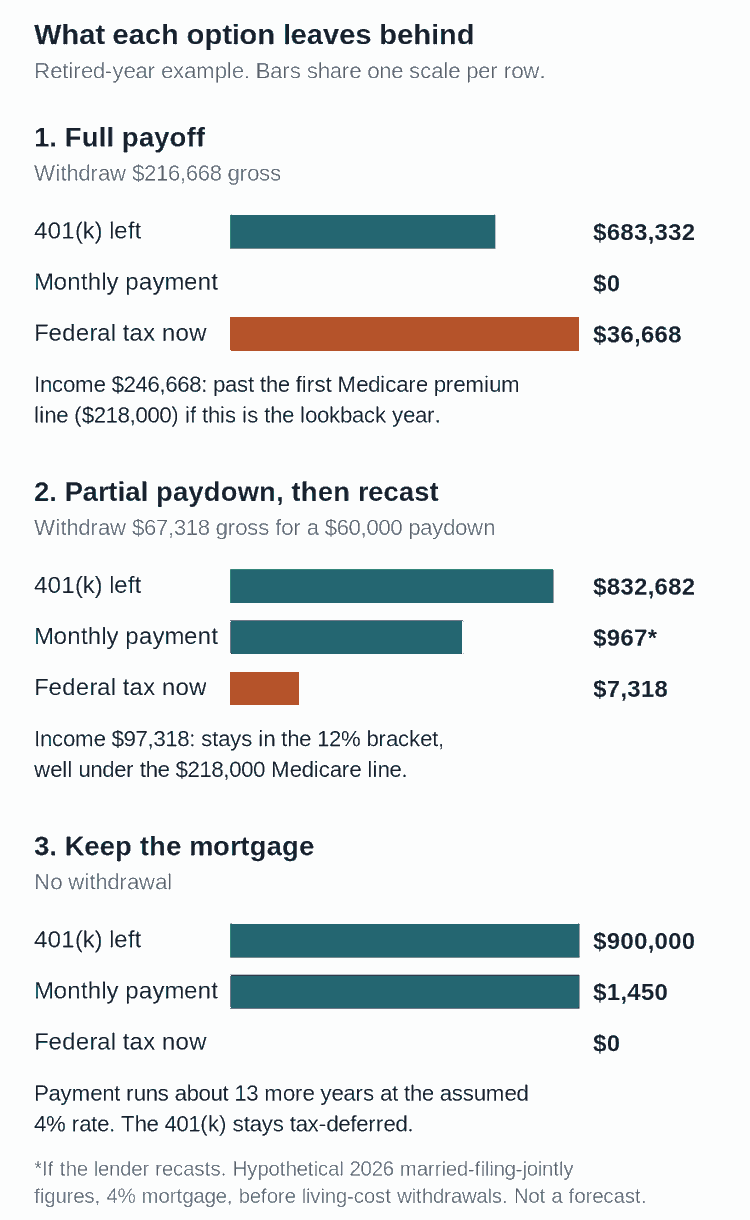
My default for someone in this spot: keep the loan until the full-year tax and health-insurance math is clear. Then consider a staged paydown, and move to a full payoff only when the checks pass. Here’s what each choice leaves behind in the retired-year example.
Full payoff
This is the cleanest outcome and the one with the most ways to go wrong. It makes sense when a real cash cushion stays outside the 401(k) after the withdrawal, when other income in that year is low, when a pension and Social Security cover most of your spending, and when Medicare and any Marketplace coverage consequences have been checked.
It’s hard to defend when the withdrawal lands in a high-income year, when the 401(k) is your main source of retirement income, or when the payoff leaves little liquid money. Peace of mind counts. It’s worth knowing what it costs.
Partial paydown or recast
A partial paydown lets you pick the year. In the retired-year example, a $60,000 paydown costs about $7,300 in federal tax. If the lender recasts, which many allow for a fee and some don’t, the payment drops from $1,450 to about $967, a $483 monthly saving, without a new loan or a new rate.
Without a recast, the payment stays the same and the loan ends sooner. Ask your lender whether it recasts, what it charges and what minimum paydown it requires.
One catch is easy to miss. The “cheap bracket room” in a low-income year is shared with the withdrawals you need for living costs. In the retired-year example, the 12% bracket has room for about $103,000 of withdrawals. If $60,000 of that is already spoken for by groceries and the electric bill, only about $43,000 is left in the 12% bracket.
A $60,000 paydown on top of that needs about $71,400 gross, costs about $11,400 in federal tax, and about $28,400 of it is taxed at 22%. Staging it across several years can still beat one big payoff, but the first number to find is how much room is left after your living draws.
The other low-income case is cleaner for federal income tax, but not automatically for health-insurance costs. If a couple had no other income at all and withdrew $45,000, the standard deduction would shield the first $32,200, leaving about $1,280 of federal tax, under 3%.
That’s the best case for waiting, and it’s why the first years after the paychecks stop are often the cheapest years to pay down debt, if the Medicare and pre-65 health-insurance timing work for each year.
Keep the mortgage and preserve the retirement assets
Keeping the loan costs about $52,700 in remaining interest at the assumed 4% rate, plus the $1,450 a month, which is the price of staying liquid. It fits when the rate is low, when cash is tight, when withdrawals are already pushing you toward a tax line, or when you’d rather make that decision again in a year with real numbers.
A higher rate moves the answer toward paying down. I’d rerun the break-even with your actual rate instead of trusting mine.
Michael’s Take
If the withdrawal pushes your income into a higher bracket, a Medicare tier or out of Marketplace premium-credit eligibility, check the date before changing the plan. The same payoff in a different year can cost thousands less.
What to Gather Before You Act
Gather these first
- A written payoff quote with a good-through date.
- Your plan’s summary plan description: in-service withdrawals, loans, hardship rules, installments and withholding.
- Your last two tax returns and a projection of this year’s and next year’s income, including a spouse’s and the withdrawals you’ll take to live on.
- Your mortgage statement’s breakdown of principal, interest and escrow.
- Each person’s birthday and expected first Medicare month.
- Your state tax rate and your estimated marginal bracket with and without the withdrawal.
- The cash you’d have left outside the 401(k) after the payoff.
- Any Marketplace coverage years, estimated premiums, and projected household MAGI before Medicare.
- Your lender’s recast terms, fees and minimum paydown.
Once you have those, run the numbers for one specific year before you move a dollar. If you don’t have a tax professional you trust, a one-time review with a fee-only planner is cheap compared with the size of this decision. This article is educational and not tax advice, and your plan’s rules and your own tax situation can change the answer.
