If you only want one retirement planning book, start with How to Retire by Christine Benz. It is the best all-around choice I found for combining the money decisions with the part most retirement books barely touch: what you actually want retirement to look like.
If you want the technical manual instead, Wade Pfau’s Retirement Planning Guidebook is my deep-dive pick. If you’re 50+ and want a more direct roadmap, Suze Orman’s revised guide is an easier place to start.
You do not need seven retirement books sitting on your nightstand judging you. You need the one that matches the decision you’re trying to make.
Quick Picks: Buy It or Read My Take First
Amazon disclosure: As an Amazon Associate I earn from qualifying purchases. I recommend these because I think they fit the reader, not because Amazon pays me. Trust me, on a book, it ain’t much.
The best retirement book isn’t the highest-rated one. It’s the one that answers the retirement decision you’re stuck on right now. Answer three quick questions and I’ll narrow the list to the best starting point for your problem.
On This Page
- Find Your Retirement Book
- Key Takeaways Ahead
- How I Picked These Retirement Books
- 1. How to Retire by Christine Benz — Best Overall
- 2. Retirement Planning Guidebook by Wade Pfau — Best Deep Dive
- 3. The Ultimate Retirement Guide for 50+ by Suze Orman — Best for 50+
- 4. Can I Retire? by Mike Piper — Best Short Read
- 5. The Retirement Savings Time Bomb Ticks Louder by Ed Slott — Best for IRA and Tax Planning
- 6. The 5 Years Before You Retire by Emily Guy Birken — Best Pre-Retirement Checklist
- 7. How to Make Your Money Last by Jane Bryant Quinn — Best for the Fear of Running Out
- Turn the reading into a retirement decision
- What I Changed From My Old Retirement Book List
- Which Retirement Book Should You Read First?
- Retirement Planning Book FAQs
- The Bottom Line
- How We Verified These Retirement Book Picks
Find Your Retirement Book
Tell me what you are trying to solve and how deep you want to go. I’ll point you to the retirement book I’d start with — plus a runner-up if you want another angle.
Privacy: Your answers stay in your browser. Nothing in this matcher is submitted or saved.
Amazon disclosure: As an Amazon Associate I earn from qualifying purchases. A book match is educational guidance, not individualized financial advice.
Key Takeaways Ahead
How I Picked These Retirement Books
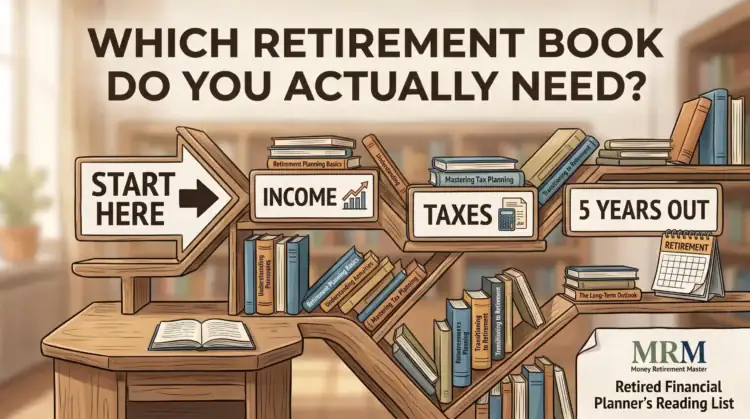
I spent almost three decades in financial services and retirement planning. One thing that experience taught me is that the “best” retirement book depends on what is keeping you up at night.
Is it the number? Social Security? Taxes? Investing after the paycheck stops? Healthcare? Or the surprisingly uncomfortable question of what you are going to do with the next 20 or 30 years?
So I did not rank these by bestseller badges, Amazon stars, or who has the loudest TV show. I looked for books that do a specific job well, explain the tradeoffs instead of selling a magic answer, and are current enough for the subject they cover.
That last part matters. A timeless lesson about behavior can age beautifully. A chapter that tells you the current Social Security, Medicare, RMD or tax rules can age like milk. Use a book to understand the framework; verify current rules before you act on them.
If your bigger question is whether your numbers work at all, start with my retirement-at-65 guide or retirement savings calculator. A book is great. A book plus your actual numbers is better.
Want one practical retirement idea each week without turning your inbox into another job? Financial Clarity is where I break down the decisions, traps and tradeoffs I spent years explaining across a desk from real people.
1. How to Retire by Christine Benz — Best Overall
Best for: The person who wants to understand retirement as a life transition, not merely a withdrawal-rate problem.
If I were handing one retirement book to a client today, this is where I would start.
Christine Benz, Morningstar’s director of personal finance and retirement planning, built How to Retire around 20 conversations with people who specialize in different parts of retirement. That gives the book something most retirement guides lack: multiple good answers can coexist.
Some chapters get into retirement income, portfolio construction and spending. Others deal with health, relationships, happiness, purpose and how your life changes when work stops organizing your week for you.
I like that because real retirement planning was never just a spreadsheet exercise. I could build somebody a mathematically beautiful plan, but if it ignored what they actually wanted their days to look like, we had not finished the job.
My one caution: this is a wide-angle book. If you want formulas, research detail and a deeper treatment of retirement-income strategy, Benz gives you the map; Pfau gives you more of the engineering manual.
2. Retirement Planning Guidebook by Wade Pfau — Best Deep Dive
Best for: The DIY planner who wants to understand retirement-income decisions at a much deeper level.
Wade Pfau’s Retirement Planning Guidebook was already on my old list, and it stays. The important change is the edition: the fully revised third edition became available in 2026.
This is the book for the reader who keeps asking “why?” Why might the investing strategy that worked while you were saving behave differently after retirement? Why does sequence-of-returns risk matter? How do guaranteed income, portfolio withdrawals, Social Security, Medicare, taxes and legacy goals interact?
Pfau’s strength is that he does not reduce retirement income to one cute rule. He lays out different approaches and the tradeoffs behind them. That makes the book more useful — and also more work.
I would not hand this to somebody who told me, “Michael, finance books put me to sleep by page 12.” For that reader, start with Benz or Piper. But if you genuinely enjoy understanding the machinery, Pfau is probably the strongest book on this page.
If this is the part of retirement you want to go deeper on, my retiree asset-allocation guide and retirement distribution guide take those questions into your actual retirement portfolio.

3. The Ultimate Retirement Guide for 50+ by Suze Orman — Best for 50+
Best for: Readers in their 50s and 60s who want a practical, plain-English checklist of the big decisions coming at them.
Suze Orman’s book also survives the rebuild, but I am updating the recommendation to the revised 2025 paperback rather than treating the old edition as permanently current.
The appeal here is not subtlety. Orman is direct. She covers the decisions people approaching retirement actually recognize — saving, spending, housing, Social Security, Medicare, long-term care, investments and family questions — without making the reader feel like they enrolled in a graduate finance course.
That makes it a particularly good fit for somebody who has spent years saying, “I know I need to get serious about retirement,” and is finally ready to do it.
My caution: do not turn any author’s rule of thumb into your personal answer. Social Security timing is a good example. The biggest monthly check is not automatically the best household decision. Taxes, longevity, spouse benefits, cash flow and Medicare premiums can all change the math. If that is your question, use my Social Security claiming framework alongside the book.
4. Can I Retire? by Mike Piper — Best Short Read
Best for: The reader who wants the important retirement mechanics explained quickly and clearly.
This is a new addition to my list, and it fills a hole the old article missed completely.
Not everybody wants — or needs — a 300- to 500-page retirement book. Mike Piper’s Can I Retire? is part of his “100 Pages or Less” series, and that constraint is the whole point.
It gives you a compact introduction to questions such as how much you may need, how retirement withdrawals work, taxes, Roth conversions and annuities without wandering through 17 chapters of motivational throat-clearing first.
For a beginner, I would rather see you understand a short book than buy the “ultimate” 600-page guide and use it as a very expensive coaster.
5. The Retirement Savings Time Bomb Ticks Louder by Ed Slott — Best for IRA and Tax Planning
Best for: People with meaningful IRA, 401(k) or other tax-deferred retirement savings who want to understand the tax side of the plan.
Retirement books often spend a lot of time talking about how to accumulate money and surprisingly little time talking about what happens when you start taking it back out.
Ed Slott lives in that second problem. His 2024 book focuses on retirement-account tax traps, distributions, Roth decisions, beneficiaries and the rule changes that can turn a perfectly good investment account into a tax-planning puzzle.
I like it as a specialist book, not as your first retirement book. Taxes are one piece of the retirement plan. They matter a lot, but the goal is not to minimize taxes at all costs; it is to make the whole plan work after taxes.
Freshness warning: tax books have a shorter shelf life than books about behavior. Slott’s edition incorporates SECURE 2.0-era changes, but Congress and the IRS can change the details again. Learn the concepts from the book, then verify current rules before acting.
6. The 5 Years Before You Retire by Emily Guy Birken — Best Pre-Retirement Checklist
Best for: Someone roughly three to five years from retirement who needs to turn “someday” into an actual checklist.
There is a point where retirement suddenly stops being theoretical. The date is close enough that healthcare, Social Security, housing, cash reserves, account withdrawals and the last few years of saving all start competing for attention at once.
Emily Guy Birken’s book is built for that moment. It is practical, broad and organized around what needs to get done rather than trying to make you an amateur retirement-income researcher.
There is one unusual timing issue as I update this page in September 2026: the current updated edition is from 2021, while the publisher has already announced a third edition for January 19, 2027.
So my recommendation changes depending on your calendar. Retiring soon and need the checklist now? I would buy the current edition and verify any rule-specific details. Retirement is still a few years away and you can wait? I would probably wait for the new edition rather than knowingly buying a book that is about to be replaced.
7. How to Make Your Money Last by Jane Bryant Quinn — Best for the Fear of Running Out
Best for: Retirees and near-retirees whose biggest question is simply, “How do I make this pile of money support the rest of my life?”
Outliving your savings is one of the biggest fears I heard from retirees. Not beating the S&P 500. Not finding the cleverest tax trick. Running out.
That is why Jane Bryant Quinn stays on the list.
How to Make Your Money Last is organized around the practical problem of turning savings into a durable retirement: spending, investing, guaranteed income, housing and the tradeoffs that determine how flexible your plan really is.
The current “Completely Updated for Planning Today” paperback is not as new as Benz, Pfau’s third edition or Orman’s 2025 revision, so I would treat it as a strong framework rather than a source for every current rule or number.
If the fear behind your book search is really portfolio longevity, pair the book with your actual withdrawal plan. My retirement distribution and RMD guide is the more useful next step than buying book number eight.
What I Changed From My Old Retirement Book List
I originally wrote this page years ago, and I do not think an honest “best books” list should pretend nothing has changed.
Christine Benz moved to #1
How to Retire did not exist when the original list was built. It now does the best job, in my view, of bridging the financial and nonfinancial sides of retirement in one readable book.
Wade Pfau stays — but the edition changes
I still like Pfau for the reader who wants depth. The difference is that I would now point you to the fully revised third edition released in 2026, not an older copy simply because an old affiliate link still works.
Carl Richards is still good, but he is no longer my #1 retirement pick
I have recommended The One-Page Financial Plan to people who were overwhelmed and needed to simplify. I still like that job for it. But it is a broader financial-planning book, not a retirement-planning book, and this page should answer the question it promises to answer.
The Wealthy Barber moves off the main list
David Chilton’s storytelling and pay-yourself-first lesson still hold up. It is a personal-finance classic. But if you came here specifically to make retirement-income, Social Security, Medicare, tax and withdrawal decisions, there are better uses of your next reading hour.
The life-insurance book comes off
I am removing Money. Wealth. Life Insurance. from the main recommendations. Life insurance can have legitimate estate-planning and risk-management uses, but a book centered on using permanent life insurance as a wealth strategy is too specialized to belong on a broad “best retirement planning books” list. It also invites exactly the kind of product-first thinking I would rather readers avoid.
That is a good rule for retirement books generally: if the book seems to discover that one product is the answer to almost every retirement problem, keep your wallet in your pocket while you read it.
Which Retirement Book Should You Read First?
Do not overthink this. Match the book to the problem.
- You want one broad retirement book: Christine Benz.
- You want to understand the technical retirement-income machinery: Wade Pfau.
- You are 50+ and want a practical action plan: Suze Orman.
- You hate long finance books: Mike Piper.
- Your biggest concern is IRA/401(k) taxes: Ed Slott.
- You are within about five years of retiring: Emily Guy Birken.
- Your biggest fear is making the money last: Jane Bryant Quinn.
And if you are just generally interested in money behavior, I still like Morgan Housel’s The Psychology of Money and Carl Richards’ The One-Page Financial Plan. I just would not pretend either one is a retirement manual.
The goal is not to become the person who owns the most retirement books. The goal is to make one better retirement decision, then the next one.
Retirement Planning Book FAQs
What is the best retirement planning book for beginners?
For most beginners, I would start with Christine Benz’s How to Retire because it explains the major money and life decisions without turning retirement into one giant formula. If you want an even shorter introduction, Mike Piper’s Can I Retire? is the better fit.
What is the best retirement book for someone over 50?
Suze Orman’s The Ultimate Retirement Guide for 50+ is my pick for a broad, action-oriented guide for readers in their 50s and 60s. The paperback was revised for 2025, which matters for a book that discusses rule-heavy subjects such as Social Security and Medicare.
What is the best retirement book for advanced planning?
Wade Pfau’s Retirement Planning Guidebook is the strongest technical choice on this list. The third edition released in 2026 covers the major retirement-income decisions in substantially more depth than the average consumer retirement guide.
Should I buy the newest retirement book?
Not automatically. Newer matters most when a book depends heavily on current tax, Social Security, Medicare or retirement-account rules. Books about behavior, purpose or general investment principles can remain useful much longer. I care more about whether the edition is current enough for the job it is trying to do.
Are retirement books enough to build a retirement plan?
No. A good book can teach you what questions to ask and how the pieces fit together. Your actual retirement plan still depends on your spending, savings, pension or Social Security income, taxes, health coverage, investment risk, family situation and time horizon.
The Bottom Line
If you are standing in front of the retirement shelf — physical or digital — wondering where to start, buy How to Retire by Christine Benz. It is the best first book for the widest range of readers.
Then stop buying books for a minute.
Use what you learned. Run your numbers. Check your Social Security decision. Look at the investment risk you will actually carry into retirement. Figure out what you want the money to do.
Because retirement planning is not a reading contest. Eventually you have to close the book and make the decision.
How We Verified These Retirement Book Picks
I checked current publisher information, 2026 search results, current reader discussions and Amazon product identifiers before rebuilding this list.
