Rich Dad Poor Dad is still worth reading in 2026—but I would read it as a mindset book, not an investing instruction manual. Robert Kiyosaki is very good at making you question the default earn-spend-repeat cycle. He is much less useful when a catchy rule gets treated like a complete financial plan.
If you came here for the short version, the book’s core message is simple: learn how money works, build things that can produce income, improve your financial skills, and stop assuming a bigger paycheck automatically creates wealth. The part I’d add after roughly 30 years around financial planning is equally important: cash flow matters, but so do risk, liquidity, taxes, diversification, financing costs, and the chance that your “asset” behaves badly.
Show the 30-second version
- My verdict: Worth reading for the mindset shift, but do not copy every tactic literally.
- Main message: Financial literacy and ownership matter more than simply earning a paycheck and buying more stuff.
- Best lesson: Judge financial decisions by what they do to your cash flow and long-term options, not by labels alone.
- Biggest weakness: Memorable rules can oversimplify risk, diversification, taxes, real estate and what counts as a good investment.
- Best for: Beginners who need a jolt out of paycheck-only thinking and will verify the implementation elsewhere.
On This Page
- Key Takeaways Ahead
- What Is Rich Dad Poor Dad About?
- The 6 Lessons in Rich Dad Poor Dad, Explained
- What Rich Dad Poor Dad Still Gets Right in 2026
- Where I Disagree With Rich Dad Poor Dad
- Turn the Mindset Into a Real Plan
- How to Use the Book Without Copying It Blindly
- Who Should Read Rich Dad Poor Dad?
- My Rich Dad Poor Dad Review: Final Verdict
- Rich Dad Poor Dad FAQ
- How We Verified This Rich Dad Poor Dad Review
Key Takeaways Ahead
What Is Rich Dad Poor Dad About?
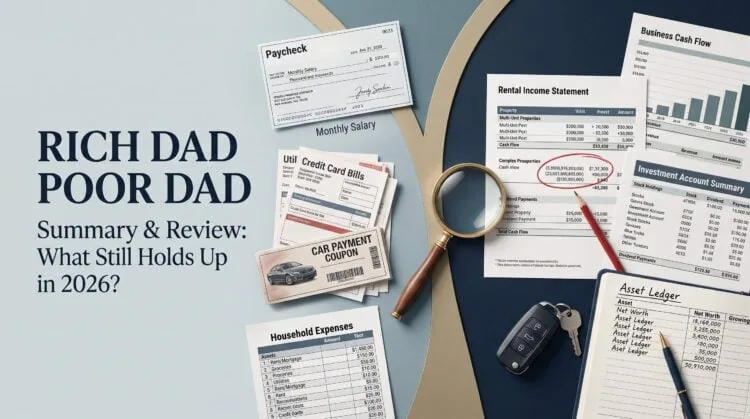
Rich Dad Poor Dad uses two contrasting money philosophies. “Poor Dad” represents the conventional path: get educated, get a secure job, earn a salary and climb the ladder. “Rich Dad” represents the ownership path: understand cash flow, acquire or build income-producing assets, develop business skills and make money work for you.
Kiyosaki’s own Rich Dad FAQ summarizes the six lessons as: the rich don’t work for money; learn financial literacy; mind your own business; understand taxes and corporations; learn to create opportunities; and work to learn rather than only to earn.
That framework explains why the book has lasted. It is not really trying to teach you how to calculate a retirement income plan or choose an index fund. It is trying to change the questions you ask about money.
That is also why the book is easy to misuse. A memorable mental model is useful. A memorable mental model mistaken for a universal law is where trouble starts.
Affiliate note: If you buy through an Amazon link here, I may earn a small commission at no extra cost to you. It does not change what I recommend. Trust me, on a book, it ain’t much.
See the current Rich Dad Poor Dad edition on Amazon
The 6 Lessons in Rich Dad Poor Dad, Explained
1. Don’t spend your whole life working only for a paycheck
Kiyosaki wants the reader to stop treating salary as the finish line. A paycheck can fund your life and your investing. It can also become a treadmill if every raise immediately turns into a bigger house, car payment and lifestyle.
I like the question underneath the slogan: What part of your income is building future choices? That might mean retirement accounts, taxable investments, a business, rental property, cash reserves or paying down expensive debt. You do not have to become an entrepreneur to understand the point.
2. Learn financial literacy before chasing investments
The book’s most durable idea is that earning money and understanding money are different skills. Income statements, balance sheets, cash flow, debt, taxes, compounding and risk are not “Wall Street stuff.” They shape ordinary household decisions.
If you want the broader foundation rather than one author’s worldview, my best investing books guide separates beginner investing, index investing, market behavior and value investing into different learning jobs.
3. Build assets that can create cash flow or long-term value
Kiyosaki’s shorthand is famous: assets put money in your pocket; liabilities take money out. As a teaching device, that is useful because it forces you to look past the sticker price and ask what an item actually does to your finances.
But it is shorthand—not accounting doctrine and definitely not a complete investment test. A rental property can produce income and still be a lousy investment at the wrong purchase price, financing cost, vacancy assumption or repair burden. A stock can be an asset and still be wildly overpriced. Cash can be safe and still lose purchasing power.
For real estate specifically, use the mindset here and then move to the actual numbers. My real estate investing books guide separates beginner, rental, BRRRR, creative-financing and long-distance paths.
4. “Mind your own business” means build your financial engine
This does not have to mean quitting your job tomorrow. The practical version is to distinguish your career from the assets you are building outside your paycheck. Your career produces income. Your financial engine determines what happens to that income next.
5. Taxes, corporations and opportunity matter—but context matters more
The book encourages readers to understand tax rules, business structures and legal entities instead of assuming everyone is treated identically. Good lesson. The dangerous version is assuming a corporation is a magic tax coupon.
Entity choice, deductions, liability, payroll, state law and tax treatment depend on what you actually own and do. A book can make you curious about the rules. It cannot substitute for the current rules that apply to your facts.
6. Work to learn, not only to earn
Kiyosaki argues for building a broader skill set—sales, communication, negotiation, management and business judgment—rather than optimizing only for the next salary increase. This is one of the book’s better lessons because skills can create options even when a particular job disappears.
What Rich Dad Poor Dad Still Gets Right in 2026
- High income is not the same as wealth. What you keep, own and build matters.
- Lifestyle inflation can quietly eat every raise. More income helps only if some of it improves your balance sheet or future flexibility.
- Financial literacy changes behavior. Once you understand cash flow, interest, risk and ownership, marketing labels lose some of their power.
- Ownership can expand your options. Investments and businesses can create income that is not tied one-for-one to hours worked.
- Skills compound too. Learning to negotiate, sell, communicate and analyze opportunities can improve more than one line of your financial life.
In practice, one of the biggest differences I have seen is not between people who know some secret investment and everyone else. It is between people who eventually build a repeatable financial system and people who keep relying on the next raise to fix everything. Even a six figure income doesn’t goes as far as it used .
Where I Disagree With Rich Dad Poor Dad
The book gets weaker when a useful provocation becomes a universal rule.
A home is not simply “not an asset”
Kiyosaki focuses on the fact that an owner-occupied home creates expenses rather than monthly income. That is a useful cash-flow reminder. But your home can still have economic value, equity and a place on your household balance sheet. Whether buying it was a good decision depends on price, financing, maintenance, taxes, how long you stay, alternatives and what the home does for your life—not one label.
Leverage can accelerate wealth—and accelerate mistakes
Borrowing to acquire an asset can work. It can also turn a modest forecasting error into a cash-flow emergency. The higher the debt load, the less room you have for vacancies, repairs, market declines, rate changes or plain old bad luck.
Entrepreneurship is not the only path to financial independence
A well-paid employee who saves aggressively, invests broadly and avoids destructive debt can build substantial wealth. A business owner can also go broke. Ownership matters, but the form of ownership is not a moral ranking.
The book is strongest as a question generator, not an instruction manual.
How to Use the Book Without Copying It Blindly
- Keep the question. Does this decision improve or weaken your future cash flow and flexibility?
- Add the missing risks. What happens if income falls, the asset drops, repairs spike, a tenant leaves or financing gets more expensive?
- Check concentration. How much of your net worth depends on one business, property, employer or idea?
- Use current tax and legal rules. Never implement entity or tax ideas from an old book without current verification.
- Compare against the boring alternative. Sometimes diversified investing plus a good career beats the complicated deal. Boring is allowed to win.
If a deal still looks attractive after that, great. If it only looked attractive before you added risk, that was not analysis. That was a sales brochure you wrote for yourself.
Who Should Read Rich Dad Poor Dad?
Read it if: you have always thought of financial success as “get a better job and earn more,” you want a very accessible introduction to ownership and cash flow, or you need motivation to start learning how investments and businesses actually work.
Read something else first if: you need a step-by-step investing plan, you are about to make a leveraged real-estate purchase, you want current tax guidance, or you are likely to turn a memorable slogan into a rule without testing the numbers.
My Rich Dad Poor Dad Review: Final Verdict
My rating of the idea, not a star score: useful mental reset, incomplete operating manual.
I would rather have a reader finish Rich Dad Poor Dad asking better questions than finish a technically perfect textbook and do nothing. That is the book’s real strength.
Just do not confuse “thinking like an owner” with “every leveraged asset is smart.” Wealth is built by what survives—not merely what looks clever on the way up.
If you’re deciding whether this belongs on your reading list at all, compare it with the broader best finance books of all time shelf.
See Rich Dad Poor Dad on Amazon
Rich Dad Poor Dad FAQ
What is the main message of Rich Dad Poor Dad?
The main message is that financial literacy, ownership and building assets matter more than relying only on salary. Kiyosaki encourages readers to understand cash flow and build income-producing or appreciating assets.
What are the six lessons in Rich Dad Poor Dad?
The six lessons are broadly: do not work only for money; learn financial literacy; mind your own business; understand taxes and corporations; learn to create opportunities; and work to learn rather than only to earn.
Is Rich Dad Poor Dad still relevant in 2026?
Yes, as a mindset and financial-literacy book. Its core questions about cash flow, ownership, lifestyle inflation and learning financial skills remain useful. Specific tax, legal, financing and investment tactics should be checked against current conditions and your own situation.
Is a house really a liability?
Kiyosaki uses a cash-flow definition: an owner-occupied house normally costs money each month instead of paying you income. In ordinary household finance, a home can still be an asset with market value and equity while also creating expenses. The useful question is not the label—it is whether the housing decision fits your cash flow, risk and goals.
Is Rich Dad Poor Dad good for beginners?
It can be, especially for readers who need a simple introduction to ownership and cash flow. Pair it with a more implementation-focused resource before making major investing, real-estate, tax or business decisions. If you are just learning the investing mechanics, begin with how to start investing rather than copying a book’s most provocative tactics.
How We Verified This Rich Dad Poor Dad Review
I checked the current Rich Dad description of the book’s core lessons, current Amazon product identity, and separated the book’s durable concepts from implementation details that depend on current rules and market conditions.
