If you are new to money, the hardest part usually is not finding a finance book. It is figuring out which book deserves to be your first one.
That distinction matters because “beginner” can mean wildly different things. Maybe nobody ever taught you what an index fund is. Maybe you understand the basics but cannot make a budget stick. Maybe debt is eating your paycheck. Or maybe your finances look fine on paper and your own behavior keeps sabotaging them.
After nearly three decades working in financial planning, here is the question I would ask before handing you a book: What money decision are you stuck on right now? The best beginner book is the one that helps you make that decision better.
And yes, there is still plenty to learn. The 2026 TIAA Institute-GFLEC Personal Finance Index found that U.S. adults answered only 47% of its 28 personal-finance questions correctly on average, the lowest result in the survey’s 10-year history.
If you want one default starting point, I would choose The Psychology of Money by Morgan Housel. If you need a practical system, choose I Will Teach You to Be Rich. If you truly need the basics explained, choose Personal Finance For Dummies or Why Didn’t They Teach Me This in School?. If debt is the emergency, start with The Total Money Makeover. If investing is your next hurdle, move to the revised The Simple Path to Wealth.
Show the 30-second version
- Best overall: The Psychology of Money — best when behavior, fear, comparison or impatience gets in the way.
- Best action system: I Will Teach You to Be Rich — best for automating saving, spending and investing instead of relying on willpower.
- Best full framework: Get Good with Money — best when your whole financial life feels scattered and you need one organized map.
- Best true basics: Personal Finance For Dummies — best reference for plain-English explanations across budgeting, debt, insurance and investing.
- Best debt reset: The Total Money Makeover — strong behavioral momentum, with an important caveat: the debt snowball is not mathematically cheapest.
- Best first investing book: The Simple Path to Wealth — use the revised 2025 edition if possible.
On This Page
- Quick Picks: Start With the Problem, Not the Bestseller List
- Find Your First Personal Finance Book
- Key Takeaways Ahead
- The 10 Best Personal Finance Books for Beginners
- What Changed in This 2026 Update
- How I Would Read These Books in Order
- A Beginner Book Should Match the Order of Operations
- Turn the Book Into an Actual Money Move
- What About Rich Dad Poor Dad?
- Personal Finance Books vs. Investing Books
- Which Personal Finance Book Should You Read First?
- How We Verified This Guide
Quick Picks: Start With the Problem, Not the Bestseller List
If you buy through one of the Amazon links below, I may earn a small commission at no extra cost to you. I recommend these because I think they fit the reader, not because Amazon pays me. Trust me, on a book, it ain’t much.
| Your biggest problem | Start with | Actions |
|---|---|---|
| I keep making emotional money decisions | The Psychology of Money | Check on Amazon ↗ |
| I need a practical money system | I Will Teach You to Be Rich | Check on Amazon ↗ |
| Everything feels financially disorganized | Get Good with Money | Check on Amazon ↗ |
| I never learned the basics | Personal Finance For Dummies | Check on Amazon ↗ |
| Debt is controlling my life | The Total Money Makeover | Check on Amazon ↗ |
| I am ready to start investing | The Simple Path to Wealth | Check on Amazon ↗ |
| I want a quick, non-textbook primer | Why Didn’t They Teach Me This in School? | Check on Amazon ↗ |
Still Not Sure? Let Me Match You With One
You do not need 10 books glaring at you from a nightstand. Answer three quick questions and I’ll narrow the list to the book I think best matches your bottleneck, plus a runner-up.
Find Your First Personal Finance Book
Do not buy ten books. Tell me what is actually keeping you stuck, how you like to learn, and what you want to fix first. I’ll narrow it to one starting book plus a runner-up.
Privacy: Your answers stay in your browser. Nothing in this matcher is submitted or saved.
Book matches are educational guidance. Amazon links are affiliate links; as an Amazon Associate I earn from qualifying purchases.
Key Takeaways Ahead
The 10 Best Personal Finance Books for Beginners
This is not a ranking of the 10 most famous money books. It is a list of books that solve different beginner problems. A book can be excellent and still be the wrong first book for you.
1. The Psychology of Money by Morgan Housel — Best Overall
Best for: Almost anyone starting a financial education, especially if fear, comparison, impatience or overconfidence keeps showing up in your decisions.
Michael’s take: This stays at #1 because personal finance is not just a math test. You can understand compound interest and still panic-sell. You can earn a great income and let lifestyle creep absorb every raise. You can know exactly what you “should” do and still not do it.
Housel is especially good at showing why reasonable people can make very different choices with money based on their experiences. That makes it a strong first book because it gives you a better operating system before you start collecting tactics.
Where it falls short: It is not a budgeting manual or a checklist for opening accounts. If your immediate problem is “tell me what to do Friday when I get paid,” pair it with Ramit Sethi or Tiffany Aliche.
If lifestyle inflation is part of your problem, my guide to avoiding lifestyle creep is a useful companion.
Check The Psychology of Money on Amazon ↗
2. I Will Teach You to Be Rich by Ramit Sethi — Best Action System
Best for: Someone who does not need another motivational speech. You need accounts, automation and a repeatable money system.
Sethi’s strength is what I would call building the plumbing. Decide where the money should go, automate as much of it as you reasonably can, and stop forcing yourself to win the same willpower battle every month.
I also like the idea that spending needs a job, not moral shame. A financial plan that technically works but makes you miserable is not much of a plan.
Where it falls short: The voice is intentionally opinionated and some readers will hate that. It is also a system, not personalized advice; taxes, benefits, debt rates and family circumstances can change the right move.
See my breakdown of Ramit Sethi’s Conscious Spending Plan.
Check I Will Teach You to Be Rich on Amazon ↗
3. Get Good with Money by Tiffany Aliche — Best Complete Framework
Best for: The beginner who feels like budgeting, debt, savings, credit, insurance and investing are six different problems happening at once.
Aliche’s “financial wholeness” framework is useful because it gives those pieces an order and a relationship. You are not just hunting for a stock tip while ignoring the rest of the house.
There is also a genuinely current reason I like it more in this update: Penguin Random House released a new paperback edition in March 2026. That does not magically make every principle new, but it means a beginner can buy the current paperback instead of accidentally landing on an older format.
Where it falls short: If you already have the basics organized and only want investing depth, this will feel broader than necessary.
Check the 2026 paperback of Get Good with Money on Amazon ↗
4. Personal Finance For Dummies by Eric Tyson — Best Plain-English Reference
Best for: Someone who truly needs terminology and fundamentals explained without assuming you already speak fluent 401(k).
This is the biggest change to my top 10. The 10th edition is a broad, current reference covering earning, saving, borrowing, budgeting, investing and protecting your finances. It is not trendy, which is kind of the point.
A recent r/personalfinance question captured this reader perfectly: the poster wanted something simpler than The Simple Path to Wealth because basic market terminology was still unfamiliar. That is a different job from teaching someone an investing philosophy. A real beginner sometimes needs the dictionary before the argument.
Where it falls short: At nearly 500 pages, this is better as a reference than a cover-to-cover page-turner. If you want quick and memorable, Cary Siegel is the lighter option.
Check Personal Finance For Dummies on Amazon ↗
5. Why Didn’t They Teach Me This in School? by Cary Siegel — Best Quick Primer
Best for: The person who says, “I need someone to explain basic money habits without making this a whole new hobby.”
The book is built around short personal-money principles rather than a long financial system. That makes it approachable and easy to finish — two features that matter more than they get credit for when you are intimidated by the subject.
Where it falls short: It was originally published in 2013, so use it for habits and foundational thinking, not as your authority for current tax limits, account rules or specific product choices.
I go deeper on that distinction in my full review of Why Didn’t They Teach Me This in School?.
Check Why Didn’t They Teach Me This in School? on Amazon ↗
6. The Total Money Makeover by Dave Ramsey — Best for Debt Behavior
Best for: Someone whose immediate problem is not portfolio optimization. It is stopping the debt cycle and building momentum.
Ramsey’s debt snowball — paying the smallest balance first — can feel powerful because progress is visible quickly. But the tradeoff needs to be stated clearly: highest-interest-first can save more money mathematically. The snowball is a behavior strategy, not proof that smaller balances are economically superior.
That is why I recommend the book selectively. If motivation and consistency are the bottleneck, a simple system you follow can beat a perfect spreadsheet you abandon.
For the broader framework, see my guide to Dave Ramsey’s 7 Baby Steps. If you want to compare books built around different debt problems, use my best books for getting out of debt.
Check The Total Money Makeover on Amazon ↗
7. The Simple Path to Wealth by JL Collins — Best First Investing Book
Best for: A beginner whose cash-flow basics are reasonably stable and who is ready to stop treating investing like a mysterious Wall Street ritual.
The appeal is simplicity: low-cost, broad diversification, long horizons and not pretending you need to outsmart everyone else. There is now a revised and expanded 2025 edition, which is the version I would choose today.
Where it falls short: It is an investing book, not a complete beginner-finance course. Reddit gave us a useful reminder here: one recent absolute beginner said even The Simple Path to Wealth still assumed more basic knowledge than she had. That is exactly why “best book” has to be matched to the reader.
Once the investing concepts click, my portfolio allocation calculator can help you think through risk and time horizon.
Check the revised Simple Path to Wealth on Amazon ↗
8. The Millionaire Next Door by Thomas J. Stanley and William D. Danko — Best for Rethinking Wealth
Best for: Someone who equates wealth with what is visible — the car, house, clothes and lifestyle.
The book’s most durable lesson is that looking wealthy and building wealth are different activities. That sounds obvious until you watch how often spending rises to meet income.
Where it falls short: The underlying research is from an earlier era. Read it as a behavioral framework, not a demographic blueprint for what today’s millionaire “should” look like.
My net-worth guide gives you the modern practical step: measure what you own minus what you owe instead of grading yourself on appearances.
Check The Millionaire Next Door on Amazon ↗
9. Broke Millennial by Erin Lowry — Best for Your First Adult Money Years
Best for: Younger adults dealing with first jobs, split checks, financial comparison, awkward money conversations and the realization that apparently everybody else got an adulting manual.
Lowry’s advantage is tone and context. Money is social. Friends affect spending. Family history affects behavior. Partners bring different assumptions. A beginner book that acknowledges that mess can be more useful than one that assumes you live inside a spreadsheet.
Where it falls short: If your only goal is investment mechanics, go straight to Collins instead.
If you are still in school or just leaving it, I also have a separate guide to the best personal finance books for college students.
Check Broke Millennial on Amazon ↗
10. The Wealthy Barber by David Chilton — Best Story-Based Classic
Best for: Someone who learns through stories and wants simple financial habits without feeling like a textbook landed on the kitchen table.
This one is personal for me because it was one of my early money books. The “pay yourself first” idea — direct some money toward your future before lifestyle spending gets a chance to absorb it — aged much better than many rule-specific details.
Important 2026 caveat for U.S. readers: Chilton released a fully updated edition in 2025, but that rewrite is designed for Canadians and discusses Canadian accounts such as TFSAs and FHSAs. The U.S. Updated 3rd Edition is much older. So I recommend the U.S. book for the story and durable habits, not for current tax or retirement-account rules.
You can read my full review of The Wealthy Barber.
To U.S. readers the new Wealthy Barber may not be available to us. The 2025 rewrite is Canadian and my be sold only through Indigo and Canadian independents, not Amazon. Check the U.S. Wealthy Barber edition on Amazon ↗
What Changed in This 2026 Update
I did not just change the year in the headline and call it an update. A few recommendations actually moved.
- Personal Finance For Dummies moved into the top 10. The 10th edition does a better job serving the true “I need the vocabulary and basics” reader than giving that slot to another investing book.
- A Random Walk Down Wall Street moved out of the beginner top 10. I still like it. It is simply a better second investing book than a first personal-finance book.
- Get Good with Money now has a March 2026 paperback. That is the edition linked here.
- The Simple Path to Wealth has a revised 2025 edition. That is the version I would buy now.
- The Wealthy Barber needs a country warning. The shiny new 2025 rewrite is Canadian. U.S. readers should not mistake its current Canadian account guidance for current U.S. rules.
If The Simple Path to Wealth makes you want more detail, A Random Walk Down Wall Street is still a very good next read. It just does not need to occupy one of the 10 beginner personal finance slots anymore.
How I Would Read These Books in Order
You do not need a 10-book curriculum. In fact, reading all 10 without changing anything would defeat the point.
- Start with your bottleneck. Pick the book that solves the problem costing you the most money or peace of mind right now.
- Take one action before starting book two. Automate a transfer, list your debts, build a starter reserve, open the appropriate account, review your spending or write down a simple investment rule.
- Then add the missing layer. If you started with mindset, move to action. If you started with debt, build resilience. If you started with investing, make sure the rest of your financial foundation is not quietly on fire.
A bookshelf full of financial wisdom is not a financial plan. I would rather see you read one useful book and automate one $25 transfer than finish 10 books and still be “getting ready” to start.
A Beginner Book Should Match the Order of Operations
One reason generic “best finance books” lists are frustrating is that they ignore sequence. Investing matters. So does having enough cash that a broken transmission does not immediately become new credit-card debt.
The Consumer Financial Protection Bureau describes a dedicated emergency fund as one of the first steps you can take to protect yourself from unplanned expenses. Even a modest reserve can reduce the chance that a financial shock turns into expensive debt. Its emergency-fund guide is a useful companion to the books above.
My educational order usually looks more like this: control cash flow, create a starter reserve, address destructive high-interest debt, capture valuable employer benefits when appropriate, build a simple long-term investing habit, and add complexity only when your real situation requires it.
That is not a universal prescription. Debt rates, employer benefits, taxes, insurance needs, family obligations and goals can change the right order. If you need to sort out the whole picture before picking your next book, start with how to get your personal finances in order.
What About Rich Dad Poor Dad?
Rich Dad Poor Dad is one of the most famous personal finance books ever written, and it can absolutely change how someone thinks about ownership, cash flow and building assets.
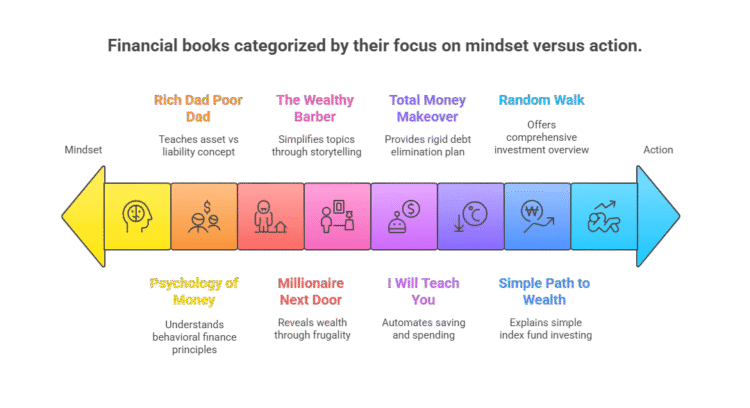
But I still would not put it in my top 10 beginner instruction books. It is stronger as a mindset provocation than as a reliable step-by-step financial system. A reader who does not yet understand budgeting, debt, diversification, taxes and risk can leave with more enthusiasm than operating instructions.
If you want the mindset reset, read it. Just pair the big ideas with more concrete, evidence-based guidance before acting on an investment or business strategy.
Personal Finance Books vs. Investing Books
Personal finance and investing overlap, but they are not the same job. This is why I moved A Random Walk Down Wall Street out of the core beginner list.
| Type | Main job | Good starting examples |
|---|---|---|
| Personal finance | Cash flow, saving, debt, credit, insurance and financial organization | I Will Teach You to Be Rich, Get Good with Money, Personal Finance For Dummies |
| Investing | Risk, diversification, asset allocation and long-term portfolio behavior | The Simple Path to Wealth; then A Random Walk Down Wall Street for more depth |
| Behavior / mindset | Decision-making, patience, lifestyle, enough and emotional control | The Psychology of Money, The Millionaire Next Door |
If investing is the next job, move to my best investing books guide. When you’re ready to stop reading and make the first real investment decision, use my how to start investing walkthrough.
Which Personal Finance Book Should You Read First?
If you want one answer from this entire list, mine is still The Psychology of Money for the widest range of beginners.
But I would override that recommendation immediately when your problem is more specific. Need basics? Start with Tyson or Siegel. Need a system? Sethi. Financial life feels scattered? Aliche. Debt is the emergency? Ramsey. Ready to invest? Collins. First-job life? Lowry.
The goal is not to finish this list. The goal is to make one better money decision, then another, until beginner finance books stop feeling like something you desperately need.
If you want one plain-English map for turning the reading into an actual plan, start with Basic Financial Planning 101. If you’ve got the basics and want a broader shelf of durable classics, compare my best finance books of all time.
Because personal finance is not a reading contest. Eventually you have to close the book and move the money.
How We Verified This Guide
I treated this as a 2026 rebuild, not a date swap. That meant checking current search intent, current editions, real beginner questions and the financial claims around debt, emergency savings and investing.
