
If Chase put a 7-day hold on your check, start with the hold notice—not with a generic “how long do checks clear?” timeline. The notice should tell you the availability date and the reason Chase is extending access to the funds.
Quick Answer
A seven-business-day hold can happen under Regulation CC exception rules or Chase’s special rules for new accounts. Large deposits, redeposited checks, repeated overdrafts, reasonable cause to doubt collectibility, and other permitted exceptions can extend availability. You usually cannot force an early release, but you can ask Chase for the exact hold reason, availability date, whether any portion is available sooner, and whether additional verification can be reviewed.
On This Page
- Key Takeaways Ahead
- Why Did Chase Put a 7-Day Hold on My Check?
- Common Reasons Chase Extends Check Holds
- Can Chase Release the Hold Early?
- What Information Should You Ask Chase For?
- Is the Hold Different From the Check Clearing?
- What If You Need the Money Before the Hold Ends?
- How to Reduce the Chance of Another Long Hold
- Chase Check Hold FAQ
- Bottom Line: Diagnose the Hold, Then Solve the Cash-Flow Problem
Key Takeaways Ahead
Why Did Chase Put a 7-Day Hold on My Check?
A hold means Chase has accepted the deposit for processing but is delaying when some or all of the money becomes available. That can happen even when the check eventually pays normally. A hold is about access to the funds; it is not proof that the check bounced.
If Chase gave you a seven-business-day availability date, use my guide to why Chase holds checks for 7 days for the exception rules, notice language, and realistic next steps.
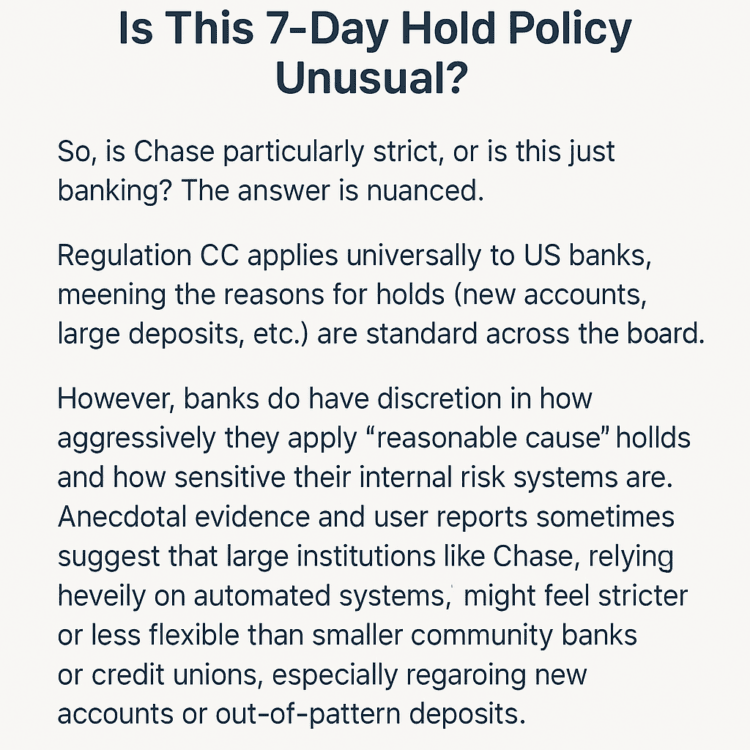
Regulation CC permits longer availability periods in defined situations. For local checks subject to an exception, the Federal Reserve describes five additional business days as a generally reasonable extension, which can create a seven-business-day total.
A longer exception hold can be reasonable in some circumstances, but the bank has the burden of establishing that.
Chase’s current Deposit Account Agreement also has special rules for accounts in their first 30 days. For certain qualifying checks, amounts above $6,725 can be available on the seventh business day; for other check deposits to a new account, Chase says funds will be available no later than the seventh business day after deposit.
Common Reasons Chase Extends Check Holds

- Large deposit: Regulation CC’s current large-deposit threshold is more than $6,725 in check deposits in one banking day; the amount over that threshold may be subject to an extended hold.
- New account: accounts open fewer than 30 days can be subject to special availability rules.
- Redeposited check: a check previously returned unpaid may qualify for an exception hold.
- Repeated overdrafts: Regulation CC allows an exception when the account meets the repeated-overdraft tests.
- Reasonable cause to doubt collectibility: the bank has specific facts creating concern the check may not be paid.
- Emergency conditions: events outside the bank’s control can delay normal processing.
Your actual Chase notice matters more than guessing which category applies. The point of this list is to help you understand the language—not to reverse-engineer a fraud model Chase does not publish.
Can Chase Release the Hold Early?
Sometimes a hold can be reviewed, but you should not assume Chase is required to release it early. The practical move is to ask whether the hold is eligible for review and whether Chase needs anything from you or the check issuer to evaluate it. A branch employee may not have authority to override a back-office or fraud-review hold.
Michael’s Rule
Do not spend the phone call arguing that the check is “obviously good.” Ask what specific fact, document or verification can change the availability decision—if anything. That gets you to the part Chase can actually act on.
What Information Should You Ask Chase For?
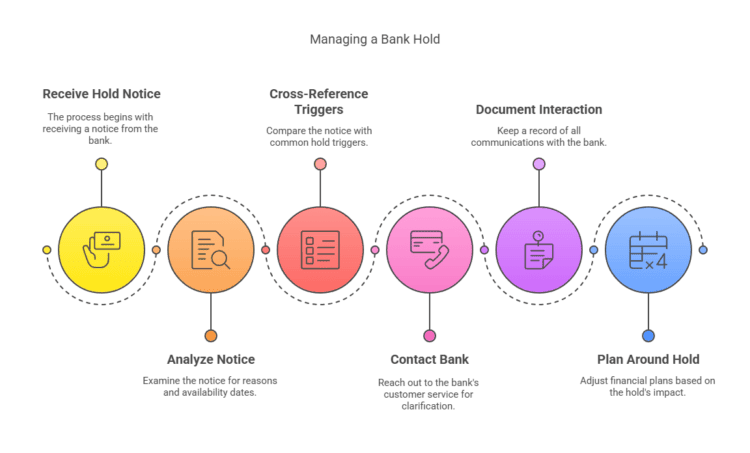
- What is the exact funds-availability date?
- What reason or policy produced this hold? Use the wording on the notice.
- Is the entire deposit held, or is part available sooner?
- Is the hold eligible for review? If yes, ask what verification or documentation Chase can consider.
- Who owns the review? If the branch cannot change it, ask which Chase team or contact path handles the decision.
Keep the hold notice and any updated availability communication. If the date or reason appears inconsistent with Chase’s disclosure, ask Chase to explain the discrepancy before escalating elsewhere.
Is the Hold Different From the Check Clearing?
Yes. This is the distinction that untangles most of the confusion:
- Funds availability: when Chase lets you use the deposited money.
- Check collection/clearing: the process of obtaining payment from the bank on which the check was drawn.
- Final payment risk: a check can still be returned unpaid after some funds were made available.
If you are trying to understand the general clearing timeline rather than a Chase-specific hold, use How Long Does It Take for a Check to Clear? If you are still at the deposit stage, use the Chase Mobile Deposit guide.
What If You Need the Money Before the Hold Ends?
A hold can become a cash-flow problem fast. The safest response is to solve the timing problem without creating a second check problem.
- Ask Chase whether any portion is already available and whether the hold can be reviewed.
- Contact the biller or payee before the due date if an essential payment will be late; ask about a short extension or payment arrangement rather than letting an automatic payment bounce.
- Use existing available funds you already control only if doing so does not create another overdraft or emergency.
- Do not deposit the same check again, cash the same deposited check elsewhere, or send money back to the check writer while the deposit is unresolved.
Avoid the “Fix” That Creates a Bigger Problem
A duplicate deposit, payday-style borrowing, or cashing the already-deposited check somewhere else can turn a temporary hold into fees, debt or a fraud investigation. Solve the bill timing first; let Chase resolve the deposit separately.
The Banking Rule Is Usually the Easy Part
The hard part is knowing what the rule means for the bill due Friday. Financial Clarity focuses on that practical gap: what changed, what matters, and what to do next without creating a second problem.
How to Reduce the Chance of Another Long Hold
- Use electronic payment when practical for trusted recurring payers. Direct deposit or another appropriate electronic method avoids the paper-check availability cycle.
- For a large or unusual check, ask about availability before relying on the money. Depositing with a banker can make the conversation easier, but it does not guarantee there will be no hold.
- Avoid repeated overdrafts. Regulation CC specifically recognizes repeated-overdraft history as an exception-hold category.
- Do not redeposit a returned check blindly. Ask the bank and issuer what changed before trying again.
Chase Check Hold FAQ
Can Chase legally hold a check for 7 business days?
Yes, depending on the deposit and account. Regulation CC permits defined exception holds, and Chase has special availability rules for new accounts. Seven business days is not a universal rule for every check.
Can Chase release a check hold early?
A hold may sometimes be reviewed, but early release is not guaranteed. Ask whether the hold is eligible for review and what verification Chase can consider.
Does a 7-day hold mean the check has not cleared?
Not exactly. The hold controls when funds are available. Check collection and final payment are related but separate processes.
What should a Chase hold notice tell me?
The key items are the reason for delayed availability and the date Chase says the funds will be available. Keep the notice and ask Chase to explain anything that does not match its stated policy.
Can a Chase mobile deposit get a 7-day hold?
Yes. Chase says mobile deposits are generally available the next business day when submitted before the cutoff, but additional review can delay availability. Once a specific hold is placed, rely on the hold notice rather than the normal mobile-deposit timeline.
Bottom Line: Diagnose the Hold, Then Solve the Cash-Flow Problem
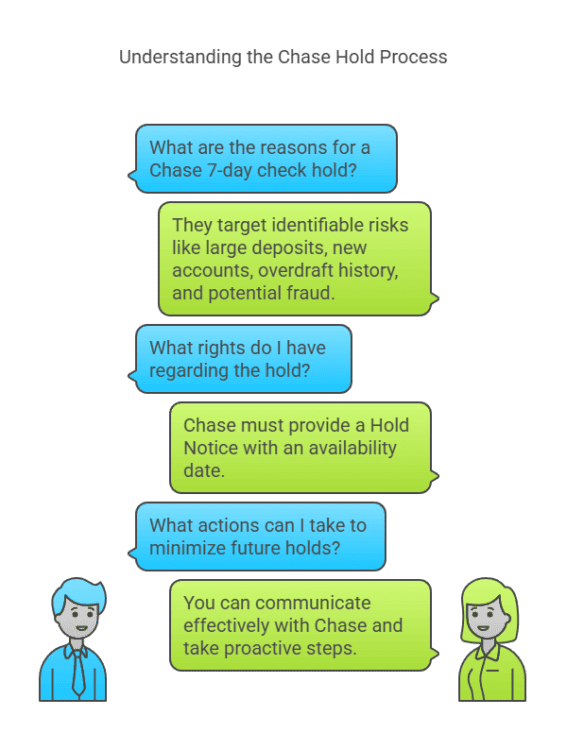
A Chase 7-day hold is not solved by memorizing one federal rule. Start with the actual notice: why is this deposit being held, and what exact date is Chase giving you? Then ask whether the hold can be reviewed and keep the clearing question separate from the funds-availability question.
