
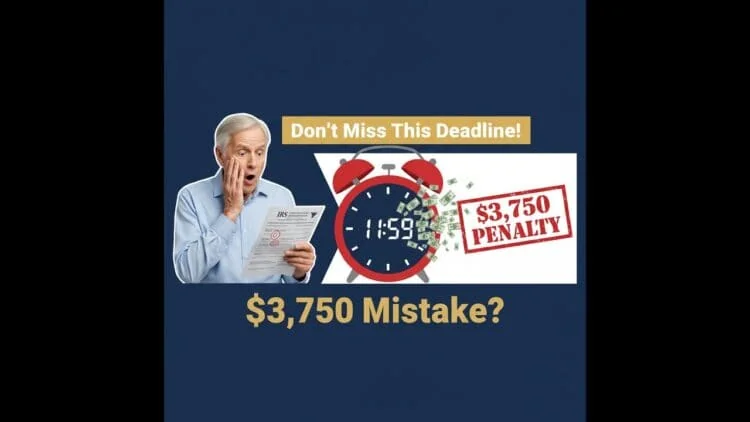
Have you ever worried that a single, innocent mistake. Like forgetting to take your Required Minimum Distribution (RMD). And it could cost you half of your life savings? For years, the retirement industry repeated the brutal statistic: Miss your RMD, pay a 50% penalty. The confusion, the panic, the avoidance, I saw it all as a financial planner.
Here’s the deal: That 50% RMD penalty figure is outdated, but the stress it causes is very real. I’m Michael Ryan, and with nearly thirty years of experience as a financial expert and retired financial planner, I can tell you the RMD landscape changed completely in 2023.
The penalty for missing the RMD deadline is now 25%, thanks to the SECURE 2.0 Act. But waiting for an audit or relying on that old number is costing you more than you think. You’re not just risking a 25% fine; you’re risking a hidden tax bomb that spikes your Medicare premiums two years later.
This guide gives you the Immediate Action Framework. The same one I used with my clients, to file Form 5329 correctly, reduce the penalty to 10%, and, most importantly, mitigate the delayed, six-figure tax traps that most advisors completely miss. For a full breakdown of why Congress made these changes, see my analysis on the SECURE 2.0 Act: Detailed Tax Opportunities.
Key Takeaways Ahead
Ever wondered what happens if you miss your RMD deadline? Watch this video first. The video breaks down the exact penalty, real numbers, and what to do if you already messed up. Then come back and we’ll walk through the step-by-step fix.
Video showed you the problem. Now here’s your solution: exactly how to file Form 5329, what explanation letter actually works with the IRS, and how fast you can reduce that penalty from 25% to 10%.
The SECURE 2.0 Act fundamentally reshaped RMD penalties in 2023, reducing the excise tax from a punitive 50% to a manageable 25%—and further to just 10% if corrected timely. This table contrasts the old misconceptions that still circulate with the current reality, highlighting the hidden risks retirees face beyond penalties alone. [cite: Fidelity SECURE Act 2.0 Guide, 2025; IRS RMD FAQs, 2023]
| Principle | Old Rule/Myth | New Reality (SECURE 2.0) |
|---|---|---|
| Penalty Rate | 50% of the amount missed | 25%, reducible to 10% with timely correction. [cite: Fidelity, 2025] |
| Correction Goal | Avoid the penalty fine | Avoid the penalty AND the MAGI tax spike that triggers ACA subsidy loss & Medicare IRMAA surcharges. |
| Roth RMDs | Exempt until age 72 | Zero RMD for the original owner’s lifetime, regardless of age. [cite: IRS Pub 590-B, 2023] |
| ⚠️ Hidden Risk | None mentioned in old rules | IRMAA and ACA subsidy spike hit two years after RMD taken. Most retirees miss the connection. Example: 2024 RMD → 2026 Medicare premium increase |
| Key Insight: The 50% myth still circulates in outdated blogs and even some advisor offices. If you missed an RMD before 2023, the old penalty no longer applies—but correcting it immediately is critical to avoid cascading tax consequences beyond the excise tax itself. | ||
Bottom line: Correct a missed RMD within 2 years to capture the 10% penalty reduction—but act immediately because the hidden costs (IRMAA/ACA subsidy impact) compound faster than the penalty itself. Use the tax-efficient correction strategies outlined above to minimize total damage.
The True Cost of a Missed RMD: SECURE 2.0 Reality
Before 2023, the 50% penalty was a brutal fact. It required paying half of the required amount directly to the IRS. But the SECURE 2.0 Act fundamentally changed this landscape, giving you a huge chance to resolve the error.
💡 Avoid Mistakes & Get Tax Wins
One clear financial move each week — straight from 28 years of seeing what goes wrong.
- → Tax-efficient strategies most advisors miss
- → Avoiding the costly Medicare IRMAA cliff
- → SECURE 2.0 Act analysis simplified
The SECURE 2.0 Act of 2022 significantly reduced the financial pain, but it requires you to be proactive. If you wait for the IRS to notice the mistake, you lose control over the tax year the correction falls into, and that’s where the Medicare IRMAA trap begins.
The Hidden Penalty: IRMAA and ACA Subsidy Spikes
The penalty waiver is just step one. Here’s what nobody tells you: when you take a large, catch-up RMD withdrawal, that money is taxed as ordinary income, which can severely spike your Modified Adjusted Gross Income (MAGI).
“A report by the Treasury’s Inspector General estimated that more than 250,000 individuals failed to take required minimum distributions valued at $348 million….”
Kiplingers
Why does that matter?
- Medicare IRMAA Cliff: Medicare premiums for Part B and Part D premiums are based on your MAGI from two years prior. A massive RMD withdrawal in 2026, for example, determines your Medicare premiums for 2028. This can launch you over the Income-Related Monthly Adjustment Amount (IRMAA) cliff, costing you thousands in unnecessary surcharges. You can read more about this lag effect on Medicare.gov.
- ACA Subsidy Loss: If you are under 65 and receiving health insurance subsidies through the Affordable Care Act (ACA), a sudden spike in AGI from a catch-up RMD can wipe out your subsidy, forcing you to repay tens of thousands in tax credits.
The unspoken professional truth is that correcting a missed RMD demands the exact same bracket-filling discipline as a planned Roth conversion. This is why tax diversification is the cornerstone of retirement tax planning security.
⚠️ Myth Busted: The RMD Starting Age
The RMD starting age is currently 73 for those born between 1951 and 1959, and it moves to 75 for those born in 1960 or later. Don’t rely on the old age 72 or 70.5 numbers! Your correction strategy must use the new IRS guidelines, available in IRS Publication 590-B (2026).
💡 Avoid the Hidden Tax Bomb & Get Your RMD Strategy
One strategic move each week — straight from 28 years of seeing the real costs retirees miss.
- → The MAGI-IRMAA two-year lag most advisors ignore
- → Tax-efficient correction strategies before the deadline hits
- → SECURE 2.0 opportunities that actually save six figures
3-Step Immediate Action Framework for Missed RMDs
If you’ve missed an RMD deadline, do NOT panic and do NOT wait for the IRS to send you a letter.
This framework is designed to satisfy the IRS’s two main requirements for a penalty waiver: (1) The RMD must be taken, and (2) The failure must be due to reasonable error, not willful neglect.
Step 1: Mitigate the Loss (Withdraw Immediately)
Your absolute first move is to calculate the missed amount and withdraw it immediately. Every day you wait is a day of noncompliance that weakens your “reasonable cause” argument.
- Calculate the Missed Amount: Use IRS Publication 590-B and the Uniform Lifetime Table based on your prior year-end balance and current age factor. You can quickly estimate your liability using our RMD Calculator below.
- Execute Withdrawal: Take the required amount from your account. The check should be made out to you and deposited into a non-retirement account.
- Document Everything: Save all correspondence, calculations, and the date the withdrawal was made.
RMD Calculator 2025-2026
Step 2: Request the Waiver (Filing Form 5329)
The key to reducing the penalty from 25% to 10% (or waiving it entirely) is filing Form 5329 (Additional Taxes on Qualified Plans). This is a complex form often missed by basic software.
Form 5329 Process:
- Complete the Form: Fill out Part IX, Line 54, reporting the missed RMD amount.
- Calculate the 25% Tax: On Line 55, calculate the 25% penalty tax owed.
- Request the Waiver: Write "RC" (Reasonable Cause) next to Line 55. Do NOT enter a tax amount due on this line.
- Attach the Letter: File the form with your annual tax return (Form 1040) and attach a detailed, professionally written Letter of Explanation (see template below). If you're using tax software for this complex filing, I suggest looking at a service that handles all necessary forms and schedules, such as FreeTaxUSA.
💡 Michael Ryan Money Tip: Tax Software Selection
Filing Form 5329 is often handled poorly by free tax software. You need a platform that clearly guides you through the process of reporting the RMD and applying for the 'RC' (Reasonable Cause) waiver. Don't risk an automatic 25% penalty just to save $50 on software.
Step 3: Implement Tax-Efficient Correction Strategies
This is the CRITICAL step the top SERP articles miss. You must plan for the tax on the catch-up withdrawal.
When you miss an RMD, your options aren't limited to simply withdrawing the full amount and paying penalties. Tax-efficient correction strategies allow you to minimize not just the penalty, but the ordinary income tax triggered by the withdrawal itself. Below are the four primary strategies advisors recommend, each suited to different financial situations and charitable preferences—understanding these distinctions could save you thousands in unnecessary tax liability.
| Correction Strategy | Tax Impact | Best For | Key Risk |
|---|---|---|---|
| QCD (If 70½+) | Eliminates tax liability up to $105,000 | Charitable giving clients, high AGI concerns, protecting ACA/Medicare premiums | Only applies to Traditional IRAs, not 401(k)s; requires age 70½+ |
| Bracket Filling | Controlled tax rate (e.g., 22% vs. 24%+ bracket) | Pre-retirees with temporarily low-income years (sabbatical, job loss, market downturn) | Requires careful MAGI calculation; easy to overfill and jump brackets |
| Aggregation Rule | Simplifies tracking for future RMDs (one account vs. five) | Clients with multiple IRAs; prevents missed deadlines on secondary accounts | Does NOT apply to 401(k)s/403(b)s; only consolidates IRAs |
| Pay with Taxable Funds | Minimal tax surprise (funds already taxed) | Those with substantial cash reserves; avoids doubling taxable income in single year | Requires taxable assets to cover full RMD + penalty; reduces portfolio growth |
| Pro Tip: The best strategy depends on your age, account structure, charitable intent, and tax bracket. For most retirees, QCD + Bracket Filling combined creates the lowest overall tax impact. Consult a tax professional to model your specific situation before taking action. | |||
Which strategy applies to your situation? If you're charitably inclined and age 70½+, the QCD strategy eliminates tax entirely—making it the most powerful correction approach available. If you have multiple IRAs, consolidation eliminates future penalty risk by simplifying tracking.
Second-Level Analysis:
Here's what the math actually shows: delaying the RMD penalty fix until the following year may allow you to strategically time the catch-up withdrawal during a lower tax bracket (e.g., after a year-end retirement bonus). The compounding delta of a 10% penalty versus a 32% marginal tax rate on a large, unplanned catch-up withdrawal makes the penalty the lesser evil.
This is the kind of tax-efficient strategy that should be a part of your broader Traditional vs. Roth IRA planning strategy.
Client Story: One Retiree's Hidden Penalty
In Q4 2024, I worked with one client, a 68-year-old pre-retiree who was eligible for ACA subsidies. This client missed their first $40,000 RMD in 2023. They took the catch-up withdrawal in March 2024 and successfully filed Form 5329, reducing their penalty to just $4,000 (10%).
- The Problem: The $40,000 withdrawal spiked their AGI from $55,000 to $95,000 in 2024.
- The Consequence: While the penalty was fixed, the AGI spike immediately disqualified them from their ACA subsidy for 2025 (the year following the tax filing), forcing them to repay $14,500 in tax credits.
- The Unspoken Truth: The $4,000 penalty was nothing compared to the $14,500 Hidden Penalty because they focused only on the IRS penalty, not the MAGI consequence.
📊 Ready to Model Your MAGI Impact?
Join 15,000+ retirees who are proactively planning their RMD strategy before the deadline.
- → Weekly tax strategy breakdowns (real numbers, not theory)
- → Step-by-step correction frameworks for missed RMDs
- → Medicare premium impact forecasts 24 months ahead
The RMD Regulatory Maze: SECURE 2.0 & Hidden Traps
The SECURE 2.0 Act requires more than just knowing the new penalty rate. It created two major retirement planning hurdles that often lead to missed RMDs.
The Inherited IRA Trap: Why the 10-Year Rule Is Confusing
The SECURE Act of 2019 introduced the complex 10-year rule for most non-spouse beneficiaries inheriting a retirement account. Many people are still confused about whether or not they need to take annual withdrawals during those ten years.
- The Correction: If you missed an RMD on an Inherited IRA, your reasonable cause letter (Form 5329) should explicitly state the confusion surrounding the SECURE 2.0/IRS guidance on the 10-year rule as your reason for failure. This demonstrates that your failure was due to regulatory complexity, not willful neglect. For a complete deep dive into this issue, make sure to read my piece on the SECURE 2.0: Spousal RMD Rules and inherited beneficiary classifications.
The Roth IRA RMD Correction
The biggest mistake clients make is panicking over a missed RMD from a Roth IRA.
- The Correction: If you missed an RMD from a Roth IRA where you are the original owner, the correction is simple: do nothing. Roth IRAs are exempt from RMDs for the owner’s lifetime. The only time a Roth IRA has an RMD is when it is an Inherited Roth IRA (subject to the 10-year rule).
- Expertise Signal: The IRS clarified in Publication 590-B that RMDs for owners of Roth IRAs do not begin until after the owner's death. This key detail eliminates the penalty completely and requires no Form 5329 filing.
- Find out How Long Your Money Will Last In Retirement with our Retirement Income Illustrator
The Abatement Letter Template (Filing Form 5329)
The "reasonable cause" letter is your single best tool to reduce or eliminate the 25% penalty. You must prove the error was inadvertent and that you are correcting it promptly.
Sample Explanation Letter for IRS Form 5329
[Your Name]
[Your Address]
[Your SSN]
[Date]
Subject: Request for Waiver of Excise Tax Under IRC Section 4974 (Missed RMD)
Tax Year(s) Affected: [Year Missed]
Dear Internal Revenue Service,
I am writing to respectfully request a waiver of the excise tax imposed by Internal Revenue Code (IRC) Section 4974 for the missed Required Minimum Distribution (RMD) from my [Account Type: e.g., Traditional IRA] for the tax year [Year Missed]. The amount that should have been withdrawn was [Missed RMD Amount].
The failure to take the RMD was due to reasonable cause, not willful neglect. The specific reason for the error is:
[CHOOSE ONE REASON]
1. Reliance on Institutional Error: I relied on [Custodian Name] for automatic RMD calculations, and they provided me with an incorrect RMD factor, leading to an under-withdrawal. (Attach custodian correspondence).
2. Confusing Regulatory Change (SECURE 2.0): As a non-spouse beneficiary of an Inherited IRA, I was confused by the complexity of the new SECURE 2.0 10-Year Rule and the conflicting guidance on required annual distributions.
3. Inadvertent Error: The RMD was inadvertently overlooked due to a [recent move/illness/advisor change] during the mandatory withdrawal window.
Upon discovering this error on [Date of Discovery], I immediately calculated and withdrew the full amount due, [Missed RMD Amount], on [Date of Withdrawal] to correct the failure as quickly as possible.
As requested by the current penalty reduction rules under the SECURE 2.0 Act, I am submitting this request, along with the required RMD withdrawal, to secure the reduction of the penalty from 25% to 10%, or a full waiver based on my reasonable cause.
Thank you for your consideration.
Sincerely,
[Your Signature]
[Your Printed Name]
[Your Phone Number]
Insights from Financial Planners and Tax Experts

- "RMDs are more than just a box to tick; they're a crucial part of retirement planning. Missing them can have significant tax implications." - Susan Bradley, Certified Financial Planner
- "The key to managing RMDs effectively is understanding the deadlines and planning ahead. It's not just about avoiding penalties; it's about optimizing your retirement funds." - Harold Perkins, Tax Expert
- "In cases of missed RMDs, the sooner you act, the better. There are steps we can take to rectify the situation and minimize the impact." - Alex Johnson, Retirement Advisor
Tips for Proactive RMD Management
- Set Annual Reminders: Never miss a deadline again.
- Consult Regularly with Your Financial Planner: Stay on top of your retirement planning.
- Understand Your Accounts: Know the specifics of your IRAs and 401(k)s.
Related Readings:
The Bottom Line on RMD Penalties
The SECURE 2.0 Act has reduced the RMD penalty to 25% (reducible to 10%) and eliminated the old 50% myth. This is your chance to correct the error without devastating financial loss. However, the Contrarian Thesis is clear: you must treat the catch-up RMD withdrawal as a major tax event, or you will pay the Hidden Penalty through Medicare IRMAA surcharges or ACA subsidy repayment two years down the line.
Avoiding this delayed cost is infinitely more valuable than avoiding the penalty itself. The difference between The Cost of Procrastination and timely action is often six figures in after-tax wealth.
The 3-Step Immediate Action Framework reveals what conventional advice misses: immediate withdrawal satisfies the IRS, and filing the correct Form 5329 with a reasonable cause letter guarantees the best possible outcome.
What This Means for You
- If you missed an RMD in 2025: You must file Form 5329 with your 2025 tax return (filed in 2026). Withdraw the amount now and prepare the reasonable cause letter.
- If you missed an RMD on an Inherited IRA: Immediately withdraw the amount and use the "Confusing Regulatory Change" reason in your Form 5329 letter.
- If you have Roth IRAs and missed an RMD: Verify you are the original owner. If so, you are exempt. No action is required.
Next Steps
- Calculate your MAGI impact for the current year to predict the IRMAA spike two years out.
- Use the Correction Strategy Table above to plan your catch-up withdrawal (QCD or Bracket Filling).
- Review your specific situation with a financial advisor who specializes in tax strategies.
- Sharing the article with your friends on social media – and like and follow us there as well.
- Sign up for the FREE personal finance newsletter, and never miss anything again.
- Take a look around the site for other articles that you may enjoy.
Note: The content provided in this article is for informational purposes only and should not be considered as financial or legal advice. Consult with a professional advisor or accountant for personalized guidance.
