

Yes, an HSA can be one of the strongest retirement accounts available—but only after you pass three gates: eligibility, liquidity, and exit planning. The tax treatment is unusually favorable. The catch is that the best long-term strategy can become a bad short-term decision if you drain your emergency cash to preserve the HSA, or keep contributing when Medicare coverage has already made you ineligible.
That is the way I would think about an HSA retirement account in 2026. First confirm that you are allowed to contribute. Then decide whether current medical bills should come from the HSA or from outside cash. Finally, plan the transition to Medicare before Part A retroactivity turns otherwise reasonable contributions into excess contributions.
Quick Answer
A Health Savings Account is a tax-advantaged account you own that can pay qualified medical expenses now or later. If you remain HSA-eligible, contributions can receive a federal tax advantage, investment earnings can grow tax-free, and distributions for qualified medical expenses can be tax-free. For 2026, the HSA contribution limit is $4,400 for self-only coverage and $8,750 for family coverage, plus a $1,000 catch-up contribution for eligible people age 55 or older. The retirement strategy works best when you can invest part of the HSA without sacrificing the cash reserves you may need before retirement.
On This Page
- Key Takeaways Ahead
- Is an HSA Really a Retirement Account?
- The 2026 HSA Eligibility Rules Changed
- Why the HSA Tax Advantage Is So Powerful
- Should You Spend the HSA Now or Invest It for Retirement?
- The Delayed-Reimbursement Strategy: Powerful, but Only With Records
- How Much Can You Contribute to an HSA in 2026?
- How to Invest an HSA Without Turning Medical Money Into Market Risk
- HSA vs. FSA: The Retirement Difference Is Ownership
- What Changes for Your HSA After Age 65?
- The Medicare 6-Month HSA Trap Is Really a Timing Problem
- Common HSA Retirement Mistakes to Avoid
- Your HSA Retirement Strategy in Five Steps
Key Takeaways Ahead
Is an HSA Really a Retirement Account?
Legally, an HSA is not a 401(k) or IRA. It is an account created under Internal Revenue Code Section 223 for eligible medical expenses. Financially, though, it can do retirement work because the money belongs to you, unused balances carry forward, and the account can remain open after you leave an employer.
The retirement angle comes from what happens when you do not need to spend every HSA dollar immediately. You can leave eligible contributions in the account, invest them if your HSA provider permits it, and potentially use the accumulated balance years later for qualified medical costs. The IRS Publication 969 explains the federal tax treatment, portability, eligibility rules, contribution limits, distributions, and recordkeeping requirements.
That does not mean “never spend the HSA.” The account is valuable precisely because it can solve two different problems: healthcare costs today and healthcare costs later. The right split depends on your cash flow, emergency reserves, medical needs, and time horizon.
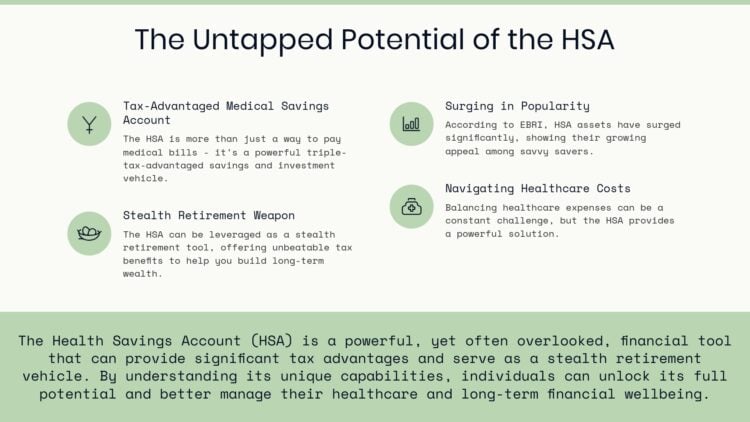
You can watch this short slideshow for a visual overview, then use the rest of this guide for the current 2026 rules and decision points.
View the HSA slideshow on Beautiful.ai
The 2026 HSA Eligibility Rules Changed
Do not assume the old “you must have a textbook HDHP” shortcut tells the whole story in 2026. The eligibility rules expanded.
Under IRS Revenue Procedure 2025-19, the standard 2026 high-deductible health plan thresholds are a minimum deductible of $1,700 for self-only coverage or $3,400 for family coverage, with maximum annual out-of-pocket expenses of $8,500 for self-only coverage or $17,000 for family coverage. The 2026 HSA contribution limits are $4,400 for self-only coverage and $8,750 for family coverage.
But a major 2026 change goes beyond those numbers. Treasury and IRS guidance on the 2026 HSA expansion says bronze and catastrophic plans of the type available through an Exchange are treated as HSA-compatible beginning January 1, 2026. IRS Notice 2026-05 clarifies that this treatment can apply whether the plan is actually purchased through an Exchange or not. The same law also allows certain direct primary care arrangements without automatically disqualifying an otherwise eligible person, subject to the statutory requirements.
- Standard HDHP route: Verify the plan meets the applicable HSA-qualified deductible and out-of-pocket rules.
- 2026 bronze/catastrophic route: A qualifying bronze or catastrophic plan can receive HSA-compatible treatment under the new rule even if it would not satisfy the ordinary HDHP definition.
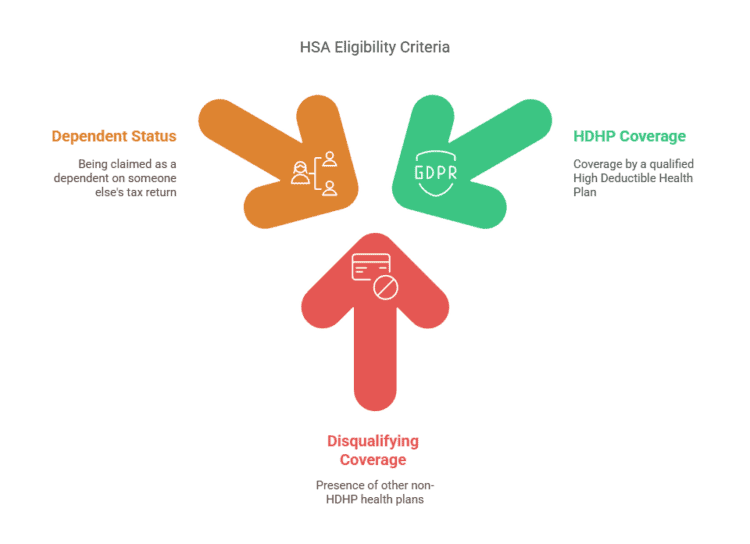
- Other coverage still matters: Disqualifying non-HDHP coverage can prevent contributions even when your primary plan otherwise qualifies.
- Medicare still matters: Once Medicare coverage begins, you are no longer eligible to contribute to an HSA.
- Dependent status still matters: A person who can be claimed as someone else’s dependent generally cannot make deductible HSA contributions for that period.
If you are choosing between health plans rather than simply evaluating an existing HSA, my guide to saving money on health insurance premiums handles that broader plan-selection decision.
Why the HSA Tax Advantage Is So Powerful
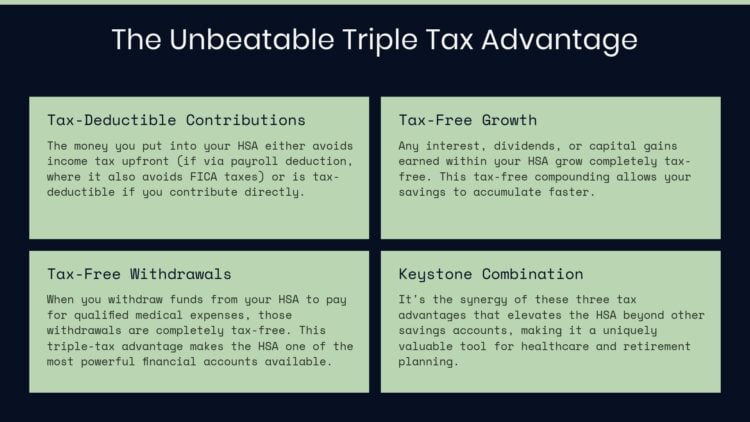
The phrase “triple tax advantage” gets repeated so often that it can become wallpaper. The useful version is more precise:
- Federal tax benefit on contributions: Eligible HSA contributions made directly can generally be deductible for federal income tax purposes. Contributions made through a qualifying employer cafeteria-plan salary reduction can generally avoid federal income tax and payroll tax.
- Tax-free growth: Interest and investment earnings inside the HSA are not included in current federal taxable income.
- Tax-free qualified distributions: HSA distributions used to pay or reimburse qualified medical expenses can be excluded from federal taxable income when the requirements are met.
That combination is why the HSA can compete with ordinary retirement accounts for dollars you truly can leave invested. A traditional retirement account generally gives you a tax break going in and taxable withdrawals later. A Roth account generally uses after-tax contributions and can provide qualified tax-free withdrawals. An HSA can potentially combine an upfront federal tax benefit with tax-free qualified medical withdrawals.
State treatment is not identical everywhere, so “triple tax-free” should not be treated as a universal state-tax promise. And payroll-tax treatment depends on how the contribution is made. Those details are exactly why I prefer the boring, accurate version over calling the HSA a magic account.
If you are deciding where the HSA belongs alongside other retirement buckets, this Roth IRA vs. 401(k) comparison gives you the neighboring account rules without turning this HSA guide into a retirement-account encyclopedia.
Should You Spend the HSA Now or Invest It for Retirement?
This is where the internet’s cleanest HSA advice often collides with real life.
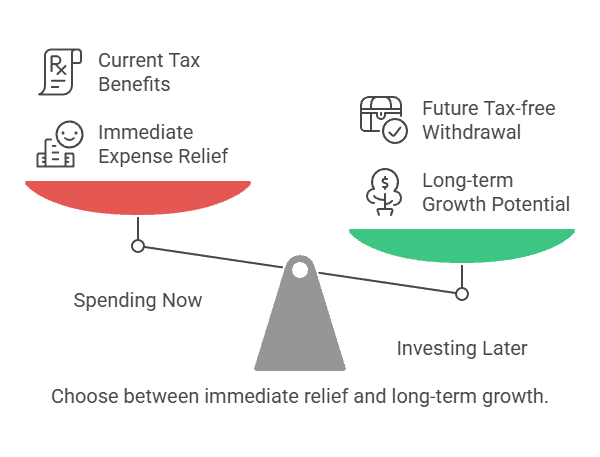
Mathematically, leaving HSA dollars invested can be attractive because the money keeps its tax-advantaged space. Operationally, that only works if paying medical bills from checking or savings does not force you into credit-card debt, leave you unable to handle the next emergency, or make you avoid care you actually need.
Michael’s Decision Rule
Do not borrow at credit-card rates or hollow out the emergency fund just to protect the HSA’s tax shelter. Tax efficiency is valuable. Liquidity is what keeps a surprise medical bill from becoming a financing problem.
The practical split is straightforward: some households can cash-flow routine expenses and leave the HSA invested; others would have to weaken their emergency reserves to do that. The tax rule does not change, but the household’s cash position changes the sensible choice.
If paying a $2,000 bill outside the HSA would leave you uncomfortably thin, using HSA funds for a qualified medical expense is not “failing” the retirement strategy. It is the account doing one of the jobs Congress designed it to do. If your cash reserves are strong, leaving the HSA invested may be more attractive. For the cash-buffer side of that decision, see how I think about building an emergency fund.
Want More Decision Rules Like This?
If “optimize the HSA” sounds different once you add cash-flow risk, that is exactly the kind of tradeoff I break down in my weekly email.
- Know when HSA tax efficiency is worth preserving—and when cash liquidity should win.
- Catch Medicare, contribution-limit, and reimbursement details before they create avoidable tax cleanup.
- Turn retirement-account rules into a short decision you can actually use.
Get the next HSA and retirement-planning check before a technically smart move becomes practically expensive.
The Delayed-Reimbursement Strategy: Powerful, but Only With Records
You do not have to reimburse yourself from the HSA in the same year you incur a qualified medical expense. That creates a useful strategy: pay an eligible expense with outside money, keep the documentation, leave the HSA invested, and reimburse yourself later.
The important part is not the cleverness. It is the paper trail. IRS Publication 969 says you must keep records showing that the HSA distribution paid or reimbursed a qualified medical expense, that the expense was not reimbursed from another source, and that you did not claim the same expense as an itemized medical deduction.
Also, the expense must have been incurred after the HSA was established. A receipt from before you had the HSA does not become reimbursable merely because you still have it.
For the underlying medical-expense definitions, IRS Publication 502 is the core federal reference. HSA rules add their own account-specific requirements, so use Publication 502 to identify the expense and Publication 969/Form 8889 to verify the HSA treatment.
A Receipt System That Can Survive 20 Years
- Save the invoice or receipt and proof of payment.
- Record the date, provider, amount, and medical-expense category.
- Store a digital copy outside the HSA provider’s platform too.
- Mark whether the expense has already been reimbursed.
- Keep a running unreimbursed total so you do not accidentally reimburse the same expense twice.
How Much Can You Contribute to an HSA in 2026?
| 2026 HSA rule | Self-only | Family |
|---|---|---|
| Annual contribution limit | $4,400 | $8,750 |
| Standard HDHP minimum deductible | $1,700 | $3,400 |
| Standard HDHP maximum out-of-pocket | $8,500 | $17,000 |
If you are age 55 or older by the end of the tax year and otherwise eligible, the additional HSA catch-up contribution remains $1,000. For married couples, each spouse who is eligible for a catch-up must make that spouse’s catch-up contribution to an HSA in that spouse’s own name.
Employer money is not “extra” room above the annual limit. Employer HSA contributions and your own eligible contributions generally share the same annual contribution ceiling. That is an easy place to overfund the account if you look only at what came out of your paycheck.
If you are HSA-eligible for only part of the year, the contribution calculation can be prorated by eligible months, subject to special rules such as the last-month rule and its testing period. That is a Form 8889 calculation—not a reason to guess from an annual maximum.
How to Invest an HSA Without Turning Medical Money Into Market Risk
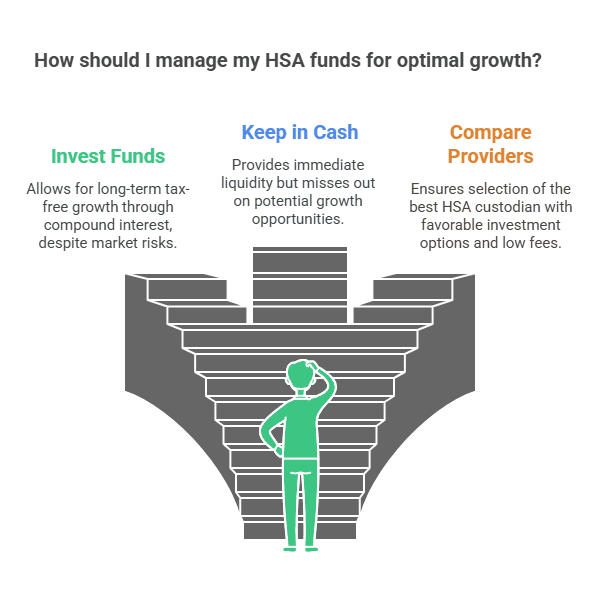
Many HSA custodians let you invest at least part of the balance, sometimes after keeping a required amount in cash. The right investment decision begins with the same liquidity question as the spending decision: How much of this HSA might you reasonably need before a market decline has time to recover?
- Near-term medical money: Keep enough readily available for expenses you expect to pay from the HSA.
- Long-horizon money: Consider diversified investments that match the risk and time horizon you would accept in another long-term account.
- Fees and investment menu: Compare administrative fees, investment expenses, cash requirements, transfer rules, and usable low-cost options.
- Do not confuse tax treatment with investment safety: An HSA investment can lose value just like the same investment held in another account.
I would not choose an HSA provider because somebody called it “the best.” The right provider is the one whose fees, investment choices, cash rules, recordkeeping, and transfer mechanics fit how you plan to use the account.
HSA vs. FSA: The Retirement Difference Is Ownership
| Feature | HSA | Health FSA |
|---|---|---|
| Who owns the account? | You own the HSA. | The arrangement is employer-sponsored. |
| Does unused money carry forward? | Yes, the balance remains yours. | Generally subject to plan-year rules; a plan may allow a limited carryover or grace period. |
| Can the balance be invested? | Often, depending on the custodian. | No comparable personal investment account. |
| Does it follow you to a new job? | Yes. | Generally no; plan and continuation rules control. |
| Retirement role | Can accumulate for future qualified medical expenses. | Primarily a current-plan-year spending arrangement. |
What Changes for Your HSA After Age 65?
Age 65 changes the penalty rules for HSA distributions; it does not make the HSA disappear.
- Qualified medical expenses: HSA distributions can still be tax-free when used for qualified medical expenses.
- Nonmedical withdrawals after 65: The 20% additional tax no longer applies, but the distribution is generally included in taxable income.
- Medicare premiums: HSA funds can generally pay certain Medicare premiums tax-free after age 65, subject to the IRS rules.
- Medigap premiums: Medigap premiums are not treated as qualified HSA medical expenses under the Medicare-premium exception.
Do not generalize the Medicare exception into “HSAs can pay all health insurance premiums in retirement.” IRS Form 8889 instructions describe the limited categories of insurance premiums that can qualify, including certain Medicare coverage after age 65, along with other statutory exceptions.
The Medicare 6-Month HSA Trap Is Really a Timing Problem
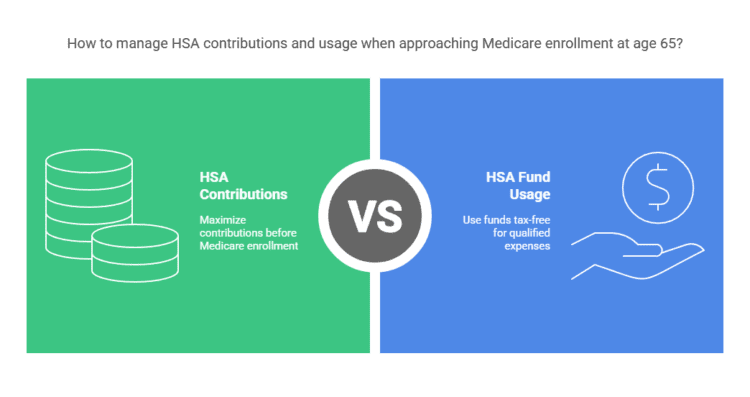
This is the exit rule I would put on the calendar, not in the back of your memory.
The 2026 Medicare & You handbook says you cannot make HSA contributions after you have Medicare. For people who delay Medicare and later enroll in premium-free Part A, Part A can begin retroactively up to six months before the application month, but not earlier than the first month of Medicare eligibility.
The Medicare Timing Trap
If you are over 65, still HSA-eligible through current employment coverage, and plan to apply for Medicare or Social Security later, the application can cause premium-free Part A to reach backward. That is the Medicare HSA six-month rule. Medicare advises people who wait at least six months after turning 65 to stop HSA contributions six months before the month they apply. Employer HSA contributions count too. The danger is not “turning 65”; it is contributing for months that later become Medicare-covered months.
If retirement, a layoff, or a Social Security filing date is uncertain, do not use a generic six-month slogan as a substitute for the actual coverage-start calculation. Check the planned Medicare and Social Security application dates, determine the Part A effective date, and calculate the HSA contribution limit for the months you remained eligible.
Common HSA Retirement Mistakes to Avoid

- Using stale annual limits. HSA contribution and HDHP thresholds change, so use the limits for the tax year you are actually funding.
- Ignoring employer contributions. Employer deposits generally use part of the same annual HSA contribution room.
- Preserving the HSA at any cost. Paying medical bills outside the HSA is not automatically smart if it causes high-interest debt or leaves your emergency reserve too thin.
- Saving receipts without a reimbursement ledger. A box of receipts is evidence, but it is not a system. Track what has and has not already been reimbursed.
- Assuming every insurance premium qualifies. HSA treatment of health insurance premiums is narrow and rule-specific.
- Waiting until Medicare enrollment to think about contributions. Retroactive Part A can change which earlier months were contribution-eligible.
- Investing money you may need soon. HSA tax advantages do not protect an invested balance from market losses.
Your HSA Retirement Strategy in Five Steps
The HSA is most useful when you stop asking whether it is “better” than every other account and give each dollar a job.
Five-Step HSA Check
- Eligibility: Confirm your 2026 plan and other coverage permit HSA contributions.
- Contribution room: Add your contributions and employer deposits before deciding what is left to fund.
- Liquidity: Decide how much HSA money needs to remain available for near-term healthcare costs.
- Long-term growth: Invest only the portion whose time horizon and risk fit long-term investing.
- Exit timing: Before Medicare or Social Security enrollment, calculate the Part A effective date and stop HSA contributions early enough to avoid excess contributions.
The “stealth retirement account” description is useful only if it helps you see the opportunity. It becomes dangerous when it makes the HSA sound like a contest to leave every dollar untouched. The better goal is simpler: use the tax shelter aggressively when your eligibility and cash flow support it, and use the medical benefit when real life needs the money.
