
Chime SpotMe can cover an eligible card purchase or cash withdrawal when your available balance is too low, without charging an overdraft fee. The catch is simple but easy to miss: fee-free does not mean consequence-free. Whatever SpotMe covers reduces the money left from a later deposit when Chime restores the negative balance.
I have used SpotMe myself, and the mechanics are genuinely convenient. The planning question is whether it stays a short bridge between deposits or quietly becomes part of every paycheck. That distinction matters more than whether your limit is $20, $75, or $200.
Michael’s Take: The Fee Is Not the Only Cost
Traditional overdraft can punish a small timing mistake with a fee. SpotMe removes that fee. It does not remove the shortfall. If you are $80 negative when $1,000 lands, you effectively begin payday with about $920 available after the negative balance is restored.
Here is the practical rule: use SpotMe as a bridge, not as a permanent extension of your paycheck. This guide shows who qualifies, what SpotMe covers, how limits and Boosts work, how repayment changes your next deposit, and what to do if using it starts to feel normal. If you are considering a lender because SpotMe is not enough, read my warning guide to payday loans that accept Chime before agreeing to a loan.
On This Page
- Chime SpotMe® Quick Check
- Key Takeaways Ahead
- What Is Chime SpotMe, and What Happens When You Use It?
- Who Qualifies for Chime SpotMe in 2026?
- How Much Can Chime SpotMe Cover?
- What Does Chime SpotMe Cover—and What Will Still Be Declined?
- The Part Most People Miss: SpotMe Shrinks What Is Left of the Next Deposit
- How SpotMe Works With the Chime Credit Builder Card
- Is Chime SpotMe a Good Deal? Use This Three-Question Test
Chime SpotMe® Quick Check
Michael Ryan’s Instant Overdraft Scenario Tool (2026)
Planner’s Pro-Tips & Key Reminders:
This is a simplified tool for illustrative purposes. Always check your Chime app for your exact SpotMe details.
document.addEventListener(‘DOMContentLoaded’,function(){ const currentBalanceInput=document.getElementById(‘sqc-current-balance’); const spotMeLimitSelect=document.getElementById(‘sqc-spotme-limit’); const transactionAmountInput=document.getElementById(‘sqc-transaction-amount’); const resultOutputDiv=document.getElementById(‘sqc-result-output’); function calculateSpotMeScenario(){ const balance=parseFloat(currentBalanceInput.value)||0; const limit=parseFloat(spotMeLimitSelect.value)||0; const transaction=parseFloat(transactionAmountInput.value)||0; let message=”,statusClass=”,tip=”; if(transaction<=0){message='Please enter a valid transaction amount.';tip='A transaction amount must be greater than zero.';resultOutputDiv.innerHTML='‘+message+’
‘+tip+’‘;resultOutputDiv.className=’sqc-result’;return;} if(balance>=transaction){const newBalance=balance-transaction;message=’✅ Transaction Covered by your balance! New balance: $’+newBalance.toFixed(2)+’.’;statusClass=’covered’;tip=”Michael’s Tip: Great job staying within your balance! This is ideal financial management.”;} else if((balance+limit)>=transaction){const spotMeUsed=transaction-balance;message=’⚠️ SpotMe to the rescue! Chime will spot you $’+spotMeUsed.toFixed(2)+’.’;statusClass=’spotme-used’;tip=”Michael’s Tip: SpotMe helped this time! Remember, it is a bridge. Your next deposit first has to refill the negative balance.”;} else{const shortfall=transaction-(balance+limit);message=”❌ Transaction Declined. You’re short by $”+shortfall.toFixed(2)+’ (even with SpotMe).’;statusClass=’declined’;tip=”Michael’s Tip: This transaction is beyond your balance and SpotMe limit. Time to reassess spending or see if a SpotMe Boost from a friend is an option for smaller amounts.”;} resultOutputDiv.innerHTML=’‘+message+’
‘+tip+’‘;resultOutputDiv.className=’sqc-result ‘+statusClass; } calculateSpotMeScenario(); currentBalanceInput.addEventListener(‘input’,calculateSpotMeScenario); spotMeLimitSelect.addEventListener(‘change’,calculateSpotMeScenario); transactionAmountInput.addEventListener(‘input’,calculateSpotMeScenario); });2026 SpotMe Rules at a Glance
- Chime describes SpotMe as fee-free overdraft coverage for eligible members.
- The standard base limit starts at $20 and may rise to $200; promotions, bonuses, or Boosts can temporarily change what the app shows.
- Chime says SpotMe covers eligible debit and credit card transactions, cash-back transactions, and ATM withdrawals.
- It does not cover Pay Anyone transfers, direct debits such as automatic bill payments, transfers to savings, Chime Checkbook transactions, or transfers to apps such as Venmo and Cash App.
- Your current eligibility and exact limit are shown in the Chime app.
Key Takeaways Ahead
What Is Chime SpotMe, and What Happens When You Use It?
SpotMe is Chime’s overdraft feature. On the debit side, Chime describes it as an optional no-fee overdraft service attached to the Chime Checking Account. On the secured credit side, the SpotMe on Credit agreement describes SpotMe on Credit as an optional no-interest, no-fee overdraft line of credit tied to the secured deposit account. Those products share a SpotMe limit when you are enrolled in both.
That distinction is worth stating because the old shorthand—“SpotMe is not a loan”—is too broad. The consumer experience can look similar either way: an eligible transaction goes through even though the applicable balance is short, up to your available SpotMe limit. But the legal structure depends on which Chime account/card is involved.
Myth: “SpotMe Is Just Free Money”
No. SpotMe can be fee-free, but the covered amount still has to be restored. Chime applies later deposits to the negative balance or amount owed. The useful comparison is not “free money versus paid money.” It is “fee-free short-term coverage versus the alternatives available for this particular cash-flow gap.”
Also, Chime itself is not a bank. It is a financial technology company; banking services are provided by The Bancorp Bank, N.A. or Stride Bank, N.A., Members FDIC. That does not change how you tap SpotMe in the app, but it is the accurate way to describe the account relationship.
Who Qualifies for Chime SpotMe in 2026?
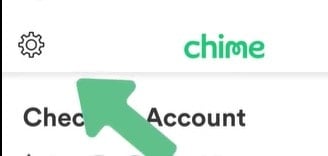
Eligibility is not simply “have a Chime account.” Chime’s current Help Center says SpotMe eligibility requires an active eligible Chime card and at least one $200-or-more qualifying direct deposit into your Chime Checking Account within the past 34 days. Chime’s broader disclosures describe the continuing requirement as $200 or more in qualifying direct deposits each month, so the safest operational check is the eligibility status shown in your app.
What Counts as a Qualifying Direct Deposit?
Chime’s terms generally treat payroll, employer, gig-economy payer, and government-benefit deposits sent by ACH—or certain gig-economy payments sent as an Original Credit Transaction—as qualifying. Transfers from another bank account, Pay Anyone transfers, trial deposits, PayPal/Cash App/Venmo transfers, mobile check deposits, cash deposits, and one-time items such as tax refunds generally do not count as qualifying direct deposits.
Fast Eligibility Check
Do not try to reverse-engineer eligibility from your last few deposits. Open the Chime app and check your current SpotMe status and limit. The app is the operational source of truth because Chime can change eligibility or limits based on account history and risk factors.
You also need an activated eligible Chime card and must enroll in SpotMe. If you still need to activate a card, see the Chime card activation guide.
How Much Can Chime SpotMe Cover?

For most eligible members, Chime says the base SpotMe limit starts at $20 and can rise to $200 based on factors such as direct deposit history and amount, membership length, account history, spending activity, and other risk factors. Chime Member Services cannot manually raise the limit.
Your exact number is personal. Reddit discussions make that uncertainty obvious: some long-time users report sitting at the same small base limit for years, while others see $5 or $10 increases after deposits. Those anecdotes are useful for understanding the frustration, but they are not a formula you can use to predict your own increase.
Do Not Budget Around a Future Limit Increase
A higher SpotMe limit is not guaranteed, and Chime says limits can change. If the app shows $40 today, build your decision around $40—not the $100 or $200 you hope to receive later.
How SpotMe Boosts Change the Limit Temporarily
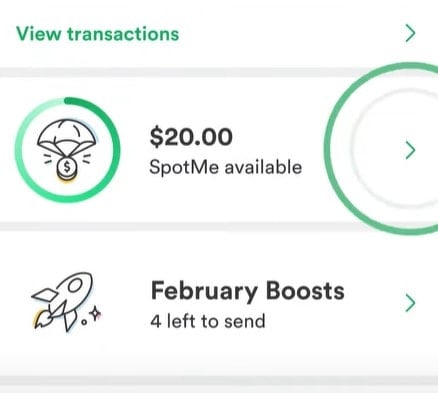
SpotMe Boosts let eligible members temporarily add $5 to another member’s SpotMe limit. Chime says Boosts refresh monthly and are subject to limits. Community “Boost-for-Boost” threads are extremely active, but a Boost is temporary overdraft capacity—not income.
A $20 Boost Still Has to Fit the Next Paycheck
If your normal SpotMe limit is $50 and friends temporarily lift it to $70, spending the full $70 does not create an extra $20 of income. It creates a $70 hole that a later deposit must refill. The Boost changes the size of the bridge, not where the bridge leads.
What Does Chime SpotMe Cover—and What Will Still Be Declined?
This is where many SpotMe misunderstandings become expensive. Chime currently says SpotMe may cover eligible debit card transactions, eligible credit card transactions, cash-back transactions, and ATM withdrawals. It does not act like a general-purpose pool of cash that can be routed anywhere.
SpotMe Does Not Cover These Common Money Moves
- Pay Anyone transfers
- Direct debits, including many automatic bill payments
- Transfers to your Chime Savings Account
- Transfers to apps such as Venmo and Cash App
- Chime Checkbook transactions
If a payment is essential—rent, utilities, insurance—confirm the transaction type before assuming SpotMe will catch it.
ATM withdrawals can be eligible for SpotMe, but “no overdraft fee” does not mean every ATM is free. Chime notes that out-of-network or third-party ATM and over-the-counter cash withdrawal fees may still apply. For broader ATM rules, use the Chime withdrawal limits guide.
If your transaction exceeds the available balance plus your SpotMe limit, Chime says the card transaction is declined and Chime does not charge an overdraft fee for that decline.
The Part Most People Miss: SpotMe Shrinks What Is Left of the Next Deposit
Chime makes repayment feel almost invisible. When money is deposited into the applicable account, Chime applies it to the negative balance or amount owed. That is convenient—but convenience can hide the cash-flow effect.
The Paycheck Compression Example
Before SpotMe: Your checking balance is $10.
You spend: $90 on an eligible purchase.
SpotMe used: $80.
Next deposit: $1,000.
Approximate amount left after restoring the negative balance: $920.
No $35 overdraft fee was added. That is valuable. But your next $1,000 deposit still has $80 less room for the bills and spending that follow.
This is the core planning insight of the entire feature. A one-time $80 bridge can be useful. An $80 bridge every pay period means your spending plan is effectively starting $80 behind every time money arrives.
Michael’s Bridge-vs.-Loop Test
Bridge: SpotMe solves an occasional timing mismatch and the next deposit comfortably resets the account.
Loop: You use SpotMe, the next deposit repays it, the smaller available paycheck creates another shortfall, and you use SpotMe again.
If you are in the loop, the problem is no longer overdraft fees. It is a recurring cash-flow deficit.
That is when I would move attention away from chasing a higher limit and toward the underlying gap. A simple spending plan and even a small emergency fund can do more for long-term stability than another $5 or $10 of overdraft capacity.
Get Better at the Decisions Between Paychecks
SpotMe is one of those tools where the rule is easy but the cash-flow consequence is easy to miss. I send practical money checks like this so you can catch the timing problem, fee trap, or “helpful” feature that is quietly changing your next move.
- Plain-English banking and cash-flow rules
- Ways to spot fee and timing traps before they hit
- Simple decision checks you can actually use
Get the next practical money check in your inbox.
How SpotMe Works With the Chime Credit Builder Card

SpotMe can also work with eligible secured Chime credit-card transactions. Chime’s current disclosures distinguish SpotMe on Debit from SpotMe on Credit, but if you are enrolled in both, the two share a single SpotMe limit.
That means a $100 displayed SpotMe limit is not necessarily $100 for debit plus another $100 for credit. It is a combined limit across the enrolled SpotMe products. The deeper mechanics of the secured card belong in the separate Chime Credit Builder and SpotMe guide.
Myth: SpotMe Itself Builds Credit
SpotMe is an overdraft feature, not a credit-building score booster by itself. Do not use SpotMe more often because you think frequent overdrafts will improve your credit. If your goal is credit building, evaluate the secured credit product on its own terms.
Is Chime SpotMe a Good Deal? Use This Three-Question Test
Compared with an overdraft program that charges $30 or more for a small shortfall, a fee-free overdraft can be meaningfully better. The Consumer Financial Protection Bureau notes that many banks and credit unions still charge $30 or more per overdraft transaction, sometimes more than once in a day. SpotMe’s lack of an overdraft fee is therefore a real benefit—not marketing trivia.
But “better than a $30 fee” is not the same as “good for every spending pattern.” I would use three questions:
- Was the shortfall temporary? A timing mismatch is different from routinely spending more than the paycheck can support.
- Will the next deposit comfortably absorb the negative balance? If repayment makes the next pay period immediately tight, the bridge is turning into a loop.
- Is the transaction actually covered? SpotMe is much more useful when you know the difference between eligible card/cash transactions and excluded direct debits or transfers.
If SpotMe Is Becoming Routine, Do This Next
For the next two pay cycles, write down three numbers: how far negative you go, how much the next deposit restores, and how many days pass before you need SpotMe again. If the same gap repeats, treat that number as a budget deficit to fix—not a SpotMe limit to increase.
I like SpotMe for what it can remove: the overdraft fee attached to a short timing mistake. I do not like pretending it removes the timing mistake itself. SpotMe can make a cash-flow bump cheaper. It cannot make a recurring cash-flow gap disappear.
Sources: Chime SpotMe; Chime disclosures; Chime: How to Use SpotMe; CFPB overdraft guidance.
