
SECURE 2.0 did not arrive all at once. Here are the rules that actually matter into 2027. And the one catch-up rule that can quietly change how your next 401(k) contribution is taxed.
The short version> 2026 is mainly a contribution-and-catch-up year for SECURE 2.0. Under the IRS 2026 retirement-plan limits, the employee deferral limit for most 401(k), 403(b), governmental 457 plans and the Thrift Savings Plan is $24,500. The standard age-50 catch-up is $8,000. If you turn 60, 61, 62 or 63 during 2026, the higher catch-up limit is $11,250.
And if your prior-year wages from the employer sponsoring your plan exceeded $150,000, catch-up contributions generally must be Roth when the plan offers a Roth feature.
Other SECURE and SECURE 2.0 rules… RMD changes, inherited IRA rules, 529-to-Roth rollovers, automatic enrollment and part-time-worker access. All started in earlier years but still affect decisions you may be making now.
Show the 30-second version
- Different SECURE and SECURE 2.0 provisions started in 2020, 2023, 2024, 2025, 2026 and later. Always check the effective year before acting.
- Most 401(k), 403(b), governmental 457 and TSP participants can defer up to $24,500 before catch-up contributions.
- The 2026 catch-up limit is $11,250 for participants who turn 60 through 63 during the calendar year, versus $8,000 for most other participants age 50 and older.
- For 2026, the Roth catch-up rule generally looks at prior-year wages from the employer sponsoring the plan. The threshold is $150,000, not your household income or current-year AGI.
- Roth workplace-plan RMDs, inherited IRA timing, 529-to-Roth transfers, automatic enrollment and part-time eligibility can affect you even though they did not all begin in 2026.
On This Page
- What Actually Changed for Retirement Savers in 2026?
- Retirement Savings Calculator
- SECURE 2.0 Timeline: Which Rules Started When?
- The 2026 Roth Catch-Up Rule, Without the Tax-Law Fog
- RMD Rules SECURE 2.0 Changed—but They Are Not New in 2026
- Inherited IRAs: The Original SECURE Act Still Matters
- 529 Rollovers, Student-Loan Matches and Other SECURE 2.0 Changes Worth Knowing
- What Should You Check in Your Retirement Plan This Year?
- Retirement Readiness Quiz
- What should you check next?
- SECURE Act 2.0 FAQs for 2026
- Bottom Line
- How We Verified This
What Actually Changed for Retirement Savers in 2026?
The easiest way to get this law wrong is to treat every SECURE 2.0 provision as a brand-new 2026 rule. It is not.
The law did not flip one switch. It set a row of timers. Some went off years ago. Some started in 2025. One of the biggest saver-facing changes becomes especially important in 2026: the Roth treatment of catch-up contributions for certain higher-paid workers.
| Your age in 2026 | Base employee deferral | Catch-up | Potential employee total |
|---|---|---|---|
| Under 50 | $24,500 | Not available | $24,500 |
| 50-59 or 64+ | $24,500 | $8,000 | $32,500 |
| 60-63 | $24,500 | $11,250 | $35,750 |
Those limits apply to most 401(k), 403(b), governmental 457 plans and the federal Thrift Savings Plan. Your plan must allow catch-up contributions, and your compensation still limits what you can contribute. SIMPLE plans have separate limits.
The age-60-to-63 enhanced catch-up itself started in 2025. What changes each year is the indexed dollar amount. For 2026, the higher catch-up remains $11,250. The standard age-50 catch-up increased to $8,000, and the base employee deferral limit increased to $24,500.
That distinction matters because a lot of summaries say “SECURE 2.0 raises the catch-up to $11,250 in 2026.” Technically, the special age band already existed in 2025. The useful 2026 question is: Which limit applies to me this year, and does my catch-up have to be Roth?
Retirement savings projection
Retirement Savings Calculator
Estimate the monthly saving needed to reach a retirement balance implied by your spending goal and assumptions.
Your entries stay in your browser and are not submitted by this tool.
Modeled monthly saving
—
—
—
—
—
Why you got this result
What to look at next
Use this estimate as one input in the larger retirement plan. Account choice, taxes, Social Security, healthcare costs, and withdrawal sequencing can all change the amount you actually need.
SECURE 2.0 Timeline: Which Rules Started When?
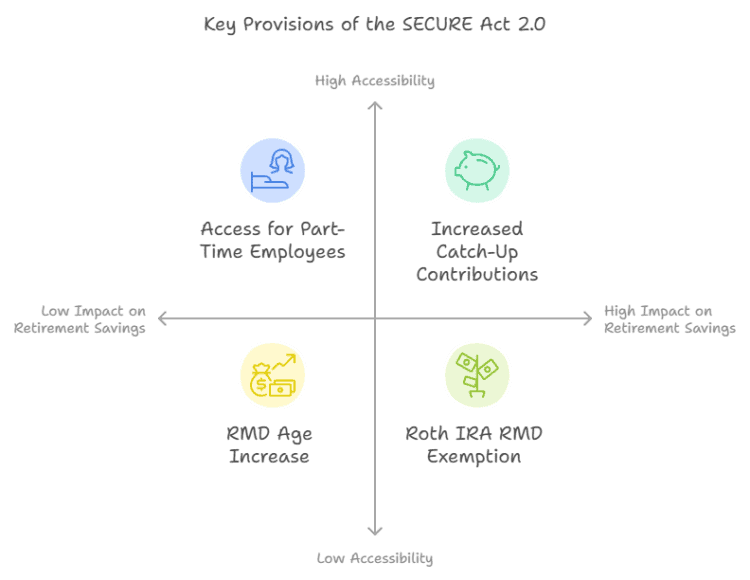
Think of SECURE 2.0 as a rollout schedule. If you know the year a provision became effective, the law gets much easier to understand.
| Effective year | Rule | Why it can matter in 2026 |
|---|---|---|
| 2024 | No pre-death RMDs from designated Roth 401(k)/403(b) accounts | You generally no longer need to move Roth workplace money to a Roth IRA just to avoid an owner RMD. |
| 2024 | Certain 529-to-Roth IRA rollovers allowed | Long-held unused 529 money may have a retirement-savings exit route, subject to strict limits. |
| 2024 | Employers may match qualified student-loan payments | A worker paying student loans may still earn a retirement-plan match if the employer adopted the feature. |
| 2025 | Higher catch-up for ages 60-63 begins | The special age band continues; the 2026 limit is $11,250 for most covered workplace plans. |
| 2025 plan years | Automatic enrollment for many newly established 401(k)/403(b) plans | Newer plans may automatically enroll eligible employees unless an exception applies; employees can still change or opt out. |
| 2025 plan years | Long-term part-time eligibility generally moves from three qualifying years to two | Some workers with two consecutive 12-month periods of at least 500 hours can become eligible to make elective deferrals. |
| 2026 | Roth catch-up requirement for certain higher-paid workers | If prior-year wages from the plan sponsor exceeded $150,000, catch-up contributions generally must be Roth when the plan offers Roth catch-ups. |
| 2033 | RMD starting age moves to 75 for later cohorts | It affects long-range withdrawal and Roth-conversion planning, but it is not a new 2026 RMD age. |
This is not every provision in the statute. It is the subset most likely to change an individual saver’s decision in 2026. Employer implementation can vary, and some provisions are optional rather than mandatory.
The 2026 Roth Catch-Up Rule, Without the Tax-Law Fog
This is the part of SECURE 2.0 most likely to surprise a high-earning worker in 2026.
Under the IRS catch-up contribution rules, if you are eligible to make catch-up contributions and your prior-year wages from the employer sponsoring the plan exceeded $150,000, your catch-up contributions generally must be made on a Roth basis when the plan has the Roth feature needed to accept them.
Three details do a lot of work in that sentence:
- Prior year: For a 2026 catch-up, the rule looks back to your 2025 wages.
- That employer: The threshold is tied to wages from the employer sponsoring the plan, not automatically your household income from every source.
- Catch-up dollars: The rule applies to catch-up contributions. It does not turn your entire 401(k) contribution into Roth money.
That last point is where people get tripped up. Your plan can hold different “sources” of money under the same account umbrella—pre-tax employee deferrals, Roth employee deferrals, employer contributions and Roth catch-up dollars. You do not need a second 401(k) just because the catch-up source is Roth.
Michael’s rule of thumb: when a retirement law changes, separate the account, the contribution source, and the tax treatment. Most of the confusion starts when those three get mashed into one label.
If your income is near the threshold or you changed employers, do not guess from your AGI. Check the wages your plan administrator is using and how your employer has implemented the rule.
RMD Rules SECURE 2.0 Changed—but They Are Not New in 2026
SECURE 2.0 changed RMD rules in meaningful ways, but calling all of them “2026 RMD changes” makes the calendar harder to understand. The current IRS RMD guidance is the controlling place to recheck deadlines and penalties.
- RMD starting age: The applicable age is 73 for many current retirees. The statutory age rises to 75 for later cohorts beginning in 2033.
- Roth workplace accounts: Pre-death RMDs for designated Roth accounts in employer plans were eliminated beginning in 2024. Original Roth IRA owners already had no lifetime RMD requirement.
- Missed-RMD excise tax: The tax is generally 25% of the shortfall, reduced to 10% when the failure is corrected within the statutory correction window and the filing requirements are met. The IRS can also waive the tax for reasonable error when the requirements for relief are satisfied.
RMDs are one area where I would rather send you to the exact tool than bury you in a giant law summary. Use the 2026 RMD calculator and multi-account planner when you need the number, and the missed-RMD correction guide if a deadline was missed.
If you have several IRAs or 403(b)s, the question of which distributions can be combined is separate again. The RMD aggregation rules explain which account categories can share a withdrawal and which cannot.
Inherited IRAs: The Original SECURE Act Still Matters
The IRS inherited-account RMD guidance makes the timeline clear: the inherited-IRA 10-year rule is important, but it is not a new SECURE 2.0 rule for 2026. It traces back to the original SECURE Act of 2019 and generally applies to many designated beneficiaries when an IRA or defined-contribution plan owner died after 2019.
There are important exceptions for certain eligible designated beneficiaries, including some surviving spouses, minor children, disabled or chronically ill beneficiaries, and beneficiaries who are not more than 10 years younger than the owner. The timing of annual distributions inside the 10-year period can also depend on the owner’s age at death and the beneficiary category.
That is exactly why I would not use a broad SECURE 2.0 article to calculate an inherited IRA withdrawal. If you inherited an account, go to the Inherited IRA RMD rules and work from the beneficiary-specific path.
529 Rollovers, Student-Loan Matches and Other SECURE 2.0 Changes Worth Knowing
Not every useful SECURE 2.0 provision is about RMDs or 401(k) catch-ups. A few earlier changes can still solve real problems in 2026.
Certain unused 529 money can move to a Roth IRA
Under IRS Topic No. 313, starting in 2024 certain long-held 529 accounts can make direct transfers to the beneficiary’s Roth IRA. The federal lifetime cap is $35,000, and the transfer is subject to the annual Roth IRA contribution limit, the 15-year account-age rule and restrictions on recent 529 contributions and earnings.
The details matter enough that this deserves its own owner. See the 529-to-Roth IRA rollover rules before moving money.
Your employer may match qualified student-loan payments
For plan years beginning after 2023, IRS guidance under SECURE 2.0 allows employers to make retirement-plan matching contributions based on qualified student-loan payments. This is optional. If you are paying student loans and skipping retirement contributions, check whether your employer adopted the feature before assuming you are leaving the entire match behind.
Many newer 401(k) and 403(b) plans must use automatic enrollment
For plan years beginning after 2024, SECURE 2.0 automatic-enrollment guidance generally requires many 401(k) and 403(b) plans established on or after December 29, 2022 to automatically enroll eligible employees, usually at an initial default rate of at least 3% and no more than 10%, with automatic escalation rules. There are statutory exceptions, including certain small, new, governmental and church plans.
Automatic enrollment is a default, not a commandment. You can generally opt out or choose a different contribution rate. The more useful question is whether the default is enough for your own plan.
Long-term part-time workers may qualify sooner
Under IRS long-term part-time guidance, for plan years beginning after 2024 the service test generally moved from three consecutive 12-month periods with at least 500 hours to two under the covered rules. This is about eligibility to make elective deferrals; it does not mean every part-time worker automatically receives the same employer contribution or vesting treatment.
There is now a federal retirement-plan Lost and Found
The Department of Labor’s Retirement Savings Lost and Found can help people search for old job-based retirement plans. If you have changed employers several times, this may be the most immediately useful SECURE 2.0 feature on the page.
What Should You Check in Your Retirement Plan This Year?
You do not need to memorize SECURE 2.0. You need to know which branch of the law touches your accounts.
- Will you be 50 or older in 2026? If yes, check whether your plan permits catch-up contributions.
- Will you turn 60, 61, 62 or 63? If yes, confirm the higher catch-up limit applies to your plan and payroll setup.
- Did 2025 wages from this plan sponsor exceed $150,000? If yes, ask how your plan is handling the Roth catch-up requirement.
- Are you subject to RMDs? Confirm the correct starting age, account type and deadline rather than using an old rule of thumb.
- Did you inherit an IRA? Treat that as a beneficiary-specific decision, not a generic 10-year countdown.
- Do you have an old 529 or forgotten employer plan? Check the 529-to-Roth rules and the federal Lost and Found before assuming the money is stuck or lost.
The best SECURE 2.0 strategy is usually not “do more.” It is identify the one rule that applies to you, then make sure payroll, beneficiaries, withdrawals and account records are set up for that rule.
Retirement Readiness Quiz
Take a quick retirement-planning check across spending, savings, income, healthcare, and implementation. The result highlights planning strengths and gaps; it does not determine whether you can afford to retire.
Your Retirement Planning Snapshot
Pieces already in place
Areas to strengthen
Useful next steps
This quiz is a general educational screening tool. It does not calculate whether you can afford to retire, predict investment results, or provide individualized financial, investment, tax, legal, Social Security, or Medicare advice.
SECURE Act 2.0 FAQs for 2026
What is the biggest SECURE 2.0 change in 2026?
For many individual savers, the biggest newly relevant 2026 change is the Roth catch-up requirement for certain higher-paid participants. The 2026 contribution limits also increased through annual cost-of-living adjustments. Several other widely discussed SECURE 2.0 provisions started in 2024 or 2025 and simply continue to matter in 2026.
Who has to make 401(k) catch-up contributions as Roth in 2026?
Generally, catch-up-eligible participants whose prior-year wages from the employer sponsoring the plan exceeded $150,000 must make catch-up contributions on a Roth basis when the plan offers the applicable Roth feature. The threshold is indexed over time, so recheck it for future years.
Does the Roth catch-up rule make my whole 401(k) Roth?
No. The requirement applies to the catch-up contribution source for covered participants. Your account can still contain multiple tax sources, including pre-tax deferrals, Roth deferrals and employer contributions, depending on your plan.
Does the $11,250 catch-up apply to a SIMPLE IRA?
No. SIMPLE plans use separate limits. For 2026, the regular SIMPLE catch-up limit is $4,000, while eligible participants who turn 60 through 63 can have a higher catch-up limit of $5,250. The standard SIMPLE salary-reduction limit is also separate from the $24,500 limit used by most 401(k), 403(b) and governmental 457 plans.
Did SECURE 2.0 change the RMD age?
Yes. The applicable RMD age is 73 for many current retirees, and the statutory age rises to 75 for later cohorts beginning in 2033. Your actual required beginning date can also depend on account type and, for some employer plans, whether you are still working.
Did SECURE 2.0 eliminate RMDs from Roth IRAs?
Original Roth IRA owners already were not subject to lifetime RMDs. SECURE 2.0 eliminated pre-death RMDs for designated Roth accounts in employer plans beginning in 2024. Beneficiary RMD rules can still apply after the owner’s death.
Is the inherited IRA 10-year rule a SECURE 2.0 rule?
No. The broad 10-year framework came from the original SECURE Act enacted in 2019. SECURE 2.0 made other retirement changes, but inherited IRA distribution rules are best analyzed under the beneficiary-specific IRS rules rather than folded into a generic 2026 checklist.
Bottom Line
SECURE 2.0 is easier to use once you stop asking, “What did the law change?” and start asking, “Which rule is active for me this year?”
For 2026, start with your age, your workplace-plan contribution limit, your 2025 wages from the plan sponsor, and whether your catch-up must be Roth. Then branch into RMD, inherited IRA, 529, automatic-enrollment or part-time rules only if they actually apply to your situation.
That keeps a 100-plus-page retirement law from becoming a 100-item personal to-do list.
How We Verified This
I checked current IRS and Department of Labor guidance on 2026 contribution limits, Roth catch-ups, RMDs, automatic enrollment, long-term part-time eligibility, student-loan matching, 529 rollovers and old-plan searches before rebuilding this guide.
