

You expected money from Venmo to be sitting in your bank account by now. It isn’t. Before you assume it vanished, figure out which Venmo money movement is actually missing.
That distinction solves a surprising amount of the confusion. A payment another person sends to your Venmo account, a transfer from your Venmo balance to your bank, and a payment funded from your bank account are three different transactions with three different clocks.
Quick Answer
If someone paid you on Venmo, check your Venmo balance first. Money received does not automatically move to your checking account. If you already transferred your Venmo balance, a free Standard transfer usually arrives within 1 business day but can take up to 3 business days. An Instant Transfer normally arrives within 30 minutes. A bank-funded person-to-person payment that is still Pending can take 3-5 business days.
On This Page
- Key Takeaways Ahead
- Why Is My Venmo Payment Not Showing Up in My Bank Account?
- First: Figure Out Which Venmo Transaction Is Missing
- Your 3-Step Fix for Missing Venmo Money
- How Long Venmo Transfers Take in 2026
- Still Missing? When to Contact Venmo or Your Bank
- The Bottom Line: Follow the Money, Not the Panic
Key Takeaways Ahead
Why Is My Venmo Payment Not Showing Up in My Bank Account?
The first question is not “How long has it been?” It is “Where is the money supposed to be right now?”
If someone sent you money, Venmo says the payment normally reaches your Venmo account right away. But according to Venmo’s bank-transfer instructions, money in your Venmo balance stays there until you spend it or transfer it to a bank or eligible debit card.
So if your friend sent you $300 and you are staring at your checking account waiting for $300 to appear, open Venmo first. If the $300 is sitting in your Venmo balance, nothing is missing. The bank transfer simply has not happened yet.
The “Someone Venmoed Me” Trap
A Venmo payment to you and a Venmo transfer to your bank are separate steps. Treating them as the same transaction is how perfectly normal money starts looking “lost.”
If the payment is not in your Venmo account either, ask the sender to open the transaction and verify the exact username, phone number, or email address they used. Venmo’s Payments & Requests FAQ specifically recommends confirming the recipient details when an expected payment has not arrived.
First: Figure Out Which Venmo Transaction Is Missing
Open Venmo, go to your personal transaction feed, and tap the transaction. You need three pieces of information before you troubleshoot anything else:
- What type of transaction was it? A payment to another Venmo user, a Standard bank transfer, or an Instant Transfer?
- What status does Venmo show? Pending, completed, failed, declined, or another status?
- Where was it sent? Confirm the last four digits of the receiving bank account or debit card.
This is the money-transfer version of checking the address before accusing the mail carrier. Waiting longer does not fix a transaction that went to the wrong destination.
Your 3-Step Fix for Missing Venmo Money
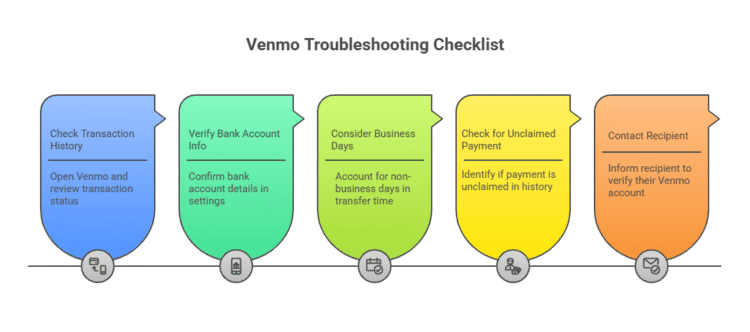
Step 1: Check the Venmo Status and Destination
Tap the transaction and verify the amount, date, status, transfer method, and destination. For bank-transfer problems, Venmo’s bank-transfer troubleshooting guidance specifically tells users to double-check the linked bank information and the last four digits.
- Pending: the money is still somewhere in the transaction process. The correct wait depends on which type of transaction it is.
- Completed: Venmo says its part of the transfer is complete. The next job is tracing the incoming transaction at the receiving bank.
- Failed or declined: stop waiting for a deposit that Venmo did not successfully send. Follow the error or support path shown for that transaction.
Watch Out: “Pending” Does Not Mean One Thing
A Pending bank-funded payment to another person is different from a Pending Standard cash-out and different again from a Pending Instant Transfer. The status word is the same; the transaction underneath it is not.
Step 2: Match It to the Correct Venmo Clock
- Standard transfer to your bank: Venmo says it typically arrives within 1 business day but can take up to 3 business days.
- Instant Transfer: Venmo says it typically arrives within 30 minutes.
- Bank-funded payment to another Venmo user: certain Pending payments can take 3-5 business days while the sender’s bank processes them.
For Standard transfers, Venmo’s current Standard Transfer FAQ says weekends and U.S. bank holidays do not count as business days. That means Friday-night timing can look much worse on a calendar than it really is in bank-processing time.
Friday-Night Example
You start a free Standard transfer Friday at 9:00 p.m. ET. Saturday and Sunday are not business days, and Venmo says a transfer started after 7:00 p.m. ET on a weekday begins processing the next business day. Monday is therefore the first processing day unless it is a U.S. bank holiday. “Three days later” on your calendar can still be only one business day into the transfer.
If bank-processing calendars regularly trip you up, the same distinction shows up with How Long For A Check Deposit: the day money is initiated, the day it becomes available, and the day you mentally expected it are not always the same day.
Banking Apps Feel Instant. The Rails Under Them Often Aren’t.
This is exactly the kind of quiet money-system detail that creates a very loud cash-flow problem. Get practical banking and money-rule updates translated into what actually changes your next move.
Step 3: Trace the Transfer at Your Bank
If Venmo shows the transfer as completed but your bank balance still looks unchanged, search for the transaction using the rail Venmo actually used.
- Standard transfer: Venmo says it should appear as an ACH deposit with the description VENMO-0 CASHOUT.
- Instant Transfer: ask the bank to look for an original credit transaction (OCT) or a real-time payment, not an ACH direct deposit.
- Check nearby statement dates: Venmo says Standard transfers can appear on a different statement date and may be back-dated by up to two days.
That wording matters. If you used Instant Transfer and tell the bank only that an “ACH deposit from Venmo” is missing, you may be asking them to search the wrong payment rail.
Michael’s Take
When money seems to disappear, separate location from timing. The transaction status and destination tell you where to look. The transfer type tells you how long the trip is supposed to take. Mixing those two questions is what turns a routine delay into a small financial crime scene in your head.
How Long Venmo Transfers Take in 2026
Standard Bank Transfer: Usually 1 Business Day, Up to 3
Venmo’s current Bank Transfer Timeline says a Standard transfer generally completes within 1 business day but can take up to 3 business days in some circumstances. A transfer initiated after 7:00 p.m. ET on a weekday starts processing the next business day; weekends and U.S. bank holidays also push the start to the next business day.
There is one useful 2026-era detail many older Venmo guides miss: Venmo says you may have a one-hour window after starting a Standard transfer in which the app offers Get it faster or Cancel it. If the option is still available, you can potentially switch to Instant Transfer instead of waiting out the Standard timeline.
Instant Transfer: Typically Within 30 Minutes
According to Venmo’s Instant Transfer FAQ, an Instant Transfer to an eligible U.S. bank account or eligible Visa, Mastercard, or Discover debit card typically arrives within 30 minutes and can be initiated 24/7/365.
The current fee is 1.75% of the transfer amount, with a $0.25 minimum and $25 maximum. “Instant” is still not a guarantee: Venmo says transfers are reviewed and can be delayed, declined, or blocked.
If 30 minutes have passed, verify the destination and check the bank statement. Venmo tells users to ask the receiving bank to search for an OCT or real-time payment if the Instant Transfer still is not visible.
Bank-Funded Venmo Payment: Pending Can Mean 3-5 Business Days
This is a different transaction entirely. Venmo’s pending-payment guidance says certain payments funded directly from a bank account can remain Pending for 3-5 business days while the bank processes them.
That is why someone can say, “Venmo took the money from my bank but the other person still hasn’t received it,” and be describing a different issue from someone who says, “I transferred my Venmo balance to my checking account and it never showed up.” Same app. Different direction. Different rail. Different fix.
If your concern changes from a delay to possible fraud—wrong recipient, account takeover, fake refund, or a stranger pressuring you to move money—stop treating it like a timing problem. My guide to protecting against Zelle, Cash App, Venmo scams covers that separate risk.
What If the Payment Is Pending Because of the Recipient?
A payment can also remain Pending when it was sent to an email address or phone number that the recipient has not verified with Venmo. In that case, waiting on ACH will not solve the problem. The recipient needs to verify the exact contact information used for the payment.
Still Missing? When to Contact Venmo or Your Bank
Once you know the transaction type, the escalation decision gets much simpler.
- Standard transfer still Pending but fewer than 3 full business days have passed: compare the estimated arrival date with the 7:00 p.m. ET cutoff, weekends, and bank holidays before escalating.
- Standard transfer shows Completed but is absent from your bank: contact the bank and ask it to search for the ACH deposit VENMO-0 CASHOUT, including nearby statement dates.
- Standard transfer is still missing after 3 full business days: contact Venmo and the bank. Venmo says incorrect bank information or a bank refusing the ACH transfer can be possible causes.
- Instant Transfer is missing after 30 minutes: contact the receiving bank and ask for an OCT or real-time payment search; then escalate to Venmo if needed.
- Person-to-person payment itself is Pending: determine whether it is a bank-funded payment still clearing or an unverified recipient-contact issue.
Have This Ready Before You Contact Support
- Your Venmo username.
- The exact amount and date.
- Whether it was Standard, Instant, or a person-to-person payment.
- The Venmo status and estimated arrival date.
- The last four digits of the receiving bank account or card.
- Screenshots of the Venmo transaction and the relevant bank statement dates.
Ask Support a Traceable Question
Instead of “Where is my money?” use: “My $___ [Standard/Instant] transfer to bank/card ending in ____ shows [Pending/Completed]. The expected arrival date was ____. Can you tell me whether Venmo still has the transfer, whether it was sent to the receiving institution, or whether it was rejected?”
For current support options, use Venmo’s official Contact Us page. Venmo also directs users with Standard-transfer problems to the in-app help path and chat support.
What If Venmo Itself Is Having a Problem?
That does happen. Recent Venmo-user discussions have included people reporting Instant Transfers or bank-funded payments stuck beyond their expected dates and receiving inconsistent support explanations. Those reports are anecdotal, not proof that Venmo is experiencing a systemwide outage at the moment you read this.
The practical lesson is simpler: if the transfer has exceeded the official window, your destination is correct, and the bank cannot locate the incoming transaction using the correct rail, you now have evidence worth escalating. “It feels late” becomes “this specific transfer exceeded Venmo’s stated timeline.” That is a much better support conversation.
The Bottom Line: Follow the Money, Not the Panic
When a Venmo payment is not showing up in your bank account, use the same three checks every time:
- Check the status and destination in Venmo.
- Identify the transaction type and apply the correct clock.
- Trace the transaction at the bank using the right payment rail.
Most “missing Venmo money” stops being mysterious once you stop treating every Venmo transaction as the same pipeline. A payment can be in Venmo but not your bank. A Standard transfer can be on time even though the weekend made it feel late. An Instant Transfer can require an OCT search instead of an ACH search. And a bank-funded friend payment can still be clearing even though the money already moved on the sender’s side.
The rule I would use is simple: do not escalate because the money feels late; escalate when the transaction has exceeded the correct official timeline and you can show exactly where the trace breaks.
