

So, the Venmo app is dangling its credit card in front of you, and you’re tempted. But before you agree to that “hard pull” on your credit report, you have one crucial question that will determine if it’s even worth it:
Am I going to get a useful credit limit, or just a token $500 that won’t even cover a grocery run?
Let’s cut through the usual “it depends” nonsense. You need real numbers to manage your expectations.
While the issuer, Synchrony Bank, has the final say, here’s the evidence-based answer: The Venmo Credit Card comes with a guaranteed minimum starting limit of $250 for anyone approved.
Planning a big purchase on your new Venmo card but worried you might hit a surprisingly low limit? You’re not alone.
However, real-world data from Credit Karma shows the average limit is a much healthier $4,159, with approvals reported as high as $30,000 for top-tier applicants.
Where you’ll land in that wide range is what we need to figure out. Let’s break down the data so you can apply with confidence.
TL;DR: Key Takeaways
- The Average Limit is Higher Than You Think: While the guaranteed minimum is just $250, with some approvals reaching as high as $30,000.
- Your FICO Score is the Key: Your approval odds and limit size are strongly tied to your credit score. The article below breaks down the specific score ranges that typically get a $2.5k, $7.5k, or $15k+ starting limit.
- You Can “Test Drive” Your Approval: The application starts with a “soft pull” that won’t hurt your credit score. This allows you to see your potential approval and limit before you commit to the hard inquiry that impacts your credit.
- It’s a Real Bank Making the Decision: The card is issued by Synchrony Bank. They care more about your credit history and income than how often you use Venmo.
What Starting Limits Are Venmo Users Actually Getting?
Forget marketing fluff. The best way to gauge your chances is to look at what real people are getting. After analyzing dozens of self-reported data points from myFICO forums and Reddit, a clear pattern emerges for the Venmo Credit Card.
| Applicant’s FICO Score | Typical Reported Starting Limit |
|---|---|
| 670 – 699 (“Fair”) | $500 – $2,500 |
| 700 – 749 (“Good”) | $2,500 – $8,500 |
| 750+ (“Excellent”) | $9,000 – $25,000+ |
Some users report truly surprising results. One applicant received a $25,000 limit, calling it their highest starting limit ever. Another, just six months after a bankruptcy discharge, was approved for $17,000, which shows Synchrony Bank heavily values income and recent credit behavior.
Read my full Venmo Credit Card Review here
The Key Factors That Synchrony Bank Cares About
As a financial planner, I can tell you that banks don’t just pull a number out of a hat. Synchrony is looking at a few key metrics to decide how much credit to extend to you.
- Your Credit Score:
This is the gatekeeper. While some users report approvals in the 640-670 range, your odds increase dramatically with a score above 670. Aiming for 700+ puts you in a much stronger position. - Your Reported Income:
This is straightforward. Higher income demonstrates a greater ability to handle payments, leading to higher limits. The average income for approved users is just over $96,000. - Your Credit Utilization:
This is the silent killer of high credit limits. It’s the percentage of your existing credit you’re currently using. If your other credit cards are maxed out, you look like a risk, and your starting limit will be lower. To improve your odds, learn how to hide your credit utilization by paying down balances before your statement closing dates.
Credit Utilization Calculator & Reporting Planner
See the two numbers that matter, separate reporting timing from real debt, and test what changes before you make a move.
Your utilization plan
Your overall ratio and your worst single card tell two different stories. Your goal determines which story matters most right now.
—
MRM planning estimate. 0-100 summarizes utilization pressure from your overall ratio, highest card, and concentration. It is not a FICO/VantageScore or a credit-score prediction.
Shaded bar is where you are now. The dark marker is where this scenario lands you.
—
The move ladder, best leverage first
Ranked by how much the ratio moves per dollar and per unit of hassle. Not every rung applies to everyone.
Your reporting deadlines
A payment only changes what gets reported if it lands before the statement closes. Money that arrives the day after does nothing for this cycle.
What the balance actually costs you
Estimated at the APR above, on today's balances, before any new purchases. Real issuer math uses average daily balance and compounds, so treat this as the neighborhood.
Card by card
The last column is the one nobody shows you: what happens to your overall ratio if you close that card once its balance is gone.
| Card | Balance | Limit | Now | After scenario | To hit target | If you closed it |
|---|
Where to send the money
Highest utilization first, which is the ratio-optimal order. If your goal is minimizing interest instead, pay the highest APR first. Those are different plans, and both are defensible.
| Card | Send this | Balance after | Utilization after |
|---|
Know somebody who is paying on the wrong day?
That is most people. Send them the image or the link. The link rebuilds this exact worksheet, with your numbers, in their browser.
Credit utilization questions people actually ask
What is a good credit utilization ratio?
Lower is better, and there is no official cutoff. FICO has published that people holding 850 scores average roughly 4.1% overall utilization, which is a long way below the 30% figure most articles repeat. A practical planning target is under 10% overall and under 30% on every individual card, with one card reporting a small balance rather than every card reporting zero.
Is 30% credit utilization actually the magic number?
No. FICO has stated directly that the data does not support the idea that a score drops the moment utilization crosses 30%. Treat 30% as the neighborhood where the effect becomes obvious, not as a line that is safe to sit on. The relationship is closer to a slope than a switch.
Why did my credit score not go up after I paid off my credit card?
Almost always timing. Your issuer reports one balance per cycle, usually the balance on your statement closing date, and that reported figure is what scoring models see. If you paid after the statement closed, the high balance was already sent. The payment shows up on the next report, not this one.
Should I pay before the statement closing date or the due date?
Both, for different reasons. Pay before the statement closing date to change the balance that gets reported. Pay at least the minimum by the due date to protect your payment history, which carries more weight than utilization. Paying the full statement balance by the due date is what keeps you out of interest.
Does credit utilization reset every month?
In most FICO versions, yes. Utilization is calculated from the most recently reported balances, and a lower ratio next cycle replaces the higher one with no lingering penalty. That is the opposite of a late payment, which sits on your report for years. VantageScore 4.0 is the exception worth knowing about: it also looks at the trend across up to 24 months, so one clean month helps less there than a sustained pattern.
Is 0% credit utilization bad?
It is usually a little worse than a small balance. FICO has noted that reporting zero across every revolving account gives the model less to work with and can keep you from the maximum points in the amounts-owed category. Letting one card report a small balance, then paying the statement in full, avoids interest and avoids the all-zero result.
Does closing a credit card hurt my credit utilization?
It can, because the card takes its credit limit with it. Your balances stay the same while your total available credit shrinks, so the ratio rises. FICO also keeps a closed account in the utilization math while it still reports a balance. An old zero-balance card can be worth keeping open when it has no costly fee and keeping it open does not create an overspending or account-management problem.
Does a credit limit increase lower my utilization?
Yes, and it moves the same math a payment moves, from the other side of the fraction. A larger limit with the same balance produces a lower ratio. The trade-offs are that some issuers run a hard inquiry for the request, and a bigger limit only helps if you do not spend into it.
Which matters more, overall utilization or one maxed-out card?
FICO looks at both your overall rate and the highest rate on individual revolving accounts. That is why a tidy-looking aggregate can still sit next to a problem: three cards at zero and one card at 95% produces a comfortable overall number and an uncomfortable individual one.
How fast does lowering utilization raise my score?
The mechanics can be fast once the lower balance is reported. Your issuer typically updates the bureaus on a cycle rather than in real time, and the new utilization can be reflected the next time a score is calculated from updated report data. Nobody can promise a specific point increase or exact timing because the rest of the credit file and the scoring model also matter.
No score prediction. This calculator estimates utilization ratios and planning scenarios. It cannot tell you whether a credit score will move, by how many points, or on what date. Different scoring models and report data can produce different outcomes.
The Utilization Health Score is ours, not FICO's. It is a 0-100 MRM planning estimate driven by your overall ratio, your worst card, and concentration. The accompanying Utilization Profile translates that estimate into plain English. Neither is a FICO/VantageScore, lender score, approval prediction, or promise of score movement.
Utilization is one input among several. In a typical FICO Score, the amounts-owed category carries about 30% of the weight, and revolving utilization is one item inside that category, not the whole thing. Payment history, derogatory marks, account age, recent activity, and credit mix all matter too.
Reported balance is not today's balance. Issuers generally report once per cycle, usually the statement balance. A payment or purchase affects a score only after it is reported and a score is recalculated from that report.
This orders payments by ratio, not by cost. A debt payoff plan may instead prioritize minimum payments, delinquent accounts, promotional-rate deadlines, or the highest APR.
Educational estimates only. Not personalized credit, lending, debt-management, legal, tax, or financial advice. Nothing you enter is transmitted anywhere; the worksheet is saved only in your own browser.
Sources and further reading
- myFICO on how FICO Scores are calculated, for the amounts-owed weighting.
- myFICO on which accounts count toward utilization, for the 4.1% figure at an 850 score, the all-zero effect, and closed-account treatment.
- myFICO on utilization targets, for the statement that the data does not support a cliff at 30%.
- VantageScore's own guide, for trended utilization over up to 24 months in version 4.0.
- Federal Reserve G.19 Consumer Credit, for the average APR on accounts assessed interest.
- On this site: the full credit-utilization guide and why the 15/3 payment hack is not required.
💡 Advisor Tip:
Your credit utilization makes up 30% of your FICO score. Before you apply for the Venmo card, pay down the balances on your other credit cards to get them below 30% utilization. This is the single fastest way to look better to the underwriting algorithm.
Important Venmo Application Details You Need to Know
The Venmo card application process has a few quirks you should be aware of.
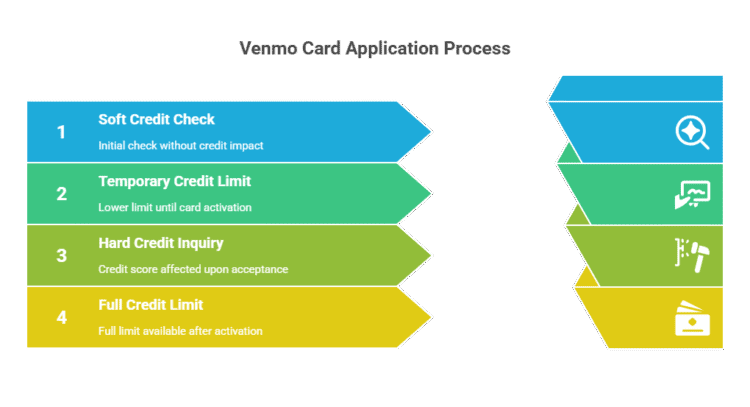
The “Soft Pull” Pre-Approval
The initial application is a soft credit check—in other words, it does NOT affect your credit score. You can see if you’re likely to be approved without any risk. Only if you accept the offer will Synchrony Bank perform a hard inquiry, which is the part that dings your score by a few points temporarily. This is a fantastic, pro-consumer feature.
The Temporary Limit Upon Approval
This is a big one that confuses people. Upon approval, you may be given a temporary, lower credit limit for immediate use within the Venmo app. One user reported getting an $8,500 approval, which showed as a $2,000 temporary limit until he received and activated the physical card a few days later. Don’t panic if this happens; your full limit will be available once the physical card is active.
Venmo Account Requirement
To apply, you must have a Venmo account that has been open and in good standing for at least 30 days. You can’t just sign up for Venmo and immediately apply for the credit card.
Got a Low Veno Limit? Here’s How to Increase It.
Look, getting a low starting limit isn’t a life sentence. It’s a starting point. I had a client, “Mark,” a 24-year-old graphic designer who was frustrated when he got approved for a Venmo card with only a $1,500 limit. We put a simple 6-month plan in place.
- He used the card for one recurring bill (his Netflix subscription) and nothing else.
- He set up autopay to pay the statement balance in full every single month.
- After six months of perfect payment history, he used the “Request Credit Limit Increase” button in the app.
The result? They bumped his limit from $1,500 to $4,000. It’s not magic; it’s just demonstrating responsible behavior over time.
Your Next Steps
Getting approved for a new card is a financial milestone. Your starting limit doesn’t define your creditworthiness—it’s just your starting line. Use the card responsibly, pay it off every month, and it will grow with you.
Want to see how your current credit habits stack up? Use our free Credit Utilization Calculator to see your ratio in seconds and find out if it’s helping or hurting your score.
Venmo Payment Not Showing Up In Bank Account
an attractive option for those who want to pay with the convenience and security of their credit card. Here are just some of the advantages:
