
A backdoor Roth IRA means making an eligible traditional IRA contribution and then converting money to a Roth IRA. It can help when your income rules out a direct Roth contribution. But before you move the money, check your other IRAs. An old rollover IRA, SEP IRA or SIMPLE IRA can make part of your conversion taxable.
Here’s where I’d start: gather your IRA statements, any earlier Forms 8606, and the dates of your transactions. The contribution tax year and the conversion calendar year can be different. That can change which year-end IRA balances matter.
On This Page
- How does a backdoor Roth IRA work in 2026?
- Which IRA balances should you check before contributing?
- How can the pro-rata rule make a backdoor Roth conversion taxable?
- Which year matters for the contribution, conversion, and December 31 balance?
- What if your existing IRA money makes the strategy expensive?
- How do you complete an ordinary backdoor Roth IRA, step by step?
- How do you report a backdoor Roth IRA on Form 8606?
- What if you already converted or discover a mistake afterward?
- What should you verify before calling your backdoor Roth complete?
How does a backdoor Roth IRA work in 2026?
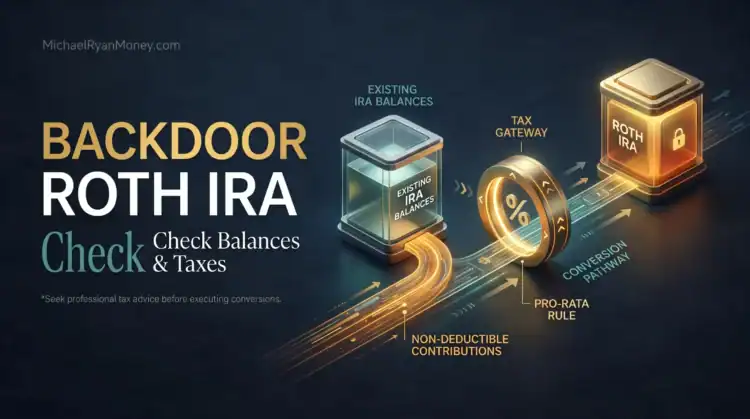
There isn’t a separate financial product called a “backdoor Roth IRA.” The term describes two regular transactions. First, if eligible, you put money into a traditional IRA and account for any nondeductible contribution as after-tax basis. Second, you convert traditional IRA money into a Roth IRA. You report the contribution and conversion according to the rules for each transaction.
For 2026, the combined annual limit for regular traditional and Roth IRA contributions is $7,500, or $8,600 if you are age 50 or older, subject to taxable compensation and other eligibility rules. Those amounts limit regular contributions, not the amount that may be converted from a traditional IRA. Your actual conversion may still be taxable. The IRS explains the 2026 limits in its 2026 retirement contribution announcement.
Who might need one instead of a direct Roth contribution?
Check whether you can contribute directly to a Roth IRA first. Direct contribution eligibility depends on modified adjusted gross income, tax-filing status, taxable compensation and the year in question. High income that restricts a direct Roth contribution does not, by itself, prohibit a Roth conversion.
A traditional IRA contribution has its own eligibility rules. Whether it is deductible may depend on income and workplace retirement plan coverage. The ordinary backdoor approach typically involves a nondeductible contribution, and the amount of the subsequent conversion that is taxable must still be determined. For the actual direct-Roth income bands, use MRM’s Roth IRA income limits guide.
The similarly named mega backdoor Roth uses a different set of employer-plan after-tax contribution and transfer rules. It is not just a larger version of these IRA steps.
Which IRA balances should you check before contributing?
Start by making an inventory, not by opening a new account. Find statements for every traditional IRA in your name, including rollover IRAs from past jobs and any SEP or SIMPLE IRAs. Look for prior Forms 8606 too. A nondeductible contribution from an earlier year may have left basis you need to carry forward.
An ordinary 401(k) balance is not the same as a traditional IRA balance for pro-rata purposes. But a former 401(k) that you rolled into a traditional IRA generally becomes part of the IRA picture. Don’t lump everything under “retirement accounts” and assume the tax treatment is interchangeable.
Before converting: follow the IRA checks
Check compensation, contribution-year limit and direct Roth eligibility.
Include prior nondeductible basis and any potential year-end amounts. A spouse’s IRA is separate.
Verify earnings, distributions, outstanding rollovers and basis before converting. Not automatic tax clearance.
Stop and calculate the potential pro-rata taxable portion. Ask whether a qualifying plan roll-in is permitted before assuming a fix.
Contribution tax year ≠ conversion calendar year. Get the December 31 IRA snapshot and check Form 8606.
This is a records preflight, not a personalized eligibility determination. SIMPLE IRAs may have additional first-two-year restrictions.
Traditional, rollover, SEP, and SIMPLE IRAs
An old rollover IRA isn’t exempt because the statement says “rollover.” SEP and SIMPLE IRA amounts also generally enter the aggregate traditional IRA calculation. A SIMPLE IRA has additional restrictions during its first two years of participation; moving money out to an unrelated plan or IRA can have consequences that a simple rollover suggestion overlooks.
The IRS’s Publication 590-A explains the contribution and rollover framework. Don’t assume a workplace plan will accept your IRA money simply because rolling certain eligible amounts into a qualified plan may be permitted under federal rules.
What if your spouse has different IRA balances?
A married couple may file one joint tax return, but their IRAs are individually owned. Your spouse’s IRA balances aren’t added to your own Form 8606 pro-rata calculation. The income and taxable compensation questions can involve household circumstances, however. Those two distinctions have to stay separate.
The separate IRA eligibility and compensation questions belong in the spousal IRA rules guide.
How can the pro-rata rule make a backdoor Roth conversion taxable?
The pro-rata rule is why moving just the recent nondeductible contribution doesn’t necessarily produce a tax-free conversion. For this calculation, the IRS generally treats basis as a portion of the relevant aggregate traditional IRA pool, rather than as dollars that you can separately select. Relevant distributions and December 31 balances enter the Form 8606 computation.
Your $7,500 conversion is not all after-tax money
Illustration: $92,500 pre-tax IRA money + $7,500 nondeductible basis; $7,500 converted; $92,500 remains on December 31. No other distributions, basis, earnings, losses or outstanding rollovers.
| Calculation | Result |
|---|---|
| Relevant IRA pool | $100,000 |
| Nondeductible basis / pool | $7,500 / $100,000 = 7.5% |
| Conversion amount | $7,500 |
| Nontaxable conversion portion | $562.50 |
| Taxable conversion portion | $6,937.50 |
Taxable portion does not mean tax bill. Actual Form 8606 inputs and state/federal taxes can change your result; use IRS instructions and your records.
The $92,500 traditional IRA and $7,500 basis example
The graphic shows $6,937.50 taxable, not $6,937.50 in tax. Your actual tax bill depends on your return. Remaining nondeductible IRA basis is tracked under Form 8606 rules.
For comparison, a spouse with the same $7,500 nondeductible contribution but no other relevant pre-tax IRA money could have a nontaxable conversion under these simplified assumptions. Filing jointly doesn’t combine their IRA balances for this calculation.
The IRS’s Form 8606 instructions govern the calculation. A different basis history, year-end balance, rollover or other IRA distribution changes the math.
Why converting only your after-tax contribution does not isolate it
Think of basis as tax accounting shared across the relevant IRA pool, not a particular set of marked dollar bills. A recently funded traditional IRA account doesn’t create a private lane that shields just those after-tax dollars from the rest of your own traditional IRA assets.
If your IRA history makes the answer complicated, MRM’s Roth conversion rules guide covers more of the broader tax treatment. But the main decision here remains straightforward: don’t presume you can choose which tax dollars are converted first.
Which year matters for the contribution, conversion, and December 31 balance?
There are two clocks. One tracks the tax year to which you assign an eligible traditional IRA contribution, sometimes made during the next calendar year before the applicable contribution deadline. The other tracks when the actual Roth conversion happens. The relevant December 31 IRA balance for Form 8606 belongs to the calendar year you convert, along with the other inputs required for the calculation.
Two clocks. One year-end IRA snapshot.
- 2025 tax year Eligible contribution designated for 2025
- March 2026 Money contributed before the applicable deadline; report nondeductible basis for 2025 as required
- May 2026 Actual Roth conversion completed in calendar 2026
- December 31, 2026 Relevant year-end IRA balances feed the 2026 pro-rata calculation
The contribution may be reported for 2025; the conversion is a 2026 event. The conversion-year IRA snapshot matters even if you contributed for an earlier tax year.
Dates are a hypothetical illustration. Actual contribution deadlines and tax forms depend on the applicable IRS year and taxpayer circumstances.
A prior-year IRA contribution converted this calendar year
You might need to review two tax returns and more than one year’s account records to verify this properly. Be careful about articles that say “do it before tax day” without distinguishing the contribution deadline from the calendar year of conversion. The exact year-specific forms and deadline extensions should be confirmed against current IRS instructions.
And don’t leave a potentially time-sensitive employer-plan rollover until the final days of December and assume it will necessarily be processed before the snapshot date. Plan acceptance and transaction completion are facts to verify, not things to infer from clicking Submit.
What if your existing IRA money makes the strategy expensive?
A partly taxable conversion isn’t automatically a bad financial decision. But it’s no longer the simple tax-free example someone may have in mind. At this point, compare what happens if you proceed and pay the applicable tax, wait while you investigate your IRA options, use another eligible savings route, or see whether an employer plan can accept a permitted rollover.
The point is to make the tax consequence a conscious choice, not a discovery on next year’s return. A broader analysis of taxable Roth conversion planning belongs in MRM’s Roth IRA conversions guide.
Can an employer plan accept eligible IRA rollover money?
Some employer plans accept rollovers of eligible otherwise-taxable IRA funds. They are not obligated to accept every IRA balance, and that kind of roll-in is not the same as moving your after-tax basis into a 401(k). The receiving plan must permit the specific source and transaction; SIMPLE IRA timing and other rules may also apply.
I would ask the plan administrator whether the plan accepts the actual kind of IRA funds you have, what documents it needs, and when the incoming rollover would be complete. Then consider whether the plan’s investments, costs, restrictions and your employment plans make that option reasonable. A permitted transfer that completes in a later calendar year cannot retroactively change a previous December 31 IRA balance.
This is a point where a tax preparer and plan administrator may need to be in the same conversation. Don’t try to fix a bad IRA snapshot using a rollover the plan has never agreed to accept.
How do you complete an ordinary backdoor Roth IRA, step by step?
Once you know what could make the conversion taxable, the mechanical steps are easier to follow. Custodians have different screens and processing times, so these are transaction stages rather than current Fidelity or Schwab button-by-button instructions.
- Check whether you are still eligible to make a direct Roth contribution. Verify the traditional IRA contribution rules, taxable compensation, annual amount and any other IRA contribution for the same year.
- Inventory your own traditional, rollover, SEP and SIMPLE IRAs and prior nondeductible basis. Confirm whether the planned conversion would produce a taxable amount. If using an employer-plan roll-in, verify it can actually be completed under the plan’s rules.
- Make an eligible traditional IRA contribution. Check that the institution records the intended tax year. A contribution isn’t automatically nondeductible merely because you call it a “backdoor.”
- Once the necessary tax facts are settled, initiate a Roth conversion through the custodian’s actual process. Document the conversion amount and completion date, including any gain or loss before transfer.
- Confirm the converted money is in the Roth IRA and invested according to your intended allocation. Cash in a settlement fund isn’t necessarily invested in the holdings you expected.
- Keep the traditional IRA contribution confirmation, conversion paperwork, relevant year-end account statements and tax forms. Reconcile the basis and taxable amount on the appropriate return rather than assuming the brokerage determined your total tax bill.
The IRS doesn’t prescribe a universal three-day holding period for every IRA conversion. Follow the custodian’s real settlement and transaction requirements. For the regular contribution amounts and conditions, see MRM’s IRA contribution limits guide.
If you can’t establish your earlier basis or the proper pro-rata amount, that’s a reason to get a qualified tax review before executing. It’s more useful than moving the money and hoping the forms sort it out later.
How do you report a backdoor Roth IRA on Form 8606?
Form 8606 is the key IRS form for reporting nondeductible traditional IRA contributions and, when applicable, figuring the taxable versus nontaxable portions of traditional IRA distributions and Roth conversions. You can successfully move the cash to your Roth account and still have an incomplete tax-reporting job.
Three forms, three different jobs
| Document | What it helps verify | What it does not prove |
|---|---|---|
| Form 8606 | Nondeductible IRA basis, applicable conversion taxable/nontaxable calculation | That the custodian executed your transactions correctly without reconciliation |
| Form 1099-R | IRA distributions/conversions reported by the payer | That the entire gross amount is taxable |
| Form 5498 | IRA contribution and related custodial reporting | That Form 8606 or a tax return has been completed; often issued after filing season |
Contribution and conversion can fall in different tax years. Match these documents with statements and the correct year-specific IRS instructions.
The IRS’s own description of Form 8606 is a better starting point than copying a tax-software screen from an old year.
What records should match Forms 1099-R, 5498, and 8606?
Save your contribution and conversion confirmations. Keep Form 1099-R, Form 5498 when issued, year-end IRA statements, and the Form 8606 you actually filed. If a contribution and conversion cross years, you may need both returns and both sets of source documents. The 2026 Form 8606 instructions may differ in presentation from earlier completed tax years, so verify the correct official version rather than assuming a specific line number always stays the same.
What if you already converted or discover a mistake afterward?
Identify which event went wrong before deciding on a repair. Maybe your original IRA contribution was ineligible or too large. Maybe you forgot an old rollover IRA when calculating the taxable conversion. Maybe you have nondeductible basis from past years that was never correctly recorded on Form 8606. Or perhaps the IRA contribution belongs to the prior tax year while your conversion happened this year.
Those situations aren’t interchangeable. In particular, an IRA-to-Roth conversion made in 2018 or later generally cannot be undone by recharacterizing it as a traditional IRA transaction. The IRS’s guidance on IRA recharacterization distinguishes that from recharacterizing an eligible regular IRA contribution, which has different rules and deadlines.
An unexpected conversion-year December 31 IRA balance does not magically disappear for that year because you roll money elsewhere in January. Gather the actual statements, confirmations and prior returns and get tax-specific advice about amended returns, excess contributions, or basis corrections where warranted. Don’t assume one generic “undo the backdoor Roth” instruction will correct every mistake.
What should you verify before calling your backdoor Roth complete?
The transfer reaching your Roth IRA is one milestone. I would consider the work properly documented only after you can explain the contribution, conversion and reporting with actual account records.
Backdoor Roth IRA record check
Before treating the work as complete, collect evidence for these checks.
- Contribution: taxable compensation, limit, filing status and contribution tax year.
- Accounts: all personally owned traditional, rollover, SEP and SIMPLE IRAs.
- Basis: prior Forms 8606 and nondeductible IRA contributions.
- Timing: conversion completion year, December 31 IRA values and other distributions.
- Optional plan roll-in: actual employer-plan acceptance and completed timing.
- Conversion: amount transferred, taxable portion and Roth investment allocation.
- Paperwork: 1099-R, 5498 and Form 8606 reconciled to the correct year.
If you cannot answer a material item, get the records or qualified tax guidance before assuming a zero-tax outcome.
If you can’t explain your taxable conversion amount from the records and Form 8606, don’t assume it’s tax-free. Get the missing statements or tax help before you call the job done.
If you meant the separate after-tax employer-plan strategy rather than an ordinary IRA backdoor, the Mega Backdoor Roth IRA guide explains the different requirements.
For ongoing plain-English retirement and tax-planning reminders, Financial Clarity Newsletter is available here. The checklist and central answer are available here without a signup.
