
If you want to know how to stop spending money, do not start by demanding more willpower from yourself. Start by figuring out what happens before the purchase. What triggered it? What story made it feel reasonable? How easy was it to buy?
After nearly three decades as a financial planner, here is the confession I wish more money professionals made. Most people who overspend already know they should spend less. The purchase makes sense in the moment. The consequence arrives later. A budget can expose that gap, but it cannot close it by itself.
Overspending often follows a loop: trigger → story → easy transaction → short-term reward → delayed consequence. To break it, make spending visible, protect important money before you can spend it, add friction where you are weakest, and make the tradeoff visible before you buy.
I have seen plenty of versions of the same problem. The income looks fine. The bills are getting paid. There may not even be obvious credit-card trouble. But somehow every month ends with almost nothing left for savings. That is still overspending. The damage is simply showing up as lost options instead of a late-payment notice.
Key Takeaways Ahead
On This Page
- How to Stop Spending Money When You Already Know Better
- The Spending Loop: Trigger, Story, Purchase, Relief
- A Planner’s Confession: Make Sure This Is Actually an Overspending Problem
- How to Stop Spending Money Without Relying on Willpower
- Match the Fix to Your Spending Trigger
- Use the 50/30/20 Calculator as a Reality Check
- 50/30/20 Budget Rule Calculator
- When Overspending Is More Than a Budgeting Problem
- Your 7-Day Spending Reset
- Turn the Reset Into a System
- How to Stop Spending Money: Frequently Asked Questions
- The Goal Is Not to Become Cheap
- How We Verified This
How to Stop Spending Money When You Already Know Better
Overspending makes more sense when you stop treating every purchase as a miniature math test. A lot of spending is trying to solve a different problem. You are bored, stressed, comparing yourself with someone else, celebrating, looking for convenience, trying to feel in control, or telling yourself you earned a reward.
At the severe end, research on compulsive buying-shopping behavior finds that buying can be used to regulate internal states and continue despite negative consequences. That does not mean ordinary impulse buying is a mental-health disorder. It does mean the short-term emotional payoff from buying is real enough that “just stop” is not much of a strategy. An expert-consensus paper on compulsive buying-shopping disorder identifies diminished control, urges, emotion regulation and continued harmful behavior among the recurring features at the severe end.
Timing makes the problem harder. The reward is now. The bill, regret or lost savings opportunity arrives later. NBER research on present bias and credit-card paydown found that short-run impatience helps explain why some consumers fail to follow their own debt-paydown plans. Shopping is not identical to debt repayment, but the mechanism is useful. Immediate rewards can beat delayed intentions.
The purchase is usually not the whole decision. It is the final click in a chain that started earlier, when you were tired, stressed, scrolling, comparing, or telling yourself a story about why this one purchase did not really count.
Social comparison is its own trigger. If you notice that your spending rises after seeing what friends, coworkers or people online are buying, my guide to keeping up with the Joneses explains that pressure in more detail.
The Spending Loop: Trigger, Story, Purchase, Relief
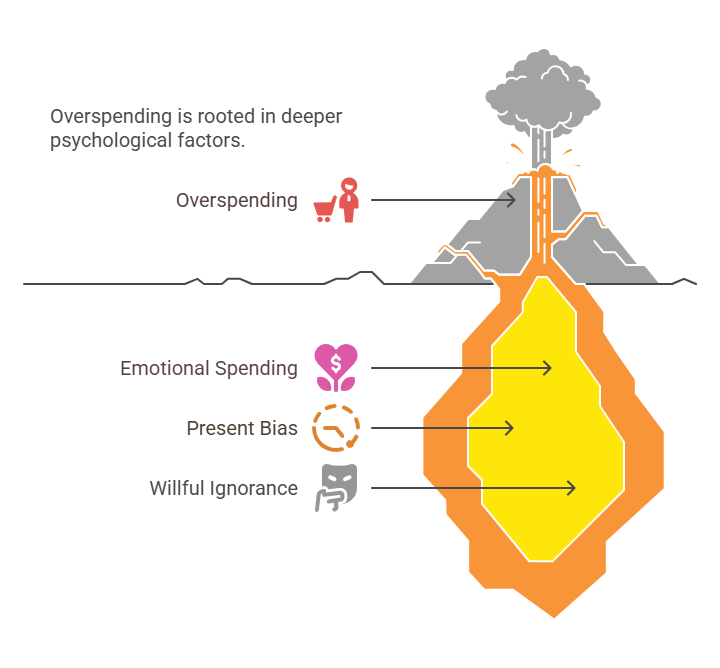
Here is the model I would put a box around:
- Trigger. Something changes your state. Stress, boredom, a sale email, scrolling, celebration, convenience or social comparison.
- Story. Your brain makes the purchase reasonable. “I deserve it.” “It is on sale.” “I will pay it off next month.” “Everyone else has one.” “This will make life easier.”
- Easy transaction. Stored cards, one-click checkout, delivery apps, saved passwords and buy-now-pay-later options remove the pause between wanting and buying.
- Short reward. You get relief, excitement, convenience, novelty, status or a temporary sense of control.
- Delayed consequence. The balance, lower savings, clutter, guilt or cash-flow squeeze shows up after the reward has faded.
The Consumer Financial Protection Bureau found a similar execution problem in its research on managing spending. People may want to control spending and may even have a budget, but the budget is not necessarily present at the moment they make the purchase. Consumers in the CFPB research showed strong interest in real-time feedback because they believed it could reduce uncertainty and help curb impulse spending. The CFPB’s managing-spending research is a useful reminder that the problem is often execution, not ignorance.
A Planner’s Confession: Make Sure This Is Actually an Overspending Problem
Early in my career, I thought the answer to overspending was mostly a better budget. Show people the categories, show them the numbers, and the behavior should follow.
That is necessary. It is not sufficient. And sometimes it is not even the main problem.
Before you call yourself an overspender, separate choice-driven spending from structural cash-flow pressure. If housing, groceries, health care, child care, transportation, minimum debt payments and other real obligations consume nearly all of your income, deleting a shopping app is not going to repair the math.
Behavior problem: Money is available, but recurring triggers and discretionary purchases keep taking it from goals you care about.
Structural problem: Essential obligations leave too little margin even when discretionary spending is reasonable.
Many households have some of both. The important part is not blaming yourself for the wrong problem.
The CFPB’s current spending-tracker guidance recommends reviewing at least a couple of weeks, and ideally a month, of spending to find surprises, unused subscriptions and patterns that no longer feel necessary. It also separates obligations from wants. That spending-tracker process is still the right financial mirror.
If the mirror shows that your basic household plan needs work, use my step-by-step guide to building a spending plan that actually works. If your main problem is that spending keeps slipping through after the plan is built, stay here. If the household numbers themselves need rebuilding, that spending-plan guide is the better next step.
How to Stop Spending Money Without Relying on Willpower
The goal is to make good decisions easier and impulsive decisions slightly more annoying. You are not trying to turn yourself into a monk. You are changing the defaults.
1. Make the spending visible before you try to cut it
Review the last 30 days of checking and credit-card activity. Do not begin by judging every line item. Mark what caused each discretionary purchase: convenience, boredom, stress, social pressure, genuine value, recurring bill, sale/FOMO or forgotten subscription.
That tells you more than labeling purchases “good” or “bad.” You are looking for the few triggers producing most of the drift.
2. Pay Future You before the spending environment gets a vote
Automate important transfers soon after income arrives. Emergency savings, retirement contributions, debt payments, sinking funds or another priority you have already chosen should not depend on what happens to be left at the end of the month.
Research on defaults in retirement plans shows why changing the environment can matter. Automatic enrollment and default contribution choices can materially change saving behavior because people do not have to remake the same decision each pay period. The exact effects come from retirement-plan settings, not shopping behavior, so I would not stretch the finding further than that. The useful lesson is simply that defaults can support intentions. The classic NBER work on 401(k) defaults documents the effect.
3. Put friction in front of your weak spots
- Delete shopping apps you open reflexively.
- Remove stored card numbers from browsers and favorite stores.
- Turn off promotional push notifications and marketing texts.
- Unsubscribe from sale emails that reliably trigger browsing.
- Use a separate debit card or checking account for discretionary spending if that makes the limit visible.
- Use a waiting period for nonessential purchases above a threshold you choose.
None of these is profound. That is the point. A useful spending system should not require a motivational speech every Tuesday.
4. Make the tradeoff visible before you buy
This is the question I would add to almost every budget:
If I buy this, what am I taking the money from?
Maybe the answer is your vacation fund, emergency savings, next car, debt payoff, investing or simply this month’s guilt-free spending. The point is to make the lost alternative visible while the purchase is still optional.
“Can I afford it?” is often too easy to answer with a credit limit. “What loses if I choose this?” forces the real tradeoff back into the room.
5. Protect some spending you genuinely value
One thing I learned from financially successful clients is that the goal was rarely to become cheap. The strongest pattern was selectivity. They could spend generously on the things they truly cared about because they were much less interested in spending on everything else.
I want a spending plan to tell you “yes, spend here” just as clearly as it tells you where to cut. Permanent deprivation is a lousy behavior-change strategy.
If you need a short, defined reset while you rebuild those boundaries, use my no-spend challenge guide. The purpose is not punishment. It is to make automatic spending visible again.
Match the Fix to Your Spending Trigger
A waiting period is useful, but it is not magic. The best intervention depends on what is actually driving the spending.
- Online impulse buying: Remove saved cards, delete shopping apps and make yourself re-enter payment information.
- Sale or scarcity FOMO: Keep a written “maybe later” list. Decide on a fixed review day instead of treating every countdown timer like an emergency.
- Stress or reward spending: Build a small intentional fun-money allowance and identify another fast reward you can use when stress is the actual problem.
- Convenience spending: Fix the recurring setup problem. Meal plan, keep a backup dinner, automate essentials or create a transportation routine before the tired version of you has to decide.
- Social comparison: Reduce the inputs that trigger comparison and ask whether you would still want the purchase if nobody else could see it.
- “I deserve it” spending: Do not argue with the desire for a reward. Decide in advance how much money is available for rewards so one rough week cannot rewrite the whole month.
If your spending is tied to deeper money scripts, guilt, scarcity or identity, my guide to your relationship with money goes further into those patterns.
Use the 50/30/20 Calculator as a Reality Check
Once you understand the behavior loop, the numbers become much more useful. The 50/30/20 framework is not a moral law and it will not fit every household. It can still show whether wants are crowding out savings or whether your essential costs are the bigger problem.
50/30/20 Budget Rule Calculator
Compare your monthly spending with the 50/30/20 budgeting guideline. The percentages are flexible reference points, not requirements.
Your Budget Snapshot
This comparison shows how your entered amounts line up with the guideline.
| Category | Guideline target | Your amount | Comparison |
|---|---|---|---|
| Needs | $0 50% | $0 0% of income | — |
| Wants | $0 30% | $0 0% of income | — |
| Savings and additional debt repayment | $0 20% | $0 0% of income | — |
Needs
Actual percentage of monthly income
Wants
Actual percentage of monthly income
Savings and debt repayment
Actual percentage of monthly income
What your numbers suggest
About the guideline: The 50/30/20 approach is a general budgeting framework, not a required allocation. Housing costs, healthcare, caregiving, debt, taxes, location, income level, and retirement circumstances can make different percentages more appropriate.
This calculator provides educational estimates based only on the amounts entered. It does not provide personalized financial, investment, tax, legal, insurance, or debt advice.
See a problem or have a suggestion? Contact Michael Ryan Money .
If the calculator shows a large gap, do not automatically cut ten categories by 5%. Go back to the loop. Find the two or three patterns producing most of the drift and redesign those first.
When Overspending Is More Than a Budgeting Problem
There is an important line between ordinary overspending and buying behavior that feels uncontrollable, repetitive, secretive or seriously damaging.
If shopping is causing major debt, relationship conflict, hidden purchases, repeated failed attempts to stop, or a feeling that buying has become your main way to regulate distress, a better spreadsheet may not be the next tool you need. Research on compulsive buying-shopping disorder describes diminished control, persistent urges, buying to regulate internal states and continued behavior despite harm. The expert-consensus research is not a self-diagnosis checklist, but it is a good reason to take severe patterns seriously.
In that situation, consider talking with an appropriate mental-health professional. If debt has become part of the problem, a reputable nonprofit credit counselor can help with the financial side. The CFPB explains what credit counselors do and how to vet one. Behavioral support and financial planning can work together.
Your 7-Day Spending Reset
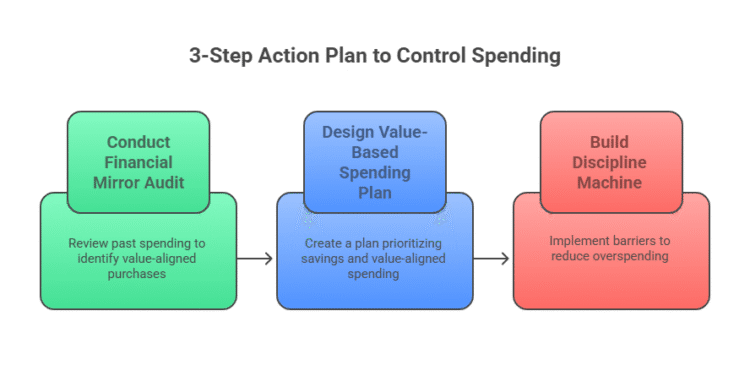
- Day 1. Audit. Review the last 30 days. Circle the five purchases you regret most and the five you value most.
- Day 2. Find the triggers. For each regret purchase, write what happened immediately before it. Stress, boredom, scrolling, sale email, convenience, social comparison or something else.
- Day 3. Remove one-click spending. Delete the saved cards, apps, notifications or email triggers tied to your biggest weak spot.
- Day 4. Automate one priority. Move one savings, debt or investing transfer closer to payday so it happens before discretionary spending.
- Day 5. Create a waiting rule. Choose a dollar threshold and waiting period for nonessential purchases.
- Day 6. Protect what you love. Pick one or two categories you genuinely value and fund them intentionally. This keeps your plan from feeling like permanent punishment.
- Day 7. Review the system. Ask what became easier, what still triggered you and which single environmental change would remove the most temptation next week.
Do the audit before you promise yourself another fresh start. If you cannot name the trigger, story and tradeoff behind your most common overspending, you are still trying to fix the symptom instead of the loop.
How to Stop Spending Money: Frequently Asked Questions
How do I train myself to stop spending money?
Do not try to train yourself with willpower alone. Track what triggers your purchases, automate priorities before discretionary spending happens, remove easy payment shortcuts and use a waiting rule for your weak spots. The goal is to make the better choice easier to repeat.
How do I stop the urge to spend?
You may not be able to eliminate every urge, and you do not need to. Create a pause between the urge and the purchase. Put the item on a list, wait, identify the trigger and ask what goal or category would lose the money if you buy it. An urge that is not instantly actionable is much easier to reconsider.
Why do I keep spending money when I know I shouldn’t?
Because knowing and doing are different jobs. Spending can deliver an immediate reward while the financial consequence is delayed. Your environment can also make buying nearly frictionless. That is why a system that changes defaults and adds friction can work better than repeatedly telling yourself to be more disciplined.
What is the simplest way to stop impulse buying online?
Remove stored payment information and promotional triggers first. Making yourself find a card, enter the number and wait before buying creates a useful pause. Then pair that friction with a written wish list or waiting rule so “not now” does not feel like “never.”
The Goal Is Not to Become Cheap
The point of controlling spending is not to prove how little you can live on. It is to stop spending money by accident so you can spend it on purpose.
That is the distinction I wish I had understood earlier as a planner. A budget is a map. It cannot drive the car for you. The real work is building a system where the route you say you want is also the easiest route to follow.
When your spending reflects your priorities instead of your triggers, saving stops being whatever happens if there is money left over.
How We Verified This
These are the authorities and references used to verify the material facts in this article.
