
A 15-minute financial wellness check-in is a short monthly review of what changed in your money, what needs attention now, and the one move you want to make before next month. It is not the time to rebuild your entire budget or recalculate every financial ratio. But… you may want to take a look at my credit utilization worksheet now.
I’ve had client conversations where the bills were paid and the income looked fine, but the month still felt like a blur. The problem was not a lack of intelligence or another missing spreadsheet. It was that nobody had stopped long enough to ask, What changed, and what do I need to fix next?
That kind of uncertainty is common. Northwestern Mutual’s 2025 Planning & Progress Study reported that 69% of U.S. adults surveyed said financial uncertainty had made them feel depressed and anxious. A monthly check-in will not magically remove money stress, but it can replace some of the vagueness with a short list of facts and a next action.
Quick Answer
Keep the monthly check-in deliberately small: scan balances and recent transactions, confirm recurring payments and savings transfers, look at cash flow, and choose one adjustment for the coming month. If your dashboard already calculates net worth or another metric, record it. If calculating the number would eat up the 15 minutes, move that work to a deeper quarterly review instead.
That monthly-versus-quarterly split matters. Fidelity’s 2026 guide to scheduled financial check-ins uses the same basic rhythm: a short monthly review for balances, transactions, unusual charges, recurring payments, spending and one small adjustment, followed by a deeper quarterly review for items such as net worth, investment strategy and broader goal progress.
The point of a monthly check-in is not to prove you can do financial homework. It is to notice drift while it is still easy to correct.
Click play for a quick overview, then use the checklist and five-step walkthrough below:
The Tools You’ll Need (The Secret to Speed)
The 15-minute limit works only if you are reviewing information that is already organized. If you spend the whole session logging into six accounts, categorizing a month of transactions, or building formulas, you are doing setup work, not a check-in.
- A financial dashboard or account list: Use whichever system you already trust to see balances and recent activity. If you use Empower Personal Dashboard, its aggregation can make the monthly review faster. A spreadsheet or another budgeting app is fine too.
- A place to record the snapshot: Write down only the few values or observations you want to compare next month.
- One calendar reminder: Pick a repeatable day near the beginning or end of the month. Consistency matters more than finding the “perfect” date.
The 15-Minute Rule
If calculating a number takes longer than reviewing the number, move that calculation to the quarterly check. Monthly is for spotting change. Quarterly is for deeper analysis.
If you want a clean baseline before you begin, use the Net Worth Calculator. Once the number is established, the monthly job can be as simple as recording the updated dashboard value and asking what moved it.
The checklist below is the action-first version of the routine. Print it or copy the four prompts somewhere you can revisit next month.
Monthly Financial Action Checklist
- Review: What changed in your balances, recent spending, or recurring charges since the last check-in?
- Track: What measurable progress did you make on the one financial goal that matters most right now?
- Automate: Did your planned savings, investment, or debt-payment transfers actually go through?
- Adjust: What known expense or change is coming next month, and what will you do about it?
Finish with one sentence: “Before my next check-in, I will ______.” Write it down or put it on your calendar.
The 5-Step, 15-Minute Financial Wellness Check-In
Set a timer for 15 minutes. Open your dashboard, account list, or worksheet. The goal is not to diagnose your entire financial life. You are looking for changes, exceptions, and one next move.
Step 1: Your Net Worth Snapshot (2 Minutes)
Net worth is your assets minus your liabilities. It is a useful balance-sheet snapshot, but it is not the same thing as your complete financial well-being. The Consumer Financial Protection Bureau’s financial well-being framework also looks at day-to-day control, resilience to a financial shock, progress toward goals, and freedom to make choices.

- Action: If your dashboard already calculates net worth, record the current number. If it does not, do not burn the monthly timer rebuilding it. Use the quarterly review to recalculate it.
- Compare: Note whether the number moved meaningfully since the last snapshot and identify the obvious reason if you know it, such as investment movement, debt paydown, a large purchase, or a cash withdrawal.
- Do not overreact: One month of market movement can change net worth without saying much about whether your financial habits improved.
Step 2: Your Savings & Automation Check (3 Minutes)
For the monthly check-in, you do not need to calculate a fresh savings rate from scratch. First confirm that the saving you intended to do actually happened.
- Check: Did your scheduled transfers, workplace retirement contributions, IRA contributions, or other savings deposits go through as expected?
- Record: If you already track a savings rate, use the same definition each month so the comparison means something. A savings rate can be defined in different ways depending on whether you use gross or take-home income and whether employer contributions are included.
- Benchmark carefully: Fidelity’s retirement guideline suggests aiming to save about 15% of pretax income for retirement, including employer contributions, but it is a planning guideline rather than a universal rule for every household.
If you need to change an IRA contribution, check the current rules before acting. My Roth IRA contribution limits guide covers the current limits and eligibility rules.
Step 3: Your Recent Spending Audit (5 Minutes)
This is the highest-attention part of the monthly check-in. Scan recent activity since your last review, but do not turn it into a forensic audit of every coffee and grocery receipt.
- Recurring charges: Is anything renewing that you no longer use or expected to cancel?
- Unusual activity: Is there a charge you do not recognize or an amount that looks wrong? If so, stop and investigate it with the card issuer or financial institution.
- Large discretionary purchases: Look at the few purchases that actually moved the month. Were they planned, useful, or likely to repeat?
If this quick scan reveals that the problem is broader than one or two transactions, move the deeper work to your Budget Worksheet rather than stretching a 15-minute check-in into a full budgeting session. If recurring subscriptions are the main issue, compare your options in my Rocket Money alternatives guide.
Step 4: Your Cash Flow Pulse (2 Minutes)
Monthly cash flow is income minus spending over the period you are reviewing. If your dashboard already summarizes it, record the result and ask why it changed.
- If cash flow was positive: Decide whether the surplus already has a job or whether some of it should be assigned to a goal.
- If cash flow was negative: Identify the main driver. One expensive month is not automatically a financial crisis, but an unexplained or repeating deficit deserves attention.
- If the numbers look wrong: Do not force a conclusion. Check whether income, transfers, reimbursements, or large one-time expenses were categorized correctly.
Step 5: Your Goal Progress Review (3 Minutes)
End with one goal, not all of them. Pick the goal that matters most right now and ask what changed this month.
- Check the balance or milestone: What measurable progress happened since the last check-in?
- Name the next action: Increase an automatic transfer, cancel a recurring charge, move cash to the right account, schedule a debt payment, or simply leave a working system alone.
- Put it on the calendar: If the action cannot happen now, schedule it before you close the check-in.
Make the Next Check-In Easier
If You Want One Useful Money Move Each Week, I’ll Send It
A monthly check-in works because it turns vague financial pressure into a few things you can actually see and fix. My weekly newsletter does the same thing between check-ins: one practical planning idea, one mistake or tradeoff worth noticing, and a clear next move when there is one.
If you want help keeping the routine simple instead of turning personal finance into another full-time job, join me below.
How often should I do a financial check-in?
For this routine, once a month is the default. A quick weekly glance at transactions can be useful if you are actively fixing a spending or fraud issue, while a deeper review of net worth, investments, and broader goals fits better quarterly or when your circumstances change.
What if my check-in takes longer than 15 minutes at first?
That usually means you are mixing setup or deeper analysis into the monthly review. Finish the time-sensitive issue, then move account setup, detailed budgeting, net-worth reconstruction, or investment review to a separate session. The monthly habit is easier to maintain when it stays small.
What should I review if I only have five minutes?
Start with recent transactions and recurring charges, then identify one issue or action that cannot wait. That gives you the best chance of catching an error, an unwanted renewal, or a spending change that needs attention before the next full check-in.
Your Next Steps to Building a Powerful Financial Habit
When the timer ends, you should be able to answer three questions: What changed? What needs attention? What am I doing next? If you can answer those, the check-in worked.
Do not confuse a short monthly pulse with comprehensive financial planning. Use the monthly check-in to catch drift and keep good systems running. Use a quarterly review when you need to recalculate net worth, examine investment strategy, revisit multiple goals, or do the kind of work that deserves more than a few hurried minutes.
Put the next check-in on your calendar now. The habit is deliberately boring, and that is part of the point. Your finances should not need a rescue mission every time you look at them.
The Financial Loose Ends Checklist: Finish One Thing This Week
Knowing what to do isn’t the same as getting it done. If your 15-minute check-in uncovered a task you keep postponing, use my three-page Financial Loose Ends Action Worksheet. It helps you find the loose end, identify what’s actually blocking it, choose an if-then next step, and check seven days later whether anything changed.
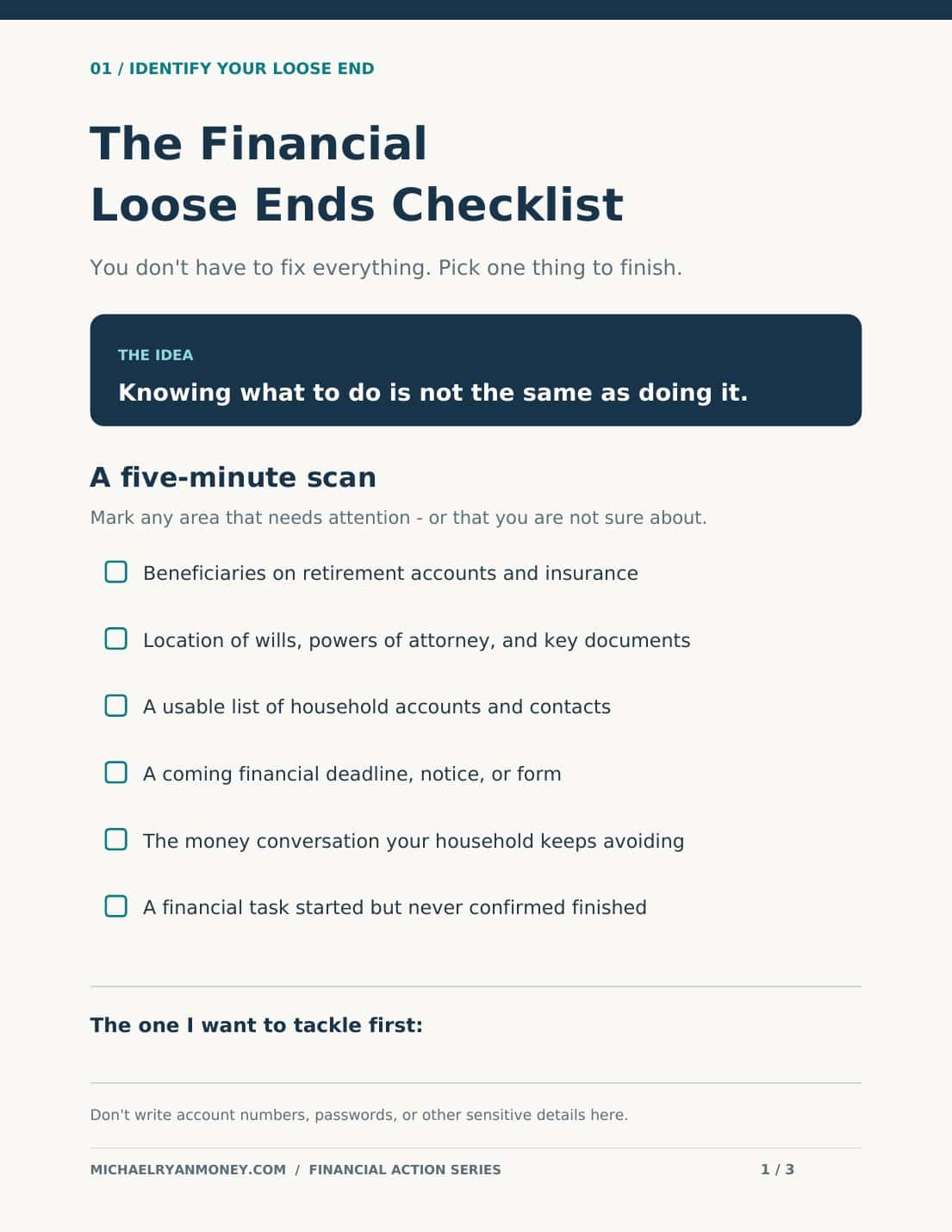
Start with one open loop, not all six. The worksheet includes room for your obstacle, first move, fallback, and confirmation date. Don’t write account numbers or passwords on it.
Get the Financial Loose Ends Action Worksheet (PDF)
Download the three-page worksheet directly: Financial Loose Ends Action Worksheet (PDF). No email address or newsletter signup required.
Sources
- Fidelity: Understanding “money dates” (January 15, 2026)
- Consumer Financial Protection Bureau: Find out your financial well-being
- Consumer Financial Protection Bureau: Why financial well-being?
- Northwestern Mutual: 2025 Planning & Progress Study
- Fidelity: How much money should I save each year for retirement?
