

Asset allocation and diversification solve two different portfolio problems. Asset allocation decides how much of your money goes into broad asset classes such as stocks, bonds, and cash. Diversification decides how widely you spread risk within and across those allocations so one company, sector, country, or type of risk does not dominate the portfolio.
That distinction sounds academic until you see the trap: two investors can both have an 80% stock / 20% bond allocation, while one is broadly diversified and the other has most of the stock side riding on a handful of similar companies. Same allocation. Very different concentration risk.
Investor.gov makes the same distinction: allocation divides a portfolio among asset categories, while diversification spreads money among different investments to reduce risk. The useful question for you is not which concept wins. It is whether both are doing their jobs.
Show the 30-second version
On This Page
- What Is the Difference Between Asset Allocation and Diversification?
- How Does Asset Allocation Work?
- How Does Diversification Work?
- Can the Same Asset Allocation Have Different Diversification?
- Does Owning More Funds Mean You’re More Diversified?
- How Do Asset Allocation and Diversification Work Together?
- What Should You Diversify?
- How Much Diversification Is Enough?
- Where Does Security Selection Fit?
- Choose your next portfolio question
- What Does Rebalancing Change?
- Bottom Line
What Is the Difference Between Asset Allocation and Diversification?
Asset allocation is about percentages. Diversification is about concentration.
If you decide that 70% of a portfolio should be in stocks, 25% in bonds, and 5% in cash, you have made an asset allocation decision. You have chosen the broad risk buckets and their weights.
If you then decide how that 70% stock allocation is spread among companies, sectors, market sizes, and countries—and how the bond allocation is spread among issuers, maturities, and credit exposures—you are making diversification decisions.
| Question | Asset allocation | Diversification |
|---|---|---|
| What does it decide? | How much goes into each broad asset class | How broadly risk is spread across and within those classes |
| Typical example | 60% stocks / 40% bonds | Many companies, sectors, regions, and bond issuers rather than a few concentrated bets |
| Main problem it addresses | Portfolio-level risk and return mix | Concentration in a particular holding or source of risk |
How Does Asset Allocation Work?
Asset allocation starts with your goal, time horizon, and tolerance for loss and volatility. The mix that makes sense for money you may need in a few years can be very different from the mix for money you will not touch for decades.
The point is not to find a universally perfect stock/bond percentage. There is no such number. The point is to choose a mix whose expected risk characteristics fit the job the money needs to do—and that you can realistically stick with when markets stop being polite.
Investor.gov specifically identifies time horizon and risk tolerance as central inputs to asset-allocation decisions. That is why generic age formulas can be a starting thought, but not a complete financial plan.
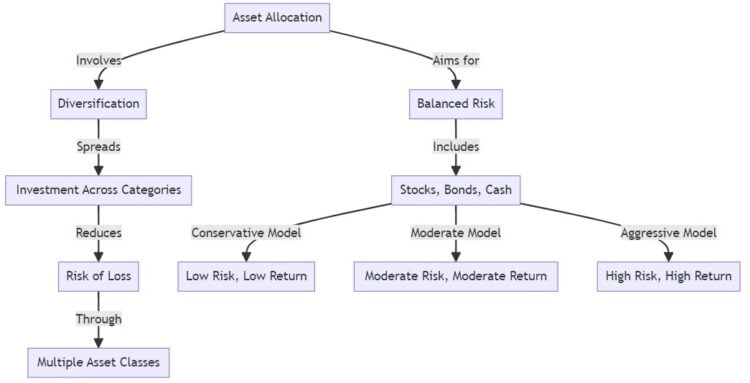
One practical check I have used for years is simpler than another spreadsheet: imagine the ugly market, not the average market. If the normal bad stretch would make you abandon the allocation entirely, the plan may be more aggressive than your real-world tolerance can handle. That is a behavioral check on allocation—not a formula for what percentage of stocks you personally should own.
How Does Diversification Work?
Diversification reduces your dependence on any one investment or narrow source of risk. It can happen at two levels:
- Across asset classes: owning more than one kind of asset, such as stocks and bonds, rather than relying on one category alone.
- Within an asset class: spreading a stock allocation across different companies, industries, company sizes, or regions instead of concentrating it in a few names or one theme.
Investor.gov explicitly warns that even mutual funds and ETFs are not automatically diversified. A narrowly focused sector fund can still leave you concentrated, and owning several funds does not help much if their top holdings are largely the same.
Diversification also has limits. It cannot guarantee a profit or prevent losses when broad markets fall. Its job is narrower and more useful: reduce the damage that can come from being unnecessarily dependent on one company, sector, country, issuer, or other concentrated exposure.
Can the Same Asset Allocation Have Different Diversification?
Absolutely. This is the easiest way to see why the terms are not synonyms.
Example: Same 80/20 allocation, different diversification.
Portfolio A: 80% stocks and 20% bonds, but the stock allocation is dominated by a handful of large technology companies and the bond side is narrow.
Portfolio B: 80% stocks and 20% bonds, but the stock side is spread broadly across many companies, sectors, and markets, while the bond side is also broadly spread.
Both portfolios can be described as “80/20.” That tells you the allocation. It does not tell you how concentrated the underlying holdings are.
This is where I see people get fooled by a clean-looking pie chart. The chart can say “80% stocks” and look perfectly organized while the actual holdings underneath are leaning on the same few companies. The percentages are neat. The risk is not.
Does Owning More Funds Mean You’re More Diversified?
No. More funds can mean more diversification, more overlap, or simply more paperwork.
This is one of the most durable portfolio mistakes I have seen: someone owns a long list of mutual funds or ETFs and assumes the length of the statement proves diversification. Then you look through the holdings and discover that several funds are leaning on the same group of large U.S. stocks.
How Do Asset Allocation and Diversification Work Together?
Think of asset allocation as the first layer and diversification as the quality-control check that follows it.
- Choose the job of the money. What goal is this portfolio funding, and when will you need it?
- Set the broad asset allocation. Decide how much risk you want coming from stocks, bonds, cash, and any other justified asset classes.
- Diversify each meaningful sleeve. Check whether one company, sector, country, issuer, or style dominates more than you intended.
- Look through fund labels. Multiple funds can overlap. Judge the underlying exposures, not the number of tickers.
- Rebalance when the mix drifts. Market moves can quietly turn yesterday’s allocation into a different portfolio.
That sequence matters. Diversification is not a substitute for choosing an allocation that fits your goal. And allocation is not proof that the holdings inside each bucket are well diversified.
What Should You Diversify?
You do not need to collect every asset class available to humanity. You need to understand where concentration can materially change your outcome.
- Asset classes: Are you dependent on one broad category of risk?
- Companies and issuers: Would one company or bond issuer materially damage the portfolio if it failed?
- Sectors: Are several holdings really one industry bet in disguise?
- Geography: Are you unintentionally dependent on one country or market?
- Fund overlap: Do multiple funds own substantially the same underlying securities?
Vanguard’s diversification guidance frames this in terms of spreading investments across asset classes, sectors, company sizes, regions, and investment styles. The exact mix is personal; the principle is to avoid accidental dependence on one narrow source of return.

How Much Diversification Is Enough?
There is no magic number of funds, stocks, or asset classes that proves a portfolio is diversified. A broad fund can hold hundreds or thousands of securities; a pile of narrow funds can still concentrate you in the same corner of the market.
Instead of counting holdings, I would use a simple role test:
- What job is this holding supposed to do? Growth, stability, income, liquidity, inflation sensitivity, or something else?
- What risk does it add? Every diversifier brings its own risks; “different” does not automatically mean “better.”
- Do I already own this exposure somewhere else? Look through funds rather than assuming different names mean different holdings.
- Would removing it meaningfully change the portfolio? If the answer is no, the position may be complexity rather than diversification.
The goal is not maximum variety. It is enough independent sources of risk and return that one avoidable concentration does not control the result, without adding so much complexity that you cannot understand or maintain the portfolio.
Where Does Security Selection Fit?
Security selection is a third question: which specific investments will you use inside the allocation?
For example, “60% stocks” is an allocation decision. Spreading that stock exposure broadly is a diversification decision. Choosing a particular stock, index fund, or actively managed fund is a security-selection decision.
That distinction has its own page because mixing the three concepts is exactly how this article got muddy before. If your next question is about broad portfolio structure versus picking specific investments, read asset allocation vs. security selection.
