
Roth IRA withdrawals follow an order. Regular contributions first, conversions and rollovers next, and earnings last. That’s why being under age 59½ doesn’t automatically mean your Roth IRA withdrawal will be taxed or penalized.
If you’re thinking about taking money from a Roth IRA before 59½, your age is probably the first thing you’re worried about. It usually isn’t the first thing I’d want to know.
I’d start here:
What kind of money is actually inside your Roth IRA?

Picture two 54-year-olds. Each has exactly $100,000 in a Roth IRA. One may be able to withdraw $30,000 without reaching converted money or investment earnings. The other could face a completely different tax question.
Same age. Same Roth IRA balance. Different answer.
Your statement shows a balance. The tax rules see layers.
One scope note before we go further: this guide is written for the original Roth IRA owner. If you inherited the Roth IRA, beneficiary distribution and required minimum distribution rules also apply, so start with those rules before using this framework.
Roth IRA withdrawals generally follow this IRS ordering sequence:
- Regular contributions
- Conversions and certain rollover contributions
- Investment earnings
Returns of your regular Roth IRA contributions aren’t included in gross income. Age 59½, the Roth five-year rules, and the 10% additional tax become more important when your withdrawal reaches conversions or earnings.
Before asking whether a Roth withdrawal is taxable or penalized, determine which layer your withdrawal reaches. [1]
On This Page
- Key Takeaways Ahead
- How Roth IRA Withdrawal Rules Actually Work
- Can You Withdraw Roth IRA Contributions Before Age 59½?
- What Happens When Your Roth IRA Includes Conversions?
- Roth IRA Earnings Have Different Withdrawal Rules
- The Roth IRA Five-Year Rule Isn’t Just One Clock
- A ,000 Roth IRA Withdrawal Example
- How Do You Know How Much You’ve Contributed to a Roth IRA?
- What About Roth IRA Early Withdrawal Exceptions?
- Before You Take Money From Your Roth IRA
- Sources
Key Takeaways Ahead
How Roth IRA Withdrawal Rules Actually Work
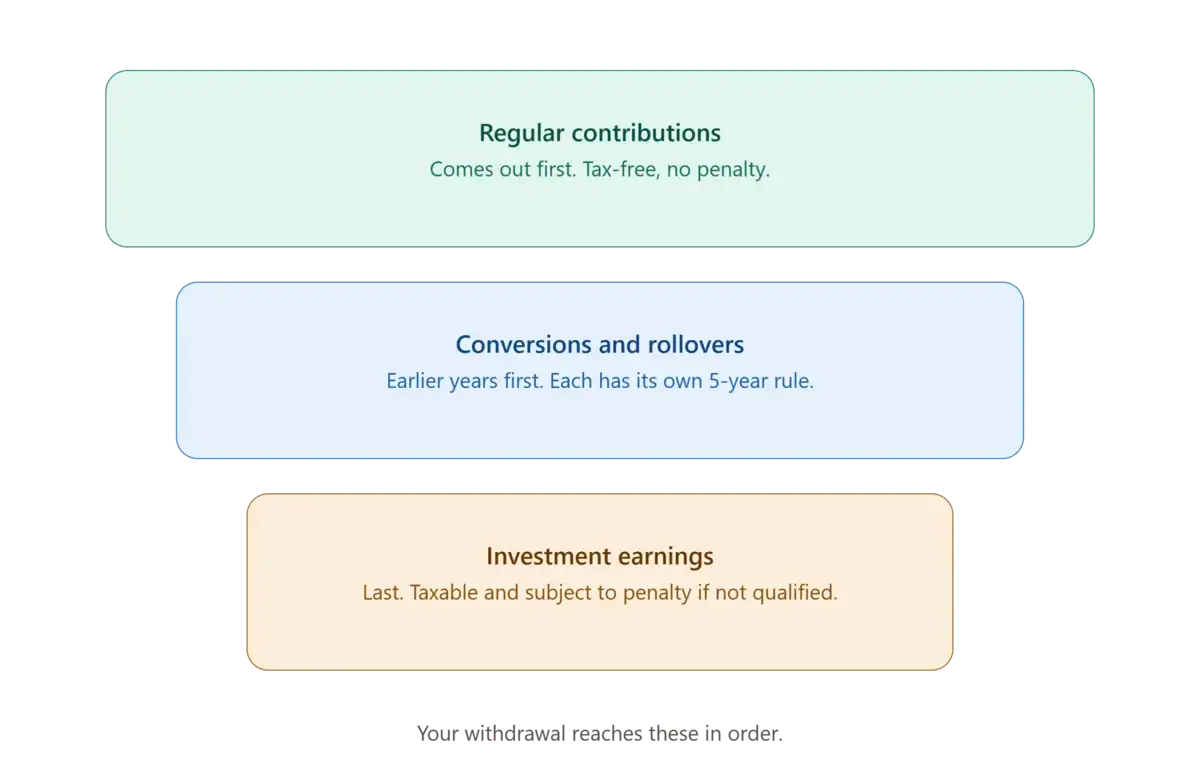
A Roth IRA may look like one account on your brokerage statement, but the money inside can come from several different sources.
For most withdrawal decisions, think of your Roth as three layers:
- Regular Roth IRA contributions
- Conversions and certain rollover contributions
- Investment earnings
Under the IRS Roth IRA ordering rules, a nonqualified Roth IRA distribution is treated as coming from regular contributions first. Conversions and rollovers generally follow on a first-in, first-out basis, with earlier years coming before later years. Within a conversion year, the taxable portion comes before the nontaxable portion. Earnings come last. [1]
That sequence matters because the tax treatment can change as the withdrawal moves from one layer to the next.
| Roth IRA Money | Withdrawal Order | Main Question |
|---|---|---|
| Regular contributions | First | How much contribution basis remains? |
| Conversions and rollovers | Second | Which conversion year does the withdrawal reach? |
| Earnings | Last | Is the distribution qualified, taxable, or subject to additional tax? |
Here’s something people frequently get wrong.
Suppose you contributed $20,000 to a Roth IRA, invested it, and the account grew to $32,000. You then sell investments and withdraw $10,000.
Selling shares that have appreciated doesn’t automatically make that $10,000 withdrawal an “earnings withdrawal.” The Roth IRA ordering rules determine which category of money is treated as coming out.
That’s the picture I want you to keep in your head: The investment you sold and the tax character of the withdrawal aren’t necessarily the same thing.
What to do next
Find the amount of regular Roth IRA contributions you’ve made over the years, adjusted for prior distributions and other relevant changes to your basis.
That number may answer more of your withdrawal question than your age does.
Can You Withdraw Roth IRA Contributions Before Age 59½?
Yes. Regular Roth IRA contributions are treated as distributed first, and a return of your regular contributions isn’t included in gross income. [1]
Because the 10% additional tax generally applies to taxable early distributions, withdrawing dollars that are still within your regular contribution layer doesn’t create that tax merely because you’re younger than 59½. [1][2]
This is where I see people make the Roth IRA harder than it needs to be. They remember hearing “59½” and suddenly the entire account feels locked.
I’d ask a different question: How much have you actually contributed?
Consider Susan. She’s 51 and has an $82,000 Roth IRA. Over the years, she made $37,000 of regular Roth IRA contributions. The remaining $45,000 represents investment growth.
Now she needs $20,000 for a major expense. Her first reaction might be:
- “I’m only 51. Won’t I get hit with an early-withdrawal penalty?”
- Her $20,000 withdrawal remains inside the $37,000 regular-contribution layer.
- It hasn’t reached her earnings.
That changes the answer.
A Roth IRA isn’t completely locked until age 59½.
Regular contributions occupy the first layer of the Roth IRA ordering rules, and a return of those regular contributions isn’t included in gross income.
The common mistake is applying the rules for conversions or earnings to every dollar in the account. [1][2]
There’s another question I think matters just as much.
Being allowed to take Roth money doesn’t make it disposable
I’ve always viewed Roth dollars as valuable tax-planning real estate.
Suppose you contributed money years ago and it now has another 20 or 30 years of potential tax-free growth ahead of it. Taking that money out may solve today’s cash need while sacrificing something that’s difficult to recreate later.
When someone tells me, “I can take $30,000 from my Roth without a penalty,” my next question is:
What other $30,000 could you use?
Access is one part of the decision. Roth contribution space and future tax-free compounding are valuable. Once old Roth dollars leave the account, you generally can’t recreate years of previously used contribution room later simply because you changed your mind.
There are situations where using Roth contribution dollars makes perfect sense.
I just wouldn’t stop the analysis at “Can I?”
Before You Pull Roth Money, Know Which Dollars You’re Touching
A Roth IRA can look available long before the tradeoff is obvious. Get one practical retirement-tax check each week so the next withdrawal, conversion, or five-year-rule decision doesn’t start with the wrong question.
- Know when contribution basis really gives you penalty-free access
- Catch conversion and five-year-rule traps before money leaves the account
- See when using Roth dollars now could cost valuable tax-free flexibility later
Get Roth withdrawal, conversion, and retirement-tax checks like this in your inbox each week.
What to do next
Before withdrawing regular contributions, compare your Roth IRA with the other realistic sources of cash available to you.
If the Roth still makes sense, document your remaining contribution basis before requesting the distribution.
What Happens When Your Roth IRA Includes Conversions?
Conversions create the second layer.
A Roth conversion contribution, in this discussion, is money moved into a Roth IRA through a conversion from another retirement account rather than through a regular annual Roth IRA contribution.
Converted and certain rollover amounts come after regular contributions under the ordering rules. Earlier conversion years generally come before later years. Within each year’s conversion layer, the taxable portion is treated as distributed before the nontaxable portion. [1]
This is where the shortcut “I already paid tax on the conversion, so it’s exactly like a regular contribution” can get someone into trouble.
A separate five-year period applies to each conversion and certain rollovers for purposes of the 10% additional tax. The period begins on January 1 of the tax year in which the conversion occurred. [1]
If you convert $40,000 in October 2026, for example, that conversion’s five-year period begins January 1, 2026.
If you’re deliberately building conversions to support an early retirement, my Roth conversion ladder for early retirement guide owns the full strategy. Including how to fund the waiting years and keep the conversion rungs organized.
For this article, I’ll keep the hierarchy clear: Contributions first. Conversions next. Earnings last.
What to do next
- If your planned withdrawal exceeds your remaining regular contribution basis, find your conversion history and the year of each conversion.
- Do NOT guess from the current account balance!
Roth IRA Earnings Have Different Withdrawal Rules
Earnings occupy the last layer. This is where age 59½ and qualified-distribution rules become much more important.
A qualified Roth IRA distribution satisfies the applicable five-tax-year requirement and one of the additional qualifying conditions, such as the distribution occurring on or after age 59½. Qualified Roth IRA distributions are tax-free. [1]
When a distribution isn’t qualified and reaches earnings, some or all of those earnings can be taxable. The 10% additional tax may also apply when an exception doesn’t. [1][2]
Notice how far we got before age 59½ became the main issue? That was intentional.
- If your distribution stays inside regular contribution basis, starting with a detailed explanation of taxable earnings answers a question you haven’t reached.
- If the distribution reaches earnings, the analysis changes.
What to do next
- Determine whether your proposed withdrawal goes beyond both your remaining regular contributions and the conversion amounts ahead of your earnings.
- If it reaches earnings, verify whether the distribution is qualified before requesting the money.
The Roth IRA Five-Year Rule Isn’t Just One Clock
One sentence causes a remarkable amount of confusion:
“You have to wait five years to take money out of a Roth.“
That isn’t precise enough to make a withdrawal decision. Roth IRAs have different five-year concepts serving different jobs.
- One helps determine whether a Roth IRA distribution is a qualified distribution.
- Another applies separately to each conversion and certain rollovers when determining whether an early distribution can trigger the 10% additional tax. [1]
So when someone tells you that “the Roth has a five-year rule,” ask:
Which five-year rule?
Qualified-distribution five-year requirement: Helps determine whether Roth IRA earnings can be distributed tax-free when the other qualifying conditions are satisfied.
Conversion five-year periods: Separate periods can apply to individual conversions and certain rollovers when determining whether an early distribution triggers the 10% additional tax.
They answer different questions. [1]
My Roth IRA five-year rule guide goes through the clocks in detail. Here, the ordering sequence remains the priority.
What to do next
- If your withdrawal reaches conversions or earnings, identify the relevant contribution and conversion dates.
- Then apply the five-year rule that actually belongs to those dollars.
A $30,000 Roth IRA Withdrawal Example
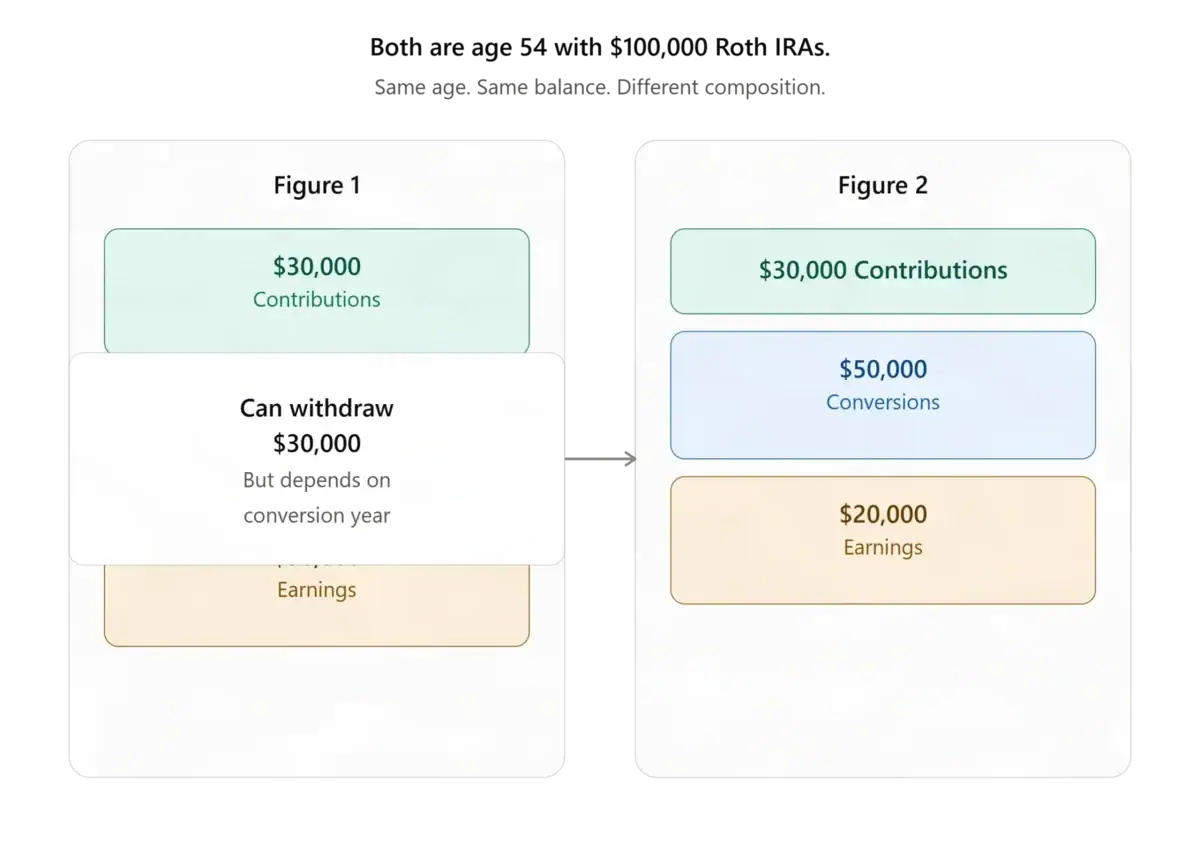
Now let’s go back to the $100,000 Roth IRA from the beginning…
Tom is 54. His Roth IRA contains:
- $38,000 of regular contributions
- $20,000 of conversions
- $42,000 of earnings
- $100,000 total
Tom wants $30,000. He sees “age 54” and “$30,000 withdrawal” and immediately worries about the 10% additional tax.
I’d slow the conversation down. Which dollars does the $30,000 withdrawal reach?
- Tom has $38,000 of regular contribution basis at the front of the ordering sequence.
- His $30,000 withdrawal stays completely within that layer.
- We haven’t reached his conversions.
- We haven’t reached his earnings.
Remember the two identical $100,000 Roth IRAs from the opening? This is why the balance alone couldn’t answer the question.
Now change one number: Tom needs $50,000
The first $38,000 still comes from Tom’s regular-contribution layer. Another $12,000 remains.
Now the withdrawal reaches his conversions. This is where the conversion year matters.
Suppose the next dollars in Tom’s ordering sequence come from a conversion whose separate 5 year period has already ended.
That $12,000 conversion amount has already moved beyond the conversion-specific five-year recapture period. The conversion principal itself isn’t taxed again when distributed, and that expired conversion period doesn’t create the 10% additional tax. [1]
Now change the facts. Suppose that $12,000 reaches the taxable portion of a recent conversion that’s still inside its separate five-year period.
- Tom is 54.
- Unless an exception applies, the $12,000 attributable to the taxable portion of that conversion can be subject to the 10% additional tax. [1]
- Same Roth IRA.
- Same $50,000 cash need.
- The conversion date changes the answer.
That’s why the sequence matters.
- How much regular contribution basis remains?
- How much of your withdrawal stays inside that layer?
- If it exceeds contributions, which conversion comes next?
- Does the withdrawal eventually reach earnings?
- Only then apply the age, five-year and exception rules that belong to those dollars.
How Do You Know How Much You’ve Contributed to a Roth IRA?
This is where the neat tax rule explanation collides with real life.
Your current custodian may know your Roth IRA balance to the penny and still lack the complete history you need to establish your remaining regular contribution basis.
- Maybe you opened your first Roth 15 years ago.
- Maybe you transferred it from one brokerage to another.
- Maybe you’ve made regular contributions, completed conversions, taken a previous distribution, and consolidated several Roth IRAs along the way.
Your current statement might say… Roth IRA value: $146,732. What you need for a withdrawal decision is different though.
- Your regular Roth contributions made over the years;
- previous Roth distributions;
- conversions and their tax years;
- returned or recharacterized contributions where relevant;
- supporting records from prior custodians.
Start with Form 5498 and your account records
Your IRA custodian reports Roth IRA contributions to the IRS on Form 5498. [4]
Old Forms 5498, year end statements, contribution confirmations, and records from previous custodians can help reconstruct what you actually put into the account.
One important distinction: you don’t file Form 8606 every year simply because you made a regular Roth IRA contribution.
Form 8606 becomes especially important when Roth distributions and conversions enter the picture.
The current IRS Form 8606 instructions say Part III is used to determine the taxable portion, if any, of Roth IRA distributions. Line 22 specifically calls for your regular Roth contribution basis, with adjustments when prior Roth distributions have already occurred. [3]
That closes the loop.
The records you keep today can become the numbers you need to defend the tax treatment of a withdrawal years later.
A brokerage statement answers:
“What is my Roth IRA worth today?”
Your withdrawal decision requires another answer:
“How much regular contribution basis do I still have?”
If you’ve changed custodians, completed conversions, or taken previous Roth distributions, reconstruct the history before relying on the current balance alone. [3][4]
You don’t need a beautiful spreadsheet. You need a defensible history.
What to do next
Gather:
- old Forms 5498;
- Roth IRA statements and contribution confirmations;
- prior Forms 1099-R for distributions;
- prior Forms 8606 when applicable;
- conversion records and tax returns;
- records from former custodians.
Then build a simple year by year history before taking a distribution you expect to treat as contribution basis.
The account balance is not the withdrawal answer
Reconstruct your Roth IRA contribution and conversion history
Use this three-page record to list regular contributions, track conversion years, and account for earlier withdrawals before deciding which Roth IRA dollars you are taking out.
- Rebuild your regular-contribution basis across custodians
- Separate conversion amounts and their tax years
- Bring an organized history to your tax professional
Enter your email to receive the PDF. Financial Clarity is optional; PDF-only does not subscribe you.
What About Roth IRA Early Withdrawal Exceptions?
Roth IRA withdrawal exceptions can help you avoid the 10% additional tax on an early distribution, but they do not override the Roth IRA withdrawal rules.
That distinction matters because Roth IRA withdrawals are generally treated as coming out in this order:
- Regular contributions
- Conversions and rollover contributions
- Earnings
If you are simply withdrawing your regular Roth IRA contributions, those dollars generally come out tax- and penalty-free, so you usually do not need an exception in the first place.
Exceptions become more important when a withdrawal reaches converted amounts that are still within their separate five-year periods or taxable earnings. Depending on the circumstances, exceptions to the 10% additional tax can include disability, certain first-home expenses, qualified higher-education expenses, substantially equal periodic payments, qualified birth or adoption distributions, domestic-abuse distributions, and certain emergency personal expenses. If you are thinking about using retirement savings for tuition, my Roth IRA for college guide explains the separate retirement and financial-aid tradeoffs.
The key point is this: Avoiding the 10% additional tax does not necessarily make the withdrawal income-tax-free.
For example, an exception might eliminate the additional tax on an otherwise taxable withdrawal of Roth IRA earnings, while those earnings could still be included in taxable income.
The IRS explains the available exceptions in Topic No. 557 and the Roth IRA ordering and taxation rules in Publication 590-B.
Before looking for an exception, first determine which Roth IRA money you are actually withdrawing. The ordering rules often answer the penalty question before an exception ever becomes necessary.
What to do next
If your distribution reaches conversions or earnings that could otherwise be subject to the additional tax, identify the specific exception you believe applies and verify its requirements before relying on it.
Before You Take Money From Your Roth IRA
If you remember one process from this article, use this one.
- Find your remaining regular Roth IRA contribution basis.
- Identify your Roth conversions and the tax year of each conversion.
- Account for previous Roth IRA distributions.
- Determine how far the proposed withdrawal moves through the IRS ordering sequence.
- Identify whether the withdrawal reaches conversions.
- Identify whether it reaches earnings.
- Apply the relevant age, five-year and exception rules to those dollars.
- Compare the Roth withdrawal with your other realistic sources of cash.
- Keep the records supporting your decision.
We’re back where we started. Your Roth IRA balance was never enough information. Age 59½ matters. Five-year periods matter. Exceptions matter.
But the first question is simpler: What kind of Roth money are you actually withdrawing?
Once you answer that, the rest of the rules finally have somewhere to attach.
Sources
[1] Internal Revenue Service. Publication 590-B (2025), Distributions from Individual Retirement Arrangements (IRAs).
https://www.irs.gov/publications/p590b
[2] Internal Revenue Service. Topic No. 557, Additional Tax on Early Distributions From Traditional and Roth IRAs.
https://www.irs.gov/taxtopics/tc557
[3] Internal Revenue Service. Instructions for Form 8606 (2025), Nondeductible IRAs.
https://www.irs.gov/instructions/i8606
[4] Internal Revenue Service. Instructions for Forms 1099-R and 5498.
https://www.irs.gov/instructions/i1099r
