
The 72(t) rule can let you take taxable retirement money before age 59½ without the usual 10% additional tax. You do it by establishing a series of substantially equal periodic payments, usually called a SEPP.
The tradeoff is control. Once the series starts, the account has to follow a precise payment schedule until the later of the fifth anniversary of your first payment or the date you reach age 59½. A payment that is too high, too low, late, or taken from the wrong account can terminate the arrangement and create current-year tax, recapture tax on earlier distributions, and interest under the IRS substantially equal periodic payment rules. [1]
I would not treat a SEPP as an early withdrawal trick. Treat it as a long-term operating agreement for one retirement account.
A 72(t) SEPP is an exception to the federal 10% additional tax on certain taxable retirement distributions taken before age 59½. You calculate an annual payment for one specific account under an accepted method, then distribute the correct amount from that account each year. The schedule generally must continue until both the five-year requirement and the age-59½ requirement have been satisfied. The strategy can create dependable bridge income, but it is a poor emergency-fund substitute because an unplanned account transaction can trigger retroactive tax and interest. [1][2]
What You Will Learn
- Which retirement accounts can use a SEPP and when separation from employment matters
- How the RMD, fixed amortization, and fixed annuitization methods differ
- Why the account you choose can matter as much as the calculation method
- How a small administrative mistake can create a large recapture-tax bill
- When the Rule of 55 or a Roth conversion ladder may be more flexible
- What records to preserve before the first payment leaves the account
On This Page
- Key Takeaways Ahead
- How the 72(t) Rule and SEPP Work
- The Two Clocks That Control When You Can Stop
- The Three IRS SEPP Calculation Methods
- The Account Decision Most Guides Miss
- What Can Break a SEPP
- How SEPP Recapture Tax Works
- 72(t) SEPP vs. the Rule of 55 vs. a Roth Conversion Ladder
- How to Set Up a SEPP Without Creating a Future Mess
- Frequently Asked Questions
- Final Decision: When a SEPP Fits
- Sources
Key Takeaways Ahead
How the 72(t) Rule and SEPP Work
Internal Revenue Code Section 72(t) generally imposes a 10% additional tax on the taxable portion of retirement-plan distributions made before age 59½. Section 72(t)(2)(A)(iv) provides an exception for a qualifying series of substantially equal periodic payments over the account owner’s life expectancy, or over the joint life expectancies of the owner and a designated beneficiary.
The IRS now uses the term SoSEPP, although most readers, custodians, and calculators still use SEPP. [1][2]
The SEPP exception changes the additional-tax treatment. It does not make a traditional IRA withdrawal tax-free. A fully taxable traditional IRA distribution generally remains ordinary income even when the 10% additional tax does not apply.
The basic rules
A qualifying arrangement generally requires you to:
- Select one eligible retirement account.
- Determine the annual payment under an accepted calculation method.
- Take the required annual amount from that account.
- Avoid additions to the account and avoid distributions other than the SEPP payments.
- Continue the arrangement until the later of the fifth anniversary of the first payment or age 59½.
- Maintain enough documentation to reconstruct the original calculation years later. [1]
The taxpayer is responsible for the tax result. A custodian can process a form, schedule a transfer, or provide a calculation, but the IRS rules do not shift responsibility to the financial institution.
Eligible accounts
The SEPP exception can apply to individual retirement accounts and certain employer plans, including:
- Traditional IRAs and rollover IRAs
- SEP IRAs
- SIMPLE IRAs
- Individual retirement annuities
- Qualified employer plans, including many 401(k) plans
- 403(a) annuity plans
- 403(b) plans [1][2]
If payments come directly from an employer plan, you generally must separate from service with the employer maintaining that plan before the SEPP payments begin. That separation requirement does not apply to an IRA or individual retirement annuity. [1]
A SIMPLE IRA has an additional wrinkle. Distributions within the first two years of participation can otherwise face a 25% additional tax, but the IRS SIMPLE IRA guidance confirms that a valid substantially equal payment exception can also apply during that two-year period. That does not make a SIMPLE IRA SEPP simple. If the exception fails during the two-year window, the higher additional-tax regime may matter, so the setup deserves careful tax review. [5]
You can work while receiving IRA SEPP payments
An IRA-based SEPP does not require you to stop working or remain retired. You may earn wages, start a business, or return to employment while the schedule continues.
The practical issue is income stacking. SEPP distributions may sit on top of wages, investment income, pensions, Roth conversions, and other taxable income. The payment can be technically correct and still create an unattractive tax result.
The first planning question is not, “How much can this formula pay?” It is, “How much dependable taxable income can I commit to receiving every year without damaging the rest of the plan?”
The Two Clocks That Control When You Can Stop
The phrase “five years or age 59½” causes avoidable mistakes because people hear the word or and assume the first milestone ends the restriction.
It does not. The payment schedule generally must continue until the later of:
- The fifth anniversary of the first SEPP payment
- The date you reach age 59½ [1]
You must clear both clocks.
Starting at age 56
Assume you begin payments on December 1 at age 56. You reach age 59½ before five full years have passed. The restriction generally remains in place until December 1 five years after the first payment.
Starting at age 52
Assume you begin on December 1 at age 52. The fifth anniversary arrives before you reach 59½. The restriction generally remains in place until the date you reach age 59½.
The IRS uses these same timing patterns in its current examples. [1]
Five annual payments do not necessarily equal five completed years. Record the exact date of the first payment and calculate the fifth anniversary from that date.
Two-Clocks Explorer
72(t) Two-Clocks Explorer
Enter your birth date and planned first SEPP payment date. The schedule generally must continue until the later of age 59½ or the fifth anniversary of the first payment.
Planning illustration only. Confirm the exact schedule and payment dates before establishing a SEPP.
The Three IRS SEPP Calculation Methods
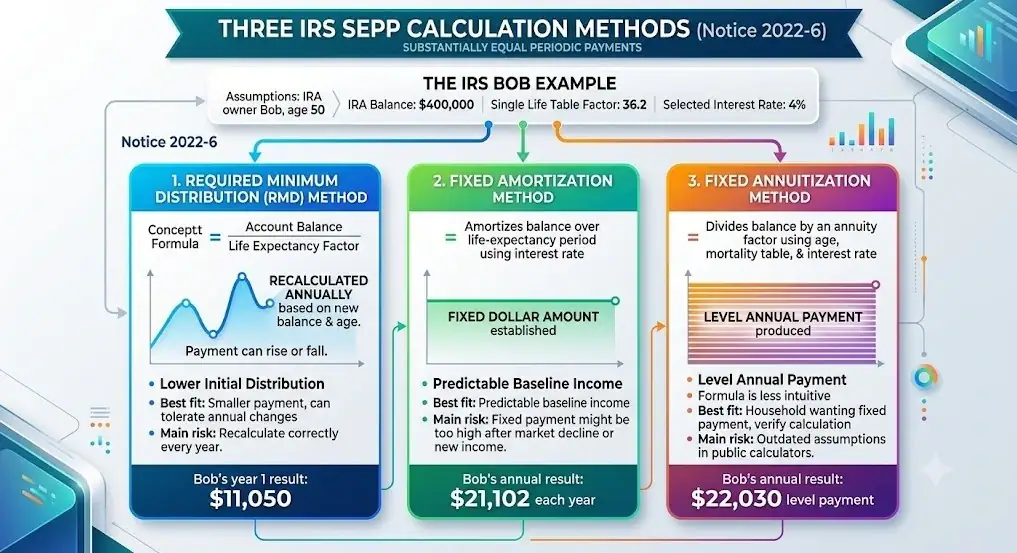
Notice 2022-6, which modified and superseded Revenue Ruling 2002-62 for new arrangements, identifies three methods that automatically satisfy the calculation requirements when properly applied:
- Required minimum distribution method
- Fixed amortization method
- Fixed annuitization method [1][2]
These three Notice 2022-6 methods are the IRS safe-harbor methods that automatically satisfy the calculation requirements when they are applied correctly. The IRS also says they are not the only methods that could theoretically qualify. Because a nonstandard method does not get that automatic treatment, this guide focuses on the three established methods rather than treating an experimental calculation as a do-it-yourself option.
All three use a life-expectancy or mortality table. The fixed methods also use a selected interest rate within the permitted limit.
Required minimum distribution method
The RMD method divides the relevant account balance by an applicable life-expectancy factor. The annual amount is recalculated each year using the new account balance and the taxpayer’s attained age.
That means the payment can rise or fall. It commonly produces a lower initial distribution than the fixed methods.
For SEPP purposes, the calculated RMD amount is the exact annual amount, not a minimum that permits you to take more, as explained in IRS Publication 590-B. [3]
Best fit: A household that needs a smaller payment and can tolerate annual changes.
Main risk: The amount must be recalculated correctly every year.
Fixed amortization method
The fixed amortization method amortizes the account balance over a life-expectancy period using a permitted interest rate. Once established, the same dollar amount is generally distributed each year.
Best fit: A household that needs predictable baseline income.
Main risk: A fixed payment that looks comfortable today may be too high after a market decline or after other income begins.
Fixed annuitization method
The fixed annuitization method divides the account balance by an annuity factor based on the taxpayer’s age, the selected mortality table, and a permitted interest rate. It also generally produces a level annual payment.
Best fit: A household that wants a fixed payment and has had the mortality-factor calculation independently verified.
Main risk: The annuity-factor calculation is less intuitive, and a public calculator may be using outdated assumptions.
The IRS Bob example
The IRS illustrates all three methods using an IRA owner named Bob who turns 50 in 2023. The assumptions are:
- IRA balance: $400,000
- Single Life Table factor: 36.2
- Selected interest rate for the fixed methods: 4%
The first-year results are:
$11,050 in the first year. The amount is recalculated in later years.
Fixed Amortization
$21,102 each year, based on the IRS example assumptions.
Fixed Annuitization
$22,030 each year, based on the IRS example assumptions. [1]
The same account can produce dramatically different cash flow depending on the selected method. That is why the method is a planning decision, not merely a tax-form decision.
What Notice 2022-6 changed about interest rates
Before Notice 2022-6, Revenue Ruling 2002-62 generally limited the fixed-method rate to no more than 120% of the federal mid-term rate for either of the two months before the first distribution. Notice 2022-6 changed the ceiling. A taxpayer may now select any rate that does not exceed the greater of:
- 5%, or
- 120% of the federal mid-term rate for either of the two months immediately before the first payment. [1][2]
Five percent is not a required minimum rate. It is part of the formula for the maximum permitted rate. You can select a lower rate.
Here is the practical difference using Bob’s official $400,000 balance and 36.2-year factor:
- At the IRS example’s 4% rate, fixed amortization is $21,102 a year.
- At 5%, the same fixed-amortization calculation is approximately $24,125 a year.
- The increase is approximately $3,023 a year, or 14.3%.
The 5% result is a calculated illustration, not a second IRS-published answer. It isolates the payment effect of selecting a higher permitted rate while holding Bob’s balance and life-expectancy factor constant.
Notice 2022-6 did not force higher payments. It gave taxpayers room to choose a higher permitted rate when the old federal-rate ceiling would have produced less income. More available income is not automatically better. A larger fixed payment also creates a larger taxable commitment.
Where to find the permitted federal rate
The IRS publishes Applicable Federal Rates in monthly revenue rulings. For a new SEPP, use the annual 120% federal mid-term rate under Section 1274(d) from either of the two months immediately before the month of the first payment. Do not substitute a rounded Section 7520 rate without confirming that it is the correct input. [6]
Method and Rate Explorer
SEPP Method and Rate Explorer
Compare the three IRS methods using the IRS age-50, $400,000 illustration. This is an explanation tool, not a personalized SEPP calculator.
The 5% amount is a controlled comparison using the same age, balance, and life-expectancy assumptions as the IRS amortization example. Verify the permitted rate and the full calculation before establishing a SEPP.
The Account Decision Most Guides Miss
Each SEPP applies to one specific account. The IRS says you cannot combine several account balances, calculate one total payment, and withdraw the money from whichever account is convenient. Separate SEPPs may be established for separate accounts, and each must be administered independently. [1]
This makes account selection one of the most important decisions in the process.
Strategy 1: Use the entire IRA
Assume you have one $1 million rollover IRA and establish the SEPP using the full balance.
Advantages:
- One account
- One calculation
- One payment schedule
- Simpler recordkeeping
Tradeoff:
- The payment may be larger than your dependable spending need.
- The entire IRA is tied to the SEPP restrictions.
Strategy 2: Split the IRA before the first payment
Assume you complete trustee-to-trustee transfers before starting and create:
- A $600,000 IRA designated for the SEPP
- A separate $400,000 IRA kept outside the SEPP
The SEPP calculation uses the $600,000 account. The other IRA remains outside that payment series and may support other planning, subject to the normal tax rules.
Splitting an IRA is a planning strategy, not an IRS requirement. Finish the intended account structure before the first payment and preserve the transfer confirmations and opening statements.
Strategy 3: Establish another SEPP later
Someone with separate IRAs could establish one SEPP now and another from a different account later.
That can create staged income, but it also creates separate:
- Calculations
- First-payment dates
- Annual payment requirements
- End dates
- Recordkeeping files
The tradeoff is straightforward: multiple accounts may add flexibility, but every additional schedule creates another payment amount, anniversary date, and recordkeeping file that can fail.
Size the first SEPP around dependable spending. Keep emergencies, major purchases, and optional spending outside the SEPP account whenever the household has enough other assets to do that.
Financial Clarity is my weekly email for catching timing traps, tax-rule mistakes, and retirement-income decisions before they become expensive.
What Can Break a SEPP
The arrangement can fail when the annual amount distributed is higher or lower than the amount required under the established method.
Common failure points include:
- Missing part of the annual payment
- Taking an extra withdrawal
- Taking a payment from the wrong IRA
- Adding money to the SEPP account
- Using the wrong balance, age, life table, rate, or annuity factor
- Recalculating a fixed payment when no permitted change applies
- Aggregating payments from separate SEPP accounts
- Losing track of the fifth-anniversary date
- Relying on a calculator that still uses pre-2022 tables [1][2]
Investment gains and losses inside the account do not themselves violate the rule. You can generally buy, sell, and rebalance investments inside the account. The danger is an unauthorized addition, distribution, or transfer involving the account.
Do not move assets into or out of an active SEPP account without having the exact transaction reviewed against current authority.
How SEPP Recapture Tax Works
A premature modification can create two federal tax amounts in the year of the failure:
- A 10% additional tax on the taxable distributions received during the modification year
- Recapture of the 10% additional tax that would have applied to prior SEPP distributions, plus interest for the deferral period [1]
This is why a small payment error can produce a much larger bill than 10% of the shortfall.
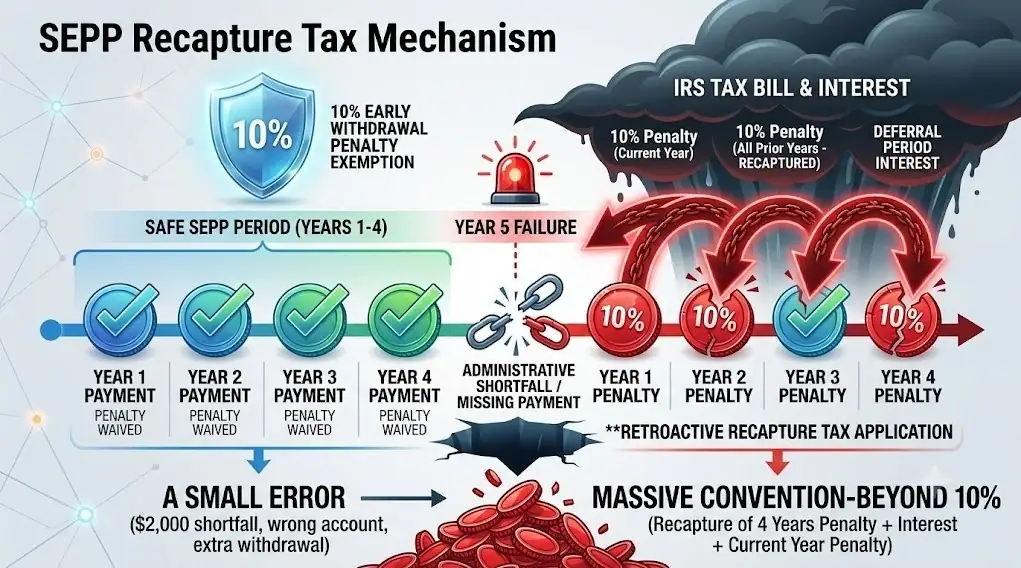
Hypothetical custodian-transition failure
Assume a taxpayer establishes a fully taxable $50,000 annual SEPP at age 50.
- Years 1 through 4: $50,000 is distributed correctly each year.
- Year 5: A custodian conversion disrupts the scheduled December transfer, and only $48,000 is distributed.
- The taxpayer discovers the shortfall after year-end.
Under the general IRS recapture framework:
- Current-year additional tax: 10% of $48,000 = $4,800
- Prior-year recapture: 10% of $200,000 = $20,000
- Total before interest: $24,800
A $2,000 administrative shortfall has created a potential $24,800 federal additional-tax and recapture amount before interest. This is a hypothetical illustration, not a prediction of a specific taxpayer’s final liability.
The IRS is not measuring how close you came. The rule is testing whether the correct annual amount came out of the correct account during the correct year. Build the process around that reality.
Recapture Damage Explorer
SEPP Recapture Damage Explorer
See how one payment mismatch can expose the current-year distribution and earlier SEPP payments to the 10% additional tax. Interest is calculated separately by the IRS and is not included here.
Assumed prior SEPP distributions:
This simplified illustration assumes the prior annual payments all equaled the required amount and were fully taxable. It excludes ordinary income tax, IRS interest, state tax, and case-specific exceptions.
The one permitted method change
A taxpayer may make a one-time switch from:
- Fixed amortization to the RMD method, or
- Fixed annuitization to the RMD method
After the switch, the taxpayer must continue using the RMD method. Moving from RMD to a fixed method, switching between fixed methods, or repeatedly changing methods can be treated as a modification. [1][2]
Complete account depletion
If the account is completely depleted and the final distribution that reduces the balance to zero is lower than the annual SEPP amount, the IRS says that short final payment is not treated as a modification that triggers the additional tax or recapture. This is a narrow exception, not permission to drain the account through extra withdrawals. [1]
72(t) SEPP vs. the Rule of 55 vs. a Roth Conversion Ladder
The best early-access method depends on where the money is, your age, when you left employment, and how much flexibility you need.
Rule of 55
The Rule of 55 may be the cleaner first option when you separate from the employer sponsoring the plan during or after the calendar year you reach the qualifying age and the plan offers usable distributions.
Why it may be better: The federal exception does not require a SEPP formula or a multiyear fixed-payment commitment.
What can still go wrong: The plan controls whether partial or periodic withdrawals are available. Tax eligibility and plan permission are separate questions.
Form 5329 exception code: 01 for the qualifying separation-from-service exception under the Form 5329 instructions. [4]
Roth conversion ladder
A year-by-year Roth conversion strategy may fit when you have enough taxable savings, Roth contribution basis, or other money to cover the waiting period and want more control over annual taxable income.
Why it may be better: You choose the conversion amount each year rather than locking one account into a SEPP payment schedule.
What can still go wrong: Each conversion has its own five-year timing rule, and the household must understand Roth distribution ordering and the Roth conversion compliance requirements.
72(t) SEPP
A SEPP may be the practical choice when you need IRA income now, do not qualify for the Rule of 55, and cannot bridge five years while building a Roth conversion ladder.
Why it may be better: It can create immediate penalty-exception income at almost any age.
What can still go wrong: The schedule is rigid, taxable income may be larger than expected, and an administrative mistake can produce recapture tax.
Before choosing a SEPP, answer three questions:
- Can the Rule of 55 give me more flexible access from the employer plan?
- Can taxable savings or Roth basis cover a conversion-ladder waiting period?
- If neither works, what is the smallest dependable annual SEPP payment that closes the gap?
Before you start a SEPP: Confirm that a more flexible employer-plan exception is not still available. Use this Rule of 55 vs SEPP comparison to test your separation timing, account location, plan withdrawal options and ability to maintain a long-term payment schedule before moving money or taking the first distribution.
How to Set Up a SEPP Without Creating a Future Mess
A 72(t) calculator result is not a complete implementation plan. The process needs controls around the account, inputs, payments, and records.
1. Calculate the dependable income need
Start with recurring expenses that the household is highly likely to pay every year.
Include federal and state income taxes, health insurance, housing, food, utilities, and required debt payments. Keep irregular purchases and the emergency reserve outside the SEPP account when possible.
2. Compare the less restrictive alternatives
Test Rule of 55 eligibility, taxable-account bridge money, Roth contribution basis, a Roth conversion ladder, part-time income, pensions, and other available exceptions before locking the account into a SEPP.
The goal is not to avoid SEPP at any cost. The goal is to use the least restrictive combination that reliably funds the plan.
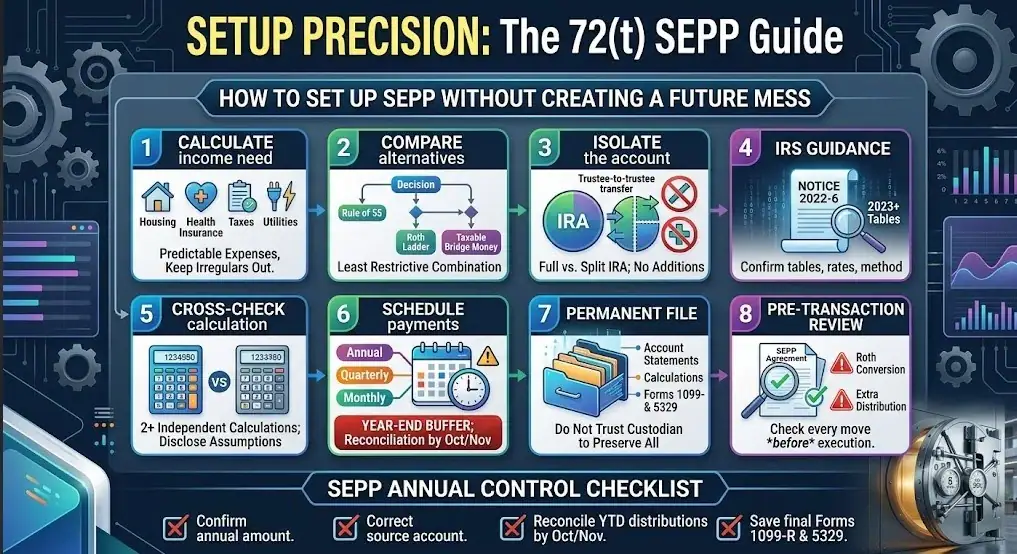
3. Choose and isolate the account
Decide whether the SEPP should use the full IRA or a smaller IRA created before the first payment.
Preserve statements showing:
- The account balance
- The valuation date
- Any trustee-to-trustee transfers used to create the account
- The absence of later additions or unauthorized withdrawals
4. Use current IRS guidance
For a new arrangement beginning after 2022, confirm that the calculation follows Notice 2022-6, not only Revenue Ruling 2002-62.
Confirm:
- The correct life-expectancy or mortality table
- The correct age or ages
- A reasonable account-balance date
- The permitted interest-rate ceiling
- The calculation method
- The annual payment amount [1][2]
5. Cross-check the calculation
Use at least two independent calculations and compare the result with the IRS Bob example where applicable.
A public 72(t) calculator should disclose:
- Which IRS guidance it uses
- Which tables it uses
- The account valuation date
- The selected rate
- Whether the payment occurs at the beginning or end of the period
- How it handles fractional life-expectancy periods
If those assumptions are hidden, the output is not ready to become a tax election.
6. Choose a payment frequency with an operational buffer
The IRS permits annual, quarterly, or monthly installments, subject to custodian or plan limitations. The total paid from each SEPP account during the year must equal the required annual amount. [1]
One annual payment reduces transaction count, but a December 31 deadline leaves no recovery time if the transfer fails. Monthly payments help cash flow but create more transactions to monitor.
Build a process that includes a year-end reconciliation well before the final business days of December.
7. Build a permanent SEPP file
Keep:
- Account name and number
- Opening balance and valuation date
- Method selected
- Life-expectancy or mortality table
- Age and beneficiary assumptions
- Interest rate and the exact AFR revenue ruling used
- Formula and independent verification
- First payment date
- Annual payment amount and frequency
- Date you reach 59½
- Fifth-anniversary date
- Final restriction date
- Custodian forms and confirmations
- Annual account statements
- Distribution confirmations
- Forms 1099-R
- Forms 5329 and tax returns
Do not assume the brokerage website will preserve every statement, calculator screen, and transaction detail through a platform migration or merger. Save local digital copies and a printed summary of the governing assumptions.
8. Review the account before every unusual transaction
Before changing custodians, moving assets, taking an extra distribution, completing a Roth conversion, changing methods, or altering the payment schedule, compare the proposed transaction with the original SEPP documentation and current rules.
- Confirm the required annual amount.
- Confirm the correct source account.
- Reconcile year-to-date distributions by October or November.
- Schedule any remaining payment with time to correct an operational failure.
- Save the final confirmation and Form 1099-R.
- Review whether Form 5329 with exception code 02 is required. [4]
Frequently Asked Questions
Can I take 72(t) payments monthly?
Yes. The annual amount may generally be paid in annual, quarterly, or monthly installments, subject to custodian or plan limitations. The installments from each account must total the correct annual amount. [1]
Can I change investments inside the SEPP account?
Generally, yes. Investment changes inside the account do not themselves violate the prohibition. Contributions, extra distributions, and unreviewed transfers are the larger concern.
Can I stop when I turn 59½?
Only if the fifth-anniversary requirement has also been satisfied. The restriction generally ends at the later date.
Can I change the payment amount?
The RMD method recalculates annually as part of the method. The fixed methods generally continue with the same dollar payment. A one-time switch from a fixed method to RMD is permitted. Other premature changes may trigger recapture. [1][2]
Can I start another SEPP later?
Yes, from a different account. Each arrangement must be calculated, distributed, documented, and tracked independently. [1]
Can I work while receiving SEPP payments?
Yes, if the payments come from an IRA. If the payments come from an employer plan, the SEPP exception generally requires separation from the employer maintaining that plan before payments begin. [1]
Can I make a Roth conversion from the SEPP IRA?
A Roth conversion from an active SEPP IRA is a distribution from that account, so it cannot be treated as a casual extra transaction. Whether a particular conversion can fit the established SoSEPP payment framework depends on the exact facts and reporting. A separate non-SEPP IRA can preserve room for Roth conversions, subject to the normal conversion and aggregation rules. Do not convert assets from the active SEPP account without transaction-specific tax review.
Does a SEPP make sense for a Roth IRA?
The statutory exception can apply to IRA distributions, but Roth IRA ordering rules already distinguish contributions, conversions, and earnings. A Roth-based SEPP may add unnecessary complexity when contribution basis or matured conversion basis is already accessible under separate rules.
Does the custodian guarantee the tax result?
No. Custodians differ in the help they provide. Some calculate payments or automate distributions; others ask the account owner to provide the amount. Keep your own records even when the custodian administers the schedule.
Which Form 5329 exception code applies?
Exception code 02 identifies distributions made as part of a qualifying series of substantially equal periodic payments. Code 01 applies to qualifying separation-from-service distributions from an employer plan, commonly called the Rule of 55. [4]
Should I trust an online 72(t) calculator?
Use it as a starting point, not as the only record supporting the arrangement. Confirm that it applies Notice 2022-6, uses current tables, discloses its assumptions, and reproduces the IRS reference example before relying on its result.
Final Decision: When a SEPP Fits
A SEPP can solve a real early-retirement problem when most of your accessible wealth sits in a traditional IRA and the more flexible alternatives do not close the income gap.
It is most defensible when:
- Baseline spending is predictable
- The account can be sized to that spending need
- Emergency and discretionary assets remain outside the SEPP
- The household understands the ordinary-income-tax effect
- The calculation is independently verified
- The payment process has an annual reconciliation control
- The full calculation and payment history can be reconstructed years later
It becomes dangerous when the account is expected to serve as income source, emergency fund, Roth-conversion source, and flexible spending account at the same time.
Before the first payment, know four things: the exact account, the exact annual amount, the exact first-payment date, and the exact date the restriction generally ends. If any one of those is fuzzy, the SEPP is not ready to start.
Sources
- Internal Revenue Service, “Substantially Equal Periodic Payments,” reviewed or updated July 23, 2026.
- Internal Revenue Service, Notice 2022-6, “Determination of Substantially Equal Periodic Payments,” Internal Revenue Bulletin 2022-5.
- Internal Revenue Service, Publication 590-B (2025), “Distributions from Individual Retirement Arrangements.”
- Internal Revenue Service, Instructions for Form 5329 (2025), “Additional Taxes on Qualified Plans and Other Tax-Favored Accounts.”
- Internal Revenue Service, “Retirement Plans FAQs Regarding SIMPLE IRA Plans.”
- Internal Revenue Service, “Applicable Federal Rates.”
