
The Rule of 55 for a 401(k) may let you take distributions before age 59½ without paying the additional 10% federal tax on early withdrawals.
To qualify, you generally must separate from the employer sponsoring the plan during or after the calendar year in which you turn 55. But age is only the first test.
The money must remain in an eligible employer plan tied to a qualifying separation, and the plan must offer a distribution method you can actually use. The Rule of 55 does not make a traditional 401(k) withdrawal income-tax-free or require your former employer to offer monthly withdrawals.

Key Takeaways:
A workable Rule of 55 strategy must open three locks:
- Timing: You separated during or after the calendar year you turned 55.
- Account: The money remains in a qualifying employer plan tied to that separation.
- Access: The plan permits the type and frequency of distributions you need.
On This Page
- Key Takeaways Ahead
- Rule of 55 Eligibility Checker
- How the Rule of 55 Works
- Which 401(k) Can You Use For Rule of 55?
- The IRA Rollover Trap
- Your Plan Controls How You Can Take the Money
- Taxes, Withholding and Roth 401(k) Money
- Public-Safety Employees and the TSP
- Rule of 55 vs. 72(t)
- Rule of 55 vs. SEPP
- Four Quick Examples
- Rule of 55 Checklist Before Leaving Your Job
- What should you check next?
- Frequently Asked Questions
- The Bottom Line
- Sources
- How We Verified This
Key Takeaways Ahead
Early-retirement access check
AccountRule of 55 Eligibility Checker
Check one retirement account at a time. Each answer moves you to the next relevant question, and dead ends stop early.
Starting point
Why you got this result
What to verify next
Rule basis: IRC Section 72(t), current IRS early-distribution guidance, IRS Publication 575, and 2026 Form 1099-R instructions. The IRA-rollover warning is also illustrated by Catania v. Commissioner, T.C. Memo. 2021-33.
Educational screening only. This checker cannot confirm every plan term, employment classification, tax-reporting fact, or individual exception.
How the Rule of 55 Works

The Rule of 55 is the common name for an exception under Internal Revenue Code Section 72(t)(2)(A)(v).
The IRS generally imposes an additional 10% tax on taxable retirement plan distributions taken before your age 59½. The separation from service exception may remove that additional tax when:
- You separate from service with the employer maintaining the plan.
- The separation occurs during or after the calendar year in which you turn age 55.
- The distribution comes from an eligible employer retirement plan rather than an IRA.
You should keep in mind that traditional 401(k) distributions generally remain subject to regular federal income tax.
You do not have to wait for your birthday!
The calendar year controls, not the exact day you turn 55.
➡ Suppose you turn 55 in November. You could potentially qualify after leaving that employer in January of the same year, while you are still 54. Many financial advisors still make this mistake
Leaving one calendar year too early does NOT work
Suppose you turn 55 in February 2027 but leave the employer in December 2026. Waiting until your birthday to withdraw does not repair the timing problem.
In Watson v. Commissioner, T.C. Summary Opinion 2011-113, a taxpayer left her employer at age 53 and took the distribution at 55. The Tax Court found that she did not qualify because the separation occurred too early.
Watson is useful as an illustration, but it is a nonprecedential Summary Opinion. The statutory language & IRS guidance remain the primary authority.
Retirement is NOT required to take advantage of Rule of 55 for your 401k
The Rule of 55 exception focuses on separation from service, not whether or not you held a retirement party.
A resignation, retirement, layoff or other genuine separation may qualify. You may also take another job later without necessarily losing access to the plan connected to the earlier Rule of 55 qualifying separation.
Rule of 55 Eligibility Checker
Which 401(k) Can You Use For Rule of 55?
You cannot determine eligibility by looking only at your present age or the name of the recordkeeper.
The important relationship is between:
- The employer sponsoring the plan
- Your separation from that employer
- Your age during that calendar year
- The plan holding the money
An employer you have not left
You generally cannot use the Rule of 55 for the retirement plan of an employer for whom you are still working. The exception requires separation from the employer maintaining that plan. It may appear I am repeating myself, and I am for a good reason. To hammer home the key point!
An old 401(k) from an employer you left before 55
Suppose you left Employer A at 47 and kept its 401(k) at the company. Turning 55 later does not make that account eligible. The separation connected to that plan occurred too early.
An old 401(k) from an employer you left at 55 or later
Now suppose you left Employer B during the year you turned 56 and kept the money in Employer B’s plan?
If you later take another job, do not assume the answer for that old plan is automatic. The statute itself does not use the phrase “most recent employer,” but several major provider explanations do describe the exception that way. The IRS primary guidance I reviewed explains the age-and-separation test clearly, but it does not cleanly resolve every multiple-former-employer fact pattern.
WHERE RULE OF 55 EXPLAINERS DISAGREE
Schwab and other major providers commonly describe the exception as applying to the plan of the employer you most recently left. The statutory text in Internal Revenue Code Section 72(t) does not literally use that phrase.
That difference is not a reason to gamble with a taxable distribution. If you have more than one former-employer plan tied to separations after 55, ask each plan administrator how it will treat the distribution and get tax guidance before relying on the exception.
What if more than one former-employer plan looks like it qualifies?
Suppose you separated from Employer A at 56 and Employer B at 58. Both separations happened after the normal age threshold, but that does not make the tax treatment of both plans something I would assume from a website summary.
Plan access can also differ. Employer A might allow quarterly withdrawals while Employer B permits only a lump sum. Two plans using the same recordkeeper can still have different employer-approved distribution provisions.
This is an edge case where written confirmation matters more than a rule of thumb. Confirm the plan’s distribution rules and the tax treatment before requesting the money.
The IRA Rollover Trap
This is very important to understand. The Rule of 55 does not apply to IRA distributions.
Suppose you leave work at 56 with $700,000 in a 401(k) that allows flexible partial withdrawals. You immediately roll the entire account into a traditional IRA.
The rollover itself may be tax-deferred. But later IRA withdrawals cannot use the age-55 separation-from-service exception. The IRS explicitly lists this exception as available for qualified plans and not for IRAs. You would need to reach 59½ or qualify under another IRA exception.
Now make the consequence concrete. At 57, you need $40,000 for living expenses. If the $40,000 could have been taken as a qualifying distribution from the former employer plan, the Rule of 55 may have avoided the 10% additional federal tax. After the rollover, if the taxable $40,000 IRA distribution has no other exception, that additional tax would be $4,000.
Same person. Same $40,000. Different account wrapper.
That is the piece people miss. A rollover is not always administrative housekeeping. Before 59½, it can also be an access decision.
MICHAEL’S TAKE
Do not roll first and ask questions later.
For years, I watched rollovers get treated like paperwork. They are not always paperwork. A rollover may improve investment choice, reduce costs or simplify your accounts. It can also change which early-withdrawal exceptions are available when you need the money.
This does not mean everyone should leave an old 401(k) untouched. It means early access belongs in the decision alongside fees, investments, creditor protection, convenience and the other reasons you may want to consolidate retirement accounts.
- Some plans may let you take the amount needed before 59½ and roll over the remainder.
- Others restrict partial withdrawals or require a particular disposition of the remaining balance.
- Confirm the sequence before submitting any paperwork.
Want the retirement rules that change the decision before you move the money?
The expensive retirement mistakes are often not bad rules. They are two perfectly valid rules colliding. A rollover can collide with the Rule of 55. A Roth conversion can collide with Medicare. A withdrawal can collide with Social Security taxes. That is the kind of practical decision I cover in Financial Clarity, so you can see the second consequence before the paperwork is already done.
Your Plan Controls How You Can Take the Money
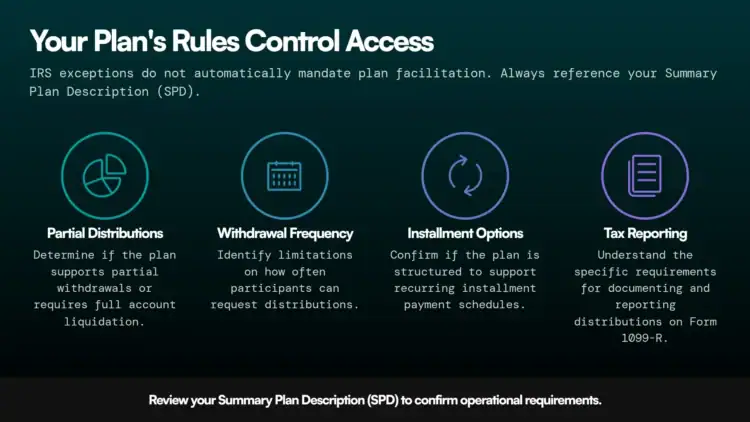
The federal Rule of 55 determines whether the additional 10% tax applies. It does not force your employer’s plan to provide every legally possible distribution option.
Your plan controls:
- Whether former employees can take partial distributions
- How frequently withdrawals are permitted
- Whether monthly or annual installments are available
- Whether installment amounts can be changed
- Whether pretax and Roth sources can be selected separately
- Whether one withdrawal triggers distribution of the remaining balance
This is why asking, “Does my plan offer the Rule of 55?” often produces an incomplete answer.
The better questions you should ask are:
- Can I take a partial cash distribution after separating and before 59½?
- How many partial distributions are allowed each year?
- Can I establish monthly, quarterly or annual installments?
- Can I change or stop those installments?
- Is there a minimum withdrawal?
- Can I take some money in cash and directly roll over the rest?
- Will a partial withdrawal affect the remaining account?
- How will the distribution be reported on Form 1099-R?
Start with the Summary Plan Description, or SPD. If it is unclear, request the complete distribution provisions. Or better yet, I suggest that you get a written answer from the plan administrator.
Before celebrating the avoided 10% tax, make sure the plan will let you take the money in a useful way.
Taxes, Withholding and Roth 401(k) Money
The Rule of 55 may eliminate the additional 10% federal tax. It does not eliminate ordinary income tax.
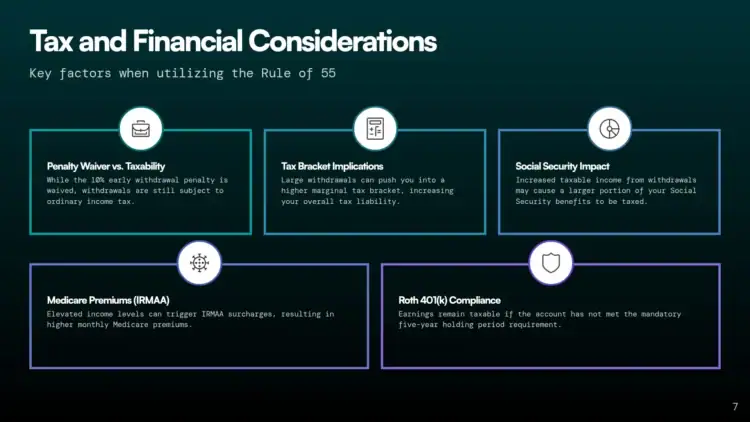
Traditional 401(k) withdrawals are generally taxable
For example, a qualifying $50,000 distribution might avoid $5,000 of additional federal tax. The taxable portion of the $50,000 can still be included in your ordinary income.
A large withdrawal may also affect your tax bracket, Social Security taxation and other income-based costs.
The Rule of 55 answers an access question. It does not determine a sustainable or tax-efficient withdrawal amount.
That belongs inside your broader retirement account withdrawal strategy.
Income tax withholding is not the final tax bill
Certain eligible rollover distributions paid directly to you are generally subject to 20% federal income tax withholding. Other forms of payment may follow different tax withholding rules.
The amount withheld is a tax prepayment, not a separate Rule of 55 penalty and not necessarily your final federal income tax liability.
Check Form 1099-R
A qualifying distribution may be reported with code 2 in Box 7, meaning an early distribution for which an exception applies.
If the plan uses code 1 even though you qualify, that does not automatically mean the additional tax is owed. Form 5329 may be used to claim an applicable exception.
Keep your separation records, distribution confirmation, Form 1099-R and written plan communications.
A Roth 401(k) withdrawal is not automatically tax-free
The Rule of 55 can address the additional 10% tax without making a Roth 401(k) distribution qualified.
A qualified Roth 401(k) distribution generally requires both:
- Completion of the applicable five taxable year participation period
- A distribution after age 59½, death or qualifying disability
Before those requirements are met, the earnings portion of a Roth 401(k) distribution may be taxable even when the Rule of 55 prevents the additional 10% tax from applying.
Watch future Medicare-income years
Rule of 55 withdrawals often begin before Medicare, but a large taxable distribution taken later can raise modified adjusted gross income and potentially increase future Medicare Part B and Part D premiums.
That interaction deserves separate planning rather than another long section here. See the guide to an IRMAA one-time income spike when withdrawals overlap with Roth conversions, capital gains, pensions or Social Security.
Public-Safety Employees and the TSP
Qualified public safety employees have a broader exception, and current law also extends special treatment to certain private-sector firefighters.
For qualifying distributions, the normal age-55 threshold is generally replaced by the earlier of age 50 or 25 years of service under the plan. Covered public-safety groups can include certain police officers, firefighters, emergency medical personnel, corrections officers, federal law enforcement employees and other specified workers.
Current IRS guidance also applies the earlier-of-age-50-or-25-years rule to a private-sector employee who provides firefighting services when the distribution comes from a qualifying employer plan after separation from service.
The exception can apply to governmental defined benefit and defined contribution plans. It can also apply to the Thrift Savings Plan for qualifying federal public-safety employees.
For other federal employees, taxable TSP distributions may generally qualify for the regular separation exception when they leave federal service during or after the calendar year in which they turn 55.
Because the public safety definitions and eligible plan types matter, verify your employment classification rather than assuming that every government employee receives the age-50 or 25-year rule.
Rule of 55 vs. 72(t)
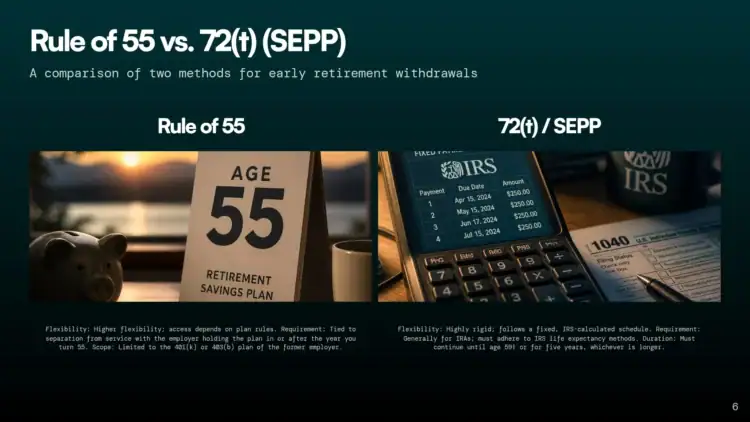
A Section 72(t) substantially equal periodic payment arrangement, commonly called a SEPP, is another possible way to access retirement money before 59½.
Rule of 55 and substantially equal periodic payments, commonly called SEPP or 72(t) payments, can both provide access to retirement money before age 59½. The key difference is flexibility: Rule of 55 depends largely on the employer plan, while SEPP withdrawals must follow a calculated payment schedule.
Rule of 55 vs. SEPP
Rule of 55
- Eligible account
- Qualifying employer plan
- Main trigger
- Separation during or after the qualifying year
- Withdrawal flexibility
- Depends mainly on plan rules
- Extra withdrawals
- Potentially, if the plan allows them
- Duration
- No separate fixed schedule under this exception
- Best fit
- Qualifying separation and a flexible plan
SEPP / Rule 72(t)
- Eligible account
- Employer plan after separation or IRA
- Main trigger
- A calculated series of payments
- Withdrawal flexibility
- Payments must follow the approved calculation
- Extra withdrawals
- Can cause the arrangement to be modified
- Duration
- Generally until the later of five years or age 59½
- Best fit
- Money is in an IRA or Rule of 55 timing was missed
Main takeaway: Rule of 55 may offer more withdrawal flexibility when the separation and plan requirements are satisfied. SEPP can provide another route to early access, but the required payment schedule makes later changes more consequential.
The Rule of 55 is usually more flexible when you qualify and the employer plan offers useful withdrawals.
A 72(t) arrangement can solve a different problem, but its payment restrictions make mistakes expensive. It should not be treated as a casual substitute.
Additional reading: If both exceptions appear possible, use this Rule of 55 vs SEPP decision guide to compare separation timing, account location, employer-plan access and the long-term SEPP commitment before moving any retirement money.
See the complete 72(t) Rule and SEPP guide for the three calculation methods, payment-duration rules, account-splitting strategy and recapture-tax risks.
Early retirement may also combine taxable savings, Rule of 55 withdrawals and a planned Roth conversion strategy rather than forcing every dollar through one account.
Four Quick Examples
- Leaving before your birthday: Maria turns 55 in October and retires in March of that year. Her separation passes the calendar-year test.
- Leaving one year too early: David turns 55 in February 2027 but is laid off in December 2026. Waiting until February to withdraw does not make the earlier separation qualify.
- Two former plans: Lisa leaves Employer A at 48 and Employer B at 56. Employer A’s plan generally fails the timing test. Employer B’s may qualify, subject to its distribution provisions.
- A restrictive plan: Robert leaves at 57, but his plan permits only one partial distribution. The federal exception may apply, yet the plan cannot provide the monthly income he expected.
The tax rule worked. The implementation did not.
Rule of 55 Checklist Before Leaving Your Job
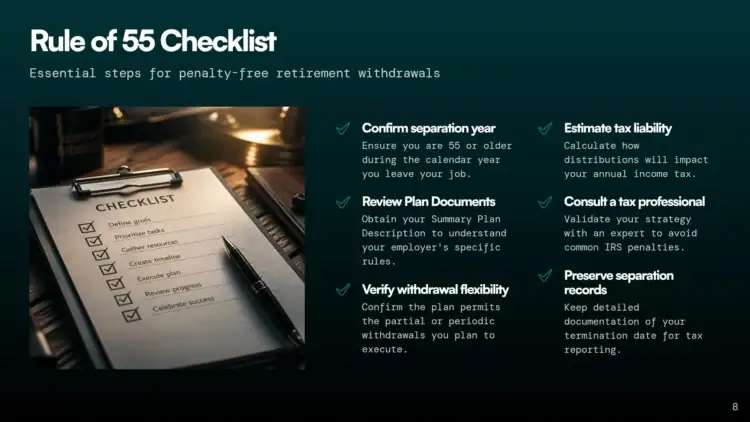
Before choosing a voluntary separation date or moving the account:
- Confirm the calendar year in which you turn 55.
- Confirm the official separation date.
- Identify the sponsor of every employer plan.
- Match each plan with the age at which you left that employer.
- Obtain the current Summary Plan Description.
- Verify partial withdrawals and installment options.
- Ask whether pretax and Roth balances can be selected separately.
- Ask how the distribution will be coded on Form 1099-R.
- Estimate taxes and the amount actually needed before 59½.
- Coordinate any rollover or Roth-conversion plan.
- Preserve written answers and separation records.
- Test whether the remaining portfolio can support retirement.
Access to the account does not prove that retirement is affordable. Run the larger decision through an early retirement calculator before treating the Rule of 55 as permission to leave work.
Frequently Asked Questions
Does the Rule of 55 apply to an old 401(k)?
It can when the distribution comes from a qualifying employer plan tied to a separation that occurred during or after the calendar year in which you turned 55. If you left that employer before the qualifying year, turning 55 later does not repair the separation timing.
Does it apply only to my most recent employer?
The statutory text does not literally say ‘most recent employer,’ while several major provider explanations use that shorthand. IRS primary guidance does not clearly resolve every multiple-former-employer fact pattern. If more than one former plan appears to qualify, confirm the treatment with the plan administrator and a qualified tax professional before taking a distribution.
Can I roll the money into an IRA first?
You can complete an otherwise qualifying rollover, but later IRA distributions cannot use this separation-from-service exception. If you are under 59½, another IRA exception would need to apply to avoid the 10% additional tax on the taxable portion.
Can I use the Rule of 55 and then take another job?
Taking another job does not change the date you separated from the former employer, but multiple-employer situations can become nuanced. Confirm the treatment of the former plan before relying on the exception for a distribution.
Does the Rule of 55 apply to a 403(b)?
The separation-from-service exception can apply to eligible 403(b) distributions. The same separation timing, account location and plan-access questions still matter.
How much can I withdraw?
The Rule of 55 does not create its own annual dollar limit. Your vested balance and plan provisions determine what is available. Your taxes and retirement-income plan determine what is sensible.
The Bottom Line
The Rule of 55 can be one of the most useful early-retirement provisions in the tax code. It also creates false confidence when someone checks only their age.
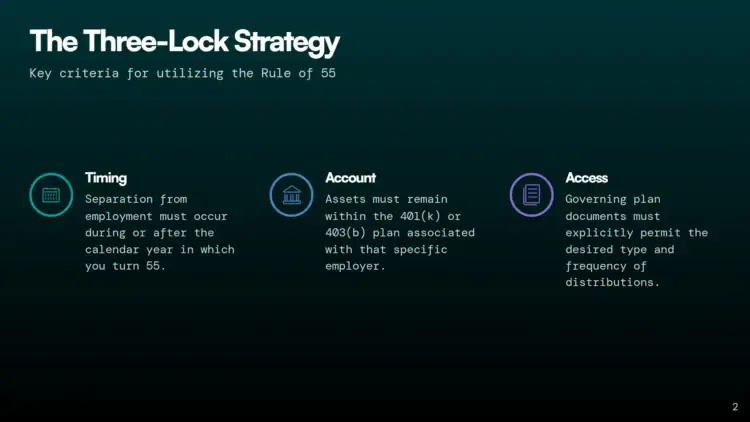
Use the three-lock test:
- Timing: Did you separate during or after the calendar year you turned 55?
- Account: Is the money still in a plan tied to that qualifying separation?
- Access: Will the plan let you withdraw it in a useful way?
Then decide how much to take without creating a larger tax, healthcare or portfolio problem.
The Rule of 55 is not a reason to retire. It is an option worth preserving while you determine whether retirement actually works.
Sources
- U.S. Code, 26 U.S.C. §72(t)
- IRS: Exceptions to Tax on Early Distributions
- IRS: When Can a Retirement Plan Distribute Benefits?
- IRS Publication 575: Pension and Annuity Income
- IRS: Designated Roth Account Rules
- IRS Publication 721: U.S. Civil Service Retirement Benefits
- Retirement Learning Center: Rule of 55 and Watson v. Commissioner
- U.S. Tax Court: Summary Opinions Are Not Precedent
- Schwab: When Can You Withdraw? 401(k)s and the Rule of 55
- IRS Internal Revenue Bulletin 2026-06: Current Guidance on Early-Distribution Exceptions
- IRS Instructions for Form 5329: Exceptions to the Additional Tax on Early Distributions
How We Verified This
The Rule of 55 is a tax exception, so the controlling rules were checked against the Code and current IRS guidance before the provider explanations were used for context.
