
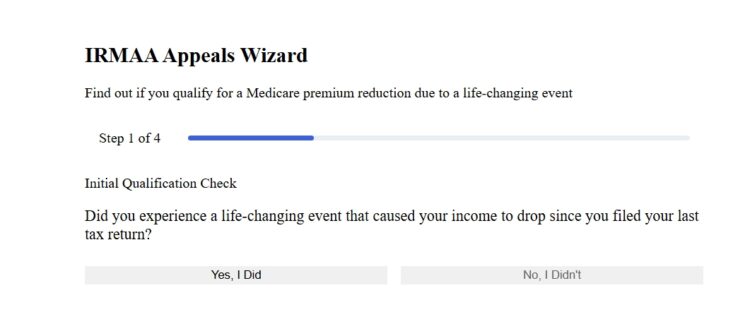
An IRMAA life-changing event is not simply “my income went down.” Social Security uses a specific list of eight events for the SSA-44 life-changing-event route. Even when your event is on that list, the second question is whether it actually reduced your modified adjusted gross income (MAGI), changed your tax filing status in a way that changes the applicable IRMAA threshold table, or both.
That is the job of this page. It does not try to replace Social Security or walk you through every box on Form SSA-44. It helps you diagnose the lane first, because an amended return, corrected IRS data, older tax information, or a voluntary one-time income spike can require a different IRMAA path.
1. Did one of SSA’s eight recognized events happen?
2. Did it reduce MAGI or change filing status in a way that can change IRMAA?
3. Do you have a newer filed return or a supportable estimate for the tax year SSA should consider?
If you get stuck at a gate, that is usually the next fact to solve before you worry about the form.
On This Page
- Use the IRMAA Life-Changing-Event Router
- Which Eight IRMAA Life-Changing Events Does SSA Recognize?
- Can an Older Life-Changing Event Still Count?
- Why a Recognized Event Is Only the First Gate
- What Evidence Should You Expect to Need?
- What If Your IRMAA Problem Is Not a Life-Changing Event?
- Where Should You Go After the Router?
- Choose the IRMAA Problem You Actually Have
- The Bottom Line
- IRMAA Life-Changing-Event Tool FAQ
- How We Verified This
Use the IRMAA Life-Changing-Event Router
The router below is educational decision support. It does not calculate your final Medicare premium, certify that you qualify, or make an SSA determination. It stops as soon as it has enough information to give you a useful next step.
Is SSA-44 the right lane?
Start with the event. The tool stops as soon as it has enough information to give you a useful next step.
No account connection. Your answers stay in your browser.
Question 1 of up to 3
This distinction matters more than it sounds. Search results, forums, and even casual explanations often collapse “appealing IRMAA” into one process. SSA actually has several reasons it may use newer or corrected information. The life-changing-event route is only one of them.
Do not start with “How do I appeal IRMAA?” Start with “Why is the information SSA used no longer the right information?” If the answer is a recognized life-changing event that changed MAGI or filing status, SSA-44 becomes the natural next lane. If the reason is something else, forcing it into SSA-44 can waste time.
Which Eight IRMAA Life-Changing Events Does SSA Recognize?
SSA’s current policy lists eight life-changing events for this type of new initial IRMAA determination:
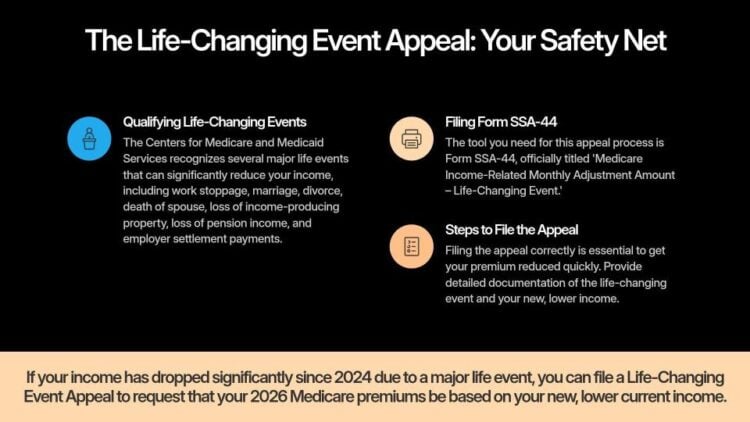
- Death of a spouse
- Marriage
- Divorce or annulment
- Work reduction
- Work stoppage, including retirement when the work actually stops
- Loss of income-producing property under qualifying circumstances outside your control
- Loss or reduction of employer pension income
- Receipt of a qualifying employer settlement payment
SSA POMS HI 01120.005 lists those categories and also gives examples of events that do not qualify. A voluntary sale of income-producing property is not the same as a qualifying property loss. A capital gain, lottery win, casino win, IRA conversion, or bond redemption does not become a life-changing event merely because it temporarily raised MAGI.
“My income went down” is not itself one of the eight events. You can have a very real income drop without fitting the SSA-44 life-changing-event lane. That does not automatically mean SSA has no way to revisit the determination. It means you need the right reason and the right process.
Can an Older Life-Changing Event Still Count?
Yes, potentially. This is one of the most misunderstood parts of the rule.
The normal IRMAA calculation often starts with tax information from about two years before the premium year. That does not mean the life-changing event itself must have happened within the previous two years. SSA policy says the event can have occurred earlier, as long as it occurred before and actually caused the later MAGI reduction or filing-status change being used for the new determination.
The current SSA-44 instructions make the same timing point another way. The event date must be in the same year as, or an earlier year than, the more recent tax year you are asking SSA to use. So an old retirement, spouse’s death, or other recognized event is not automatically disqualified because the calendar has moved on. The causation still matters.
The event opens the lane. The newer income and filing status determine where that lane leads.
The event date is not a magic expiration clock. The useful question is whether that event is what caused the lower MAGI or changed filing status SSA should now consider.
Why a Recognized Event Is Only the First Gate
A recognized event gives SSA a reason to consider more recent information. It does not guarantee a lower premium.
SSA describes a significant MAGI reduction as one that decreases or eliminates IRMAA for the premium year. A filing-status change can also matter when it moves you to a different threshold table. If the newer income still produces the same IRMAA result, the event can be genuine without producing much or any premium reduction.
This is why the router asks about the financial effect rather than stopping after the event checkbox. A checkbox-only “eligibility quiz” would sound confident while skipping the part that actually determines whether newer information changes the surcharge.
What Evidence Should You Expect to Need?
Think in two buckets. SSA generally needs evidence that the life-changing event happened and evidence of the more recent MAGI and filing status you want it to use.
- Event evidence: documentation appropriate to the event, such as a marriage certificate, divorce decree, death evidence, employer documentation for work reduction or stoppage, pension-plan documentation, property-loss evidence, or employer-settlement documentation.
- Income evidence: a more recent filed federal tax return when available, or a reasonable supported estimate when the return for the year SSA should use has not yet been filed.
The current Form SSA-44 instructions specifically allow actual or estimated AGI and tax-exempt interest for the more recent year. If you use an estimate, SSA expects you to provide the filed return when it becomes available.
If you are not sure what belongs in IRMAA MAGI, use my IRMAA MAGI guide before guessing. MAGI for this purpose is generally adjusted gross income plus tax-exempt interest, not taxable income and not simply whatever amount feels like “retirement income.”
What If Your IRMAA Problem Is Not a Life-Changing Event?
This is one of the most valuable results the tool can give you: SSA-44 may be the wrong lane.
SSA separately recognizes situations involving an amended tax return, corrected IRS information, or cases where it used older tax data even though newer tax data is available. Those are new-determination situations, but they are not the same thing as claiming one of the eight life-changing events.
A voluntary capital gain, Roth conversion, large IRA withdrawal, lottery win, or similar one-time income spike also generally does not become a life-changing event just because it caused IRMAA. If that is the real problem, use my IRMAA one-time income spike guide instead of inventing an SSA-44 category that does not fit.
For the agency’s current starting point, see Social Security’s request-to-lower-IRMAA page.
Where Should You Go After the Router?
Once you know the lane, the rest of the site can do the deeper job without making this page bloated.
- Divorce or death of a spouse: use the divorce/death IRMAA guide for the event-specific timing and evidence issues.
- Recognized event plus a likely MAGI or filing-status effect: use the SSA-44 form guide for the actual filing procedure.
- Not sure about MAGI: use the IRMAA MAGI guide.
- Need the current 2026 surcharge table: use the 2026 IRMAA brackets guide.
- Planning future years instead of fixing this one: use How to Avoid IRMAA.
