

The 4% rule is a retirement-withdrawal starting point, not a promise. The basic idea is simple: withdraw 4% of your portfolio in the first year of retirement, then adjust that dollar amount for inflation in later years. But your actual spending plan also depends on retirement length, asset allocation, market returns, inflation, fees, taxes, guaranteed income, and how willing you are to cut spending after a bad market.
That last piece matters more than it gets credit for. A retiree who can trim travel or other discretionary spending after a rough year has a different plan from someone whose portfolio must cover nearly every dollar of essential spending no matter what markets do.
Quick Answer
The 4% rule means taking 4% of your starting portfolio in year one and then adjusting that withdrawal amount for inflation each year. On a $1 million portfolio, the first withdrawal is $40,000. It was built around a roughly 30-year retirement, so treat it as a benchmark—not an automatic “safe” number for every retiree.
On This Page
- 4% Rule & Retirement Withdrawal Stress Test
- Key Takeaways Ahead
- How the 4% Rule Works
- What the 4% Rule Does—and Does Not—Promise
- Is 4% Still a Good Retirement Withdrawal Rate in 2026?
- Why Sequence Risk Matters So Much
- When a Flexible Withdrawal Strategy Can Help
- How Guardrails Work
- How Much Can You Withdraw From 0,000, Million, or Million?
- How to Stress-Test Your Retirement Withdrawal Plan
- Frequently Asked Questions
- The Bottom Line
- Sources
4% Rule & Retirement Withdrawal Stress Test
Stress-test how a starting withdrawal rate interacts with stock exposure, retirement length, and your ability to reduce spending after difficult markets. This is a trade-off model, not a prediction of portfolio success.
Your Withdrawal Trade-Off
What This Combination Means
What matters most in this combination
Stress-test question
Use the tool above as a stress test. Change the withdrawal rate, stock exposure, retirement horizon, and spending flexibility. If a small change moves the result from moderate to elevated pressure, that sensitivity is part of the answer.
Key Takeaways Ahead
How the 4% Rule Works
The rule is often misunderstood as “take 4% of whatever your account is worth every year.” That is not the classic version.
- Year 1: withdraw 4% of the portfolio value at retirement.
- Year 2 and later: adjust the prior year’s dollar withdrawal for inflation.
- Do not automatically reset to 4% of the new balance every year. A percentage-of-current-balance strategy is a different withdrawal method.
| Starting portfolio | 4% first-year withdrawal | Monthly equivalent |
|---|---|---|
| $500,000 | $20,000 | $1,667 |
| $750,000 | $30,000 | $2,500 |
| $1,000,000 | $40,000 | $3,333 |
| $1,500,000 | $60,000 | $5,000 |
| $2,000,000 | $80,000 | $6,667 |
Those amounts are portfolio withdrawals before taxes. Social Security, pensions, annuities, rental income, and other cash flow can reduce how much you need from investments.
What the 4% Rule Does—and Does Not—Promise
William Bengen’s original 1994 research tested historical retirement periods and found that an inflation-adjusted withdrawal beginning around 4% had survived the historical 30-year periods he studied under the portfolio assumptions used in the research.
That was valuable research. It was never a guarantee that every retiree can withdraw exactly 4%, increase spending every year, and stop thinking about the plan.
What 4% Does Not Mean
It does not mean you earn 4% a year. It does not mean you withdraw 4% of the current balance every year. It does not guarantee the portfolio lasts forever. And it does not automatically account for your taxes, fees, healthcare costs, retirement age, Social Security, pension income, or willingness to cut spending.
Is 4% Still a Good Retirement Withdrawal Rate in 2026?
It is still a useful benchmark, but I would not treat 4% as a universal safe rate.
Morningstar’s current retirement-income research estimates a 3.9% starting withdrawal rate for its base case: a 30-year retirement, inflation-adjusted spending, a 90% probability of funds remaining, and the study’s forward-looking return assumptions. That is remarkably close to 4%, but the assumptions matter.
The same research also found that more flexible spending methods can support higher initial withdrawals because the retiree agrees to adjust spending when portfolio conditions change. In other words, there is no free lunch: higher starting spending generally buys you less certainty or more future flexibility.
Michael’s Take
The debate over 3.9% versus 4.0% can become a distraction. A tenth of a percentage point matters much less than whether your plan can survive a bad first five years, unexpected inflation, higher taxes, or a retirement that lasts longer than you modeled.
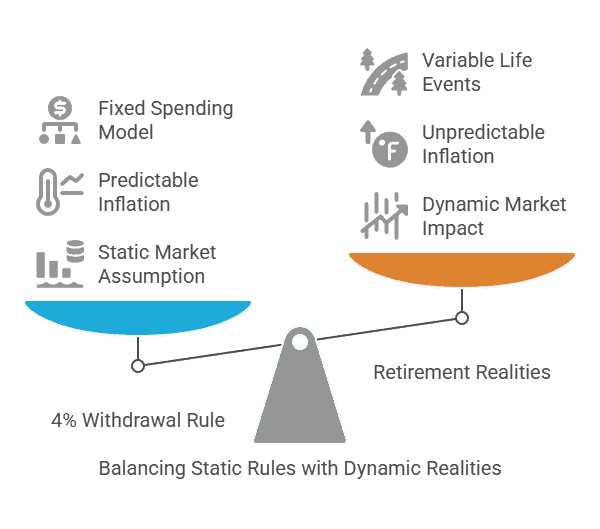
Why Sequence Risk Matters So Much
Two retirees can earn the same average return and still have very different outcomes if the bad years arrive at different times.
If the market falls early in retirement while you are also taking withdrawals, you may have to sell more shares at depressed prices. That leaves fewer shares participating in the recovery. This is sequence-of-returns risk.
Morningstar’s 2026 research specifically found that poor returns in the first five years were much more dangerous when retirees did not reduce spending. That is why a retirement plan needs more than an average-return assumption.
Inflation can create a second early-retirement shock
The classic 4% method increases the withdrawal amount with inflation. That protects purchasing power, but a burst of inflation early in retirement can force larger withdrawals at exactly the wrong time.
The answer is not to ignore inflation. It is to recognize that the combination of weak markets + high inflation + rigid spending can be much harder on a portfolio than any one of those problems by itself.
When a Flexible Withdrawal Strategy Can Help
A flexible withdrawal plan starts with a simple admission: retirement spending is not perfectly flat.
Housing, food, insurance, and basic healthcare may be hard to cut. Travel, gifts, dining, vehicle replacements, and other discretionary expenses may have more room. That distinction matters because a flexible strategy only works if the spending cuts are actually possible when the rule calls for them.
| Approach | Main advantage | Main trade-off |
|---|---|---|
| Fixed real spending | Predictable inflation-adjusted cash flow | Less responsive to poor markets |
| Percentage of current balance | Automatically reduces withdrawals after losses | Income can fluctuate substantially |
| Guardrails | Allows raises and cuts within preset rules | Requires annual monitoring and willingness to act |
How Guardrails Work
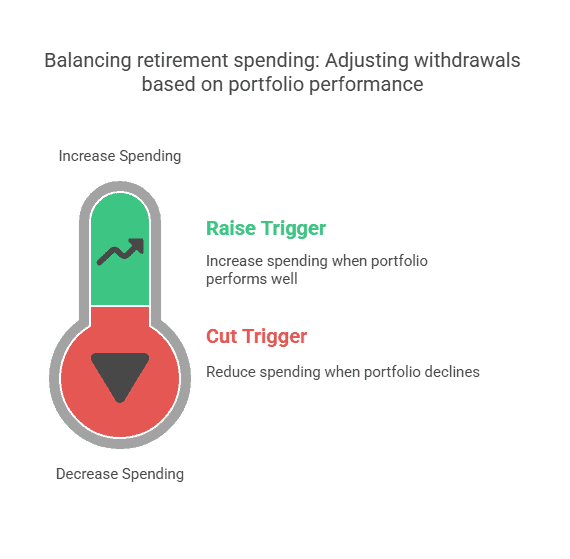
Jonathan Guyton and William Klinger developed one of the best-known guardrail approaches. Instead of blindly increasing spending every year, the method compares the planned withdrawal with the current portfolio and uses preset rules to determine when spending should rise, stay flat, or fall.
Morningstar’s current explanation of the strategy describes a 20% guardrail around the initial withdrawal percentage. If the current withdrawal percentage moves far enough below the starting rate after strong markets, spending may receive an additional increase. If it moves far enough above the starting rate after poor markets, the strategy calls for a reduction.
The Catch
A guardrail is only useful if you will follow it. If the plan assumes you can cut discretionary spending by 10% after a bad market and you know you would refuse to make that cut, model the plan with less flexibility from the beginning.
How Much Can You Withdraw From $500,000, $1 Million, or $2 Million?
Searches for the 4% rule often boil down to a dollar question. The first-year math is easy; deciding whether that amount fits your retirement is the harder part.
| Portfolio | 3.5% | 4.0% | 5.0% |
|---|---|---|---|
| $500,000 | $17,500 | $20,000 | $25,000 |
| $1,000,000 | $35,000 | $40,000 | $50,000 |
| $2,000,000 | $70,000 | $80,000 | $100,000 |
A $1 million portfolio does not automatically mean a $40,000 lifestyle. Add Social Security and pension income, then subtract taxes, healthcare, housing, and other spending. The decision is whether the portfolio-funded gap is reasonable for the plan—not whether you happen to own a round-number portfolio.
How to Stress-Test Your Retirement Withdrawal Plan
I would rather see three imperfect scenarios than one beautifully precise forecast.
- Base case: use the withdrawal rate, allocation, retirement length, and spending flexibility you currently expect.
- Rough-start case: assume weaker early returns, higher inflation, or a larger-than-expected expense.
- Adaptation case: keep the tougher assumptions, then test a spending cut, part-time income, later Social Security, or another lever you could realistically use.
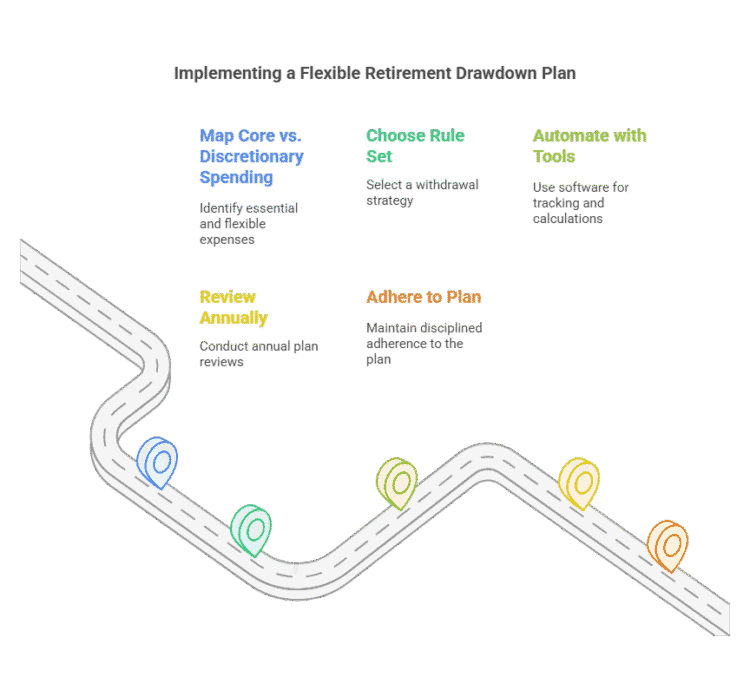
Then ask the practical questions the percentage cannot answer: Which expenses could you cut? Which ones cannot move? How much reliable income arrives later? What taxes apply to the accounts funding the withdrawals? How many years does the portfolio need to last?
Frequently Asked Questions
Why does the 4% rule no longer work for some retirees?
The 4% rule can still be a useful benchmark, but it may be a poor fit when retirement is much longer than 30 years, spending is inflexible, taxes or fees are high, the portfolio differs from the assumptions behind the research, or poor returns and high inflation arrive early.
How long will $1 million last using the 4% rule?
The classic 4% rule was designed around a 30-year retirement framework, but it does not guarantee that every $1 million portfolio will last exactly 30 years. The result depends on returns, inflation, asset allocation, fees, taxes, and future spending adjustments.
Is 4% of $1 million $40,000 a year?
Yes. Four percent of $1 million is $40,000. Under the classic rule, that is the first-year withdrawal before taxes; later withdrawals are adjusted from that dollar amount for inflation.
Does the 4% rule include Social Security?
No. The 4% calculation applies to portfolio withdrawals. Social Security, pensions, annuities, and other reliable income should be modeled separately because they can reduce the amount your investments need to provide.
Is 5% too much to withdraw in retirement?
Not automatically, but a 5% starting withdrawal creates more spending pressure than 4% under otherwise identical assumptions. Flexible strategies may support higher starting withdrawals in some scenarios, but usually with more variable future spending or a lower margin of safety.
What is a safe withdrawal rate by age?
Age alone is not enough. A useful withdrawal rate also depends on expected retirement length, asset allocation, guaranteed income, spending flexibility, fees, taxes, and goals for leaving money behind. Someone retiring at 50 may need a much longer horizon than someone retiring at 75.
The Bottom Line
The 4% rule deserves its popularity because it gives retirees a simple place to begin. The mistake is turning a starting point into an autopilot setting.
Start with the percentage. Then test the retirement length, stock exposure, inflation, reliable income, taxes, fees, and—especially—how much spending could actually change after a bad market.
A good retirement withdrawal plan is not the one with the prettiest percentage. It is the one you can still follow when the first few years do not cooperate.
