
Let’s stop guessing about your risk tolerance. After nearly 30 years in financial planning, one pattern showed up repeatedly. People often feel comfortable with risk while markets are rising, then discover their real tolerance only after a sharp decline.
Most investors have no idea what their true risk tolerance is until it’s too late.
They take a simple online risk tolerance quiz, get labeled “aggressive,” and pile into stocks, feeling invincible during a bull market. Then, the first 20% drawdown hits, and that paper-tiger courage evaporates. They panic-sell at the bottom, locking in devastating losses. I
I’ve seen it happen dozens of times. This isn’t just an article defining a term. This is a playbook forged from decades of real-world experience, designed to help you avoid that fate.
We’re going to dismantle the myths pushed by “finfluencers” and oversimplified quizzes. We’ll replace them with a professional framework—the same one I used with my clients. That aligns with regulator standards from the SEC and FINRA and is grounded in the hard truths of behavioral finance.
We will move beyond one-dimensional thinking and explore the three critical pillars of your investor profile:
- Risk Tolerance (Your Willingness)
- Risk Capacity (Your Ability)
- Risk Composure (Your Real-World Behavior)
By the end of this guide, you won’t just have a label; you’ll have a deep understanding of your financial DNA and a practical workflow to build an asset allocation you can actually stick with, in good times and bad.
On This Page
- Key Takeaways Ahead
- The 3-D Risk Framework: Tolerance vs. Capacity vs. Composure
- How to Actually Determine Your 3-D Risk Profile: A Regulator-Aligned Workflow
- How to Determine Your True Risk Tolerance (An Interactive Analysis)
- Building a Portfolio You Can Stick With
- What a Durable Risk Plan Looks Like
- Your Risk Tolerance Next Steps: From Guesswork to a Bulletproof Financial Plan
Key Takeaways Ahead
The 3-D Risk Framework: Tolerance vs. Capacity vs. Composure
For years, the industry used “risk tolerance” as a catch all term. It’s dangerously incomplete. To build a durable portfolio, you must analyze your profile in three dimensions.

Take our free Risk Tolerance Questionnaire here
Client Story: When Investment Tolerance of Risk & Capacity Collide
Consider a hypothetical couple. One spouse has a high, stable income and enough financial cushion to absorb a major portfolio decline, which means strong risk capacity. The other spouse is deeply uncomfortable with losses and has much lower risk tolerance.
If a portfolio is built only around the household’s financial capacity and ignores the more cautious spouse’s emotional tolerance, an aggressive stock allocation may be mathematically affordable but behaviorally unsustainable.
During a serious market decline, that mismatch can lead to panic selling at exactly the wrong time. The lesson is simple. A portfolio must fit both the household’s financial ability to take risk and the people who actually have to live through the losses.
This is why regulators like FINRA and the SEC mandate a suitability assessment it’s about aligning the math with the person.
Why You Don’t Know Your Risk Tolerance (And Neither Does a 5-Minute Quiz)
The biggest problem with determining risk tolerance is that our brains are wired to be terrible investors.
The most powerful bias is Loss Aversion. As their Nobel Prize-winning Prospect Theory explains, the psychological pain of losing $1,000 is about twice as powerful as the pleasure of gaining $1,000. This is why people who claim to be “aggressive” in a rising market suddenly become terrified conservatives the moment their portfolio turns red.
How to Actually Determine Your 3-D Risk Profile: A Regulator-Aligned Workflow
Professionals operating under a best interest standard (like Regulation Best Interest in the U.S. or MiFID II in the EU) can’t just rely on a simple quiz. We use a multi-step process to build a comprehensive client profile. Here’s how you can do it for yourself.
Step 1: Assess Your Risk Tolerance (Willingness)
Start with a quality investor questionnaire. The one from Investor.gov, an official SEC site, is a great, unbiased starting point. But I have a better tool for you in a minute…
Answer honestly. This gives you a baseline label: Conservative, Moderate, or Aggressive.
Step 2: Calculate Your Risk Capacity (Ability)
Now, ignore the quiz results and do the math. This is about your capacity for loss.
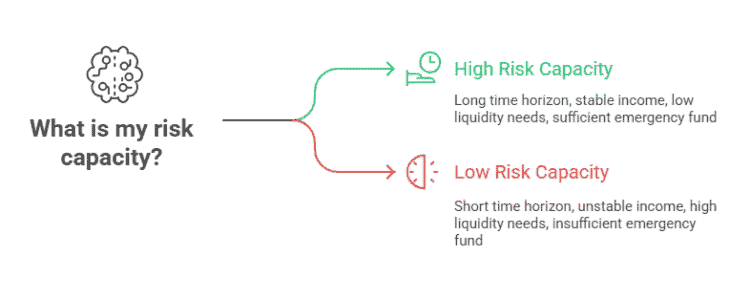
- Time Horizon:
How long until you need this money? More than 10 years gives you high capacity; less than 5 years is low. - Income Stability & Human Capital:
Is your job secure? A tenured professor has higher capacity than a freelance artist. - Liquidity Needs:
Do you have major expenses coming up (college, down payment)? This reduces your capacity. - Emergency Fund:
Do you have 3-6 months of living expenses in cash? If not, your capacity for investment risk is very low.
Step 3: Test Your Risk Composure (Behavior)
This is the step that separates amateurs from serious investors. This is the step that separates amateurs from serious investors, focusing on what financial planner Michael Kitces has termed risk composure.
- The -30% Stress Test:
Open your latest investment statement. Multiply the total by 0.70.
Write that number down. Imagine that is your new balance tomorrow.
How does that physically feel? Be honest. If your stomach churns, your composure is lower than you think. - What did you actually do during a past market shock such as 2008, March 2020, or another sharp drawdown you lived through? Did you sell, freeze, rebalance, or keep contributing? Your real behavior under stress is more informative than the answer you wish you would give on a questionnaire.
How to Determine Your True Risk Tolerance (An Interactive Analysis)
You can determine your true risk tolerance by analyzing three distinct dimensions of your investor profile: your emotional willingness to take risks (Tolerance), your financial ability to withstand losses (Capacity), and your likely behavior during a market crash (Composure). This professional 3-step analysis prevents the #1 mistake I’ve seen in my career: overestimating your courage and panic-selling at the worst possible time.
The interactive tool below will guide you through this process:
- The Gut Check: You’ll answer two questions to establish your baseline emotional comfort with market volatility.
- The Reality Check: You’ll use sliders to calculate your financial capacity based on your time horizon, emergency fund, and income stability.
- The Fire Drill: You’ll face a crisis scenario to test your behavioral composure and reveal how you’d likely act under extreme pressure.
Based on your inputs, the analyzer will generate your unique 3D Risk Profile, my personal “Advisor’s Take” on your results, and a suggested starting asset allocation. Begin the analysis below to get your personalized results in under 2 minutes.
The 3D Risk Profile Analyzer
Explore three separate dimensions of investment risk: your willingness to accept volatility, your financial ability to absorb losses, and your likely behavior during difficult markets.
Your 3D Risk Profile
Illustrative allocation range
Michael’s perspective
What to examine before choosing an allocation
Building a Portfolio You Can Stick With
Once you have your 3-D profile, you can build an asset allocation that fits. This involves diversification across different asset classes.
- Conservative Profile:
Often 20-40% stocks, 60-80% bonds and cash. Focus is on wealth preservation and avoiding volatility. - Moderate Profile:
Typically a 50/50 or 60/40 mix of stocks and bonds. A balance between growth and stability. - Aggressive Profile:
80-100% in stocks. For investors with high tolerance, high capacity, and proven composure over a long time horizon.
Related Reading You Might Enjoy

What a Durable Risk Plan Looks Like
Risk tolerance becomes useful only when it changes the portfolio you can realistically stick with. A durable plan combines willingness, financial capacity, and behavior under stress.
For example, two investors can hold the same stock-and-bond mix and still need different plans. The investor with a long horizon, strong cash reserves, and a history of staying disciplined during declines may be able to tolerate more volatility than someone who needs near-term withdrawals or repeatedly sells when markets fall.
Why could I do that? Because I followed my own 3-D framework:
Tolerance:
Use your actual reaction to previous losses as evidence. If a 15% or 20% decline would make you abandon the plan, build that reality into the allocation before the decline happens.
Capacity:
Capacity depends on your time horizon, spending needs, emergency reserves, debt, income stability, and how soon you may need portfolio withdrawals.
Composure:
Composure is behavioral. Look at what you have actually done during stressful markets, not what a quiz says you intend to do.
That’s the practical value of knowing your true risk tolerance. You make the allocation decision before the next crisis, when you are calm, instead of improvising after losses have already arrived.
Your Risk Tolerance Next Steps: From Guesswork to a Bulletproof Financial Plan
Understanding your risk profile is the most important step in your investment journey. It’s more critical than picking the hot stock of the day and more impactful than timing the market. It is the foundation upon which your entire financial plan rests.
By moving beyond a simple quiz and embracing the 3-D framework of Tolerance, Capacity, and Composure, you stop being a passenger in your financial life and become the pilot. You create an Investment Policy Statement (IPS), a personal set of rules, that guides your decisions not based on fear or greed, but on a deep, honest assessment of who you are and what you can handle.
This is how you build a portfolio that lets you sleep at night. This is how you stay the course during the next inevitable market storm—whether it’s driven by tariffs, AI disruption, or geopolitical shocks. As we navigate 2026 with continued uncertainty around interest rates, inflation, and policy volatility, the investors who win won’t be the ones with the highest risk tolerance on paper. They’ll be the ones who combined honest self-assessment with the discipline to stick to their plan when everyone else is panicking. This is how you win.
Take our FREE Risk tolerance questionnaire and let us know where you stand?
