
Delaying Social Security can create more room for Roth conversions before benefits begin. But it can also produce a larger taxable benefit later. Claiming at 62 can reduce that conversion room, yet it may lower withdrawals from other accounts. That is why IRMAA should be modeled as one cost inside the Social Security decision, not used as the reason to claim early or late by itself.
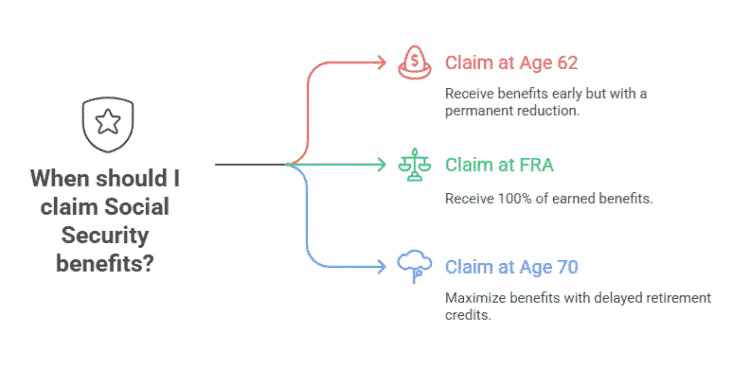
If you were born in 1960 or later, Social Security says your full retirement age is 67. Claiming at 62 permanently reduces the worker benefit, while delaying from 67 to 70 increases it through delayed retirement credits. The tax question is what happens to the rest of your retirement income while you wait.
Quick Answer
For many retirees with large tax-deferred balances, delaying Social Security can preserve a valuable low-income window for Roth conversions. But there is no universal “delay to avoid IRMAA” rule. The right comparison includes lifetime Social Security, survivor benefits, taxable Social Security, Roth conversions, portfolio withdrawals, future RMDs, Medicare IRMAA, and longevity.
On This Page
- Key Takeaways Ahead
- How Social Security Secretly Feeds the IRMAA Engine
- The Strategic Conflict: Claiming at 62 vs. Delaying to 70
- The Real-World Impact: Why the Conversion Window Matters
- So, When Should You Claim at 62?
- Frequent Reader Questions About Social Security Timing and IRMAA
- Final Recommendations: Coordinate the Claiming Decision, Conversion Window, and IRMAA
- Sources
Key Takeaways Ahead
How Social Security Secretly Feeds the IRMAA Engine
IRMAA is based on Medicare modified adjusted gross income, which starts with adjusted gross income and adds tax-exempt interest. Social Security is not simply dumped into MAGI dollar for dollar. Instead, the taxable portion of your benefit enters adjusted gross income.
The IRS uses a separate Social Security tax calculation based on one-half of benefits plus other income and tax-exempt interest. Depending on filing status and income, up to 85% of Social Security benefits can be taxable. See IRS Publication 915 and my deeper guide to Social Security taxation and the IRMAA interaction.
The Social Security Tax Thresholds Are Not IRMAA Thresholds
These are two different systems. For Social Security taxation, the IRS base amounts are $25,000 for most single filers and $32,000 for married couples filing jointly; higher income can make up to 85% of benefits taxable. IRMAA uses a much higher MAGI scale. For 2026, the first Part B IRMAA tier begins above $109,000 single or $218,000 married filing jointly.
That distinction matters because a Social Security claiming decision can raise taxable income without necessarily causing IRMAA, while a Roth conversion can push MAGI across an IRMAA threshold even before Social Security starts. Use my IRMAA income guide or IRMAA calculator when you need to isolate that Medicare cost.
The Strategic Conflict: Claiming at 62 vs. Delaying to 70
Here is the key correction to a lot of casual retirement advice: claiming Social Security early usually does not create more Roth-conversion room. Delaying it often does. When benefits have not started, there is one less income stream competing for tax-bracket and IRMAA space.
| Path | Potential Advantage | Potential Cost |
|---|---|---|
| Claim at 62 | Cash flow arrives earlier and may reduce withdrawals from investments or tax-deferred accounts. | Permanent benefit reduction; taxable benefits can consume Roth-conversion and IRMAA room. |
| Delay to FRA | Larger monthly benefit and more pre-benefit years for conversions. | More portfolio funding may be needed before benefits begin. |
| Delay to 70 | Highest worker benefit; delayed retirement credits continue after FRA until 70; potentially larger survivor benefit. | Largest future taxable benefit and more years that must be funded from the portfolio. |
For someone born in 1960 or later, SSA shows age 67 as full retirement age and age 70 as 124% of the full-retirement-age benefit. Claiming as early as 62 produces a permanent reduction. That guaranteed-benefit trade-off deserves at least as much weight as an estimated future Medicare surcharge.
Social Security Retirement Income Estimator
Compare estimated monthly retirement benefits at age 62, full retirement age, and age 70 using an SSA estimate or a rough covered-earnings model.
Estimated Retirement Benefits
Estimated monthly benefit by claiming age
How the estimate was calculated
What to consider before choosing a claiming age
Get your official estimate
Your personal Social Security account uses your actual indexed earnings record and is the appropriate source for a personalized benefit estimate.
Open my Social SecurityThe Real-World Impact: Why the Conversion Window Matters
Consider a hypothetical 62-year-old retiree with a large traditional IRA, taxable savings available for living expenses, and no wages. If Social Security is delayed, those pre-benefit years may be unusually attractive for Roth conversions because salary is gone and Social Security has not yet entered the tax return.
That does not make “convert as much as possible” the answer. Roth conversions themselves increase adjusted gross income. After Medicare begins, a conversion can trigger IRMAA two years later. Before Medicare, the same conversion may affect Affordable Care Act subsidies. The useful question is therefore how much to convert each year, not whether a conversion window exists.
To put dates on that two-year Medicare lookback, use the Roth conversion timing window guide to map each conversion tax year to its potential Medicare premium year.
The RMD side also needs current rules. Under SECURE 2.0, the applicable RMD age is generally 73 for people who reach age 73 before 2033, while people who reach age 74 after 2032 generally have an applicable age of 75. A 62-year-old in 2026 is therefore not automatically facing an RMD at 73. The birth year matters.
Michael’s Rule
Do not optimize Social Security and Roth conversions in separate spreadsheets. Social Security changes the income floor. Conversions change future RMDs. Both can change Medicare premiums. The useful model is one timeline showing all three.
So, When Should You Claim at 62?
Claiming at 62 can be reasonable, but “I have a large IRA” is not enough. I would look for a combination of reasons that actually favor earlier income.
- Shorter life expectancy or serious health concerns: the value of waiting falls when the probability of collecting the larger benefit for many years falls.
- Real cash-flow need: taking Social Security may prevent costly debt or forced sales from a depleted portfolio.
- Portfolio-risk concerns: early benefits can reduce withdrawals during a bad market, although this must be weighed against the permanently smaller guaranteed benefit.
- Spousal strategy: the household decision can differ from the worker-only decision, especially when the higher earner’s benefit may become the survivor benefit.
- Tax modeling actually favors it: in some cases, early Social Security can reduce withdrawals from traditional accounts enough to offset part of the additional taxable benefit.
What I would not use as a standalone reason is “I want to avoid IRMAA.” IRMAA is a one-year Medicare premium consequence tied to MAGI. A Social Security election can last for decades. The scales are different.
For the broader claiming decision—longevity, break-even age, spouses, survivor benefits, and work status—see When to Claim Social Security: My 5-Step Guide. For conversion mechanics, see Roth IRA conversions.
Frequent Reader Questions About Social Security Timing and IRMAA
Does delaying Social Security help avoid IRMAA?
It can create more MAGI room before benefits start, which may help with Roth-conversion planning. But the conversions themselves can trigger future IRMAA, and the larger delayed Social Security benefit can raise taxable income later. Delaying solely to avoid IRMAA is too narrow a rule.
Does Social Security count toward IRMAA income?
The taxable portion of Social Security enters adjusted gross income and can therefore affect Medicare MAGI. Social Security is not counted dollar for dollar; depending on your other income and filing status, up to 85% of benefits may be taxable.
Should I claim at 62 so I can do Roth conversions?
Usually that logic is backward. Starting Social Security generally adds taxable income and can reduce conversion room. Delaying benefits often preserves more room for conversions, although your complete cash-flow and tax picture can produce exceptions.
Can a Roth conversion trigger IRMAA?
Yes. A Roth conversion is generally included in adjusted gross income. If the conversion pushes Medicare MAGI above an IRMAA threshold, it can raise Part B and Part D costs two years later under the normal lookback process.
Do RMDs always start at 73 now?
No. Under SECURE 2.0, the applicable RMD age depends on birth year. Many people now have age 73, while younger retirees can have age 75. Use your birth year before building a Social Security-versus-RMD timeline.
Final Recommendations: Coordinate the Claiming Decision, Conversion Window, and IRMAA
- Start with the Social Security decision. Compare age 62, full retirement age, and 70 using your actual benefit record and household longevity/survivor needs.
- Map the low-income years. Identify the years after wages stop but before Social Security and RMDs begin.
- Layer Roth conversions into that window. Test conversion amounts against federal/state tax brackets, Medicare IRMAA, and any ACA subsidy exposure.
- Model RMD age correctly. Use your birth year rather than assuming everyone starts at 73.
- Measure lifetime after-tax cash flow. A one-year IRMAA surcharge can be worth paying if the conversion materially lowers future taxes and RMDs.
