

For a federal retiree, IRMAA is usually a timing problem before it is a Medicare problem. Social Security generally uses tax information from two years earlier to determine the income-related surcharge on Medicare Part B and Part D. So a taxable TSP move you make in 2026 can generally affect your 2028 Medicare premiums.
That is the part people miss. Your TSP decision happens in one calendar year. IRMAA usually sends the bill two years later. By then, your work status, FEHB coverage and Medicare enrollment may have changed completely.
In planning conversations, I have seen federal employees focus on the immediate tax bill from a TSP move and miss the Medicare premium year waiting behind it. The better question is not simply, “How do I avoid IRMAA?” It is: What will this move do to my total MAGI, which Medicare year will it reach, and is that extra cost worth the reason I am making the move?
Quick Answer
IRMAA is an income-related Medicare premium surcharge, not a separate tax. For Medicare purposes, Social Security generally looks back two years at your modified adjusted gross income, or MAGI. A taxable Traditional TSP distribution can increase that MAGI and potentially move you into a higher IRMAA tier, while a qualified Roth TSP distribution generally does not increase gross income. Federal retirees should map the tax year, the future Medicare premium year and their FEHB/Medicare status before making a large TSP move.
On This Page
- Key Takeaways Ahead
- How Federal Retiree IRMAA Works: One Tax Year, One Future Premium Year
- How TSP Withdrawals and Roth Moves Affect IRMAA
- How FEHB and Medicare Part B Change the IRMAA Decision
- A 4-Step Federal Retiree IRMAA Planning Sequence
- Federal Retiree IRMAA FAQs
- The Bottom Line: Plan the Calendar, Not Just the Withdrawal
Key Takeaways Ahead
How Federal Retiree IRMAA Works: One Tax Year, One Future Premium Year
IRMAA stands for Income-Related Monthly Adjustment Amount. It is an additional amount paid with Medicare Part B and, when applicable, Part D by beneficiaries whose income exceeds annual thresholds.
For 2026, the Centers for Medicare & Medicaid Services says the standard Part B premium is $202.90 per month. IRMAA begins above $109,000 of MAGI for most individual filers and $218,000 for married couples filing jointly. Higher tiers raise the Part B premium and can also add a Part D adjustment.
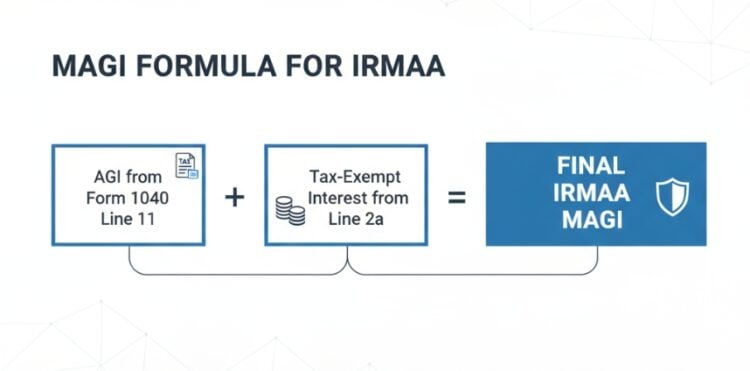
For IRMAA, Social Security defines MAGI as adjusted gross income plus tax-exempt interest. If you want the fuller income-by-income breakdown, see What Income Counts Toward IRMAA.
The two-year lookback is where federal retirement planning gets interesting. Social Security generally uses tax information from two years before the Medicare premium year. That gives you a simple mapping rule:
| Tax decision | Tax return / MAGI year | Medicare premium year generally affected | What to check |
|---|---|---|---|
| Taxable TSP distribution in 2026 | 2026 | 2028 | Total 2026 MAGI and whether you expect to be subject to Part B or Part D IRMAA in 2028 |
| Taxable TSP distribution in 2027 | 2027 | 2029 | Total 2027 MAGI and then-current Medicare coverage |
One important correction to a common IRMAA fear: one unusually high tax year generally creates one unusually high Medicare premium year two years later. It does not automatically create two years of IRMAA. If your MAGI stays elevated in two consecutive tax years, however, those two tax years can feed two consecutive premium years.
Michael’s Take
Do not make “avoid IRMAA at all costs” the goal. Sometimes paying a surcharge is the rational price of a larger tax or retirement-income decision. The planning mistake is paying it accidentally because nobody mapped the calendar first.
How TSP Withdrawals and Roth Moves Affect IRMAA
The TSP decision that matters for IRMAA is not simply “withdrawal or no withdrawal.” The important question is how much of the transaction enters gross income in that tax year.
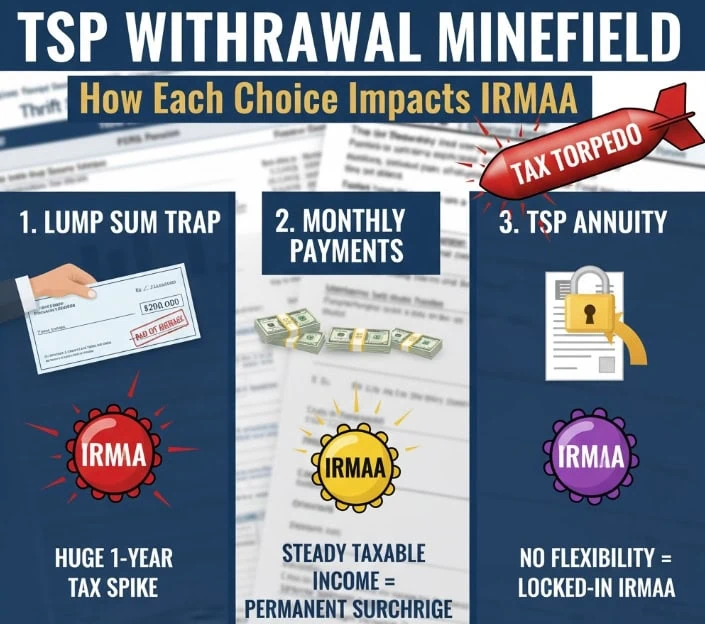
Traditional TSP distributions can raise IRMAA MAGI
The IRS explains that Traditional TSP contributions and earnings are generally taxed when distributed, subject to exceptions such as tax-exempt combat-pay contributions. That taxable income can increase AGI, which can increase IRMAA MAGI. Your FERS or CSRS pension, taxable Social Security, investment income, capital gains and other income can be sitting in the same MAGI calculation, so judging the TSP move by itself can be misleading.
Before making a large distribution, use the IRMAA Income Checker to identify which income items belong in the calculation. Then project the entire tax year, not just the withdrawal.
Qualified Roth TSP distributions generally do not increase MAGI
A qualified Roth TSP distribution is excluded from gross income. The IRS explains that qualified distributions from a designated Roth account are tax-free when the applicable five-year and age, disability or death requirements are met. If a Roth distribution is not qualified, the earnings portion can be taxable, so “Roth” does not automatically mean every distribution is invisible to IRMAA.
Roth conversions can be worth an IRMAA cost, but price it first
An in-plan Roth conversion or other conversion of previously untaxed retirement money generally creates taxable income in the conversion year. That can raise MAGI and future IRMAA. But an IRMAA increase does not automatically make the conversion a bad move. It is one cost in a larger calculation involving current tax rates, future tax rates, future required distributions and how long the Roth money may remain invested.
If that is the decision you are facing, the dedicated Roth conversion versus IRMAA cost analysis goes deeper. This page stays focused on the federal-retiree coordination problem.
Hypothetical: The mortgage payoff that changes one Medicare year
Suppose a retiring federal employee takes a large taxable Traditional TSP distribution in 2026 to pay off a mortgage. The distribution raises 2026 MAGI enough to cross an IRMAA threshold. If income drops back the next year, the 2026 spike would generally show up in 2028 Medicare premiums, while 2027 income would generally be used for 2029. The lesson is not “never pay off the mortgage.” The lesson is to price the tax and Medicare consequences before choosing the year and amount.
The goal is not to win a contest for the lowest Medicare premium. The goal is to know what a TSP move costs before you make it.
Keep the TSP-to-Medicare calendar straight
If this article helped you see that a withdrawal decision and a Medicare premium year are connected, my weekly email keeps those timing traps on your radar.
- Check TSP and Roth decisions before they hit MAGI.
- Make sense of FEHB and Medicare choices in plain English.
- Watch the IRMAA thresholds and rule changes that matter.
Get the federal retirement notes in your inbox.
No spam. Unsubscribe anytime.
How FEHB and Medicare Part B Change the IRMAA Decision
IRMAA changes the price of Medicare Part B, but it does not answer whether Part B is worth having alongside FEHB. That is a separate cost-and-coverage decision.
Federal retirees: your FERS survivor election can affect more than pension income. At retirement, a standard full FERS spouse-survivor election provides 50% of the unreduced earned annuity after your death and generally reduces your annuity by 10%; a partial election provides 25% and generally reduces your annuity by 5%. Before declining a survivor benefit, check the spouse’s FEHB continuation rights: OPM generally requires the spouse to have been covered under Self Plus One or Self and Family at death and to be eligible for a monthly survivor annuity or, in qualifying employee-death cases, a Basic Employee Death Benefit. Exceptions and temporary continuation or conversion rights can apply, but do not assume FEHB will simply continue if you elect no survivor benefit. Verify your election and your spouse’s eligibility with OPM’s survivor-benefit and FEHB guidance before signing.
The first distinction is employment status. While you are an active federal employee covered by FEHB based on current employment, OPM says FEHB generally pays first and Medicare pays second. After retirement, FEHB becomes annuitant coverage. If you are enrolled in Medicare as an annuitant, OPM says Medicare generally pays first and FEHB pays second.
That distinction also matters if you are considering delaying Part B. OPM explains that people covered through current federal employment can have a Part B Special Enrollment Period after that employment ends. An annuitant who simply waits outside the applicable enrollment period can face a Part B late-enrollment penalty later. The exact decision depends on your FEHB plan, health-care use, Part B premium including any IRMAA, and how much value Medicare-first coordination gives you.
For the full decision, use the dedicated FEHB and Medicare Part B cost-benefit guide. This article’s job is narrower: make sure the Medicare choice is considered in the same calendar as the TSP decision that can change its price.
Watch Out: FEHB drug coverage and Part D are not always as simple as “I never enrolled”
FEHB prescription coverage is generally creditable for Medicare Part D purposes, so keeping FEHB can protect you from the Part D late-enrollment penalty. But OPM also notes that FEHB plans offering Medicare drug benefits can automatically enroll eligible members, with an opt-out available. Read your plan’s Medicare notices before assuming Part D IRMAA cannot apply simply because you never filled out a separate Part D application.
A 4-Step Federal Retiree IRMAA Planning Sequence
You do not need a complicated IRMAA strategy for every TSP decision. You need a repeatable sequence that catches the expensive mistakes before the transaction is irreversible.
1. Map the tax year to the Medicare year
Write the tax year next to the Medicare year it will generally affect. If the transaction is in 2026, start by looking at 2028. Then ask whether you expect to have Part B, a Part D arrangement that could carry IRMAA, or a different employment and enrollment situation by then.
2. Project total MAGI, not just the TSP transaction
Add the taxable portion of the TSP move to the rest of the income that can affect AGI and IRMAA MAGI. A $30,000 distribution is not a “$30,000 IRMAA decision” if your pension, Social Security, investment income or capital gains are already near a threshold.
3. Price the IRMAA cost against the reason for the move
Ask what you are buying with the extra taxable income. Are you eliminating expensive debt? Funding a major purchase? Creating Roth assets for future tax flexibility? Avoiding a later tax problem? A higher Medicare premium can be a real cost without being a veto.
Decision Rule
If the TSP move still makes sense after you add the estimated federal tax cost and the plausible future Medicare premium cost, IRMAA may be an acceptable tradeoff. If the move only works when you ignore the Medicare effect, you have not finished the calculation.
4. Check whether retirement gives you an SSA-44 path
A voluntary TSP withdrawal or Roth conversion by itself is not one of Social Security’s listed life-changing events. Retiring can qualify as a work stoppage when you or your spouse stops working and the event reduces household income.
If you retire and your more recent income is substantially lower than the older tax return Social Security is using, review Social Security’s IRMAA reduction rules. The key nuance is that your newer MAGI projection still has to include taxable TSP distributions or conversions you voluntarily make in that newer year. For the filing mechanics, use the SSA-44 IRMAA appeal guide.
Federal Retiree IRMAA FAQs
Do Traditional TSP withdrawals count toward IRMAA?
The taxable portion generally can. A taxable Traditional TSP distribution increases gross income, which can increase AGI and therefore IRMAA MAGI. The result depends on your total income for the year, not the TSP withdrawal by itself.
Do Roth TSP withdrawals count toward IRMAA?
A qualified Roth TSP distribution is excluded from gross income, so it generally does not increase IRMAA MAGI. A nonqualified Roth distribution can include taxable earnings, so confirm the tax treatment before assuming the entire distribution is excluded.
Can retirement lower an IRMAA determination through SSA-44?
Potentially. Social Security lists work stoppage as a life-changing event, so retiring can qualify when you or your spouse stops working and income falls. A voluntary TSP withdrawal or Roth conversion is not itself a listed life-changing event, and any taxable amount you take still belongs in the newer MAGI estimate used for the request.
The Bottom Line: Plan the Calendar, Not Just the Withdrawal
A federal retiree can make a perfectly reasonable TSP decision and still dislike the Medicare bill it creates later. That does not mean the decision was wrong. It means the Medicare cost belonged in the decision from the start.
Before a large Traditional TSP withdrawal or taxable Roth move, put three things on one page: the tax year, the Medicare premium year two years later, and the FEHB/Medicare coverage you expect to have then. Then project total MAGI and price the IRMAA consequence alongside the tax and retirement benefit of the move.
That is the federal-retiree IRMAA playbook in one sentence: plan the calendar before you move the money.
Sources
- CMS: 2026 Medicare Parts A & B Premiums and Deductibles
- Social Security: IRMAA Modified Adjusted Gross Income rules
- Social Security: Request to lower an IRMAA
- OPM: Medicare and FEHB enrollment options
- OPM: Medicare and FEHB for annuitants
- OPM: Medicare and FEHB for active federal employees
- IRS Publication 721: TSP taxation and federal retirement benefits
- IRS: Roth accounts in employer retirement plans
