
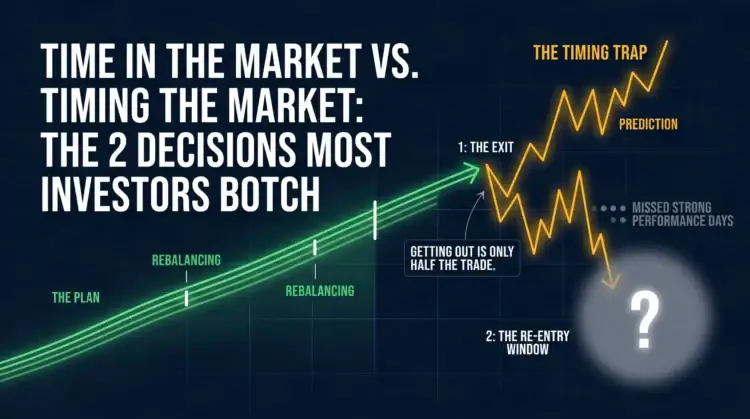
Time in the market usually beats timing the market because successful timing requires getting two decisions right: when to get out and when to get back in. For a long-term investor, the more reliable job is usually to build an allocation that fits the plan, stay invested through normal volatility, and make changes for plan-based reasons. Not because the headlines suddenly feel convincing.
But “stay invested” does not mean “never touch your portfolio.” Rebalancing after your allocation drifts, changing risk because your goals or time horizon changed, or keeping cash for a real spending need can all be sensible. The useful question is not, “Did I make a trade?” It is: “What triggered the decision?”
That distinction matters more than the old slogan. After nearly 30 years around financial-planning conversations, I’ve seen versions of the same problem over and over.
People call a forecast a “strategy” because it feels more respectable than saying, “I’m scared and I think I know what happens next.” Markets have a way of charging tuition for that lesson.
Show the 30-second version
- Short answer: For long-term money, staying invested in a suitable diversified plan has historically been more reliable than repeatedly trying to predict market exits and re-entry points.
- DALBAR 2026: In 2025, DALBAR reported a much smaller equity-investor gap than in 2024: 0.72 percentage points versus 8.48 percentage points. Behavior costs are not a fixed annual penalty.
- Market timing: Changing exposure because you expect a near-term market move is market timing—even when you call the cash 'dry powder.'
- Rebalancing: Returning a drifted portfolio to a predetermined target allocation is plan maintenance, not a forecast about the next market move.
- Legitimate changes: A real change in goals, time horizon, risk capacity, or near-term cash needs can justify changing the portfolio without pretending to predict the market.
On This Page
- Table of Contents
- What the 2026 DALBAR Study Actually Shows About Investor Behavior
- Why Time in the Market Usually Beats Timing the Market
- Rebalancing Is Not Market Timing: Use the Trigger Test
- Why Market Timing Feels So Reasonable in the Moment
- Behavioral Armor: Four Rules to Make Before the Market Gets Loud
- Where to go next
- Market Timing FAQs
- The Bottom Line: Follow the Plan, Not the Prediction
- How We Verified This
Table of Contents
What the 2026 DALBAR Study Actually Shows About Investor Behavior
The latest data is more interesting than the usual “average investors are terrible” headline.
DALBAR’s 2026 Quantitative Analysis of Investor Behavior (QAIB) reported that the S&P 500 returned 17.88% in 2025 while its Average Equity Investor measure returned 17.16%. That is a 0.72 percentage-point gap.
A year earlier, the reported gap was 8.48 percentage points. In other words, 2025 was not another giant “investors blew it” year. DALBAR called the 2025 equity gap the third-smallest since 1985 and the smallest since 2012.
Michael’s Take
This is why I don’t like turning one DALBAR number into a permanent tax on being human. The gap moves around. The durable lesson is that investor decisions and fund flows can change realized results—and the size of that effect can look very different from one year to the next.
DALBAR also reported heavy equity selling in 2025: withdrawals totaled 6.91% of assets, including a record 2.30% monthly withdrawal rate in July. On the fixed-income side, its Average Fixed Income Investor returned 2.41% versus 7.30% for the Bloomberg U.S. Aggregate Bond Index, a 4.89 percentage-point gap.
One important qualification: QAIB is a fund-flow-based study of the “Average Investor.” It is useful evidence about investor behavior and realized investor returns, but it is not proof that every individual investor personally lost exactly 0.72%, 4.89%, or 8.48% because of one bad timing decision. That distinction matters.
Why Time in the Market Usually Beats Timing the Market
Market timing sounds simple because the sentence is simple: sell before the drop, buy before the rebound. The problem is the word before.
FINRA defines market timing as shifting money in or out of the market—or among investments—to exploit anticipated short-term price moves. It also points to the practical obstacles: more trading costs, possible tax consequences, emotional decision-making, and the risk of missing a recovery after you exit.
That last one is the trap people underestimate. Some of the market’s strongest days arrive during periods of high volatility. The scary days and the rebound days can live uncomfortably close together. You do not get a calendar invitation for either one.
Market timing is not one prediction. It is a chain of predictions: get out, stay out, and then get back in before the recovery gets away from you.
That is why “I’ll just wait until things calm down” is not neutral. It is a decision to hold less market exposure until you decide conditions look safe enough again. The second decision—the re-entry—is often the harder one.
None of this means stocks always go up, that losses do not matter, or that every dollar belongs in the market. Money you need soon has a different job from money invested for a long-term goal. If you do not yet have a real liquidity buffer, start with the role of an emergency fund before treating every available dollar as investment capital.
Rebalancing Is Not Market Timing: Use the Trigger Test
This is the distinction most “time in the market” articles leave fuzzy: staying invested does not mean staying frozen.
Vanguard describes rebalancing as adjusting a portfolio after its preferred asset allocation has drifted. That is different from selling stocks because you think the market is about to fall. One responds to your plan; the other responds to your forecast.
| Action | What triggers it? | Market timing? |
|---|---|---|
| Stay invested | Your long-term plan still fits | No |
| Rebalance | Your allocation drifted from its predetermined target | No |
| Change strategic allocation | Your goals, time horizon, cash-flow needs, or ability to take risk materially changed | Not necessarily |
| Hold a cash reserve | You need liquidity for emergencies or known near-term spending | No |
| Hold “dry powder” for the dip | You expect a better market entry point later | Yes—that depends on a market forecast |
Here is a simple 60/40 example. Suppose your plan calls for 60% stocks and 40% bonds. After a strong stock run, the portfolio drifts to 70/30. Bringing it back toward 60/40 is not a claim that stocks are about to crash. You are restoring the risk mix you chose before the market moved.
The reverse can happen after stocks fall. If your predetermined process calls for rebalancing, you may wind up adding to the part of the portfolio that fell and trimming the part that held up better. Psychologically, that can feel like the opposite of what every nerve ending is asking you to do. That is part of the point: the rule was made when the room was quiet.
Likewise, a change in your life can justify a change in your portfolio. Vanguard’s volatility guidance distinguishes staying the course from “set it and forget it”: goals, time horizon, risk tolerance, cash needs, and allocation drift still deserve review.
The Trigger Test
Before changing your portfolio, finish this sentence: “I am making this change because…” If the answer is a forecast about what markets will do next, you are probably timing. If the answer is a predefined allocation rule or a real change in your financial life, you are probably managing the plan.
Why Market Timing Feels So Reasonable in the Moment
The hardest part of market timing is not understanding the slogan. Most people already know “buy low, sell high.” The hard part is that fear and confidence rarely show up at convenient prices.
When markets are falling, recent losses can start to feel like evidence that more losses are inevitable. When prices have been climbing, a hot investment can start to feel safer precisely because it has already gone up. And one lucky call can make all of us a little too impressed with our forecasting department.
That is why the real-life version sounds less like “I am market timing” and more like:
- “I’m just going to cash for a while.”
- “I’ll get back in after the uncertainty clears.”
- “I’m keeping dry powder because a better buying opportunity has to be coming.”
- “This time is different, so my long-term allocation no longer applies.”
Sometimes the plan really does need to change. But if the reason appears only after the market gets scary, I would slow the decision down and ask whether the financial facts changed—or whether the feeling changed.
Behavioral Armor: Four Rules to Make Before the Market Gets Loud
I call this Behavioral Armor. It is not a claim that you can remove emotion from investing. Good luck with that. The goal is to keep a temporary emotion from becoming a permanent portfolio decision.
1. Education: Know What Counts as a Plan Change
Know the difference between volatility and a broken plan. Your investment mix should be connected to financial goals, time horizon, liquidity needs, and the amount of risk you can live with. If one of those changes materially, review the allocation. If only the market forecast changed, be more suspicious of the urge to act.
2. Automation: Move Good Decisions Away From Bad Moods
Regular contributions and a predetermined rebalancing process can reduce the number of times you have to ask yourself whether “today feels like a good day to invest.” FINRA notes that periodic investing such as dollar-cost averaging follows a set schedule rather than a short-term market call. It does not guarantee a profit or protect against losses, but it can remove one layer of timing pressure.
3. Accountability: Make the Prediction Explain Itself
Before a major reactive change, write down the reason, what must happen for the decision to be right, and—this is the part people skip—the rule for getting back in. If you cannot state the re-entry rule, you do not have a complete timing strategy. You have an exit.
4. Auditing: Review the Plan on Purpose, Not on Every Red Day
Schedule portfolio reviews around the plan: allocation drift, a changed goal, a shorter time horizon, a new spending need, or a meaningful change in your ability to take risk. Watching the portfolio more often does not automatically make the decisions better. Sometimes it just gives anxiety more meeting invitations.
A four-question market-drop check
1. Did my goal change? 2. Did my time horizon or cash need change? 3. Did my target allocation drift enough to trigger my existing rebalancing rule? 4. Or am I changing the portfolio because I think I know where the market goes next?
Market Timing FAQs
Can market timing ever work?
Yes, a particular timing decision can work. The harder claim is that an investor can repeatedly identify exits and re-entry points well enough to improve long-term results after missed opportunities, costs, taxes, and mistakes. For most long-term investors, that is a much higher bar than it first appears.
Why does missing a few strong market days matter so much?
Large market moves are unevenly distributed, and strong rebound days can occur close to sharp declines. If you exit during volatility, you can miss part of the recovery while deciding when it feels safe to return. The exact impact depends on the market period and the days missed, so there is no honest universal number.
What is the biggest mistake investors make when trying to time the market?
Treating the exit as the whole decision. Selling is only step one. A timing strategy also needs a re-entry rule, and fear that was strong enough to push you out can still be present when prices begin recovering.
Is dollar-cost averaging a good way to reduce timing pressure?
It can be. Investing a fixed amount on a regular schedule reduces the need to pick a perfect entry day. It does not guarantee a profit or prevent losses, and it is different from deciding whether a lump sum should be invested immediately, but it can be a useful behavioral system for ongoing contributions.
The Bottom Line: Follow the Plan, Not the Prediction
“Time in the market beats timing the market” is useful, but incomplete. The better rule is:
Change the portfolio when the plan gives you a reason—not when the prediction gives you a feeling.
Stay invested when the plan still fits. Rebalance when the allocation drifts according to your process. Revisit the strategy when your goals, time horizon, liquidity needs, or capacity for risk actually change. Keep cash when the cash has a job. And when you hear yourself say, “I’m just waiting for a better entry point,” call it what it is: a market-timing decision that still needs a re-entry rule.
The point is not to be passive. It is to be deliberate before the market gets loud. That is what Behavioral Armor is for.
How We Verified This
The current market-timing and investor-behavior claims were checked against primary or authoritative sources before this rebuild.
