
A practical guide to sizing your cash reserve, moving money between buckets, and deciding whether three buckets are worth the extra work.
A retirement bucket strategy divides the investments funding your retirement into three jobs: cash for upcoming withdrawals, bonds and other relatively stable investments for intermediate needs, and growth investments for later years. Interest, maturities and rebalancing proceeds can replenish cash. The goal is to give you options when stocks fall—not to eliminate losses or improve returns by labeling investments.
The crucial decisions are how much the portfolio must pay, when to refill cash, and what to do if stocks and bonds both struggle. A diversified portfolio with systematic withdrawals and rebalancing may be simpler and just as suitable.
After decades of helping people turn savings into a retirement paycheck, I learned something: the spreadsheet can work while the people living with it cannot. That matters especially when two spouses see the same market decline differently.
By Michael Ryan, retired financial planner with approximately 30 years of experience; formerly held FINRA Series 7 and 63 licenses. Editorial policy.
Article reviewed: October 26, 2026.
On This Page
- Why a Market Crash Feels Different Once You Retire
- The Nelsons, a Tube of Crest, and a Better Retirement Question
- How the Three Retirement Buckets Work
- Follow the Money: An Illustrative $3 Million Waterfall
- When Should You Refill the Retirement Buckets?
- What If Stocks Fall for Years? The Lesson of 2000 and 2008
- How Much Cash Should a Retiree Keep in Bucket 1?
- The Reasonable Argument Against a Three-Bucket Strategy
- A Married Couple Can Share a Portfolio and Disagree About Every Risk
- Will Your Bucket Plan Still Work at 85?
- What If Some Retirement Income Is Guaranteed for Life?
- Five Ways the Bucket Strategy Can Go Wrong
- Retirement Bucket Strategy FAQs
- A 10-Minute Retirement Income Stress Test
- Bottom Line: Buckets Are a Tool, Not a Retirement Rule
Why a Market Crash Feels Different Once You Retire
During your working years, a market decline is unpleasant. You may even be adding to your investments at lower prices. In retirement, you could be selling shares to fund groceries, travel, insurance premiums and property taxes.
Say an investment trades for $100 a share. Selling 400 shares raises $40,000 before taxes and costs. If the price falls 30% to $70, raising at least $40,000 takes 572 whole shares. That’s 43% more shares for the same cash need. Those extra shares won’t be there when the investment eventually recovers.
This is sequence-of-returns risk: the order in which investment gains and losses arrive matters when withdrawals are taking money out of the portfolio. Two retirees can experience similar long-run average investment returns but very different retirement outcomes if one faces steep losses early while withdrawing.
The useful question is: What pays the bills while I wait? That is the job of a withdrawal policy, whether or not you use buckets.
The Nelsons, a Tube of Crest, and a Better Retirement Question
I remember working with a couple I’ll call the Nelsons as they approached retirement. The summer before their planned retirement, we discussed turning a meaningful portion of their portfolio into income they wouldn’t outlive. It was a way to reduce how much of their day-to-day spending would depend on market prices.
During one conversation, the possibility of an economic downturn came up. I made the case that established consumer companies might still have customers years later. Would people simply stop brushing their teeth with Crest?
Mrs. Nelson had a better objection than I expected. People might keep brushing their teeth, she reasoned, but shop at Dollar Tree instead.
Good point. I stopped at Dollar Tree on my way home and looked. There was a tube of Crest. I photographed it and sent her the picture. Her objection made me test an assumption instead of waving it away.
Both observations could be true. People might change where they buy a product and still buy the brand. But a recognizable brand on a shelf does not mean its parent company’s stock price cannot fall, or that a retiree can comfortably wait through that fall.
The lesson was about the household, not Crest. You can believe a business will survive a downturn and still need an entirely different answer for next year’s bills. That answer might involve lifetime income, cash, bonds, flexible withdrawals—or a mix.
Confidence in an investment is not the same thing as a plan for spending it.
For the broader investment mix behind the buckets, see Asset Allocation for Retirees: Stocks, Bonds & Cash. The bucket plan decides when investments may fund spending; asset allocation decides how much risk the overall portfolio takes.
How the Three Retirement Buckets Work
The usual structure is simple. The amounts aren’t. Begin with the dollars your investments must supply after Social Security, pensions and other dependable income—not necessarily your entire household budget. Then match investments to when those dollars are needed.
Bucket 1: Money you’ll need soon
This is the spending reserve. In a common version, it covers roughly one or two years of planned portfolio withdrawals, plus any additional near-term outlay that isn’t already accounted for. It might hold insured deposits, Treasury bills or another appropriate short-term cash equivalent. Its job is access and relative stability, not chasing the highest return.
Bucket 2: The intermediate runway
This money is intended to help fund later spending and replenish Bucket 1. High-quality bonds or a thoughtfully designed maturity ladder can serve this job. Interest payments and maturing principal can flow toward near-term withdrawals. But a bond fund’s value can fall, individual bonds can have credit risk, and higher yields don’t automatically mean more dependable spending power.
Bucket 3: Money that gets time to grow
This holds investments intended for longer-term growth, usually diversified stocks and other assets appropriate to the household’s risk capacity. The hope is that you won’t need to liquidate these holdings to pay ordinary bills immediately after a severe decline. That is why its refill rule matters.
- Bucket 3 — growth: long-horizon investments may supply rebalancing proceeds after appreciation when the overall allocation and tax situation justify selling.
- Bucket 2 — stability and income: interest, distributions and maturing principal can support the next stage of withdrawals and help replenish the spending reserve.
- Bucket 1 — spending: liquid resources pay the portion of household expenses not covered by Social Security, pensions or other income.
Money can move from the longer-horizon investments toward current spending, but it doesn’t have to pass through every bucket mechanically. Each transfer depends on need, investment risk, target allocation, taxes and available liquidity.
Morningstar’s bucket allocation guide likewise starts with actual portfolio spending needs and then works backward to stocks, bonds and cash. The key is to avoid confusing a household’s total expenses with the amount its portfolio must provide.
Follow the Money: An Illustrative $3 Million Waterfall
Here is a numerical illustration of the kind of system I explained to clients. These are illustrative numbers, not the Nelsons’ documented balances or investment results.
- Bucket 1: $250,000 in near-term spending reserves.
- Bucket 2: $750,000 in intermediate-term income and stability investments.
- Bucket 3: $2,000,000 in long-term growth assets.
- Portfolio-funded spending need: $125,000 a year, after other household income, before future inflation or any unmodeled taxes and fees.
With zero investment earnings, $1 million in the first two buckets would cover $125,000 per year for eight years only if those assets remain available at their assumed values when needed. That is a cash-flow illustration, not a guarantee of eight years’ protection: bond prices can change, maturities may not line up, and spending and taxes can increase.
Now suppose Bucket 2 produces $40,000 a year in cash distributions and those amounts really are earnings rather than a return of principal. That’s approximately 5.33% of its starting $750,000 value—a hypothetical assumption, not a promised yield or a safe income target.
| After | Starting Bucket 1 | Portfolio spending paid | Cash distributed from Bucket 2 | Ending Bucket 1 |
|---|---|---|---|---|
| Year 1 | $250,000 | −$125,000 | +$40,000 | $165,000 |
| Year 2 | $165,000 | −$125,000 | +$40,000 | $80,000 |
By the end of year two, the household has spent $250,000 but has also received $80,000 of distributions. Bucket 1 still holds $80,000, which would cover approximately 7.7 more months at the original $125,000 annual withdrawal pace if no new cash arrived.
The practical point: you can route cash flows toward spending before Bucket 1 runs dry.
One important accounting rule: if those $40,000 payments partly represent the return of your own principal, don’t count them as both earnings and an intact Bucket 2 balance. The portfolio didn’t create money merely by moving it from one account to another.
And the $125,000 spending need is an assumption, not a declaration that a $3 million portfolio can safely sustain that amount forever. Starting withdrawals are about 4.17% of the full portfolio; sustainability still depends on return paths, inflation, taxes, longevity and spending flexibility. See my retirement money longevity calculator for the separate sustainability question.
What the waterfall really buys: options. A retiree with money coming due and enough liquidity to fund near-term spending may be able to leave long-term investments alone through a decline. The buckets do not cancel losses, guarantee returns, or eliminate the need to review withdrawals.
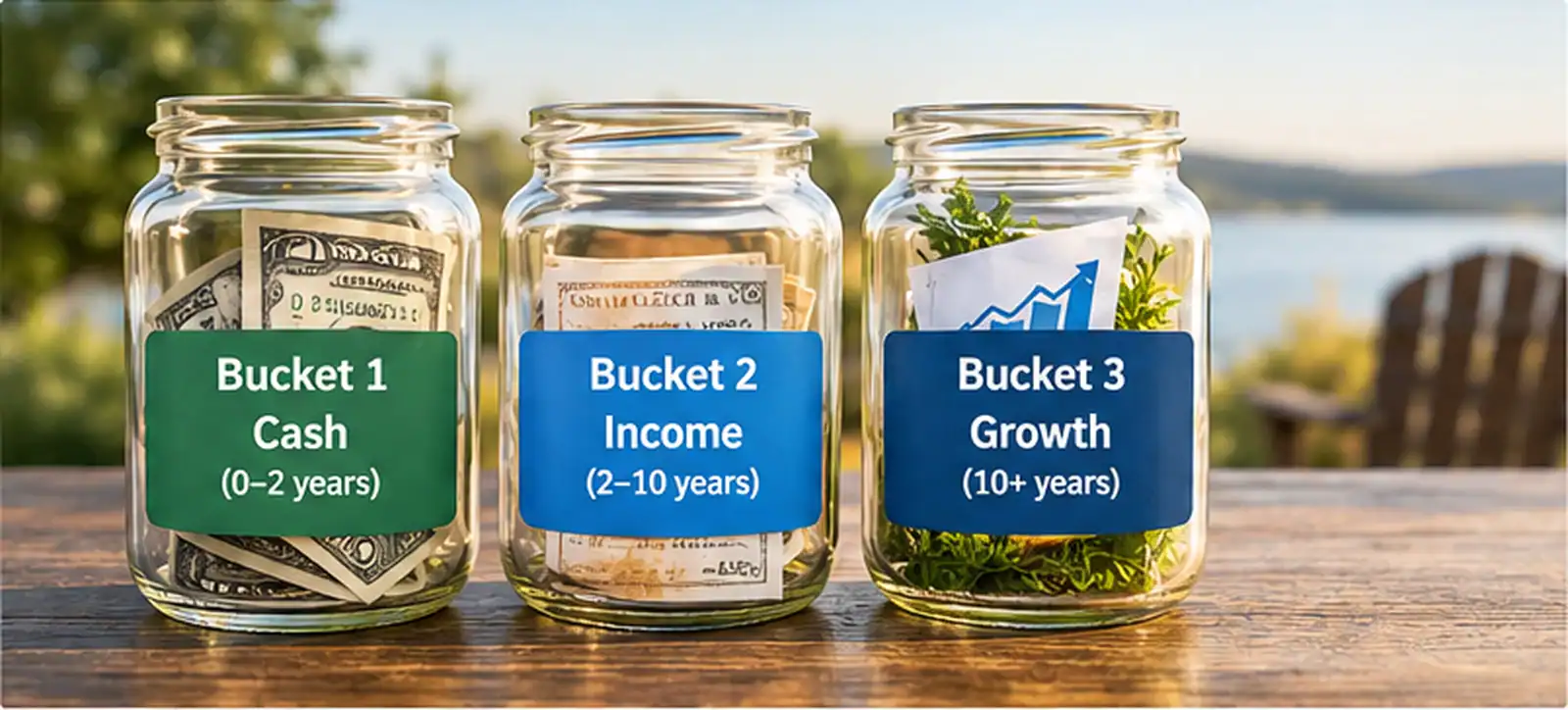
Illustration: The retirement bucket strategy organizes a portfolio around cash for near-term withdrawals, intermediate income assets, and longer-term growth. The year ranges are examples, not fixed rules.
When Should You Refill the Retirement Buckets?
A bucket diagram is not a withdrawal policy. Write the refill rules before a bad market tests them.
A useful maintenance plan should answer four questions before the first serious decline:
- What funds the monthly withdrawal? Usually cash already earmarked for spending, supplemented by relevant income distributions and maturities. Decide which accounts will actually make the payments.
- When does Bucket 1 need a refill? Set a review date and a minimum reserve range tied to the next known withdrawals—not a guess about when stocks have peaked.
- What should be sold or allowed to mature? Consider the overall target allocation, assets that are overweight, cash flows already scheduled, trading costs and taxes. In a strong stock year, trimming appreciated equities may replenish the reserve. In a weak year, cash and suitable bond maturities may help instead.
- What happens when nothing looks attractive to sell? Review spending flexibility, available safe maturities, risk exposures and whether the long-term plan needs a controlled adjustment. Don’t assume you can avoid selling risky assets indefinitely.
Suppose Bucket 3 rises from $2 million to $2.2 million. That $200,000 gain is not an automatic $200,000 refill. Sell only what makes sense after checking the overall allocation, cash target, taxes and coming withdrawals.
One illustrative refill sequence (not a universal selling order): At a scheduled review, first account for cash already available from interest, dividends and bond maturities. Next, if cash is below its target range, consider selling assets that are overweight relative to your overall allocation, after checking taxes and account constraints. If markets are down and no sale is attractive, use the reserve as intended while reviewing spending and the timing of remaining maturities. Set a floor that triggers a fresh plan review; do not promise to avoid stock sales indefinitely.
In practice, withdrawals can become part of disciplined rebalancing: sell assets that are overweight relative to the plan, rather than making a market forecast. The SEC’s investor education guide explains rebalancing as the process of bringing a portfolio back to its target allocation. It also warns that cash’s apparent safety comes with inflation risk.
Do not make the next refill depend on guessing the market top.
What If Stocks Fall for Years? The Lesson of 2000 and 2008
I worked through the dot-com bust and the 2008 financial crisis with people who had to live through those headlines, not just look them up in a historical chart. Both episodes matter because an investor could have faced major losses more than once within the same decade.
Long stretches of disappointing returns have happened, and outcomes depend on whether you measure price changes, dividends, inflation or the exact start and end dates. Historical returns are not a promise of recovery within ten years.
The 2000–2009 period is a reminder that U.S. large-cap stocks can deliver poor cumulative returns across a full decade, depending on the exact measure. Even when a portfolio eventually grows again, a retiree who has been withdrawing through the bad years may have fewer shares left to benefit.
A long reserve can help. It isn’t an excuse to call Bucket 2 risk-free. In 2022, stocks and many bonds fell together as interest rates rose. The SEC’s guidance on bond funds explains that rising rates can reduce bond-fund prices and that credit quality and maturity still matter.
Your plan therefore needs to withstand more than the slogan, Stocks fall, bonds go up. Sometimes they don’t. A well-matched maturity ladder, sufficient liquidity and flexible withdrawals may be more useful than counting on a bond fund’s market price to rescue the stock allocation.
How Much Cash Should a Retiree Keep in Bucket 1?
Start with the cash the portfolio must pay out. Suppose the household spends $140,000 annually, receives $70,000 from Social Security and a pension, and needs $70,000 from investments. A two-year portfolio-withdrawal reserve would be $140,000, not $280,000, before any extra planned outlays or emergency cushion.
If that couple knows they’ll replace a car for $45,000 next year and hasn’t already included the purchase in the annual budget, they may want to account for it separately. But if the car was already included in the $140,000 spending figure, don’t count it twice.
The more dependable outside income covers essential spending, the less exposed a retiree may be to forced portfolio withdrawals. Still, cash has a cost: over decades inflation can erode its buying power, and substantial cash holdings can reduce expected long-term returns.
For a household with a strong pension and low portfolio withdrawals, an enormous cash bucket might be unnecessary. For someone living almost entirely on investments, especially just after retirement, near-term liquidity may deserve more attention. For both, the right answer should include a plan for when cash gets depleted.
The Reasonable Argument Against a Three-Bucket Strategy
Let’s give the critics their due. Calling investments three buckets does not make a diversified portfolio perform better. When the holdings and withdrawals are comparable, the bucket labels themselves cannot manufacture returns.
Morningstar research first published in 2024 and updated in 2025 compared systematic withdrawals with several bucket approaches. Its modeled cash-reserve and two three-bucket variants underperformed systematic withdrawals on viable spending, while a different time-bucket method delivered higher modeled spending with a wider spread of outcomes. These are results for specific rules and assumptions, not a verdict on every possible bucket plan.
Here is the twist: when Morningstar modeled an investor abandoning equities after a sharp loss, systematic withdrawals performed worse than the cash-reserve and three-bucket strategies. The point is not that buckets beat rebalancing. It is that the plan someone can follow may beat a theoretically sound plan they abandon at the worst moment.
A simple target allocation with periodic rebalancing can achieve many of the same portfolio-management tasks with fewer rules and fewer opportunities for confusion. That’s a legitimate criticism, especially if someone treats each bucket as an isolated account and never checks the combined portfolio.
That matches what I saw in planning conversations: buckets sometimes helped people stick to a plan because they could identify next year’s spending money. It does not prove a performance advantage for the portfolio itself.
If the buckets make the household more disciplined and the rules are sound, they can be useful. If they become an elaborate excuse for market timing or excessive cash, simplify them.
If the retirement date, income floor, and withdrawal amount are not decided yet, start with my five decisions for planning retirement before assigning money to three buckets.
A Married Couple Can Share a Portfolio and Disagree About Every Risk
I’ve worked with hundreds of people making the switch from a paycheck earned at work to income drawn from savings and investments. You would be surprised how often a married couple could agree on the retirement date and still disagree about the retirement plan.
Two people might have been married 30, 40 or 50 years. Same house. Same accounts. Same money. But one sees a 25% stock decline as a temporary setback; the other sees a threat to the rest of their life. One wants to leave as much as possible to children. The other doesn’t want to spend retirement denying themselves experiences they saved for.
There isn’t necessarily a villain in that conversation. They are weighting different risks. A rigid rule of thumb may produce a neat answer on paper and a terrible argument at the kitchen table.
The better question is: What part of the household’s spending has to be dependable, and how much uncertainty can both people actually live with? The answer can guide cash, bonds, growth assets, spending flexibility and whether any additional lifetime income is worth considering.
For readers who need to separate their willingness to accept risk from their financial ability to absorb it, I explain that distinction in Risk Tolerance in Investing.
Will Your Bucket Plan Still Work at 85?
At 65, the plan may revolve around travel, hobbies, a recently retired spouse and a long growth horizon. At 75, grandchildren, changing health, a different home or a painful market decline may change what matters. At 85, a surviving spouse may care far more about simplicity, stable income and whether the family knows how to manage the accounts.
Your priorities can change. Your withdrawal rules should be reviewable without becoming a reaction to every market headline.
That doesn’t mean changing investments every time a headline scares you. It means setting review triggers beyond the stock market: a death, major health change, new dependent, large inheritance, an unexpected expense, a material shift in guaranteed income, or simply a change in your willingness to manage complicated rules.
Ask whether your 85-year-old self—or a surviving spouse—could operate the system without memorizing trading rules. If not, simplify it now.
A sustainable plan should be something the surviving spouse can understand without an hour-long lecture about which ETF to sell on a Wednesday.
What If Some Retirement Income Is Guaranteed for Life?
A bucket plan should account for Social Security, pensions and other dependable income before the portfolio allocation is built. That’s why the Nelsons’ interest in converting part of their assets into income they couldn’t outlive was an important planning conversation.
Some lifetime-income arrangements can reduce the amount a household must withdraw from a volatile portfolio to pay necessary bills. But the details matter. Purchasing an annuity may involve giving up liquidity, accepting less inflation protection, choosing a survivor benefit that affects the payment, and relying on the issuing insurer’s financial strength. The SEC’s annuity guide outlines the contract differences and risks. My immediate annuity guide explores the specific tradeoffs.
I would not classify the entire value of a lifetime-income contract as readily spendable Bucket 2 money. A monthly annuity payment and a liquid bond holding do different jobs. Count income as income, and count liquid assets as liquid assets.
Some retirees value a reliable floor for essentials; others prioritize flexibility, inheritance or continued market exposure. The right mix depends on the household, the contracts and what could change later.
Five Ways the Bucket Strategy Can Go Wrong
- Counting income twice. Interest or distributions that are actually a return of principal must not also be treated as new earnings on an unchanged account balance.
- Stretching for yield in the supposedly safer bucket. A bond fund or security offering higher income may carry the exact credit or price risk the intermediate reserve was meant to reduce.
- Keeping too much in cash for too long. Cash provides liquidity, but inflation and forgone investment growth create another risk.
- Waiting for an all-time high before every refill. No one knows when the next ideal selling day will arrive. Rebalancing rules and spending needs should drive the process.
- Ignoring taxes and actual account access. A distribution from a traditional IRA can be taxable even when the portfolio’s bucket diagram shows only a transfer. Required minimum distributions, taxable gains and Medicare income surcharges can change the after-tax result. See Retirement Plan Distributions for account-level withdrawal mechanics and tax-year coordination.
Make the dollars reconcile. Then make the rules usable in a bad year.
Retirement Bucket Strategy FAQs
What is the three-bucket rule for retirement?
The so-called three-bucket rule is a planning framework, not a legal rule or guaranteed formula. It generally puts near-term portfolio withdrawals in cash, intermediate spending needs in comparatively stable investments such as high-quality bonds, and long-term money in growth investments. The amount in each bucket depends on spending needs, other income, time horizon and risk capacity.
Is the three-bucket strategy better than a 60/40 portfolio?
They’re not direct opposites. A 60/40 allocation describes the investment mix; three buckets describe how assets and withdrawals are organized across time. The same underlying holdings can be presented using either framework. Neither automatically delivers better results without an actual withdrawal and rebalancing method.
Do I need three separate brokerage accounts?
Usually not. Buckets can be planning labels within existing accounts; what matters is identifying which investments fund which needs, including how money moves and what gets sold. Taxes, RMDs and account access still have to be handled at the actual account level.
How many years of retirement withdrawals belong in cash?
One to two years of expected portfolio-funded withdrawals is a common starting framework, not a universal rule. Add known near-term outlays only if they aren’t already included, and consider whether outside income makes the reserve larger than necessary.
Can I refill the cash bucket with dividends and bond interest?
Yes, cash distributions can be directed into the spending reserve instead of reinvested. But distribution amounts change, and a payment that returns principal isn’t the same as investment earnings. Bond maturities and disciplined rebalancing may also supply cash.
What happens if both stocks and bonds fall?
The cash reserve may buy some time, but it won’t last forever. Check the actual bond maturities and credit risk, the spending flexibility of the household, the target allocation and what sales would be required. Do not assume bonds automatically rise during a stock decline.
Does a decade of reserves mean I never have to sell stocks at a loss?
No. Eight or ten years of projected spending coverage depends on asset values, withdrawal amounts, maturity schedules and other assumptions that can change. Historically, U.S. stocks have experienced losing nominal 10-year periods, and inflation can make an apparently positive decade negative in purchasing-power terms.
Is a bucket strategy appropriate for every retiree?
No. Someone with a large pension, modest withdrawals and a simple index portfolio might reasonably prefer direct withdrawals and periodic rebalancing. Someone who needs the structure to understand upcoming spending could prefer a bucket framework. Both still need diversification, a sustainable spending plan and periodic reviews.
A 10-Minute Retirement Income Stress Test
Before labeling anything Bucket 1, 2 or 3, write down five numbers and decisions:
- Annual spending need: What does the household actually expect to spend, including irregular bills?
- Dependable outside income: What portion is covered by Social Security, pensions or other payments, and which benefits continue for a survivor?
- Annual portfolio gap: How much must investments provide after the dependable income is counted?
- Available near-term money: What can be spent or allowed to mature without depending on stock prices recovering next year?
- Refill and change rules: Who decides what to sell, when is the reserve reviewed, and what life changes would require a new plan?
Then ask both spouses to answer one more question separately: If the market fell 30% tomorrow, what would make you feel that this plan was still working? Compare answers before choosing investments. The disagreement could tell you more than a risk-tolerance quiz.
Keep the retirement plan, not just the retirement article. My Financial Clarity Newsletter tackles the money decisions that change as retirement unfolds—from income withdrawals and market risk to Medicare and taxes. Get Financial Clarity.
Bottom Line: Buckets Are a Tool, Not a Retirement Rule
I like buckets when they help both people see where the next withdrawals come from and follow the plan in a bad market. I do not like them when they create unnecessary accounts, excessive cash or a trading rule no one can explain.
The test is not whether you can draw three buckets. It is whether the withdrawal plan still makes sense when markets fall, life changes—or one spouse has to manage it alone.
Source references and reporting notes
- Morningstar, Systematic Withdrawal Strategy: Benefits and Risks for Retirement Income, originally published February 8, 2024, updated November 24, 2025 (a regional page also displays September 3, 2026). Modeling of withdrawal approaches and investor overreaction; results are assumption-dependent.
- Morningstar, How Do You Maintain a Bucket System?, May 29, 2025. Maintenance and income-flow approaches.
- U.S. Securities and Exchange Commission, Beginners’ Guide to Asset Allocation, Diversification, and Rebalancing; Bond Funds and Income Funds; and Annuities.
- IRS, Retirement plan and IRA required minimum distributions FAQs. For the separate withdrawal-tax and RMD discussion.
