
Most RMD calculators can answer one question pretty quickly: “How much is my required minimum distribution from this account?”
That is useful. Sometimes that is literally all you want.
But the harder RMD question usually comes next: “Okay… I have multiple IRAs, an old 401(k), I already took some money out, maybe made a QCD, and my spouse is younger than me. What do I actually still have to take?”
So I built this calculator to do both.
Choose How Far You Want to Go
Quick Estimate: Enter the basic information for one retirement account and get your estimated 2026 RMD.
Full RMD Portfolio Plan: Keep going and the tool can work through multiple retirement accounts, spouse-beneficiary rules, amounts already withdrawn, QCDs, aggregation rules, still-working situations, and the estimated amount you still need to take.
You don’t have to decide up front. Start simple. If the quick answer is all you need, stop there.
For a standard RMD, the arithmetic itself is still simple:
2026 RMD Formula
December 31, 2025 account balance ÷ your applicable 2026 IRS distribution period = your 2026 RMD.
The division isn’t usually where people get into trouble. The setup is.
The wrong IRS table, the wrong year-end balance, treating a 401(k) like an IRA, forgetting an old account, overlooking a younger-spouse rule, or assuming a withdrawal from one account satisfies another can produce a perfectly calculated wrong answer.
On This Page
- 2026 RMD Calculator: Quick Estimate or Full Portfolio Plan
- What This RMD Calculator Checks That a Basic Calculator Doesn’t
- Key Takeaways Ahead
- How a 2026 RMD Is Calculated
- Which IRS RMD Table Applies? The Calculator Checks for You
- When Do RMDs Start?
- Multiple Accounts: The Number Isn’t the Same as the Withdrawal Plan
- How Much of Your RMD Is Still Left to Take?
- What Can Still Make an RMD Result Wrong?
- What Happens If You Miss an RMD?
- Your RMD Is Covered. Now What?
- Bottom Line: Calculate the Requirement, Then Solve the Portfolio
- Sources
2026 RMD Calculator: Quick Estimate or Full Portfolio Plan
Start with the basic information. The calculator will give you the option to stop with a simple RMD estimate or continue into the full planner. If you continue, it reuses what you already entered—you don’t have to start over.
[rmd_calculator_2026]
What This RMD Calculator Checks That a Basic Calculator Doesn’t
A basic calculator can divide an account balance by an IRS factor. I wanted this one to help answer the question that matters after that:
The Bigger Question
What do I actually have to do across all of my retirement accounts before the RMD deadline?
- Quick one-account estimate. If that’s all you came for, you can get the number and be done.
- Multiple retirement accounts. Add traditional, SEP and SIMPLE IRAs, 401(k)s, 403(b)s, governmental 457(b) plans and supported Roth accounts instead of pretending everything is one giant IRA.
- Automatic IRS table selection. The calculator uses the standard Uniform Lifetime Table when appropriate and can apply the Joint Life and Last Survivor Table when your spouse is your sole beneficiary and more than 10 years younger.
- Account-specific spouse treatment. Beneficiary status can differ from one account to another, so the full planner handles the younger-spouse question at the account level rather than making one assumption for your entire portfolio.
- Aggregation rules. It separates RMDs that may generally be satisfied together from accounts whose requirements generally need to be satisfied separately.
- Distributions you’ve already taken. Enter what has already come out during 2026 instead of calculating as though it were still January 1.
- QCDs already completed. Eligible qualified charitable distributions can be included when estimating how much of an IRA RMD requirement has already been satisfied.
- Estimated RMD remaining. The full planner doesn’t stop at “your RMD is $X.” It works toward the more practical question: how much appears to remain?
- Still-working checks for workplace plans. When relevant, the tool asks about the current employer and ownership because the exception does not work the same way for every account.
- Shows its work. Results identify the IRS table and factor used so you can verify the calculation instead of trusting a mystery number.
One Important Boundary
This is an owner RMD calculator, not an inherited IRA RMD calculator. Inherited accounts can involve the 10-year rule, beneficiary classifications, date-of-death rules and different life-expectancy calculations. If you inherited the account, use my inherited IRA RMD guide instead of forcing it through the wrong calculator.
And even with all of that logic built in, I still want you to verify the result when real money is moving. The result shows you the table and factor it used so you can compare it with IRS Publication 590-B and confirm unusual situations with your custodian, accountant or tax professional.
Why I Built It This Way
Most people don’t need more math. They need the calculator to ask the question they didn’t know they were supposed to ask.
That’s why the advanced mode checks account type, spouse information, aggregation, prior withdrawals and other details instead of just giving you a bigger-looking calculator.
Key Takeaways Ahead
How a 2026 RMD Is Calculated
Underneath all the extra logic, the core RMD calculation is still straightforward. The trick is making sure the correct inputs reach the formula.

- Find the prior year-end balance. For a 2026 RMD, the starting value is generally the account balance as of December 31, 2025.
- Determine your age for 2026. The applicable IRS distribution period is based on the age you reach during the distribution year.
- Use the correct IRS table. Most original owners use Table III, the Uniform Lifetime Table. The younger sole-beneficiary spouse exception can require Table II instead.
- Divide the balance by the distribution period. That gives you the RMD for that account before any permitted aggregation is applied.
The IRS lays out the underlying calculation in Publication 590-B.
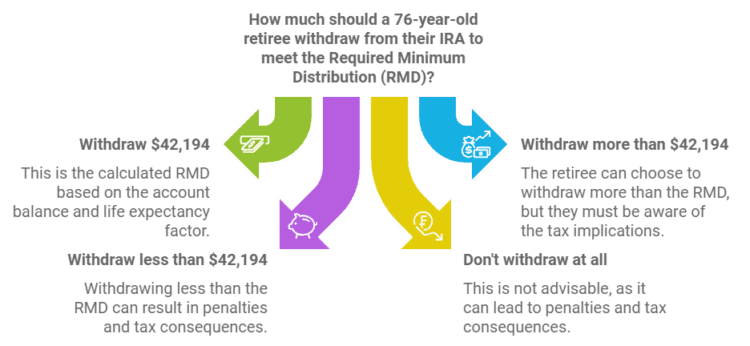
Simple Example: $1 Million IRA at Age 76
Suppose you turn 76 in 2026, your traditional IRA was worth $1,000,000 on December 31, 2025, and Table III applies. The Uniform Lifetime Table factor at age 76 is 23.7.
Quick Calculation
$1,000,000 ÷ 23.7 = $42,194.09.
Your estimated 2026 RMD for that account would be about $42,194.
If that is your only relevant account and nothing unusual applies, congratulations—you may be done.
If you have three IRAs, an old 401(k), money already withdrawn and a QCD… that’s where the full planner earns its keep.
Which IRS RMD Table Applies? The Calculator Checks for You
Most original account owners use Table III, the Uniform Lifetime Table.
But there is an important exception when your spouse is your sole beneficiary and is more than 10 years younger. That account can use Table II, the Joint Life and Last Survivor Table.
| Situation | Calculator treatment |
|---|---|
| Unmarried original account owner | Uses Table III when otherwise applicable |
| Married, spouse not more than 10 years younger | Uses Table III when otherwise applicable |
| Spouse is sole beneficiary and more than 10 years younger | Uses the applicable Table II factor based on both ages |
| Inherited retirement account | Stops and routes you to inherited-account guidance rather than pretending owner rules apply |
The important improvement here is that you do not have to recognize the younger-spouse exception, leave the calculator, hunt through an IRS table and come back with a divisor.
In the full planner, you provide the spouse information and beneficiary status. When the exception applies, the calculator can use the corresponding Table II factor and show you what it used.
Still Verify the Special Case
If Table II is used, check that the spouse really is the sole beneficiary of that account and confirm the displayed ages and IRS factor against Publication 590-B or with your tax professional or custodian.
When Do RMDs Start?
Under current SECURE 2.0 rules, the applicable RMD age is generally 73 for people who reach age 73 before 2033. The applicable age later moves to 75 for younger cohorts covered by the law.
Your first RMD is for the year you reach the applicable age. You may be allowed to delay that first distribution until April 1 of the following year.
Deadline Option ≠ Automatically a Good Tax Move
Delaying your first RMD can cause your first distribution and your next regular RMD to land in the same calendar year. Before doing that, look at the income-tax and Medicare consequences of bunching two taxable distributions together.
The current starting-age and account rules are summarized in the IRS required minimum distribution guidance.
Multiple Accounts: The Number Isn’t the Same as the Withdrawal Plan
This is probably the biggest reason I added the full portfolio mode.
You generally start by calculating the RMD for each account separately. Only then do you determine whether the law allows some of those obligations to be satisfied with distributions from another account in the same permitted group.
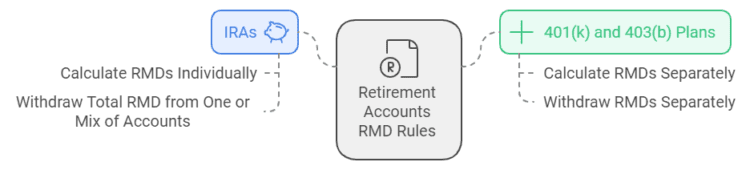
| Account type | Calculate separately? | May the requirement be combined? |
|---|---|---|
| Traditional, SEP and SIMPLE IRAs | Yes | Generally, eligible IRA RMDs can be totaled and taken from one or more eligible IRAs |
| 401(k) and most employer plans | Yes | Generally no; the plan’s RMD is satisfied separately |
| 403(b) | Yes | Special aggregation rules may allow eligible 403(b) amounts to be combined |
| Governmental 457(b) | Yes | Generally treated as its own plan requirement rather than combined with an IRA RMD |
The Mistake: “My Total RMD Is $20,000, So I Can Take $20,000 Anywhere”
Not necessarily. A $20,000 total on a spreadsheet is not the same thing as permission to withdraw $20,000 from whichever retirement account is easiest.
The full planner keeps those account categories separate and explains the aggregation treatment in the result.
If you want the rule itself in more detail, see my RMD aggregation guide. The IRS also has an IRA vs. defined-contribution-plan RMD comparison.
How Much of Your RMD Is Still Left to Take?
This is the question a normal RMD calculator gets worse at as the year goes on.
In January, “What is my RMD?” may be enough.
By September or December, the question may really be:
The Real-Life Version
“My IRA RMDs total $14,600. I’ve already withdrawn $5,000 and sent $3,000 directly to charity as an eligible QCD. How much appears to remain?”
Estimated remaining IRA-group requirement: $6,600.
That is why the full planner allows you to enter distributions already taken during 2026 and eligible QCD amounts. It can compare those amounts with the calculated requirement and estimate what remains.
One distinction matters here: a QCD does not change the RMD calculation itself. When it qualifies, it can count toward satisfying the IRA RMD requirement. Those are two different steps.
The same logic is why the planner doesn’t simply subtract every retirement-account withdrawal from one household RMD total. It keeps account categories and aggregation rules in the calculation.
What Can Still Make an RMD Result Wrong?
The new calculator catches more of the setup mistakes automatically, but no calculator can verify everything happening outside the browser.
- Wrong December 31 balance. Entering today’s value instead of the required prior-year-end balance changes the result.
- Wrong beneficiary information. Table II depends on the spouse actually being the sole beneficiary of that account.
- Missing retirement account. The tool cannot include an account you forgot existed.
- Incorrect current-employer assumptions. A still-working exception can depend on the plan, the employer relationship and ownership facts the calculator cannot independently verify.
- Incorrectly entered prior distributions or QCDs. The remaining-RMD estimate is only as good as the amounts you give it.
- Inherited-account rules. Do not enter an inherited IRA as though you were the original owner.
- Waiting until the last minute. Calculating the amount is not the same thing as successfully completing the distribution.
2026 Roth Check
Roth IRAs and designated Roth accounts in 401(k), 403(b) and governmental 457(b) plans are not subject to lifetime RMDs for the original owner under current rules. Beneficiary rules are different.
Traditional-account RMDs are also generally taxable income, subject to basis and other exceptions. If you are trying to understand the income treatment, see how RMD withdrawals are taxed and whether they count as earned income.
What Happens If You Miss an RMD?

If you fail to take enough of a required distribution, the shortfall can be subject to a 25% excise tax. The rate can fall to 10% when the shortfall is corrected within the applicable correction period.
The practical lesson matters more than memorizing the percentage: don’t freeze when you find the mistake. Correct the distribution promptly, document what happened and review the Form 5329 and waiver rules that apply.
Once you have actually missed the requirement, this calculator is no longer the main tool you need. Use my missed RMD penalty and correction guide.
Michael’s Take
The arithmetic rarely causes the expensive mistake. The setup does.
That’s really the whole reason the calculator grew from one division problem into two modes. If you only need the division problem, great. If your retirement life is messier than that—and it usually gets messier as accounts accumulate—the calculator should help you organize the rules instead of making you know them first.
Your RMD Is Covered. Now What?
This is the point where I intentionally stop expanding the calculator.
The full planner can help answer how much is required, where the requirement belongs, what you’ve already satisfied and what appears to remain.
It does not pretend that those facts tell you the best investment to sell, the ideal withholding amount, whether you should spend or reinvest the proceeds, or whether a QCD is the best tax strategy for you.
Calculation First. Strategy Second.
Once the requirement itself is clear, then ask:
- Do I need the RMD for spending?
- Should federal or state tax be withheld?
- Am I already giving money to charity, making a QCD worth investigating?
- Could the added income affect Medicare IRMAA later?
- If I don’t need the cash, what do I do with the proceeds after satisfying the RMD?
If you don’t need the money for spending, start with what to do with RMD proceeds you don’t need.
If charitable giving is already part of your plan, see how qualified charitable distributions can interact with RMDs and IRMAA.
And if Medicare premiums are the concern, use the IRMAA calculator separately rather than trying to turn an RMD calculator into an entire retirement tax-planning system.
For 2026, the inflation-adjusted QCD exclusion limit is $111,000 per eligible individual. QCD eligibility begins at age 70½, and the transfer generally must go directly from the IRA trustee to an eligible charity.
Bottom Line: Calculate the Requirement, Then Solve the Portfolio
If you have one straightforward IRA and just want your 2026 RMD, use the Quick Estimate. There is no prize for turning a simple question into a 20-question financial intake form.
If your situation includes multiple accounts, a younger spouse, workplace plans, withdrawals already taken, QCDs or uncertainty about which accounts can be combined, continue into the Full RMD Portfolio Planner.
The Rule I Want You to Remember
Calculate each requirement correctly. Figure out what can be combined. Subtract what you’ve legitimately satisfied. Then deal with the tax and investment strategy.
That’s a little more useful than handing you $18,742.16 and wishing you luck. lol.
Sources
- IRS Publication 590-B, Distributions from Individual Retirement Arrangements
- IRS Required Minimum Distribution Guidance
- IRS Required Minimum Distribution Worksheets
- IRS RMD Comparison Chart: IRAs vs. Defined Contribution Plans
Calculator methodology: The tool applies published 2026 owner-RMD rules to information you enter, including applicable IRS life-expectancy factors and supported account-category rules. Advanced results depend on the accuracy of the account, beneficiary, employment, ownership, distribution and QCD information you provide. Review unusual situations against current IRS guidance and your plan or custodian records.
Disclaimer: This calculator and article are for educational purposes and are not individualized tax, legal or investment advice. RMD rules can vary by account type, beneficiary status, employer plan terms and individual circumstances.
