

A Roth conversion calculator should answer more than, “What is 24% of the amount I convert?” The real question is how much of your conversion falls into each federal tax bracket, what the conversion may cost now, and whether the modeled future after-tax value looks better than leaving the same money pre-tax.
That is what the calculator on this page is built to do for 2026. Enter your filing status, estimated taxable income before the conversion, the amount you are considering, and a few planning assumptions. The tool calculates the added federal tax bracket by bracket instead of asking you to guess one tax rate for the entire conversion.
The result is a planning model, not a tax return. A Roth conversion can also affect Medicare IRMAA, ACA Marketplace credits, Social Security taxation, capital gains, deductions, credits, state taxes, and other income-sensitive items. I would rather show those boundaries clearly than pretend one calculator can safely do every tax job.
Show the key points
- 2026 tax math: The calculator uses the actual 10%, 12%, 22%, 24%, 32%, 35%, and 37% federal ordinary-income brackets instead of multiplying the whole conversion by one guessed rate.
- Bracket spillover: You can see how much of the taxable conversion stays in your starting bracket and how much moves into higher brackets.
- Long-term model: The tool compares modeled Roth value with the after-tax value of leaving the same amount pre-tax, using your return and future-tax assumptions.
- Hidden costs: IRMAA, ACA credits, capital-gain stacking, Social Security taxation, NIIT, and state-specific rules can change the real cost and require separate analysis.
- No 2025 sunset: The old pitch that today's seven federal rates automatically expired after 2025 is obsolete. The current rate structure was made permanent, although bracket thresholds still change with inflation.
The calculator starts with the number that matters most for federal bracket math: your estimated taxable income before the Roth conversion. That is different from salary, gross income, or adjusted gross income. Once the starting point is set, the calculator layers the taxable portion of the conversion on top and computes the incremental federal ordinary-income tax.
It does not tax the entire conversion at one rate. If part of a $60,000 conversion lands in the 22% bracket and the rest lands in the 24% bracket, the result shows those slices separately. That is closer to how federal marginal brackets actually work.
2026 Roth planning modeler
On This Page
- Roth Conversion Calculator
- How to Read the Roth Decision Calculator Result
- What a Roth Conversion Changes
- Roth Conversion vs. Leaving the Money Pre-Tax
- How to Read the Roth Conversion Tax-Bracket Spillover
- Costs a Roth Conversion Calculator Cannot Safely Collapse Into One Number
- Roth Conversion Rules to Verify Before You Act
- Roth Conversion Calculator FAQs
- Your Next Move: Test the Amount, Then Test the Side Effects
- How We Verified This
Roth Conversion Calculator
Estimate the federal tax created by a Roth conversion using the 2026 tax brackets, then compare the modeled long-term after-tax value with leaving the same money pre-tax. A second mode checks a 2026 Roth-vs-Traditional IRA contribution decision.
Estimated 2026 conversion tax
Estimated federal tax created by conversion
Enter or change your assumptions above. The result will update automatically.
What to check next
2026 federal ordinary-income brackets and IRA limits are based on current IRS guidance. This is an educational model, not a tax return or individualized tax advice.
Model limits: The conversion estimate models ordinary federal income tax on taxable income plus an optional flat state-rate estimate and user-entered ACA cost. It does not fully calculate capital-gain stacking, Social Security taxation, NIIT, AMT, credits, deductions that change with income, IRMAA, state-specific tax rules, the IRA pro-rata calculation, or early-distribution exceptions.
On this page
- Read the 2026 Roth conversion result
- Understand what a conversion changes
- Compare converting with staying pre-tax
- Read the bracket spillover result correctly
- Check costs the calculator does not fully model
- Verify Roth conversion rules before acting
- Roth conversion calculator FAQs
How to Read the Roth Decision Calculator Result
Start with the conversion mode. The second mode is a separate Roth-vs-Traditional IRA contribution check because this shortcode is also used elsewhere on MichaelRyanMoney.com. Annual IRA contribution limits and income phaseouts do not limit the amount you are allowed to convert from a traditional IRA to a Roth IRA.
The 2026 conversion result shows four things I would look at first: the added federal tax, the highest bracket reached, the effective federal tax rate on the conversion itself, and the amount of the conversion that spills into a higher bracket.
Do not ask only, “Can I afford the tax?” Ask, “Which dollars am I choosing to pay tax on, at which rates, and what other income-based costs do those dollars trigger?” The conversion amount is a dial, not an all-or-nothing switch.
What a Roth Conversion Changes
A Roth conversion moves money from a pre-tax retirement account into a Roth account. To the extent the converted amount has not already been taxed, it is generally included in taxable income for the year of the conversion. The IRS uses Form 8606 to report traditional-IRA basis and Roth conversions when it applies.
The trade is straightforward. You accept a tax cost now in exchange for moving those dollars into a Roth environment where qualified distributions can be tax-free. Whether that trade is attractive depends on more than a prediction that “taxes will be higher later.” Your current bracket, future bracket, time horizon, source of the tax payment, RMD exposure, estate goals, and income-based side effects can all matter.
The old “convert before the 2017 tax rates expire after 2025” argument is stale. Current IRS 2026 guidance reflects the seven 10%, 12%, 22%, 24%, 32%, 35%, and 37% individual rates under the post-2025 law. Bracket thresholds still move with inflation, but there is no automatic 2026 snapback to the pre-2018 rate schedule.
That does not make Roth conversions irrelevant. It just removes a fake deadline. The real planning question is whether paying tax on selected dollars now improves your after-tax flexibility later.
If you need the broader strategy and execution sequence rather than the calculator math, use the Roth IRA conversion guide.
Roth Conversion vs. Leaving the Money Pre-Tax
The calculator compares the same starting retirement dollars under two modeled paths. In the Roth path, the amount that reaches the Roth grows under your return assumption. In the pre-tax path, the money stays tax-deferred and the future balance is reduced by the future withdrawal-tax rate you enter.
If you pay the current conversion tax with outside cash, the calculator also treats that cash as money that could otherwise have grown at the same assumed return. That creates a tougher hurdle for the Roth and prevents the comparison from pretending the tax bill is free. The model does not attempt to calculate taxable-account drag on that outside money, so treat the result as an educational comparison rather than a forecast.
Suppose your taxable income is near the top of the 22% bracket and you test a $50,000 taxable conversion. Some dollars may stay at 22% while the rest move into 24%. The important decision is not whether “your bracket is 22%.” It is how much of the proposed conversion is actually taxed at each rate.
That is also why the calculator shows the estimated federal tax on the next $1,000 of conversion. It gives you a marginal view of the decision instead of one giant yes-or-no output.
How to Read the Roth Conversion Tax-Bracket Spillover
The biggest improvement in the rebuilt calculator is the bracket-spillover result. Federal marginal tax brackets apply in layers. Crossing from 22% into 24% does not suddenly cause every dollar you earned that year to be taxed at 24%.
For example, if the calculator says $18,000 of your proposed conversion stays in your starting bracket and $32,000 spills higher, that is the planning signal. You can test a smaller amount, a larger amount, or a different year and immediately see what changes.
“If I cross into the next bracket, the whole conversion gets taxed at the higher rate.” No. Only the taxable income that lands inside the higher bracket is taxed at that higher marginal rate.
Costs a Roth Conversion Calculator Cannot Safely Collapse Into One Number
A useful calculator needs a boundary. Your federal ordinary-income bracket is important, but it is not the only place a conversion can show up.
A conversion can reduce ACA Marketplace premium tax credits, change how much Social Security is taxable, push investment income into a different capital-gain interaction, affect credits or deductions, and raise future Medicare IRMAA premiums. The real marginal cost can therefore be higher than the federal bracket printed next to the conversion dollars.
The calculator lets you add an independently estimated state-tax rate and ACA cost. It deliberately does not invent an ACA credit from incomplete household information. HealthCare.gov confirms that the additional Marketplace savings available through 2025 ended on December 31, 2025, which makes current-year ACA estimates especially important for readers who buy coverage through the Marketplace.
Medicare IRMAA is a separate decision job too. If Medicare premiums are part of your sizing question, use the dedicated guide on how much Roth you can convert before IRMAA. This calculator should not quietly duplicate a second volatile Medicare engine.
I would rather see you run a clean base case here, then test the specific side effect that actually applies to you, than stare at one “perfect” number built from assumptions you cannot audit.
Roth Conversion Rules to Verify Before You Act
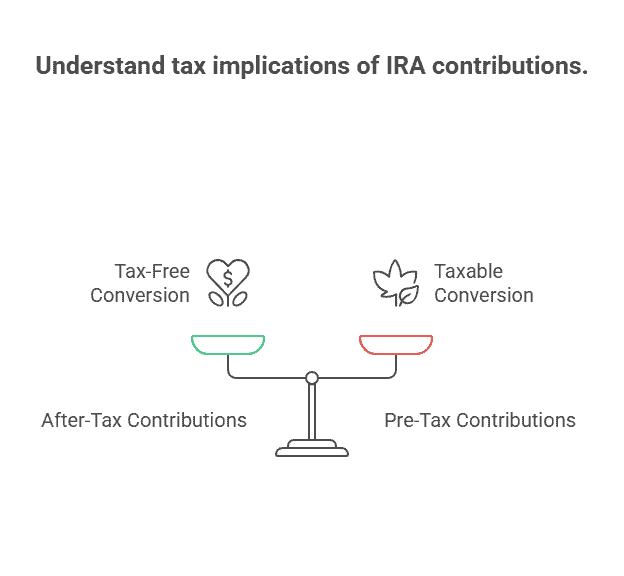
The calculator helps with modeling. It does not replace the IRS rules that determine the taxable amount and reporting.
- After-tax IRA basis matters. If you have nondeductible basis in traditional, SEP, or SIMPLE IRAs, Form 8606 and the pro-rata calculation can make the taxable amount different from the gross amount you convert.
- A conversion cannot simply be undone later. Roth conversions made after 2017 generally cannot be recharacterized back to a traditional IRA.
- Each taxable conversion can have its own five-year additional-tax period. IRS Publication 590-B explains that if converted money comes back out too soon and you are under age 59½, the 10% additional tax can apply unless an exception does. The separate Roth qualified-distribution five-year rule is a different clock.
- Withholding is not free. If part of the retirement distribution is withheld for taxes instead of reaching the Roth, less money gets converted. Depending on age and exceptions, the withheld portion can also create an early-distribution issue.
The dedicated Roth conversion rules guide owns those compliance details. Use it before executing a transaction.
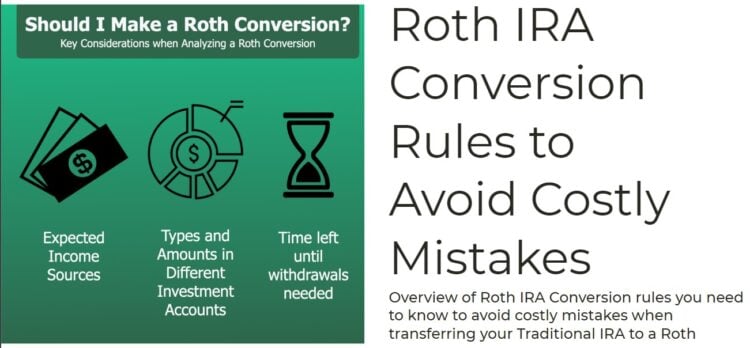
Roth IRAs are not subject to lifetime RMDs for the original owner, and current IRS RMD guidance says designated Roth accounts in 401(k) and 403(b) plans also do not require lifetime RMDs while the employee is alive. Older articles that say a Roth 401(k) still forces owner RMDs are outdated.
Roth Conversion Calculator FAQs
How much should I convert to a Roth IRA in 2026?
There is no universal “right” amount. A useful starting method is to model several conversion sizes and watch the incremental tax, bracket spillover, cash needed for taxes, and any IRMAA or ACA consequences that apply to your household.
Does the Roth IRA income limit stop me from doing a conversion?
No. The Roth IRA contribution income limits are rules for annual contributions. They are not a dollar or MAGI cap on converting eligible pre-tax retirement assets to Roth.
Should I use my marginal tax rate or effective tax rate?
For conversion planning, you care about the marginal rates applied to the additional taxable income. That is why this calculator asks for taxable income and calculates the 2026 federal brackets rather than asking for your overall effective tax rate.
Does a Roth conversion affect Social Security taxes?
It can. Taxable conversion income can increase provisional income and cause more Social Security benefits to become taxable. This calculator does not run the full Social Security taxation formula, so treat that as a separate check when you are already receiving benefits.
Does a Roth conversion affect IRMAA?
It can because a taxable Roth conversion generally increases MAGI used for Medicare IRMAA. IRMAA uses a two-year lookback in the ordinary case, and threshold-specific sizing belongs in the dedicated IRMAA workflow rather than this calculator.
Can I pay the Roth conversion tax from the IRA?
You can have tax withheld from a retirement distribution, but the amount withheld is not converted to Roth. If you are under age 59½, the withheld amount can also create a 10% additional-tax issue unless an exception applies. Model both funding choices before treating withholding as painless.
What are the 2026 IRA contribution limits in the calculator’s second mode?
The combined 2026 contribution limit for traditional and Roth IRAs is $7,500, or $8,600 if you are age 50 or older, subject to taxable compensation and other rules. The second mode also reflects the 2026 Roth IRA MAGI phaseout ranges. Those contribution limits are separate from Roth conversion rules.
Your Next Move: Test the Amount, Then Test the Side Effects
Run the calculator with the conversion amount you are considering. Then change it. Try an amount that stays inside your current bracket, one that spills into the next bracket, and one that intentionally crosses the line because the long-term tradeoff might still make sense.
That is the way I would use a Roth conversion calculator in real planning. Not to produce a magic answer, but to expose the point where the decision changes. A roth conversion 5 year ladder can provide a strategic approach to managing your taxable income over time. It allows you to convert portions of your traditional retirement accounts gradually, potentially minimizing the tax impact.
A conversion can look attractive in the federal-tax model and still be a poor fit after Medicare premiums, Marketplace credits, cash needs, estate goals, or a short time horizon are considered. The calculator tells you what to investigate next. It should never hide the assumptions from you.
How We Verified This
Key 2026 rules and calculator inputs were checked against current IRS and federal guidance.
