
Quick answer: divide your annual salary by the number of hours you actually work in a year. For a 40-hour week over 52 weeks, that means dividing by 2,080. A $50,000 salary works out to about $24.04 per hour before taxes and deductions.
Use the calculator below with your real work schedule. That matters more than most people realize: the same annual salary can translate into a very different hourly rate when one job expects 40 hours a week and another quietly expects 50 or 55.
Have an hourly wage and want the yearly equivalent instead? Use the Hourly to Salary Calculator. That page owns the reverse calculation.

On This Page
Salary to Hourly Calculator
Enter your annual salary, average hours worked per week, and weeks worked per year. The result is your gross hourly equivalent before taxes, insurance premiums, retirement contributions, and other deductions.
Salary to Hourly Calculator
Convert annual salary to an estimated gross hourly rate using the work schedule you actually expect.
Estimated gross hourly rate
This is a gross-pay comparison before taxes, benefits, bonuses, and other deductions or compensation. It is educational, not personalized financial advice.
The calculator gives you the number. The more useful question is what that number means when you compare two jobs, a raise, or a new offer.
How to Calculate Hourly Rate From Annual Salary
The formula is:
Hourly rate = Annual salary ÷ (hours worked per week × weeks worked per year)
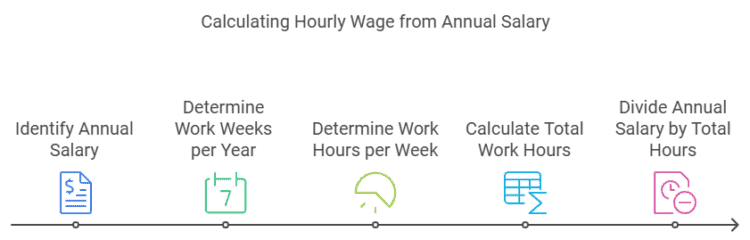
If you work 40 hours a week for 52 weeks, you work 2,080 hours in a year:
$50,000 ÷ 2,080 = $24.04 per hour
That 2,080 shortcut is convenient, but it is not a law of nature. It is simply 40 hours × 52 weeks. If your actual schedule is 37.5 hours, 50 hours, seasonal, or otherwise different, use the schedule you really expect to work.


Salary-to-Hourly Examples
Assuming 40 hours per week and 52 weeks per year:
| Annual salary | Hourly rate |
|---|---|
| $40,000 | $19.23/hour |
| $50,000 | $24.04/hour |
| $60,000 | $28.85/hour |
| $75,000 | $36.06/hour |
| $100,000 | $48.08/hour |
Adjust for Your Actual Work Schedule
This is where salary-to-hourly math becomes genuinely useful. A salary can look better on paper while paying less for each hour of your time.
For example, a $60,000 salary works out to:
- $30.77/hour at 37.5 hours per week
- $28.85/hour at 40 hours per week
- $23.08/hour at 50 hours per week
Same salary. Very different value for your time.
Your Effective Hourly Rate May Be Lower Than It Looks
I’ve seen this become the deciding factor in job-offer conversations. One client, “James,” was looking at a jump from $95,000 to $115,000. On salary alone, the new job looked like the obvious winner.
His current job was about 40 hours a week. At 52 weeks, that is roughly $45.67 an hour. The new role was expected to run closer to 55 hours a week. At that schedule, $115,000 works out to about $40.21 an hour.
So yes, the paycheck was bigger. But he would have been giving the employer roughly 15 more hours every week while earning less for each hour of his time.
That is the part a salary number can hide. When you compare jobs, raises, or promotions, convert the salary to an hourly rate using the hours you actually expect to work—not the hours you wish the job required.
Michael’s take: A bigger salary is not automatically a better-paying job. I want to know what you are being paid for your time, what benefits come with it, and how much of your life the job is buying.
What the Hourly Rate Doesn’t Tell You
Your calculated hourly rate is a useful comparison tool, not a complete compensation statement. Before choosing between jobs, also look at:
- Health insurance: employer premiums and plan quality can materially change what a job is worth.
- Retirement benefits: employer matches or contributions belong in the comparison.
- Paid time off: two jobs with the same salary can have very different vacation, holiday, and sick-time policies.
- Bonuses and commissions: variable compensation may raise annual pay without changing base salary.
- Schedule stability: a predictable 40-hour week can be worth more to you than a role with constant nights, weekends, or unpredictable overtime.
- Overtime eligibility: salary status by itself does not tell you whether additional hours are separately compensated.
And keep gross hourly rate separate from take-home pay. This calculator converts salary to an hourly equivalent before taxes and deductions. It is not a paycheck or tax calculator. If that’s what you are looking for, go play with my Paycheck Calculator here
Salary-to-Hourly FAQ
How much is $50,000 a year per hour?
At 40 hours per week for 52 weeks, $50,000 a year equals about $24.04 per hour before taxes and deductions.
How much is $75,000 a year per hour?
At 2,080 annual work hours, $75,000 equals about $36.06 per hour.
How much is $100,000 a year per hour?
At 40 hours per week for 52 weeks, $100,000 equals about $48.08 per hour. At 55 hours per week, the same $100,000 salary falls to about $34.97 per hour.
Why does everyone use 2,080 hours?
Because 40 hours per week × 52 weeks equals 2,080 hours. It is a convenient full-time convention, not a universal work schedule. Use your actual hours whenever they differ.
Should paid vacation reduce the weeks I use?
Not automatically. If your annual salary stays the same while you take paid vacation, the salary itself has not fallen. For job comparisons, the better approach is usually to calculate your effective rate based on the time you actually expect to spend working, while evaluating paid time off separately as part of total compensation.
How do I convert hourly pay back to an annual salary?
Use the Hourly to Salary Calculator. Keeping the two directions separate makes each calculator easier to use and avoids mixing formulas.
Bottom Line
To convert annual salary to hourly pay, divide the salary by your annual work hours:
Annual salary ÷ (hours per week × weeks per year) = estimated gross hourly rate.
The arithmetic is simple. The useful part is being honest about the hours. If one job pays $100,000 for 40 hours a week and another pays the same $100,000 for 55 hours, they are not the same deal—even though the salary line is identical.
