

The couple sat across from me, retirement 18 months out, staring at a $380,000 tax bomb they didn’t see coming. Their advisor had told them to “let it ride” in their pre-tax 401(k). Now, they were trapped.
A Roth IRA conversion eliminates federal income tax on all future qualified withdrawals. Here’s what most advisors miss now that the TCJA tax rates are permanenthttps://www.irs.gov/newsroom/irs-releases-tax-inflation-adjustments-for-tax-year-2026: the game isn’t about beating a phantom deadline anymore. It’s about surgical timing based on your life.
Before we go deeper, here’s what you need to know upfront:
- The “2026 Sunset” is a Myth: The TCJA tax rates were extended. Stop planning around an expired deadline.
- Timing is Everything: The new arbitrage is converting during personal low-income years (job loss, sabbatical) or major market dips.
- Pay Attention to the Clocks: The 5-year rule applies separately per conversion, not just per account. This is a critical detail.
- Isolate Your Basis: The pro-rata rule requires a specific strategy—like a reverse 401(k) rollover—to avoid unexpected tax bills on backdoor conversions.

Key Takeaways Ahead
Video: Roth Conversion Strategy for 2026
Before you read the full breakdown below, watch this 7-minute breakdown of the exact framework I use to help clients identify their personal Roth conversion window. Additionally, integrating a thorough Roth conversion IRMAA cost analysis into your strategy will help you avoid unexpected expenses and maximize your tax efficiency.
What you’ll discover:
- The real reason 2026 is a conversion opportunity (and why the “sunset” narrative is outdated)
- How one client converted $105,000 in a single year and saved $21,500 in taxes
- The R.I.S.C. Framework—the 5-step process that guides every conversion decision
- How to avoid the pro-rata rule trap with a simple reverse rollover strategy
👇 Watch below, then scroll down for the complete framework, real numbers, and the calculator.
How a Roth Conversion Actually Works

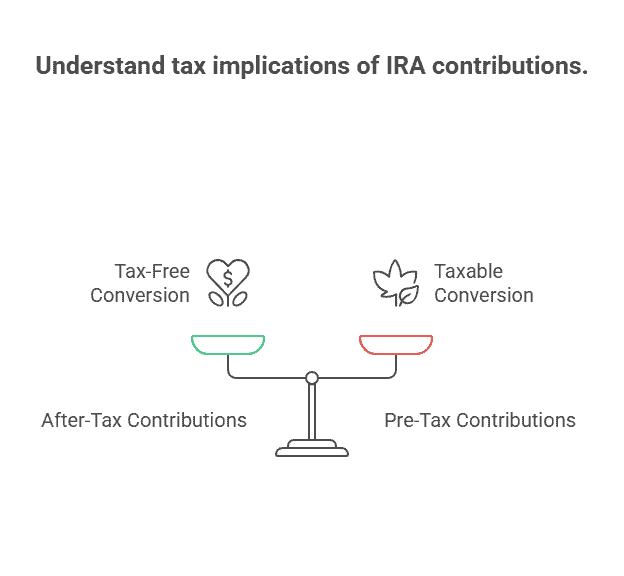
This isn’t magic; it’s math. When you convert a traditional IRA to a Roth IRA, you move money from a pre-tax account (Traditional IRA, 401(k)) to a post-tax Roth IRA. You pay the tax now to make it tax-free forever.
- Identify Your Bracket Capacity.
- Calculate how much you can convert before you jump into a significantly higher tax bracket.
- Execute the Conversion.
- The cleanest method is a direct trustee-to-trustee transfer from your current institution (like Fidelity or Vanguard) to your Roth IRA.
- Pay the Tax.
- The converted amount is added to your ordinary income for the year. You must plan to pay this tax with cash from outside the retirement account.
- Wait for Tax-Free Access.
- For qualified, tax-free withdrawals of earnings, you must be 59½ and have had any Roth IRA open for five years. But each conversion also has its own 5-year clock for penalty-free access to the principal if you’re under 59½.
Real Numbers Example:
Let’s say you’re married, filing jointly, with $150,000 in taxable income in 2026.
- The 24% tax bracket ends at $201,050.
- Your conversion “capacity” within that bracket is $51,050.
- The immediate tax cost is $51,050 × 24% = $12,252.
- You just turned a $51,050 tax-deferred problem into a tax-free solution. The break-even on that tax payment is typically 7-9 years. [ Vanguard Tax-Efficient Investing Report, 2025]
What High-Earners Fear Most
You’re probably staring at a massive 401(k) balance and wondering: “Will converting this monster IRA account push me into the top tax bracket and trigger insane Medicare surcharges?“
Answer: Yes, if you do it wrong. A lump-sum conversion is almost always a mistake. The key is AGI manipulation.
The strategy isn’t to convert everything at once. It’s to perform a series of smaller, strategic conversions over several years, specifically in years where your income is temporarily lower.
This “fills up” the lower 12%, 22%, and 24% brackets without ever touching the 32% or 37% brackets.
💡 Stop Planning Around Myths — Start Timing for Tax Wins
One smart money move each week — straight from 28 years of seeing what really works (and what blows up later).
- → Decode hidden Roth conversion traps
- → Learn how to spot “tax cliff” years early
- → Get exclusive timing tactics for retirees and high-earners
Client Story:
In Q3 2025, I worked with Eleanor, a 52-year-old software architect. Her normal income was $350,000. She planned a sabbatical for all of 2026 to travel. Her income would be zero. We saw the opportunity.
Instead of doing nothing, we converted $105,000 from her IRA. After her standard deduction, the entire conversion was taxed at just the 12% and 22% rates. The total tax bill was about $16,500.
Had she converted that same amount during a working year, her tax bill would have been over $38,000. That one sabbatical year saved her $21,500 in taxes and secured $105,000 of tax-free growth for life.
The R.I.S.C. Check for Optimal Conversion Timing
Forget the dead “TCJA sunset” narrative. Use this framework to find your personal conversion window.
The Michael Ryan Money CONVERT Framework™
Your 7-Step Roth Conversion Roadmap. Click each step to learn more.
C Calculate Current vs. Future Tax Bracket
Action: Calculate your combined marginal tax rate (Federal + State) for this year. Then, create a realistic projection of your income streams in retirement (Social Security, pensions, taxable withdrawals) to estimate your future marginal tax rate.
Key Metric / Focus: Marginal Rate Delta. A positive delta (future rate > current rate) signals a green light for a conversion. A negative delta suggests you may be better off paying taxes in retirement.
Why It’s Crucial: This is the entire ballgame. A Roth conversion is a calculated bet that the tax rate you pay today on the converted amount will be lower than the rate you’d pay on that same money in the future. Don’t forget that RMDs can force you into a higher bracket than you anticipate.
O Offset Conversion Income Where Possible
Action: Can you pair the conversion with tax-reducing events? Consider converting in a year with unusually low income, a large business loss, or significant capital losses from a taxable brokerage account (up to $3,000 in losses can offset ordinary income).
Key Metric / Focus: Net Tax Cost. This is the final tax bill after all deductions and offsets are applied. The goal is to make this number as small as possible.
Why It’s Crucial: A large conversion acts like a bonus paycheck from a tax perspective. By strategically offsetting that “income,” you can execute a larger conversion for the same tax cost, maximizing the amount of money that gets to grow tax-free forever.
N Navigate Income-Sensitive Thresholds
Action: Model how the conversion’s impact on your Modified Adjusted Gross Income (MAGI) affects other parts of your financial life. A higher MAGI can trigger Medicare IRMAA surcharges, reduce eligibility for ACA health insurance subsidies, or phase out education tax credits.
Key Metric / Focus: MAGI “Cliff” Awareness. Know the exact income thresholds where these benefits are reduced or eliminated. Sometimes it’s better to convert $1 less to avoid crossing a costly cliff.
Why It’s Crucial: The tax cost of a conversion isn’t just the income tax. Losing a $5,000 ACA subsidy is a very real cost. A holistic analysis prevents you from winning the tax battle but losing the financial war.
V Verify All Rules & Timing
Action: Confirm your understanding of the two critical 5-year rules. The clock for withdrawing *earnings* tax-free starts on Jan 1 of the year you made your *first-ever* Roth contribution. The clock for withdrawing *converted principal* penalty-free (if under 59.5) starts on Jan 1 of the year of *that specific conversion*.
Key Metric / Focus: Compliance Score. Are you 100% compliant with IRS Publication 590-A and 590-B? Have you accounted for the pro-rata rule if you have any non-deductible IRA basis?
Why It’s Crucial: A mistake here is costly. Withdrawing converted principal from a 3-year-old conversion (even if your Roth account is 20 years old) can trigger a 10% penalty. Details matter.
E Execute with Precision
Action: Instruct your financial institution to perform a “direct trustee-to-trustee transfer” from your Traditional IRA/401(k) to your Roth IRA. Ensure you have sufficient cash in a non-retirement account (e.g., checking, brokerage) to pay the resulting tax bill.
Key Metric / Focus: Transfer Method. The goal is 100% trustee-to-trustee. Avoid the 60-day rollover option where you receive a check; it’s fraught with risks like missed deadlines and automatic tax withholding.
Why It’s Crucial: Paying the conversion tax from the converted funds themselves is a costly error. If you are under 59.5, that tax payment is treated as an early distribution, subject to both income tax AND a 10% penalty.
R Review Annually
Action: At the end of each year, assess your income, market performance, and the current tax code. Look for opportunities to make strategic partial conversions to “fill up” your current tax bracket without spilling into the next one.
Key Metric / Focus: Bracket Fill Percentage. How much of your current tax bracket did you use? Leaving “room” in lower brackets is a missed opportunity that you can’t get back.
Why It’s Crucial: Most people shouldn’t do one massive conversion. A series of smaller, deliberate conversions over several years is a more tax-efficient and manageable strategy. It allows you to average your tax cost over time and react to new legislation.
T Transfer Strategically (e.g., Mega Backdoor)
Action: For high-earners, investigate your 401(k) plan documents. Look for three key phrases: “after-tax contributions,” “in-service distributions,” or “in-plan Roth conversions.” If your plan allows these, you may be able to utilize the Mega Backdoor Roth strategy.
Key Metric / Focus: Maximize After-Tax to Roth Potential. This strategy allows you to contribute far beyond the standard 401(k) limits, getting huge sums of money into a Roth vehicle with minimal tax drag. You can learn more here: Roth IRA income limits explained.
Why It’s Crucial: This is one of the most powerful wealth-building tools available for those with access to it. It’s a legal way to supercharge your tax-free retirement savings, completely separate from a standard Traditional-to-Roth conversion.
The Pro-Rata Rule: The Backdoor Conversion Killer

The pro-rata rule is the landmine for high-earners trying to execute a Backdoor Roth IRA. Here’s what most advisors miss: there is a clean, legal way to disarm it.
The rule requires that if you have any pre-tax money in any Traditional, SEP, or SIMPLE IRA, your conversion will be proportionally taxable. You can’t just convert the non-deductible portion tax-free.
But here’s the unspoken professional truth: many 401(k) plans allow you to roll in money from your IRAs.
How to Eliminate the Pro-Rata Problem
The solution is a reverse rollover. It’s a two-step financial quarantine.
- Isolate the Pre-Tax Funds: You instruct your IRA custodian to roll all of your pre-tax IRA money directly into your current employer’s 401(k) plan.
- Execute a Clean Conversion: Now, your Traditional IRA holds only your non-deductible (after-tax) basis. You can convert this amount to your Roth IRA, and because there is no pre-tax money left, the conversion is largely tax-free.
This maneuver completely sidesteps the pro-rata calculation. [cite: IRS Publication 590-A, 2026]
⚡ Bottom Line: The pro-rata rule is only a problem if you leave pre-tax money sitting in an IRA. For many, the fix is as simple as moving those funds into a 401(k) before you execute the final conversion step.
💡 Stop Planning Around Myths — Start Timing for Tax Wins
One smart money move each week — straight from 28 years of seeing what really works (and what blows up later).
- → Decode hidden Roth conversion traps
- → Learn how to spot “tax cliff” years early
- → Get exclusive timing tactics for retirees and high-earners
Michael Ryan Money Roth Conversion Decision Calculator
Considering a Roth IRA conversion? Our user-friendly calculator helps you analyze the potential benefits. Input your information, including age, income, and desired conversion amount, to estimate growth and tax implications. Discover the breakeven point and make an informed decision. Simplify the process and optimize your retirement savings. Try our Roth Conversion Calculator today!
Frequently Asked Questions
Can I reverse a Roth conversion if the market drops?
No. The Tax Cuts and Jobs Act of 2017 eliminated recharacterizations for conversions completed after December 31, 2017. All Roth conversions are now permanent, making timing decisions based on the R.I.S.C. framework critical for tax efficiency. [IRS Notice 2018-74]
Understanding why market timing doesn’t work for selling but can inform buying/conversion decisions is key.
How does the 5-year rule work for conversions?
Each Roth conversion starts its own 5-year clock. To withdraw converted amounts penalty-free before age 59½, that specific conversion must have occurred at least five tax years prior. This is separate from the 5-year rule for earnings, which starts with your first-ever Roth contribution. [IRS Publication 590-B]
Do Roth conversions affect Medicare premiums?
Yes. Conversions increase Modified Adjusted Gross Income (MAGI) for the conversion year, which can trigger Income-Related Monthly Adjustment Amounts (IRMAA). For 2026, IRMAA surcharges begin at a MAGI of $109,000 (single) or $218,000 (married).[Medicare.gov IRMAA]https://www.medicare.gov/plan-compare/irmaa The impact hits your premiums two years after the conversion year.
Is there a limit to how much I can convert?
No, there are no income or contribution limits for a Roth conversion. The practical limit is your ability and willingness to pay the associated income tax in the year of the conversion.
The Bottom Line on Roth Conversion Strategies 2026

The R.I.S.C. Check reveals what the outdated “tax sunset” advice misses: the most powerful moments for a Roth conversion are dictated by your life and the markets, not an old law. For high-earners staring down a massive RMD tax bomb, this translates to hundreds of thousands of dollars in tax savings over a 30-year retirement.
What This Means for You
- If you’re a high-earner within 10 years of retirement: Start executing small, annual “bracket-filling” conversions now to lower your future RMD liability.
- If you are anticipating an income dip (sabbatical, job change): This is your golden window. Plan to make your largest conversion during that low-income year.
- If you have non-deductible IRA basis and want to do Backdoor Roths: Execute a reverse rollover of your pre-tax IRAs into your 401(k) this year to clear the path for clean conversions.
Next Steps
- Review your specific situation with a fee-only, fiduciary advisor who understands tax planning and doesn’t have AUM conflicts.
- Calculate your conversion capacity using the R.I.S.C. Check checklist above.
- Model different scenarios with a quality Roth conversion calculator that includes state tax.
Disclaimer: This article is for educational and informational purposes only and does not constitute tax or investment advice. I am a retired financial advisor and this content reflects my experience and understanding of general principles. Tax laws are complex and subject to change. Consult with a qualified, currently practicing financial advisor, CPA, or tax professional before making any decisions regarding Roth IRA conversions or your retirement accounts. Especially if you are retiring early and deciding on IRA withdrawals. All links to external government resources like IRS.gov(e.g., Publication 590-A, Form 8606), SSA.gov, and Medicare.gov are provided for convenience and will open in a new tab; always ensure you are on official government sites for the most current information.
- Sharing the article with your friends on social media – and like and follow us there as well.
- Sign up for the FREE personal finance newsletter, and never miss anything again.
- Take a look around the site for other articles that you may enjoy.
Note: The content provided in this article is for informational purposes only and should not be considered as financial or legal advice. Consult with a professional advisor or accountant for personalized guidance.
