
Three hospital nights can leave you short of the inpatient days Medicare usually requires for skilled nursing facility care. Here is what to count and what to ask before discharge.
Suppose you spend Monday, Tuesday and Wednesday nights in a hospital, then leave Thursday. Three nights. But if Monday was observation and your inpatient admission started Tuesday, only two days count toward Medicare’s usual skilled nursing facility requirement.
That’s why I’d check the recorded status before counting the nights. A hospital room can make inpatient admission feel obvious. For Medicare, it isn’t.
Under Original Medicare’s usual rule, you need at least three consecutive, medically necessary inpatient days before Part A can cover a qualifying skilled nursing facility stay. Observation is outpatient care, even if you sleep in a hospital bed. Observation time and the hospital discharge day do not count. Medicare Advantage plans and approved waivers may change the stay requirement, and the skilled nursing facility care still has to meet the other coverage conditions.
If you’re trying to sort this out for yourself or someone in your family, start with two questions. What status is recorded for each hospital day? And will the proposed skilled nursing facility care qualify under your coverage?
Here, skilled nursing facility care, or SNF care, means the type of post-hospital care often called rehab. A rehabilitation hospital is a different setting with different coverage requirements.
Short on time? Jump to the five discharge questions.

On This Page
- Medicare observation status vs. inpatient: Which days count?
- A three-day hospital stay does not guarantee SNF coverage
- When the three-day rule may not apply
- What to do if your hospital status changes
- Five questions to ask before hospital discharge
- After the Immediate Discharge Questions
- How We Verified This
Medicare observation status vs. inpatient: Which days count?
Start with the admission order. Medicare’s explanation of hospital status says inpatient status begins when you’re formally admitted under an inpatient admission order. Moving from the emergency department to a hospital room doesn’t establish inpatient status by itself.
And outpatient doesn’t mean you went home. You can receive treatment, stay overnight and still be under observation. It also doesn’t mean Medicare pays nothing.
With Original Medicare, Part A generally covers inpatient hospital services. Part B generally covers outpatient hospital services and doctors’ services, including doctors’ care during an inpatient stay. Your status affects what you may owe for the hospital care. Whether Medicare will cover the skilled care afterward is a separate question. We need to check both.
For the usual SNF stay requirement, CMS’s three-day rule guidance counts inpatient calendar days. Include the inpatient admission day. Exclude the discharge day and any emergency department or observation time before inpatient admission. Don’t try to solve this with a 72-hour stopwatch.
In a March 2026 patient account, a Medicare Advantage enrollee said they were moved into a regular hospital room and told they were being admitted. They later learned that earlier days were observation and asked whether those days could count. They also wanted to know where to find waiver language in their plan documents. That’s one person’s report, not proof of what their plan covered, but it makes the confusion easy to recognize.
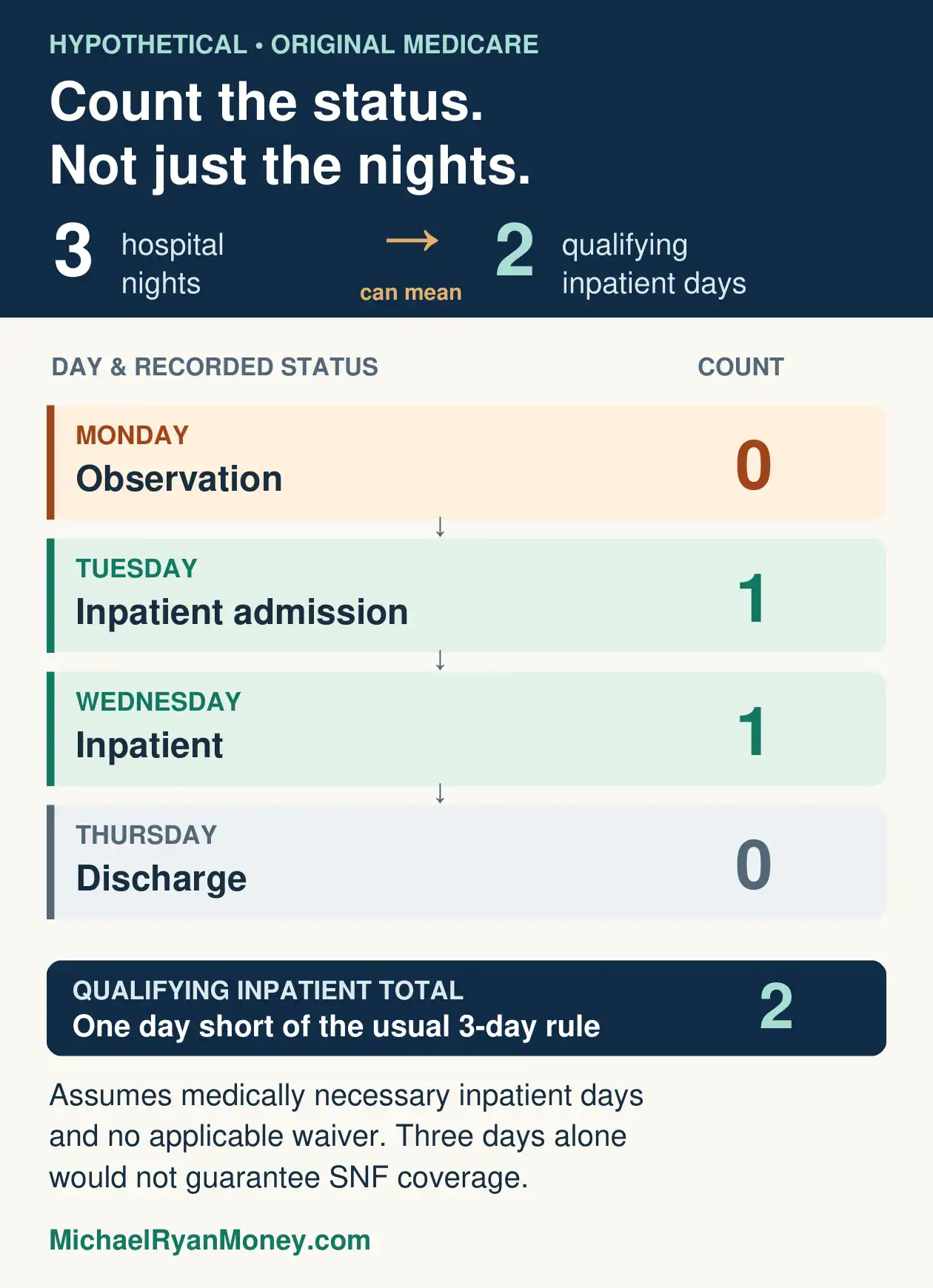
Read the day-count visual as text
Three hospital nights. Two qualifying inpatient days.
Now put the opening example on the calendar. This is a separate hypothetical, with a medically necessary inpatient stay and no applicable waiver.
- Mondayobservation
0 qualifying inpatient days
- Tuesdayinpatient admission
1 qualifying inpatient day
- Wednesdayinpatient
1 qualifying inpatient day
- Thursdaydischarge
0 qualifying inpatient days
You were in the hospital Monday night. That part isn’t in dispute. Monday just wasn’t an inpatient day. Tuesday and Wednesday count; Thursday is the discharge day, so it doesn’t.
If formal inpatient admission had started Monday instead, Monday, Tuesday and Wednesday would ordinarily give you three qualifying days. Same number of nights. Different inpatient admission date. Neither version, by itself, establishes every requirement for SNF coverage.
One more distinction before we move on. Medicare’s “two-midnight” guidance concerns whether inpatient admission is generally appropriate based on the expected need for medically necessary hospital care. It isn’t the three-day SNF rule. Two midnights don’t automatically establish SNF coverage.
A three-day hospital stay does not guarantee SNF coverage
Say the inpatient count checks out. Good. Now we need to check the care itself. A recommendation for rehab doesn’t answer whether Medicare will pay for that particular SNF stay.
Medicare’s skilled nursing facility coverage requirements include all of these, in addition to the usual qualifying hospital stay:
- You have Part A and SNF benefit days available.
- You need daily skilled nursing or therapy services that a qualified clinician has determined are necessary.
- You receive the care in a Medicare-certified skilled nursing facility.
- The skilled care addresses a qualifying condition, such as one treated during the hospital stay, or a new condition that develops during covered SNF treatment.
The facility being Medicare-certified answers one question on that list. It doesn’t answer the other three.
SNF admission and the needed care generally must begin within 30 calendar days after hospital discharge. Federal coverage rules allow specified medical-appropriateness exceptions. That window isn’t permission to postpone care you need, and being inside it doesn’t guarantee coverage.
If your progress levels off, that doesn’t automatically end Medicare coverage. Skilled care can still qualify when it’s needed to maintain your condition or prevent it from getting worse, not just to improve it. You must still meet the skilled-care and other coverage requirements.
Help with everyday activities alone is different. Medicare does not cover custodial care by itself, such as help bathing, dressing or eating. Someone living in a nursing home may still receive covered medical services. What matters is the care being provided, not just the name on the building.
If the ongoing need is personal care rather than qualifying skilled care, you’re working on a different funding problem. That’s where the question of whether to self-fund long-term care or consider insurance belongs. It won’t make an otherwise nonqualifying SNF stay payable by Medicare.
What covered SNF care costs in 2026
Before using a Medicare cost figure to plan for the bill, make sure the stay is covered. Otherwise, you could be budgeting around a number that doesn’t apply.
For a qualifying Original Medicare SNF stay in a benefit period:
- Days 1 to 20: no daily SNF coinsurance after the applicable Part A deductible. You don’t pay that deductible again if you already paid it for the same benefit period.
- Days 21 to 100: $217 per day in 2026 before any help from other insurance.
- Day 101 onward: this Part A SNF benefit does not cover the costs.
CMS’s 2026 amounts set the Part A deductible at $1,736 per benefit period and the daily SNF coinsurance at $217 for covered days 21 to 100. But 100 days is a maximum, not a promised stay. Coverage can end sooner if the requirements are no longer met.
Does Medigap pay the $217 a day? If you have standard Medigap Plan G or Plan N, its SNF coinsurance benefit covers the full $217 per day for Medicare-covered days 21 to 100 in 2026. High-deductible Plan G is different: you must first meet its $2,950 deductible in 2026. Other Medigap plans may cover a different share or none, and Massachusetts, Minnesota and Wisconsin use different standardization rules. Confirm which policy you have with your insurer.
That coinsurance benefit does not fix a stay Medicare won’t cover because the qualifying-stay requirement wasn’t met and no waiver applies. Check whether the stay qualifies before counting on Medigap to pick up the coinsurance.
A benefit period isn’t an annual allowance. It generally ends after 60 consecutive days without inpatient hospital care or skilled-level SNF care. Going back into the hospital doesn’t automatically give you a fresh set of SNF days.
And don’t rely on missing paperwork as proof that you’re covered. When there’s no qualifying inpatient stay and no waiver applies, CMS’s SNF billing guidance says the facility isn’t required to issue a Skilled Nursing Facility Advance Beneficiary Notice of Noncoverage before charging for that noncovered care. The absence of that particular notice does not mean Medicare will pay.
When the three-day rule may not apply
If your count comes up short, check your actual coverage before concluding that Medicare can’t cover the SNF stay. The usual Original Medicare rule isn’t the only possibility.
With Medicare Advantage, a plan may waive the minimum inpatient stay. Ask your plan about the proposed SNF, any authorization or network requirements, and your cost sharing. Don’t assume every plan waives the rule or charges the same amounts as Original Medicare.
Approved waiver programs can also matter. Certain accountable care organization arrangements and CMS models can waive the stay requirement for eligible patients using approved SNFs. An ACO connection alone doesn’t establish that you or the receiving facility qualify.
What to do if your hospital status changes
First, pin down what changed. Were you under observation from the start, or did the hospital admit you as an inpatient and later change the status to observation? Those are not the same situation for the special appeal process below.
Ask about your formal status while you’re still in the hospital, ask again if it changes, and keep the notices. There are two names worth recognizing.
Two notices. Different jobs.
MOON
The Medicare Outpatient Observation Notice, or MOON, explains that you’re receiving outpatient observation services rather than inpatient care. It applies to Medicare beneficiaries, including Medicare Advantage enrollees. Under CMS’s notice instructions, people receiving observation services for more than 24 hours must get the notice no later than 36 hours after observation begins. If discharge, transfer or inpatient admission comes first, the notice must be delivered sooner. Count from the start of observation services, not automatically from your arrival in the emergency department.
MCSN
The Medicare Change of Status Notice, or MCSN, concerns a specific inpatient-to-observation change and the associated appeal rights for eligible Original Medicare beneficiaries. It isn’t another name for the MOON. The document matters because it points you toward the process that actually fits your situation.
The special appeal is for qualifying inpatient-to-observation changes
The special status-change appeal process starts with a specific requirement. You must first have been admitted as an inpatient and then reclassified by the hospital to observation. It isn’t a universal appeal for everyone who receives observation care.
Federal status-appeal rules add these conditions. Either you did not have Part B during the hospitalization, or you had at least three consecutive hospital days with fewer than three inpatient days. The day count excludes the discharge day. If you were under observation from the beginning, you don’t meet the inpatient-reclassification condition.
For eligible beneficiaries, the hospital must provide the MCSN as soon as possible once the qualifying conditions apply and no later than four hours before release.
For a timely expedited status appeal, make the request before you leave the hospital. You can call or request it in writing. An eligible beneficiary can still make a late request, but the specific billing protection for disputed services does not apply.
Keep that deadline with that process. A hospital-discharge appeal is different; don’t borrow its deadline for a status appeal.
Already left, or never received the notice? Contact the BFCC-QIO for the route that applies. Don’t assume every appeal option is gone. An appeal still doesn’t guarantee inpatient payment or SNF coverage.
Appealing an older inpatient-to-observation status change
Watch the dates if you’re researching an old hospital stay. Articles about appealing observation-related stays going back to 2009 may describe a filing window that has already closed. The ordinary window for the special retrospective process ended January 2, 2026.
As checked October 22, 2026, Medicare’s retrospective appeal guidance requires good cause for a new late request. The process’s other eligibility conditions also apply. It also warns of significant processing delays for requests submitted after May 15, 2026.
That historical route is separate from the current process for a qualifying status change during a new hospitalization. A closed ordinary filing window for the old route doesn’t answer which options apply to a new stay.
Five questions to ask before hospital discharge
You don’t need to memorize the notice acronyms to start this conversation. Bring these questions to the discharge planner or case manager. Include the receiving SNF and your Medicare Advantage plan, if applicable, when their answers are needed.
Work with the clinical team on a safe discharge plan. Don’t extend a hospital stay solely to try to manufacture qualifying days.
Ask the discharge planner to walk through the hospital dates and the receiving SNF’s coverage answer with you. If the answer is only that you’ve been in the hospital three nights, you haven’t finished the coverage check.
How We Verified This
Rules checked against Medicare, CMS and federal sources on October 22, 2026; Medigap and BFCC-QIO checks updated October 23, 2026. Individual coverage and appeal eligibility depend on the facts of your stay.
