
A rainy day fund, emergency fund, and cash reserve are not standardized financial terms. In fact, the Consumer Financial Protection Bureau defines an emergency fund as a type of cash reserve, while Investor.gov sometimes uses “rainy day fund” and “emergency fund” for the same basic idea.
So I would not spend much time arguing over the labels. Give the money a job instead.
For this article, I use a simple three-bucket planning framework: a rainy day bucket for smaller irregular hits, an emergency fund for bigger financial shocks, and broader cash reserves only when your household needs extra liquidity for income timing, near-term obligations, or retirement withdrawals.
The terms overlap, so there is no universal rule saying a rainy day fund, emergency fund, and cash reserve must be three separate accounts. The useful distinction is the job of the money. Use a rainy day or sinking-fund bucket for smaller irregular costs, an emergency fund for unplanned expenses or income loss that could disrupt essential bills, and extra cash reserves only when your circumstances justify an additional liquidity buffer. The goal is not to maximize cash. It is to keep enough cash available that a bad surprise does not force expensive debt or an untimely investment sale.
| Bucket | What it is for | Typical examples | Does everyone need it? |
|---|---|---|---|
| Rainy day | Smaller irregular costs you want to absorb without debt | Tire replacement, an urgent pet bill, a small appliance repair | Not necessarily as a separate account |
| Emergency fund | Unplanned expenses or income loss that could disrupt essential bills | Job loss, major medical bill, urgent home or car repair | Usually the core liquidity bucket |
| Broader cash reserves | Extra liquidity beyond the emergency fund for timing or portfolio needs | Variable income buffer, near-term planned spending, retirement withdrawal cushion | No. This depends on your situation |
On This Page
- Key Takeaways Ahead
- The Terms Overlap. The Jobs Don’t Have To
- Three Cash Jobs: Rainy Day, Emergency, and Reserve
- Before You Call It an Emergency, Ask If It’s a Sinking Fund
- How Much Emergency Cash Should You Keep?
- Use the 3-Bucket Calculator as a Starting Estimate
- Where Should You Keep Each Bucket?
- When Cash Becomes Too Much Cash
- Two Situations That Can Justify a Wider Cash Buffer
- A Practical Starting Plan
- The Bottom Line
- Sources
Key Takeaways Ahead
The Terms Overlap. The Jobs Don’t Have To
Here is the accuracy point most comparison articles skip: the labels are fuzzy.
The CFPB calls an emergency fund “a cash reserve” set aside for unplanned expenses or financial emergencies. Investor.gov also uses “rainy day fund” as a plain-English description of emergency savings.
That means an article promising one official, exact dictionary difference would be giving you more certainty than the terminology deserves.
My planning distinction is functional instead:
What event is this cash supposed to handle, and how quickly might I need it?
That question is more useful than the label on the savings account.
The labels are sloppy. The jobs shouldn’t be. If you know why the cash exists, when you may spend it, and what would happen without it, you can size the bucket intelligently even if your bank calls every bucket “savings.”
Three Cash Jobs: Rainy Day, Emergency, and Reserve
You can keep these buckets in separate accounts, subaccounts, or one account with clear tracking. The separation is a planning tool, not a banking requirement.
Bucket 1: Rainy Day Fund
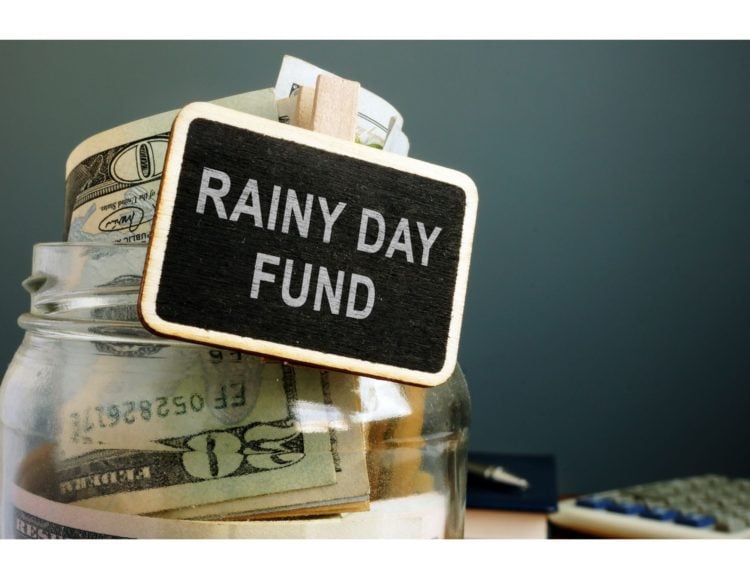
I use rainy day fund for smaller irregular expenses that are annoying but usually do not threaten your ability to pay the mortgage, buy groceries, or keep the lights on.
Think of a tire replacement, an urgent pet bill, or a modest appliance repair. You may not know the exact date or amount, but you know life produces expenses like these.
This is also where terminology starts to blur with a sinking fund. If you know the expense is coming, such as annual insurance, holiday spending, a planned car replacement, or a roof you expect to replace in a few years, I would normally treat that as a sinking-fund goal rather than an emergency.
The practical advantage of a smaller first-line bucket is psychological as much as mathematical. You do not have to raid the full emergency fund every time life hands you a mid-sized repair bill.
Bucket 2: Emergency Fund
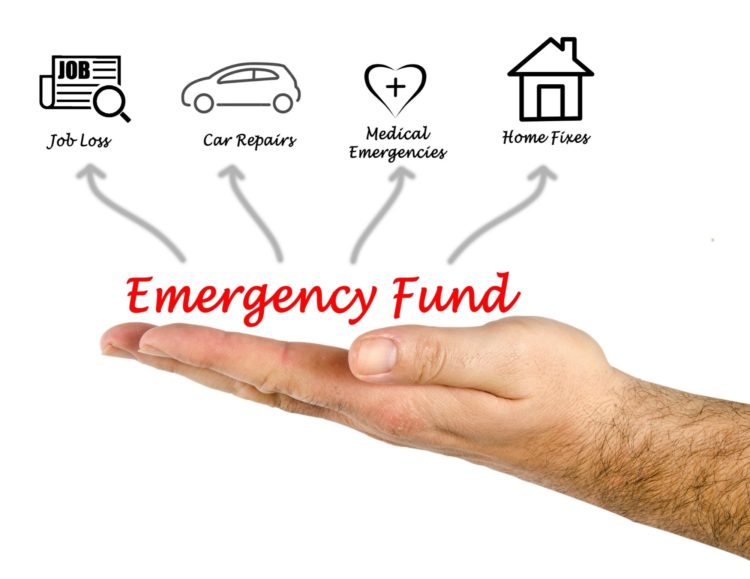
An emergency fund is the core protection bucket. It covers unplanned expenses or income disruptions large enough to interfere with your normal essential bills.
The CFPB lists car repairs, home repairs, medical bills, and loss of income as common examples. The important relationship is not the name of the expense. It is whether the expense is unplanned and difficult to absorb from normal cash flow.
That emergency cash can keep one bad event from turning into revolving credit-card debt or a forced withdrawal from other savings. The CFPB specifically notes that borrowing for a financial shock can make the original expense larger because of interest and fees.
If you need the foundational build-up process rather than this comparison, MRM’s guide to building an emergency fund owns that deeper job.
Bucket 3: Broader Cash Reserves

For this framework, I use cash reserves as the broadest label, and that broader pool can include your emergency fund. When I refer to a separate “reserve” bucket here, I mean liquidity beyond ordinary emergency savings that solves a distinct timing problem.
That extra liquidity can make sense when:
- your income is uneven or commission-based,
- you have a large known expense in the near future,
- a business needs working-capital breathing room,
- or a retiree wants a cash cushion as part of a withdrawal strategy.
It is not an automatic third savings requirement for every household. A stable dual-income household may decide its emergency fund plus planned sinking funds already provide enough liquidity.
That is an important correction to the old version of this page: cash reserves can be broader than an emergency fund, but an emergency fund is itself a form of cash reserve.
Before You Call It an Emergency, Ask If It’s a Sinking Fund
This is the distinction real people keep tripping over.
A recurring question in the recent personal-finance discussions I reviewed is what to do with expenses that are unpredictable in timing but predictable in existence: tires, laptops, home maintenance, property taxes, annual insurance, and car replacement.
My rule is simple:
- Known expense, unknown date: usually a sinking fund or planned-expense bucket.
- Unknown expense that must be handled quickly: rainy day or emergency savings, depending on size and consequence.
- Income disappears or a major shock threatens essential bills: emergency fund.
A water heater does not become an emergency just because it refused to send you a calendar invitation.
If you own a house, car, pet, or any other object with a talent for breaking at inconvenient times, building some of those expected costs into your budget can make your “emergency” target smaller and more honest.
If you need help finding the amount your normal spending actually requires, MRM’s budget worksheet gives you a cleaner baseline than guessing from gross income.
How Much Emergency Cash Should You Keep?
A common rule of thumb is three to six months of expenses. T. Rowe Price uses that range for workers, but it is a starting point, not a law of personal finance.
The CFPB does not prescribe one universal month count. Its current guidance says the amount depends on your situation. That is the right way to think about it.
Start with essential monthly expenses, not gross salary. Include the bills you would still have to pay if income stopped: housing, utilities, basic food, insurance, transportation, minimum debt payments, prescriptions, and other non-negotiable obligations.
Then adjust for the risks that would make recovery slower or more expensive:
- Income stability: one income, self-employment, commissions, or seasonal work usually argue for a wider cushion.
- Household backup: two stable incomes can reduce the amount one job loss would remove from household cash flow.
- Insurance and deductibles: a high deductible or weak coverage can increase the amount you may need quickly.
- Dependents and caregiving: more people relying on the same income can reduce your ability to cut spending fast.
- Housing and transportation risk: homeowners and households that require a car for work may face larger unavoidable repairs.
My planning ranges are just that, planning ranges. I might start a very stable dual-income household closer to the lower end of the conventional range and a single-income or highly variable-income household closer to the upper end or beyond it. The facts of the household should determine the target, not the slogan.
Do not calculate an emergency fund as “months of income.” Calculate it from essential expenses, then widen or narrow the cushion based on how hard it would be to replace income and how much unavoidable risk the household carries.
Use the 3-Bucket Calculator as a Starting Estimate
The existing Liquidity Logic Calculator on this page is useful for one thing: forcing you to think in separate jobs instead of one giant savings number.
It is not a regulatory formula, a CFPB rule, or personalized financial advice. Its preset multipliers are MRM planning heuristics. The calculator also assigns a separate reserve bucket automatically, even though some households may not need that third bucket once emergency savings and sinking funds are properly funded.
Use the output as a discussion starter. If the result feels too high or too low, go back to the inputs that actually matter: essential expenses, income stability, insurance, dependents, known near-term costs, and whether you have a real reason for additional cash reserves.
This tool uses simplified household-risk categories and fixed bucket formulas. Treat the result as an illustrative planning estimate, not a required cash target. Do not increase the result merely because a label sounds safer, and do not cut it merely because investing the money feels more productive.
The Liquidity Logic Calculator
Input your monthly “non-negotiable” expenses (housing, food, utilities, insurance) to see your custom bucket breakdown.
Treat the three outputs as categories to question, not accounts you must open. If the rainy-day result is really covering expenses you can plan for, move those costs into sinking funds. If the reserve result has no defined timing or portfolio job, you may not need that extra bucket.
Where Should You Keep Each Bucket?
The common requirement is simple: emergency money should be safe and accessible.
The CFPB says emergency savings should be kept somewhere safe, accessible, and not too tempting to spend. For many households, that points to a separate savings account or another insured deposit account that can be reached without taking market risk.
A few practical distinctions matter:
- Rainy day or sinking-fund cash: usually works well in a savings account or bank subaccount because you may use it relatively soon.
- Emergency fund: usually belongs in a liquid bank or credit-union account rather than an investment whose value can fall when you need the money.
- Broader reserves: placement depends on when the money may be needed. Near-term reserve money should remain appropriately liquid; money with a genuinely long time horizon may belong in a longer-term portfolio instead.
Under FDIC deposit-insurance rules, checking accounts, savings accounts, money market deposit accounts, and certificates of deposit at an FDIC-insured bank are covered deposit products within applicable limits. The standard FDIC insurance amount is $250,000 per depositor, per insured bank, per ownership category. MRM’s FDIC insurance guide goes deeper into those limits and ownership rules.
One terminology trap: a bank money market deposit account is not the same thing as a money market mutual fund. Do not assume every product with “money market” in the name has the same protections.
When Cash Becomes Too Much Cash
Cash solves liquidity risk. It does not solve every financial problem.
Investor.gov explains the tradeoff: money needed for short-term goals generally should not take the same investment risk as money with a long time horizon. Savings can provide safety and access, while longer-term investing offers more growth potential with more risk.
So once your emergency savings, near-term spending, and justified reserve needs are covered, extra cash needs a reason to remain cash.
This is where a lot of careful savers get stuck. They keep adding because the growing balance feels safe, but they never define “enough.” The result can be years of money sitting in a low-risk bucket even though the money is meant for a 10-, 20-, or 30-year goal.
The fix is not “invest everything.” It is to match the money to its time horizon and job.
Ask one question:
What would make me spend this dollar in the next few years?
If you have a concrete answer, liquidity may be doing useful work. If the answer is “nothing, I just feel better seeing it there,” you may have found cash that has outlived its job.
Two Situations That Can Justify a Wider Cash Buffer
Variable or Irregular Income
A freelancer, commission earner, seasonal worker, or business owner can have perfectly healthy finances and still need more liquidity than a salaried household.
The reason is timing. A normal household expense can become a cash-flow problem when invoices arrive late, commissions fall, or business receipts swing from month to month.
In that situation, I would separate two jobs:
- Emergency protection for a genuine shock.
- Income-smoothing reserves for the normal volatility of how you get paid.
Mixing those jobs can make it look as if you are constantly “using the emergency fund” when you are really managing predictable income variability.
Retirement
Retirement changes the problem again. Job-loss protection becomes less central, while withdrawal timing, planned spending, and portfolio volatility become more important.
T. Rowe Price, for example, suggests retirees consider cash reserves that could cover one to two years of spending. That is one planning approach, not a universal emergency-fund rule. The right amount is a portfolio and withdrawal-planning decision that depends on the rest of the retirement plan.
The broader point is enough for this page: retirees may have a legitimate reason for cash beyond a worker’s emergency fund, but that reserve should have a defined spending or portfolio job.
A Practical Starting Plan
If your cash is currently one undifferentiated pile, you do not need to open six new bank accounts tonight.
Start here:
- List foreseeable irregular expenses. Move annual bills, planned replacements, maintenance, and other known costs into sinking-fund or planned-expense categories.
- Calculate essential monthly spending. Use the bills you would still have to pay during an income interruption.
- Set the emergency-fund target. Use the conventional three-to-six-month range as a starting point, then adjust for income stability, dependents, insurance, housing, and other household risks.
- Decide whether a separate reserve has a real job. Variable-income households, businesses, retirees, or people with large near-term obligations may have a good reason. Many households will not need another generic cash bucket.
- Choose safe, accessible storage. Keep near-term and emergency money where a market drop cannot reduce the amount available when you need it.
- Create a refill rule. If you use a bucket, decide which future cash flow replenishes it and when you will stop refilling.
- Review after major life changes. A new job, new baby, home purchase, retirement, divorce, health change, or major insurance change can alter the amount of liquidity you need.
The goal is not three accounts. The goal is three clear answers: What is this cash for? How much risk is it covering? What tells me I have enough?
The Bottom Line
A rainy day fund, emergency fund, and cash reserve can overlap. There is no universal financial dictionary that forces them into three separate boxes.
What matters is the job.
Use planned-expense or sinking-fund money for costs you can reasonably anticipate. Keep an emergency fund for financial shocks that could disrupt essential bills. Add broader cash reserves only when income timing, near-term spending, or retirement strategy creates another legitimate liquidity need.
That approach fixes both sides of the problem. You are less likely to reach for debt when life goes sideways, and less likely to keep piling up cash long after the cash has stopped solving a real risk.
Liquidity with a job description beats cash with a comforting label.
If separating rainy-day money from emergency savings made your cash plan clearer, keep using the same test as life changes: what risk is this dollar supposed to absorb?
In the newsletter, I break down practical decisions like when to refill an emergency fund, when a larger cash reserve is justified, and when “playing it safe” with cash starts creating a different tradeoff.
Get the next Michael Ryan Money decision guide in your inbox.
Sources
- Consumer Financial Protection Bureau: An essential guide to building an emergency fund
- Investor.gov: Making the Most of Your Lump Sum Payment
- Investor.gov: Gauge Your Risk Tolerance
- Federal Deposit Insurance Corporation: Deposit Insurance
- T. Rowe Price: Emergency fund planning: How much cash should I have on hand?
