
Investing can feel like a tightrope walk without a net. You want the financial freedom that comes with growth, but the fear of a market crash can be paralyzing.

As a financial planner with nearly 30 years of experience, I’ve seen the same painful story play out countless times: an investor takes a standard risk tolerance questionnaire, gets labeled “aggressive,” and then panics and sells everything at the first sign of trouble.
Consider a common hypothetical. A 52-year-old business owner takes a questionnaire during a calm market and scores as an aggressive investor. Then a sharp market decline arrives and he sells most of his stock exposure because the losses feel intolerable. The questionnaire measured what he thought he could handle. His behavior revealed something different.
His investment risk questionnaire said one thing, but his real-world behavior said another.
This is the fatal flaw of most portfolio risk assessments. They ignore the complex real world of investor psychology and behavioral finance. This guide is different. We’ll debunk the myths, explain why traditional quizzes fail, and provide a better framework—and an interactive quiz.
To help you understand your true investment personality.
Key Points: A Smarter Approach to Investment Risk
- Standard Quizzes Are a Starting Point, Not the Final Answer:
Most online quizzes fail to account for powerful psychological biases like Loss Aversion and Recency Bias, which can dramatically skew your results and lead to a mismatched portfolio. - Know the Two Types of Risk:
Your Risk Tolerance is your emotional ability to stomach market volatility. Your Risk Capacity is your financial ability to withstand losses without derailing your goals. A successful plan must account for both. - Behavioral Finance is Key:
Understanding your “Behavioral Investor Type” can be more predictive of your real-world actions than a simple score. Are you a Guardian, an Accumulator, or a Straight Arrow? - Asset Allocation is Your Goal:
The entire purpose of an investment risk assessment is to build a diversified asset allocation of stocks, bonds, and other assets that lets you sleep at night while still reaching your financial goals.
On This Page
- Key Takeaways Ahead
- Why Most Investor Risk Tolerance Questionnaires Are Flawed
- What a Real Market Shock Teaches About Risk Tolerance
- The Critical Difference: Risk Tolerance vs. Risk Capacity
- The Interactive Investor Personality Quiz
- Interpreting Your Quiz Results: What Your Investor Profile Means
- From Profile to Portfolio: Building Your Asset Allocation
- AI & Robo-Advisors in 2026: The Future of Risk Assessment
- Frequently Asked Questions (FAQ)
- My Final Verdict: Beyond the Questionnaire
Key Takeaways Ahead
Why Most Investor Risk Tolerance Questionnaires Are Flawed

Most financial advisors are required by regulators like FINRA to perform an investment suitability assessment.
The problem? The risk tolerance tools they use are often outdated and fail to capture the nuances of human psychology.
This disconnect is a core focus of behavioral finance, a field pioneered by Nobel laureate Daniel Kahneman. His work on Prospect Theory proved that for most people, the pain of losing money is twice as powerful as the pleasure of gaining an equal amount.
A truly effective risk profiling questionnaire must go beyond simple hypotheticals to probe the psychological triggers that drive your real-world decisions.
📉 Bad Advice to Ignore: “Just trust the score from the online quiz.”
Most questionnaires can’t differentiate between your risk tolerance during a roaring bull market and your tolerance during a terrifying crash. Your answers are heavily influenced by recent market performance, a dangerous cognitive bias known as Recency Bias.
What a Real Market Shock Teaches About Risk Tolerance
A sharp market decline is a better test of risk tolerance than a calm-market questionnaire because real losses create fear, uncertainty, and the urge to act. The point is not to predict the next shock. It is to build an allocation you can continue holding when the next one arrives.
Here’s what I observed across my client base and the broader market:
- Labels can mislead:
An “aggressive” questionnaire score does not guarantee that you will tolerate a large real-world loss without selling. - Market conditions influence answers:
People often feel more comfortable with risk after gains and less comfortable after losses. Revisit your answers across different market environments. - Behavior matters:
A portfolio only works if you can follow it. Frequent panic-driven changes can defeat an otherwise reasonable long-term allocation. - Diversification is not a promise of smooth returns:
Different assets can still fall or become volatile at the same time. Diversification is about managing concentration and portfolio risk, not eliminating losses.
The Critical Difference: Risk Tolerance vs. Risk Capacity
Before you take any quiz to judge your tolerance for investment risk, you must understand these two distinct concepts. Getting this right is the foundation of a successful financial planning journey.
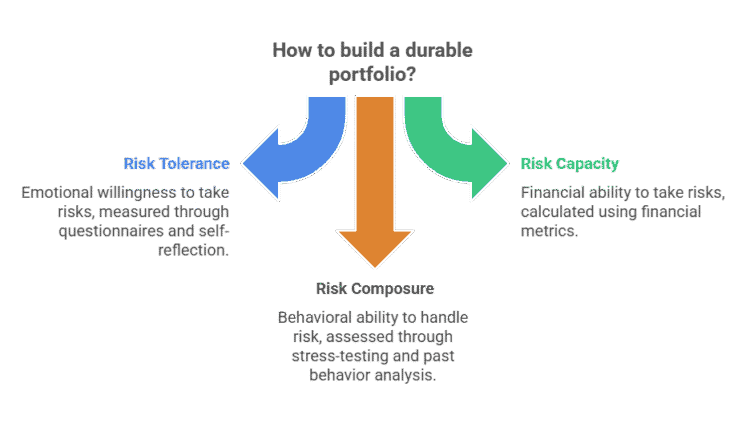
Risk Tolerance: Your Emotional Stamina
Your tolerance for risk is your psychological willingness to take on investment risk. It’s a measure of your gut reaction to portfolio volatility. If a 15% drop in your portfolio would cause you to lose sleep or panic sell, your risk tolerance is likely low, regardless of your age or income.
Risk Capacity: Your Financial Shock Absorber
Your capacity for risk is your financial ability to take on risk without jeopardizing your goals. It’s a mathematical reality, not an emotion. Key factors include:
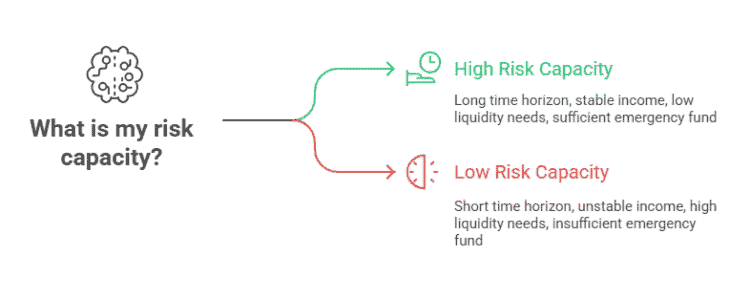
Time Horizon:
A 30-year-old has a high capacity for risk because they have decades to recover from a downturn. A 65-year-old has a very low capacity.
Liquidity Needs:
If you’ll need the money soon for a down payment, your capacity for risk is low.
Income Stability & Net Worth:
Higher, more stable incomes and a larger net worth increase your ability to absorb potential losses.
💡 Michael Ryan Money Tip
I’ve had clients with high risk tolerance but low capacity (young, aggressive investors with little savings) and clients with low tolerance but high capacity (wealthy, anxious retirees). The golden rule is to let the *lower* of the two—your tolerance or your capacity—drive your final investment decisions.
Insights from psychology and psychometrics on measuring risk tolerance
The Interactive Investor Personality Quiz
This investment personality test is designed to give you a more nuanced understanding of your profile. Answer based on your first instinct.
The 3D Risk Profile Analyzer
Explore three separate dimensions of investment risk: your willingness to accept volatility, your financial ability to absorb losses, and your likely behavior during difficult markets.
Your 3D Risk Profile
Illustrative allocation range
Michael’s perspective
What to examine before choosing an allocation
Assessing risk tolerance for asset allocation
Interpreting Your Quiz Results: What Your Investor Profile Means
Once you complete the quiz, you’ll fall into one of five general profiles. This helps form the basis of your Investment Policy Statement, a crucial document for any serious investor.

Conservative:
Your primary goal is capital preservation. You are willing to accept lower returns in exchange for minimal downside risk.
Moderately Conservative:
You are willing to accept a small amount of risk to achieve modest growth, but you are still focused on protecting your principal.
Moderate (or Balanced):
You seek a balance between risk and return, typically with a portfolio mixed between stocks and bonds. This is a common profile for those with a medium-to-long time horizon.
Moderately Aggressive:
You are comfortable with significant market fluctuations and are focused on long-term growth investing.
Aggressive:
Your main objective is to maximize long-term returns, and you are willing to accept a high level of portfolio volatility to do so.
From Profile to Portfolio: Building Your Asset Allocation
Your investment risk profile directly translates into your asset allocation. Aka the mix of different asset classes in your portfolio. This concept is a cornerstone of Modern Portfolio Theory. Dr. Harry Markowitz’s theory emphasizes that asset class diversification is the most important driver of long-term returns.

Here are some sample model portfolios. Note that these are simplified examples; a real portfolio would include further diversification into international stocks, real estate (REITs), and other asset classes.
| Risk Profile | Stocks | Bonds | Avg. Return (Long-Term) |
|---|---|---|---|
| Conservative | 30% | 70% | 3% to 5% |
| Moderately Conservative | 50% | 50% | 4% to 6% |
| Moderate | 70% | 30% | 5% to 7% |
| Moderately Aggressive | 80% | 20% | 7% to 9% |
| Aggressive | 90% | 10% | 10% to 12% |
For more on this topic, see our deep dive on different asset allocation models. —
AI & Robo-Advisors in 2026: The Future of Risk Assessment
Digital tools can make risk assessment easier to repeat and can help organize information about goals, time horizon, liquidity needs, and past behavior. They should support judgment, not replace it.
Hyper-Personalized Risk Profiling
Some digital advice systems can incorporate more than a one-time questionnaire, such as account history, portfolio changes, or repeated answers over time. That can add useful context, but the inputs, privacy practices, methodology, and limitations still matter. No tool can guarantee how you will react during the next real loss.
The Hybrid Advisory Model: Best of Both Worlds
A practical approach is to use technology for measurement and monitoring while keeping major allocation decisions tied to your goals, financial capacity, and behavior.
- Technology monitors: Tools can track portfolio drift, contributions, and allocation changes.
- A person interprets: You or an advisor still need to decide whether a change reflects your goals or a temporary emotional reaction.
- Automation follows rules: Rebalancing or other automated actions should follow a clearly defined policy you understand.
- You decide: Major risk and allocation changes should remain deliberate decisions, not reactions to a score or headline.
The useful role of technology is consistency. It can help you measure and monitor the plan. It cannot remove market risk or substitute for judgment about how much loss you can actually live with.
Frequently Asked Questions (FAQ)
How accurate are risk tolerance questionnaires?
They are a helpful starting point but can be flawed. Their accuracy is limited because they can’t fully predict your emotional reactions during a real market crash. Use them as a guide, not gospel.
How often should I retake a risk tolerance assessment?
It’s wise to reassess your risk profile every 3-5 years or after a major life event (marriage, new job, nearing retirement). Your financial situation and emotional comfort with risk will evolve.
What if my quiz says I’m aggressive, but I panic and sell during market dips?
This is a very common and important discovery! It means your true emotional risk tolerance is lower than you thought. You should always build your portfolio based on your behavioral tolerance, not your aspirational one. Adjust to a more moderate or conservative allocation you can stick with
My Final Verdict: Beyond the Questionnaire
Determining your risk tolerance is a critical first step, but it’s not a one-time event. It’s an ongoing process of self-discovery. A questionnaire is a tool to start a conversation with yourself (and your financial advisor) about your goals, fears, and financial realities.
The most successful investors I’ve known aren’t the ones who chase the highest returns. They’re the ones who understand their own psychology and build a disciplined buy and hold strategy they can stick with for the long haul—especially during extreme volatility like we saw in April 2025. As we move deeper into 2026, with continued market uncertainty around tariffs, interest rates, and AI-driven economic shifts, the investors who thrive will be those who combine self-awareness with the right tools, whether that’s a human advisor, a hybrid AI model, or simply a well-designed questionnaire that forces honest self-reflection.
