
When your employer changes the company that keeps your 401(k) account records (its recordkeeper) your retirement plan does not automatically turn into a taxable withdrawal. The plan may move its records, website, investments, and sometimes investment options to a new provider.
What happens to your particular holdings depends on the transition instructions from your employer and plan administrator. Do not assume everything will move without a change, and do not assume you must cash out.
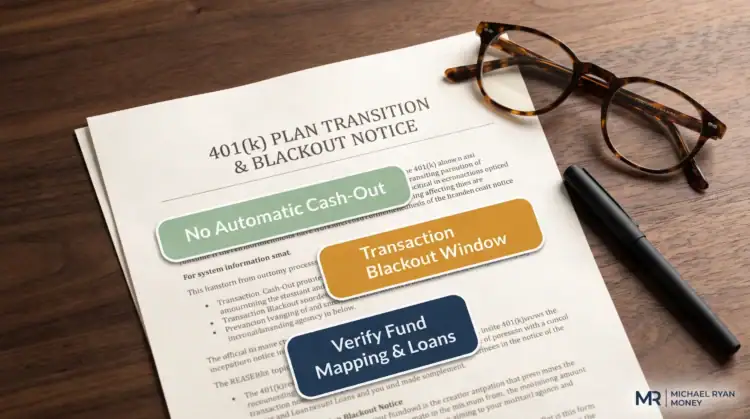
The useful first move is to read the transition notice and identify three things: when you will lose transaction access, how your current investments will be mapped, and whether your loan or beneficiary information needs attention.
Show the 30-second version
- What changes: A recordkeeper switch alone does not automatically cause a taxable withdrawal or a different retirement plan.
- Blackout: Save your notice and verify which transactions are restricted and on what dates.
- Investments: Confirm investment mapping, fees and whether any holdings could spend time uninvested.
- Loans and deposits: Confirm loan payments, payroll contributions, beneficiary records and the first new statement.
On This Page
- First, is the 401(k) plan changing or just its recordkeeper?
- What the blackout notice means for you
- Will my investments be sold, and will I miss market gains?
- What happens to an existing 401(k) loan?
- What happens to payroll contributions, beneficiaries, and account access?
- The before, during, and after checklist
- Should I roll the 401(k) into an IRA instead?
- What if the old account shows zero or the new account is missing?
- The three questions I would ask before the handoff
- Bottom line
- How We Verified This
First, is the 401(k) plan changing or just its recordkeeper?
Recordkeeper conversion
Accounts may move to a new website and administrator-facing service. Your plan may remain the same, but confirm holdings, fees, loan servicing and access restrictions.
Plan-level change
A merger, termination, or change of plan terms is a different event. Ask the plan administrator which distribution, investment and loan rules apply to you.
A recordkeeper tracks participant accounts and transactions. Your employer or another plan sponsor remains responsible for the plan. A new website or customer-service phone number does not necessarily mean the employer created a new retirement plan. But changing service providers can coincide with a new investment menu, different fees, and changes in account features.
If your employer is instead joining a pooled employer plan, ask whether the existing plan is being terminated or merged into a different plan; do not treat that as a recordkeeper-only conversion.
Read the employer’s plan communication. Look for the names of the current and new providers, the effective date, the investment mapping schedule, and the plan administrator’s contact information. Ask whether the plan itself is being merged, terminated, or simply moved to another recordkeeper.
Those are different events with different consequences.
A useful question to ask HR: “Is this a recordkeeper-only conversion, or are the plan terms, investment menu, and withdrawal or loan rules also changing?”
What the blackout notice means for you
A blackout period is a temporary restriction on certain rights, commonly the ability to direct investments, request a distribution, or obtain a plan loan. It can occur during a recordkeeper transition. Under the Department of Labor’s rules, a qualifying blackout generally involves a restriction lasting more than three consecutive business days.
Affected participants generally must receive notice at least 30 but no more than 60 days before the last day on which they can exercise the affected rights, with regulatory exceptions.
Short maintenance interruptions do not automatically trigger the same rule. The specific definition, notice deadline and exceptions come from 29 CFR 2520.101-3; the DOL reporting and disclosure guide summarizes the disclosure obligations.
The blackout is not the same as your investments necessarily sitting in cash. It restricts transactions. Whether assets stay invested, are converted to replacement funds, or spend time awaiting reinvestment depends on the actual transition. Your plan’s mapping notice, not a generic article, controls that question.
Before the last day you can make changes, save the notice and check whether an upcoming required action falls inside the freeze. If you rely on a scheduled distribution, rebalance, or loan request, ask your administrator how that action will be handled. During the blackout, watch for official communications; do not use a suspicious email link to set up your new account. Afterward, confirm you can access the new recordkeeper’s portal.
Where is your 401(k) during the switch?
Your access, your investments and the account records do not necessarily change at the same time.
- 01Before the blackout
Save your old statement, current holdings and the notice showing restricted transaction dates.
- 02During the blackout
Some transactions may be unavailable. Investments may stay invested, change funds or be sold and reinvested, depending on the plan.
- 03After access resumes
Reconcile holdings, fees, contributions, loans and beneficiaries in the new account.
MichaelRyanMoney.com · Illustrative process, not a live transfer tracker
Will my investments be sold, and will I miss market gains?
Possibly, but do not assume that a provider switch always means a market exit. Some investment positions or equivalent exposures may transition according to a plan-directed mapping process; others may be liquidated and reinvested. The asset mix and time out of a particular investment can differ by fund, plan, and transition arrangement.
A temporary inability to trade is not proof that assets are held in cash. Ask the plan administrator for the written investment mapping and dates
- What will replace each current fund?
- Will there be a period during which any assets are uninvested?
- How will new paycheck contributions be directed?
- If your old target-date or index fund is replaced, compare investment objective, expense ratio, and risk characteristics before making changes after the blackout.
- Request the plan’s participant investment-and-fee disclosure and comparative chart; for participant-directed plans subject to 29 CFR 2550.404a-5, it shows plan investment options and important fees, not just the new website’s display names.
There is no reliable promise that the value shown immediately before and after the transfer will be identical. Markets move, and statements may be recorded at different dates. Reconcile shares, balances, prices, and the effective dates before treating a difference as an error.
The balance matches. Did everything else?
Fictional account example. Switch between the two statements to see what deserves a closer look.
Replacement diversified fund (0.48% fund expense ratio). Compare investment strategy, risk and fees.
Verify 5% pretax plus 5% Roth elections still apply.
Confirm intended beneficiary records transferred correctly.
Reconcile applicable loan, Roth and after-tax records.
MichaelRyanMoney.com · Fictional illustration
What happens to an existing 401(k) loan?
A recordkeeper change by itself is not proof that your loan automatically defaults or becomes taxable. The controlling documents are your plan’s loan policy, your signed loan terms, and the transition instructions. You must verify whether payroll deductions and the repayment record will transfer correctly and whether any action is required during the conversion.
The actual tax risk is a repayment failure. The IRS explains that loans failing applicable repayment requirements can result in a deemed distribution, and a plan loan offset is a separate event governed by its own conditions. Do not confuse either with a routine website or vendor change. See the IRS guidance on loan failures and IRS plan loan offsets.
If you have a loan, ask HR or the plan administrator to confirm in writing the new payment amount, deduction method, first payment date, outstanding balance, and whom to contact if a deduction is missed. Keep your previous repayment statements until the new account shows the correct balance and history.
If you intend to take a new loan, separately ask whether the new recordkeeper’s processing dates, application process or plan loan provisions will affect when you can obtain it; these are not necessarily the same question as servicing an existing loan.
What happens to payroll contributions, beneficiaries, and account access?
A recordkeeper change does not by itself determine whether your contribution rate or beneficiary designation changes. Those details depend on the plan’s conversion and recordkeeping procedures. Ask HR whether your current salary-deferral election, employer contributions, automatic escalation, and beneficiary information will be carried forward or require renewed confirmation.
Check your first post-transition pay stub against the first new account statement. A paycheck deduction that was made but has not yet appeared in the new account needs a dated follow-up; it does not, by itself, establish that the money was lost. Keep old statements and screenshots securely until the reconciliation is complete.
If you are close to retirement, also ask when distributions, installment withdrawals, and required transactions will resume. A former employee taking periodic distributions has a different immediate problem from an active employee making contributions.
The before, during, and after checklist
401(k) transition checklist
Check each task as you complete it. Your progress is not saved or transmitted.
0 of 9 completed
BEFORE THE BLACKOUT
DURING THE BLACKOUT
AFTER ACCESS RETURNS
MichaelRyanMoney.com
The lesson is simple: the paperwork is where you find out whether this is only an administrative handoff or a meaningful change to the decisions you can make.
Should I roll the 401(k) into an IRA instead?
Not merely because the provider changes. A switch of recordkeepers does not automatically create a right to take an in-service distribution. Whether you can roll money out depends on the plan, your employment and distribution eligibility, and the type of money involved. A former employee’s options can differ from an active employee’s. Transferring pretax plan money to a Roth IRA may have tax consequences rather than being a tax-free change of provider.
If you already have an eligible distribution, compare the plan’s investment menu, fees, creditor considerations, early-access rules, and tax character before choosing. For a broader comparison, see Should I Consolidate Retirement Accounts? on MRM.
If you are near an early-retirement decision, also review the Rule of 55 before moving assets that might be subject to plan-specific access rules.
What if the old account shows zero or the new account is missing?
A closed old-provider portal or temporary zero display can be part of a transition, but do not assume that is always the explanation. Check the written dates, contact the plan administrator using a verified number, ask when the new account should be visible, and request a reconciliation if it is not.
Keep copies of the old statement and any official transfer confirmation. If the plan administrator does not resolve a material issue, the U.S. Department of Labor’s Employee Benefits Security Administration can explain participant rights and complaint options.
The three questions I would ask before the handoff
As a planner, I would not start by trying to predict the market during the transfer. I would start by eliminating avoidable uncertainty: What rights are temporarily restricted? What happens to each holding? Who is responsible if a payment or instruction goes missing? Those answers tell you whether the change is routine or requires personal action.
For a broader retirement-plan starting point, see MRM’s 401(k) employer-plan guide.
Stay informed about the decisions that matter: The Financial Clarity Newsletter covers practical retirement, tax, and investing decisions without making you decipher plan jargon on your own.
Bottom line
A recordkeeper change is usually an administrative event, not a reason to abandon your investment plan. But a good handoff still requires verification. Check the blackout dates, investment mapping, loan payments, beneficiaries and first new statement. The right outcome is not simply that the new login works. It is that the account and the choices it represents survived the move.
How We Verified This
These are the authorities and references used to verify the material facts in this article.
