


You can sometimes avoid or reduce IRMAA, but the right move depends on which IRMAA clock you are trying to change. Medicare normally uses modified adjusted gross income from two years earlier, so lowering this year’s MAGI may change a future Medicare premium, while an SSA-44 request can help sooner only after a qualifying life-changing event.
That timing distinction matters more than memorizing a list of tax tricks. A Roth conversion, for example, can reduce future required minimum distributions but raise MAGI today. A Qualified Charitable Distribution can keep an otherwise taxable IRA distribution out of income, but only if you meet the age and charitable-giving rules. And a one-time income spike is not automatically appealable just because it was unusual.
Before choosing an IRMAA strategy, ask: Am I trying to lower MAGI for an open tax year, reshape income several years from now, or ask Social Security to use newer income after a qualifying life event? Those are three different jobs.
Quick Answer
- Can you avoid IRMAA?: Sometimes. The useful strategy depends on whether you can still change the income year Medicare will use.
- 2026 first threshold: For most single filers, the first 2026 IRMAA tier starts above $109,000 of 2024 MAGI; for married couples filing jointly, it starts above $218,000.
- Roth conversion catch: A conversion can reduce future RMD pressure but generally raises MAGI in the year of the conversion, which can increase a later IRMAA premium.
- QCD opportunity: If you are age 70½ or older and already give to charity, a properly executed QCD can keep an otherwise taxable IRA distribution out of income.
- SSA-44: SSA-44 can help after a qualifying life-changing event lowers your income; it is not a general appeal for any one-time income spike.
- Big-picture rule: IRMAA is a cost to model, not an automatic stop sign. Sometimes paying a surcharge is still the better lifetime tax decision.
Key Takeaways Ahead
First: Which IRMAA Problem Are You Solving?
Most IRMAA advice gets messy because it mixes prevention, long-term tax planning, and appeals into one list. I would separate them before doing any math.
| Your situation | What can still change | Typical tools |
|---|---|---|
| The tax year is still open | Current-year IRMAA MAGI | QCDs, gain/loss management, timing income you actually control |
| You are planning several years ahead | Future RMDs and taxable income | Roth conversions, withdrawal sequencing, charitable planning |
| You already received an IRMAA determination | The income year SSA uses, but only when the rules allow it | SSA-44 after a qualifying life-changing event |
The same financial move can help one clock and hurt another. That’s why “avoid IRMAA” is not a complete planning instruction.
How IRMAA Works in 2026
IRMAA is the Income-Related Monthly Adjustment Amount added to Medicare Part B and Part D costs when your Medicare MAGI exceeds an applicable threshold.
For IRMAA, Social Security defines MAGI as your adjusted gross income from Form 1040 line 11 plus tax-exempt interest from line 2a. Social Security generally uses tax information from two years earlier, so 2026 premiums are generally based on 2024 income. Social Security’s current MAGI rules explain the formula and lookback.
For 2026, the first threshold is $109,000 for single, head-of-household, and qualifying surviving-spouse filers and $218,000 for married couples filing jointly. Married-filing-separately rules can be different.
If you want the complete current table rather than turning this page into another bracket page, see the 2026 IRMAA brackets and Medicare surcharge amounts.
For a single filer, moving from $109,000 of 2024 IRMAA MAGI to $109,001 puts the beneficiary into the first 2026 surcharge tier. Part B rises by $81.20 per month and Part D IRMAA adds $14.50 per month. That’s $95.70 per month, or $1,148.40 over 12 months, before the person’s regular Part D plan premium.
That’s why people call IRMAA a cliff. The extra premium is based on the tier you enter, not just the dollar that crossed the threshold. CMS confirms the 2026 Part B amounts, while Social Security publishes the combined Part B and Part D sliding-scale table. See the official 2026 CMS premium table.
What Counts as Income for IRMAA?
The shortest useful answer is: start with AGI, then add tax-exempt interest. Wages, pensions, taxable IRA withdrawals, taxable Roth conversions, interest, dividends, and realized capital gains can affect AGI. Some cash flow that feels “tax-free” can still matter because tax-exempt interest is specifically added back for IRMAA.
That does not mean every dollar that hits your bank account counts. If you’re trying to classify a specific income source, use the IRMAA Income Checker rather than guessing from the label on the account.
What Can Lower or Control IRMAA MAGI in the Current Year?
If the income year that may later determine IRMAA is still open, focus on transactions that actually change AGI or tax-exempt interest. Not every deduction reduces the MAGI Social Security uses, and not every strategy is worth doing solely to save a Medicare surcharge.
Qualified Charitable Distributions Can Be Unusually Efficient
If you are at least age 70½, a Qualified Charitable Distribution, or QCD, can send money directly from an eligible IRA to a qualified charity. The distribution is generally excluded from income and can count toward an RMD when you are subject to RMDs. For 2026, the annual QCD exclusion limit is $111,000. The IRS published the 2026 inflation-adjusted QCD limit.
A QCD is especially interesting when you already intended to give to charity. It is not a reason to give away money just to save Medicare premiums.
For the eligibility and execution details, see how QCDs can lower IRMAA exposure.
Capital Gains and Losses Can Move MAGI
Realized capital gains can increase AGI and therefore IRMAA MAGI. Capital losses first offset capital gains. If losses still exceed gains, the IRS generally allows up to $3,000 of net capital loss to reduce other income for the year, or $1,500 if married filing separately. IRS Publication 550 explains the capital-loss deduction and carryover rules.
That makes tax-loss harvesting potentially useful near an IRMAA threshold, but the effect depends on the gains and losses you actually realize. It is not a guaranteed $3,000 IRMAA reduction for everyone.
Income Timing Helps Only When You Actually Control the Timing
Some retirees can choose when to realize a gain, take a discretionary distribution, exercise an option, or start certain income streams. Others can’t. Pension income, Social Security, RMDs, wages, and contractual payments may leave little flexibility.
Don’t spend $10,000 to save a $1,148 surcharge, and don’t let IRMAA push you into a worse tax or investment decision. The surcharge is one line in the plan, not the whole plan.
Roth Conversions Can Reduce Future IRMAA and Raise MAGI Now
This is the IRMAA tradeoff I see people trip over most often. A Roth conversion can reduce the size of a traditional IRA and potentially reduce future RMDs, but the taxable portion of the conversion is included in gross income in the conversion year. IRS Publication 590-A confirms the conversion income rules.
So a Roth conversion done in 2026 can increase 2026 IRMAA MAGI and, under the normal two-year lookback, affect 2028 Medicare premiums.
There’s another catch: the official 2028 IRMAA thresholds are not known yet. Using the published 2026 threshold as if it were the exact 2028 ceiling creates false precision.
IRMAA is a cost to model, not an automatic stop sign. I’d rather knowingly pay a temporary surcharge when the larger Roth conversion clearly improves the long-term tax plan than save the surcharge and accidentally create a bigger RMD problem later.
The decision should compare the conversion tax, possible future IRMAA, future RMDs, survivor filing status, and the value of moving money into Roth. If you’re sizing a conversion now, use the dedicated guide on how much Roth to convert before IRMAA becomes a constraint.
Plan RMD Exposure Before Medicare Starts
Required minimum distributions are often where an old tax decision becomes a Medicare-premium problem years later. Traditional IRA and other pre-tax retirement balances can eventually create taxable distributions you no longer fully control.
Under current law, the applicable RMD age is 73 for people who reach age 73 before 2033, with the applicable age increasing to 75 for younger cohorts under SECURE 2.0. Employer-plan rules can differ in some situations. The IRS explains the SECURE 2.0 applicable-age rules.
The best planning window is often before RMDs force the income onto the return. But Medicare’s two-year lookback means “before Medicare” is not the same as “before age 65.” A large conversion at age 63 can still show up in the income year used for age-65 Medicare premiums.
That’s the real point of multi-year planning: not to make every year’s MAGI as low as possible, but to choose which years should absorb taxable income before the choice disappears.
When SSA-44 Can Lower IRMAA You Already Owe
SSA-44 is not a general “my income was unusually high” appeal. It lets you ask Social Security to use more recent income when a qualifying life-changing event reduced your household income.
Qualifying events include marriage, divorce or annulment, death of a spouse, work stoppage, work reduction, certain losses of income-producing property, certain losses of pension income, and certain employer settlement payments. Social Security’s current IRMAA reduction page lists the process and submission options.
A voluntary Roth conversion is not a qualifying life-changing event by itself. Neither is realizing a large capital gain merely because it happened once.
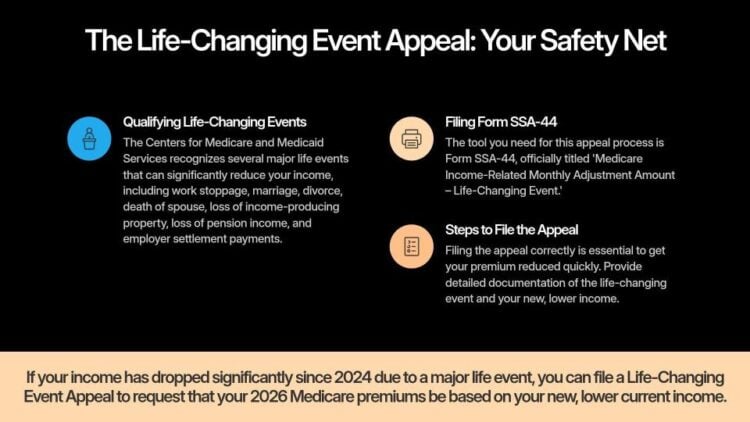
Social Security now lets eligible beneficiaries submit the SSA-44 process online, in addition to fax, mail, or a Social Security office. If you qualify, the step-by-step paperwork belongs in the SSA-44 IRMAA appeal guide.
SSA-44 changes which income Social Security may use after a qualifying event. QCDs, Roth conversions, gain management, and withdrawal sequencing change the income itself. Those are different tools for different problems.
Can Selling a Home Trigger IRMAA?
Yes, but the number that matters is not the sale price. What matters is the taxable gain that reaches your adjusted gross income.
If you meet the IRS rules for selling a principal residence, you may be able to exclude up to $250,000 of gain from income, or up to $500,000 on many married-filing-jointly returns. Gain above the applicable exclusion, or gain that otherwise doesn’t qualify, can increase AGI and therefore IRMAA MAGI. IRS Topic 701 explains the home-sale exclusion rules.
This is exactly the kind of transaction to model before closing when possible. A home sale itself is not one of SSA’s listed life-changing events for SSA-44, so don’t assume a large one-time taxable gain can simply be appealed away later.
How Much Buffer Should You Leave Below an IRMAA Threshold?
There is no official “safe buffer.” The right margin depends on how predictable your income is and whether you’re planning around a threshold that has actually been published.
If the relevant tax year is still underway, dividends, mutual-fund capital-gain distributions, interest, year-end trades, Roth conversions, and other income can move the final number. If you’re planning two years ahead, the future IRMAA brackets themselves may not be official yet.
If you and I were looking at this together, I wouldn’t aim for the line with zero room unless the remaining income is unusually predictable. The goal isn’t to win a game of tax limbo by one dollar. The goal is to make a good retirement decision that still works if the final tax return moves a little.
Which IRMAA Strategy Fits Your Situation?
| Situation | What I’d examine first | Main caution |
|---|---|---|
| Age 70½+ and already giving to charity | QCD from an eligible IRA | Must follow QCD rules and fit real charitable intent |
| Several years before large RMDs | Multi-year Roth conversion and withdrawal plan | Conversions raise MAGI in the year converted |
| Near a threshold with taxable gains | Gain realization and available capital losses | Investment and broader tax consequences still matter |
| Recently retired or had another qualifying life event | SSA-44 using more recent lower income | The event must satisfy SSA rules |
| Planning a home sale | Taxable gain after any home-sale exclusion | Gross sale price isn’t IRMAA income, but taxable gain can be |
| Roth conversion would cross an IRMAA tier | Lifetime tax and RMD tradeoff, including the surcharge | Avoiding IRMAA may not be the best overall decision |
The most useful question isn’t “Which IRMAA trick should I use?” It’s “Which income year am I trying to change, and is that year still changeable?”
IRMAA Questions That Usually Change the Answer
How Long Does IRMAA Last?
IRMAA is not automatically permanent. Social Security determines it for a premium year using the tax information available under its rules. A later premium year normally looks at a later tax return, so your surcharge can rise, fall, or disappear as your income changes. If a qualifying life-changing event reduces income sooner, SSA-44 may let Social Security use more recent information.
What Is the Maximum Income to Avoid IRMAA in 2026?
For most single, head-of-household, and qualifying surviving-spouse filers, 2026 IRMAA begins when 2024 MAGI is above $109,000. For married couples filing jointly, it begins above $218,000. Married filing separately has a different table, so don’t use the joint-filer threshold if that isn’t your status.
Can a QCD Reduce IRMAA?
It can. A properly executed QCD is generally excluded from income, so it can reduce AGI compared with taking an otherwise taxable IRA distribution and then writing a separate charitable check. The benefit depends on your eligibility, charitable intent, other income, and where your final MAGI lands.
Can I Appeal IRMAA Caused by a Roth Conversion?
Not merely because the conversion was a one-time event. SSA-44 requires a qualifying life-changing event and lower income associated with that event. A voluntary conversion doesn’t become appealable simply because you dislike the Medicare consequence afterward.
Does IRMAA Use Gross Income?
No. For IRMAA, Social Security uses MAGI defined as adjusted gross income on Form 1040 line 11 plus tax-exempt interest on line 2a.
Should I Always Stay Below the Next IRMAA Tier?
No. Staying below a tier can save Medicare premiums, but that savings should be compared with income taxes, future RMDs, investment consequences, charitable goals, survivor taxes, and the rest of your retirement plan.
Bottom Line: Solve the Right IRMAA Problem
IRMAA planning gets much easier when you stop treating every strategy as interchangeable.
If the tax year is still open, look for legitimate ways to control the MAGI that will eventually reach Medicare. If you’re years ahead, focus on future RMDs, Roth conversions, and withdrawal sequencing. If you already have an IRMAA notice after a qualifying life-changing event, SSA-44 may be the faster lane.
And sometimes the right answer is to pay IRMAA on purpose because the larger retirement-tax decision is worth more than the surcharge.
Don’t ask, “How do I avoid IRMAA?” until you ask, “Which income year can I still change?” That one question usually tells you which strategy belongs on the table and which ones are already too late.
How We Verified This
These are the authorities and references used to verify the material facts in this article.
