
A home insurance claims adjuster investigates the loss, documents the damage, reviews the policy terms that apply, estimates the covered repair or replacement cost, and reports the claim findings to the insurance company.
That is the textbook answer. The more useful answer is this: the adjuster helps the insurer turn a messy real-world loss into four decisions:
- What happened?
- What was damaged?
- What does the policy cover?
- How did those answers become this payment?
If you understand those four questions, the process gets much less mysterious. You also know where to look when your contractor says $38,000 and the insurer’s estimate says $21,000.
I learned this from the other side of the desk while owning a property-and-casualty insurance agency in South Florida. A claim disagreement can feel like one big argument over whether the number is fair. The more useful question is usually much more specific:
Which part of the claim file do we actually disagree about?
Maybe the cause of damage is disputed. Maybe a room or repair step is missing. Maybe depreciation changed the payment. Maybe the policy limits what is payable. Those are different problems, and they call for different responses.
On This Page
- What Does an Insurance Claims Adjuster Do?
- Key Takeaways Ahead
- What the Home Insurance Adjuster Does — and What They Don’t Control
- What Happens Before, During, and After the Adjuster Inspection
- How the Adjuster’s Estimate Becomes a Claim Payment
- Why the Insurance Estimate and Contractor Estimate Can Be Far Apart
- What to Do If the Adjuster’s Estimate Looks Too Low or Incomplete
- When This Stops Being an Adjuster or Estimate Question
- A Practical Home Insurance Claim Checklist
- Frequently Asked Questions About Home Insurance Claims Adjusters
- The Bottom Line
- Sources
What Does an Insurance Claims Adjuster Do?
A homeowners insurance adjuster typically inspects and documents the damage, investigates the cause of loss, reviews relevant policy coverage, estimates the amount of covered damage, and communicates the insurer’s claim position. The National Association of Insurance Commissioners (NAIC) says company and independent adjusters calculate the amount of damage and review the policy for applicable deductibles and coverage limits.
The adjuster’s estimate matters, but it is not the same thing as a promise that every repair cost will be paid. Coverage, deductibles, depreciation, policy limits, additional documentation, supervisors, specialists, and sometimes your mortgage servicer can all affect what happens after the inspection.
The most important distinction: a company adjuster and an independent adjuster assigned by the carrier work on the insurer’s claim. A public adjuster is hired by the policyholder.
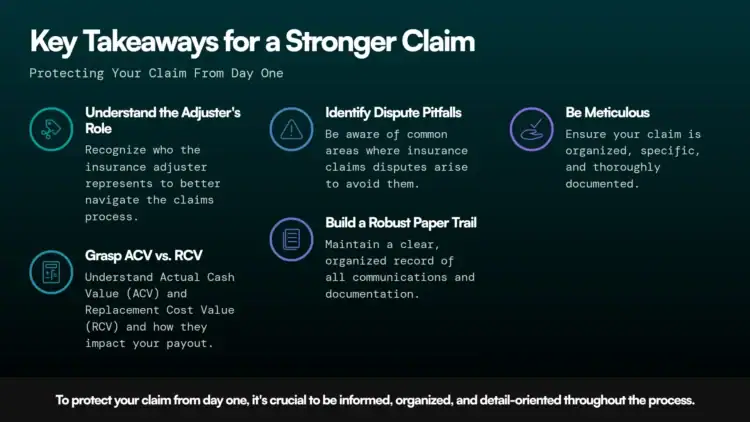
Key Takeaways Ahead
What the Home Insurance Adjuster Does — and What They Don’t Control
When the insurance company assigns an adjuster, that person becomes one of the main fact-finders on the claim. Depending on the loss and the insurer’s process, the adjuster may:
- inspect the damaged property;
- photograph and measure affected areas;
- ask questions about when and how the damage occurred;
- review contractor estimates, receipts, inventories, or other documentation;
- identify which policy provisions may apply;
- prepare or review a repair estimate;
- apply or explain deductibles and depreciation;
- request more information or a reinspection; and
- communicate findings to the insurer and policyholder.
The NAIC’s consumer claim guidance says company and independent adjusters calculate damage, review policy provisions, and determine which deductibles or coverage limits may apply. That makes the adjuster influential, but not all-powerful.
An adjuster may not personally control every coverage decision, payment authorization, engineering opinion, legal interpretation, or mortgage-servicer requirement. A large or complicated claim can involve desk adjusters, supervisors, engineers, specialty units, contractors, counsel, and other reviewers.
That distinction matters when something feels stuck. If the real issue is a missing line item, you need a scope discussion. If the insurer is relying on an exclusion, you need the exact policy language and written coverage explanation. If the claim check is payable to you and your mortgage company, the adjuster cannot rewrite your mortgage agreement.
Company adjuster vs. independent adjuster vs. public adjuster
Company (staff) adjuster: an employee of the insurance company handling claims for that carrier.
Independent adjuster: an outside adjuster or adjusting firm hired by the insurance company. This is common when a catastrophe creates more claims than the carrier’s staff can handle. “Independent” describes the employment relationship; it does not mean the adjuster is a neutral representative hired for both sides.
Public adjuster: a professional hired by the policyholder to help document and negotiate a property claim. Licensing and fee rules vary by state, so verify the public adjuster’s license and the rules that apply in your state before signing a contract.
If you’re looking for negotiation tactics or ways to respond to a low offer, that is a related but different job. My separate guide to home insurance claim adjuster tactics owns that deeper negotiation question. This page is about understanding the adjuster’s role and the claim mechanics first.
What Happens Before, During, and After the Adjuster Inspection
The inspection is not a courtroom cross-examination, and it is not a casual walkthrough either. Treat it like a fact-gathering appointment.
Before the adjuster arrives
If it is safe to do so, document the loss before cleanup or temporary repairs change what can be seen.
Take:
- wide photos showing the affected room, roof area, or exterior elevation;
- close-ups of damaged materials;
- a video walkthrough;
- photos of model or serial numbers when relevant;
- photos of temporary mitigation work; and
- copies of receipts for emergency work or damaged items.
Current CFPB disaster guidance recommends taking pictures or video of damaged property and doing so before and after repairs when possible. NAIC claim guidance likewise tells homeowners to make a list of damaged property and take photos and videos.
Your policy may also require you to protect the property from additional damage, so emergency mitigation and evidence preservation may need to happen at the same time.
If you already have a contractor estimate, have it available. Don’t expect the adjuster to adopt it automatically. The value is that it gives both sides something specific to compare.
During the inspection
Walk the property with the adjuster when practical. Point out affected areas instead of assuming everything is obvious.
Answer questions accurately, but don’t guess at facts you do not know. “I don’t know; I’ll check” is better than inventing a date, cause, or history that later turns out to be wrong. That is the practical answer to what not to say to a homeowners insurance adjuster: do not speculate, exaggerate, or fill in facts you cannot verify. For the deeper negotiation and tactics question, see my separate guide to home insurance claim adjuster tactics.
This is where a lesson from my agency days still matters: the claim is the file. Photos, estimates, notes, receipts, emails, measurements, and policy language are what remain after everybody forgets the conversation.
That does not mean writing a five-page memo after every phone call. A short recap is enough when something important happened:
Thanks for today’s inspection. We reviewed the roof, living-room ceiling and flooring. I’m sending the contractor estimate you requested. Please let me know if you need anything else before the estimate is completed.
Now there is a timestamped record of what was inspected and what comes next.
After the inspection
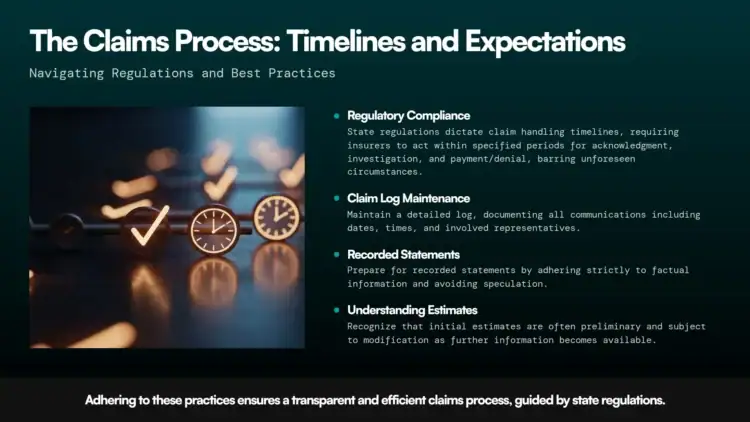
Ask when you should expect the estimate or coverage decision, and keep a simple claim log with:
- date;
- person you spoke with;
- what was requested or discussed;
- documents you sent; and
- the next stated step.
Claim-handling deadlines vary by state. If communication stops or you need a state-specific deadline or complaint process, use the NAIC directory to find your state insurance department rather than relying on a generic national timeline.
How the Adjuster’s Estimate Becomes a Claim Payment
This is the part that causes the most confusion because several different decisions can get compressed into one number on a check.
Think of the estimate as four layers.
1. Cause of loss: What happened?
The insurer first needs to decide whether the damage resulted from a covered cause of loss and whether an exclusion or limitation applies.
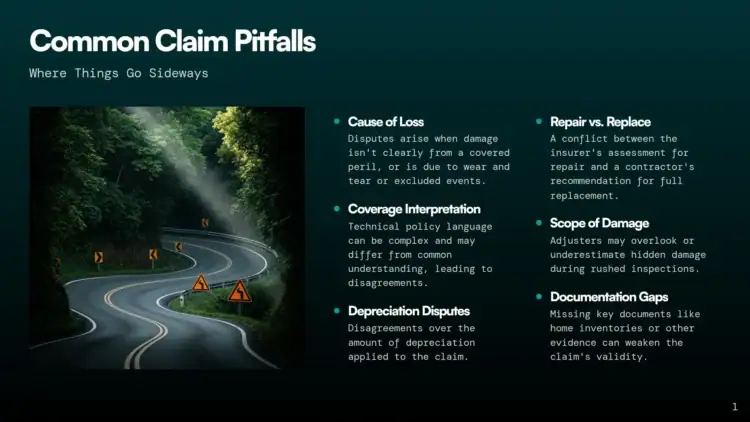
A wind-damaged roof, a sudden plumbing leak, long-term seepage, wear and tear, and flood are not interchangeable events under a homeowners policy. The exact policy language and facts control.
If the insurer says damage is excluded or pre-existing, ask for the written explanation and the policy provision being applied. Do not try to solve a coverage dispute by arguing only about the repair price.
2. Scope: What actually needs to be repaired or replaced?
This is the physical repair list.
Which rooms are affected? How many square feet? Can the material be repaired, or does it need replacement? Does something have to be detached and reset to reach the damaged area? Was hidden damage discovered after demolition?
Two estimates can use similar labor rates and still end up thousands apart because one estimate includes work the other does not.
3. Coverage: Which parts of that scope does the policy pay for?
A contractor’s job is to describe what they believe must be done to repair the property. The insurer’s job is different: determine what the policy pays for under the facts of the loss.
That is why a contractor estimate and insurance estimate can disagree even when neither side simply “did the math wrong.”
Code upgrades, matching, special roof provisions, sublimits, exclusions, and other policy terms can change what is payable. Those rules can also vary by state and policy, so this is a place to read the actual contract rather than assume a rule you saw online applies everywhere. If you need the broader policy framework first, my guide to homeowners insurance policies and coverage explains the major coverage pieces.
4. Settlement math: How did the covered amount become this check?
Even after the insurer agrees on a covered repair amount, the first payment may be lower because of the deductible and, depending on the coverage, depreciation.
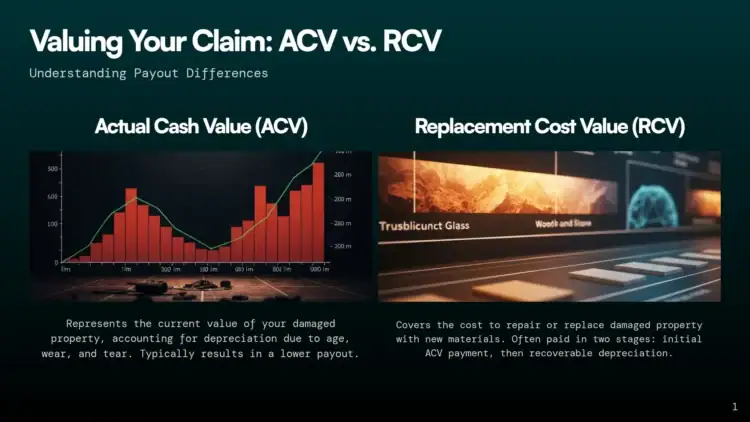
The NAIC explains the core distinction this way: actual cash value (ACV) takes age, wear and tear, and depreciation into account, while replacement cost value (RCV) generally pays the cost to repair or replace damaged property with materials of like kind and quality, subject to the policy terms.
Here’s a simplified example:
| Claim calculation | Amount |
|---|---|
| Covered replacement-cost estimate | $24,000 |
| Depreciation withheld | -$6,000 |
| Deductible | -$2,000 |
| Initial payment | $16,000 |
A homeowner who sees a $24,000 estimate and a $16,000 check may think $8,000 simply vanished. But those are two different questions:
What did the insurer estimate the covered repair will cost?
What amount is payable right now under this policy?
Under some replacement-cost policies, recoverable depreciation may be paid after repair or replacement conditions in the policy are satisfied. Do not assume depreciation is recoverable in every policy. Ask the insurer to show you the depreciation, deductible, and any amount that may be recoverable later.
The CFPB also explains that when a home has a mortgage, insurance payments are generally made to both the homeowner and mortgage servicer or lender. That is another reason the estimate and the cash immediately available for repairs may not be the same number.
Make the Claim Number Make Sense
If the four-part claim-file test helped you see why an estimate and a payment can differ, Financial Clarity does more of that—turning confusing money paperwork into a decision you can actually check.
- Spot what changed the number before you argue about the total.
- Know which document, rule, or assumption to verify next.
Get practical insurance and money decision checks in your inbox.
Educational only. No product pitch.
Why the Insurance Estimate and Contractor Estimate Can Be Far Apart
A big gap between estimates feels like one disagreement. Usually it is several smaller ones stacked together.
Start by comparing the estimates line by line, not total against total.
Look for differences in:
- scope: one estimate includes a room, slope, trade, or repair step the other omits;
- quantity: square footage, linear footage, material counts, or labor hours differ;
- repair vs. replacement: one side believes an item can be repaired while the other says replacement is needed;
- material or quality: the estimates use different material assumptions;
- access work: detach-and-reset, demolition, protection, or cleanup is included on one side only;
- code or matching issues: one side includes work that may depend on policy language or state/local rules;
- depreciation: the insurer applies depreciation that the contractor estimate does not show; and
- work discovered later: hidden damage was not visible during the original inspection.
Here’s the distinction I would want you to keep:
“The estimate is too low” is a conclusion. “The estimate is missing 220 square feet of flooring and the cabinet detach-and-reset” is something someone can actually evaluate.
That is why documentation beats outrage. You can support a missing-scope argument with photos, measurements, contractor notes, invoices, model numbers, or a second inspection. You cannot document “this feels unfair” the same way.
What to Do If the Adjuster’s Estimate Looks Too Low or Incomplete
First, get the full estimate and written coverage explanation. Do not try to reverse-engineer the claim from the check amount alone.
Then use this sequence:
- Compare scope before price. Confirm both estimates are pricing the same work.
- Mark every specific difference. Missing room, quantity, labor step, material, depreciation, code item, or repair method.
- Attach evidence to each disagreement. Photos, contractor explanation, measurement, invoice, product information, or policy language.
- Ask for clarification or correction in writing. Keep the request narrow and specific.
- Request a reinspection or supplemental review when new information warrants it. Hidden damage or a documented scope omission can change an estimate.
- Escalate the right problem. A scope dispute, coverage denial, long delay, and legal interpretation are not the same issue.
The NAIC notes that a homeowners claim settlement is usually not a single transaction and can involve separate payments for different parts of the loss. A first payment is therefore not automatic proof that every part of the claim is final.
If you need the deeper playbook for negotiating a low offer or challenging claim handling, use my separate guide to home insurance claim adjuster tactics. I keep that material separate on purpose so this page can answer the simpler question first: what is the adjuster doing, and what do the numbers mean?
When This Stops Being an Adjuster or Estimate Question
Most homeowners do not need to begin a claim by hiring another professional. But sometimes the problem outgrows a normal estimate discussion.
A public adjuster may be worth evaluating when…
The property loss is large or complex, documenting the scope is becoming a project of its own, or you want someone to represent you in preparing and negotiating the property claim. Public-adjuster licensing, contracts, and fee rules vary by state, so verify the professional through your state insurance department before signing.
Your state insurance department may be the right next stop when…
You need the state’s claim-handling rules, licensing information, or complaint process. The NAIC maintains a directory that routes consumers to their state insurance department.
An attorney is a different kind of resource when…
The dispute turns on legal rights, policy interpretation, litigation, a significant coverage denial, or another issue where legal advice is actually the job. Those questions are state-specific and fact-specific, so this article intentionally does not turn a national adjuster explainer into a 50-state bad-faith guide.
That boundary matters. A missing drywall line item and a disputed exclusion can both reduce a claim payment, but they are not the same problem.

A Practical Home Insurance Claim Checklist
Before the inspection
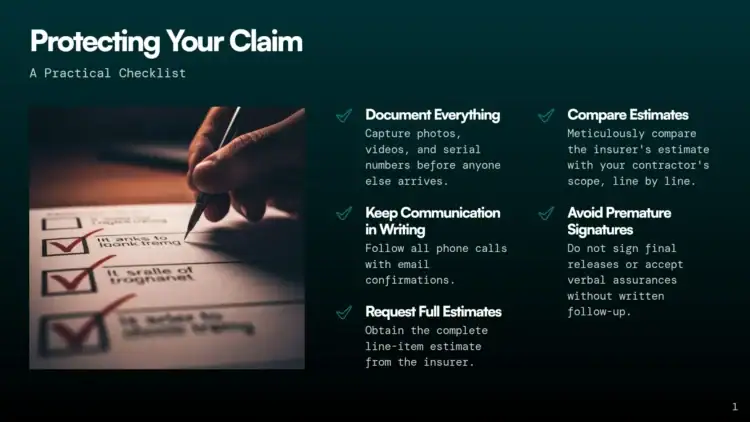
- Photograph and video the damage when safe.
- Protect the property from additional damage as your policy requires.
- Save emergency mitigation receipts.
- Make a list of every affected area.
- Gather pre-loss photos, inspection reports, or maintenance records when relevant.
- Keep contractor estimates available.
During the inspection
- Point out affected areas rather than assuming they were noticed.
- Answer facts you know; do not guess at facts you do not know.
- Ask what additional documents the adjuster needs.
- Note any areas that could not be inspected.
When the estimate arrives
- Get the detailed line-item estimate.
- Confirm the cause-of-loss and coverage explanation.
- Compare scope before comparing totals.
- Identify the deductible.
- Identify depreciation and whether any of it may be recoverable under your policy.
- Compare the insurer’s estimate with your contractor’s estimate line by line.
- Respond with evidence tied to specific differences.
If the claim stalls
- Ask what is still needed and who owns the next step.
- Keep important communication in writing.
- Request a reinspection or supplemental review when new documented damage or scope information exists.
- Use your state insurance department for state-specific rules or complaint procedures.
- Consider professional representation when the size or nature of the dispute justifies the cost.
Frequently Asked Questions About Home Insurance Claims Adjusters
Does an independent insurance adjuster work for me?
Generally, no. An independent adjuster is an outside adjuster or adjusting firm hired by the insurance company. A public adjuster is hired by the policyholder to represent the policyholder’s side of the property claim.
Can I disagree with the adjuster’s estimate?
Yes. Ask for the detailed estimate, identify the specific scope, quantity, repair-method, depreciation, or coverage difference, and submit documentation supporting your position. A disagreement is easier to evaluate when it is tied to line items rather than only the total.
Can a home insurance adjuster deny my claim?
An adjuster can document findings and may communicate or recommend a coverage position, but the final authority can depend on the insurer’s claim process, the adjuster’s authority, and state rules. If all or part of the claim is denied, ask for the decision in writing and the specific policy language the insurer is relying on.
Is the first insurance check the final payment?
Not necessarily. The NAIC notes that homeowners claim settlements may involve multiple payments for different parts of the loss . In some replacement-cost claims, depreciation may become payable later if the policy’s repair or replacement conditions are satisfied.
What if my contractor’s estimate is much higher than the insurer’s?
Compare the estimates line by line. Determine whether the difference comes from scope, quantity, labor, materials, repair versus replacement, code-related work, depreciation, or work discovered after the first inspection. Then document the specific differences for the insurer.
When should I consider a public adjuster?
Consider evaluating one when a property claim is large or complicated enough that professional documentation and negotiation may justify the fee. Licensing and fee rules vary by state, so verify the professional and contract requirements with your state insurance department.
The Bottom Line
A home insurance claims adjuster does more than walk through the house and put a number on the damage. The adjuster helps turn the loss into a claim file:
- What happened?
- What was damaged?
- What does the policy cover?
- How did the covered loss become this payment?
That is also the easiest way to diagnose a problem.
If you disagree about what happened, gather facts about the cause of loss.
If you disagree about what was damaged, compare the scope.
If you disagree about what the policy covers, ask for the policy language and written explanation.
If you disagree about the payment, trace the estimate through depreciation, the deductible, and payment conditions.
You do not need to be more aggressive than the adjuster. You need to be more specific about the disagreement.
That is usually where a confusing claim starts becoming a solvable one.
Sources
- NAIC — What You Should Know About Settling a Homeowners Insurance Claim
- NAIC — Actual Cash Value vs. Replacement Cost Coverage
- NAIC — What You Need to Know When Filing a Homeowners Claim
- NAIC — State Insurance Departments
- CFPB — How Home Insurance Companies Pay Out Claims
- CFPB — What to Do After a Disaster
