
Home title fraud is real, but the scariest version of the story usually skips an important distinction: a forged deed does not magically make the theft lawful or automatically erase the true owner’s rights. What it can do is put a fraudulent document into the public record, create the appearance of ownership, and give a criminal an opening to try to sell, borrow against, or otherwise exploit the property before anyone catches it.
As a security and fraud investigator who teaches White-Collar Crime, I’ve seen the aftermath. Deed & home title fraud isn’t a technical problem, but a human one. It’s the violation of having your safest space, your home stolen from under you with nothing but a pen and a lie.
Professor Alan Saquella, CPP, CPE — co-author and fraud-investigation expert
Saquella is an Assistant Professor of Global Security and Intelligence at Embry-Riddle Aeronautical University, a Certified Protection Professional and Certified Polygraph Examiner, and a former security operations and investigations director. His background is exactly why I wanted his investigator’s lens on this guide: the mechanics matter, but so does understanding what criminals are actually looking for.
And in 2026, there is a second reason to revisit this topic. The protection landscape changed. Free county alert systems have expanded, federal prosecutors are still bringing deed-fraud cases, and the title industry now has newer post-policy forgery endorsements that did not fit the old blanket advice about title insurance.
Show the 30-second version
- What it is: Home title fraud usually involves impersonation, forged deeds or other false documents used to create a fraudulent ownership record, obtain financing, or sell property the criminal does not own.
- What it is not: Recording a forged deed does not make the fraud legal. The danger is the false public record and the costly transactions or disputes that can follow before the fraud is corrected.
- Best free first step: If your county offers a property-recording alert, sign up. It can warn you when a deed, mortgage, or other document is recorded in your name, but it does not literally lock the title or prevent a filing.
- Paid monitoring: The FTC warns that so-called title-lock services generally monitor records and alert you after a change; they are not the same thing as title insurance and they do not make forged filings impossible.
- 2026 insurance update: Ask what owner's title policy you actually have. ALTA's newer 49 and 49.1 endorsements are designed to add post-policy protection against certain forged deeds or mortgages where available.
- If something looks wrong: Get the recorded document, contact the recorder or clerk, notify your title insurer and lender if applicable, speak with a real-estate attorney, report the identity fraud, and preserve every piece of evidence.
On This Page
- Key Takeaways Ahead
- What Is Home Title Fraud. And What Does a Forged Deed Actually Do?
- How Home Title Fraud and Deed Theft Work
- Your 5-Point Home Title Protection Check
- Who Is Most at Risk for Home Title Fraud?
- Warning Signs of Home Title Fraud
- Free County Alerts vs. Paid Monitoring vs. Title Insurance
- How to Protect Your Home From Title Fraud
- What to Do If You Suspect Deed Fraud
- Keep building your fraud defenses
- Frequently Asked Questions About Home Title Fraud
- The Best Defense Is a Tripwire, Not a Panic Button
- How We Verified This
Key Takeaways Ahead
What Is Home Title Fraud. And What Does a Forged Deed Actually Do?
Home title fraud, deed fraud, deed theft, and title theft are overlapping labels for schemes that use false documents or impersonation to manipulate property ownership or financing. A criminal may forge an owner’s signature, use stolen identity information, create a fake seller, misuse a notary, or file a fraudulent deed or mortgage.
The most important word in that paragraph is fraudulent. The criminal act does not become legitimate because a document was recorded. But the public record can still become wrong, and that wrong record can create a very real mess: an attempted sale, a fraudulent loan, an eviction fight, tax notices sent elsewhere, or a legal battle over what happened.
2026 Reality Check: Do not use the FBI’s broad “real estate fraud” number as a deed-theft count.
The FBI’s 2025 IC3 report recorded 12,368 real-estate-fraud complaints and $275.1 million in reported losses. That category also includes other real-estate scams, so it is useful evidence that real-estate fraud is costly, but it is not a clean national count of stolen home titles. That distinction matters. Scary precision is still bad precision.
How common is home title fraud?
There is no clean national incident count for deed theft, which is why I would not give you a made-up “1 in X homeowners” number. A 2025 National Association of REALTORS® survey found that 63% of association advocacy professionals surveyed were aware of deed or title fraud in their markets during the prior 12 months. But NAR also warned that the sample sizes were small and the figures should be treated as guiding points, not a national incidence rate. The same survey said vacant land appeared far more often than owner-occupied homes in the reported cases.
So the fair answer is: the crime is real and active, but anyone claiming a precise nationwide chance that your home will be stolen is probably outrunning the data.
The strongest evidence that deed fraud is not theoretical comes from actual cases. In July 2026, a federal court sentenced a woman to 75 months in prison after a scheme involving fake deeds for at least 19 properties worth more than $1.4 million. Prosecutors said stolen identities, fake IDs, forged notary signatures, and online sales channels were part of the scheme. In another 2026 case, New York prosecutors won a deed-theft conviction involving two Harlem brownstones worth about $4.7 million.
That is the useful way to think about the threat: not “someone clicks a button and your house legally disappears,” but identity fraud plus weak verification plus time. The longer the false record sits unnoticed, the more opportunities the fraudster has to build another transaction on top of it.
How Home Title Fraud and Deed Theft Work
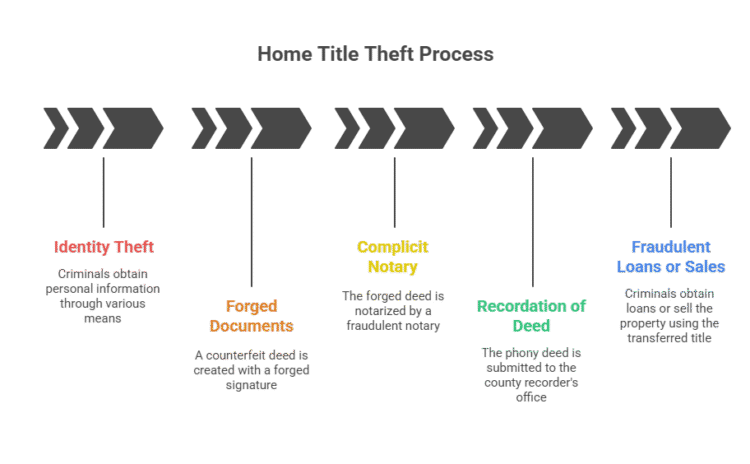
Professor Saquella’s investigator’s view is useful here because the paperwork is usually the last step, not the first. The scheme starts with an opportunity.
- The criminal identifies a property or owner that looks easier to impersonate. Vacant property, absentee owners, estates with stale ownership records, and homes with substantial equity can all create opportunity.
- They collect identity and property information. Public records, stolen mail, breached data, phishing, social media, or information from a prior relationship can help build the false identity.
- They manufacture documents. That may mean a forged deed, fake identification, fraudulent notary information, fabricated company records, or a fake email account that makes the impersonation look routine.
- The false document is recorded or presented in a transaction. The goal is to make the criminal appear to have authority to sell, borrow against, or control the property.
- They try to turn paper into money. The endgame may be a sale, mortgage, home-equity loan, rent collection, or another transaction before the real owner or a professional catches the fraud.
Michael Ryan Money Tip: The “quiet asset” problem
People watch the bank account that moves every day. A deed can sit untouched for years. That is exactly why a low-effort alert can be so useful: you are adding a tripwire to an asset you otherwise have almost no reason to check.
Your 5-Point Home Title Protection Check
The old version of this guide gave readers a “risk score.” I don’t think that is defensible. No five-question quiz can tell you that your house is a “fortress” or that you are objectively safe from deed fraud.
So this version does something more useful: it checks whether you have five practical layers in place and tells you what you are missing. This is a preparedness check, not a prediction of whether you will become a victim.
How many protection layers do you already have?
Check each statement that is true today.
Who Is Most at Risk for Home Title Fraud?
I would not use a “top five states for title theft” list here. There is no clean national dataset that lets us rank states with the confidence those lists imply, and the FBI’s real-estate category is broader than deed fraud.
The more useful question is: what makes a property easier to impersonate or slower to notice?
- Vacant and second homes: fewer day-to-day signals mean strange mail, utility changes, or a new occupant may take longer to notice.
- Property owned by someone who died: stale public records, unresolved estates, or heirs who have not updated ownership can create openings. A 2026 federal indictment in Kentucky specifically alleged a scheme targeting vacant houses after the true owner died without a will.
- Absentee owners and landlords: the owner may not be physically present when signs of a fraudulent listing, sale, or record change appear.
- Homes with substantial equity or no active mortgage: these can be attractive because there may be more value to extract and fewer routine lender interactions involving the property.
- Owners whose identity data is already compromised: deed fraud often rides on top of identity theft, impersonation, fake IDs, or hacked communications.
Saquella’s broader fraud-prevention principle fits perfectly: criminals look for opportunity, weak controls, and time. You cannot make yourself invisible, but you can make the fraud harder to complete quietly.
Warning Signs of Home Title Fraud
Most homeowners will not discover deed fraud by staring at the deed itself. They notice something around it that suddenly makes no sense.
- Property-tax, mortgage, insurance, or utility mail stops arriving or suddenly comes in another person’s name.
- You receive a deed, mortgage, foreclosure, lien, title, or lender notice tied to a transaction you did not authorize.
- A lender inquiry, mortgage account, HELOC, or other unfamiliar credit activity appears on your credit reports.
- A real-estate agent, buyer, tenant, neighbor, or contractor contacts you about a sale, listing, rental, or ownership change you know nothing about.
- Your county property alert reports a deed, mortgage, or other document that you did not initiate.
- The official property record shows an unfamiliar owner, mailing address, document, or lien.
One odd letter is not proof your deed was stolen. But a weird ownership or lending notice is not something to throw into the “I’ll deal with that later” pile either.
Free County Alerts vs. Paid Monitoring vs. Title Insurance
This is where the old article needed the biggest cleanup, because these three products get talked about as if they do the same job. They do not.
| Protection Layer | What It Actually Does | Does It Prevent a Forged Filing? | Typical Cost |
|---|---|---|---|
| County/property-recording alert | Notifies you when a document is recorded using your name or property, depending on the local program. | Usually no. It is an early-warning system. | Often free where offered. |
| Paid title monitoring | Monitors public records and may bundle alerts, identity monitoring, support, or recovery services depending on the company. | Generally no. Read the contract; “lock” is often marketing language. | Subscription fee. |
| Owner’s title insurance / forgery endorsement | May provide covered-loss protection and legal defense for specified title risks, subject to the exact policy and endorsements. | No. Insurance responds to covered loss; it is not a recorder lock. | Policy or endorsement premium. |
Start with the free alert when it exists
The Federal Trade Commission makes this distinction unusually clear: a “home title lock” is not literally a lock, and it is not the same thing as title insurance. The service generally monitors records and alerts you after a change. The FTC specifically recommends checking whether your local government offers free property-recording notifications.
Florida is a good example of how much this has expanded. Florida Court Clerks & Comptrollers says all 67 counties now offer free property-fraud alert services. California is moving in the same direction: under a law taking effect January 1, 2027, county recorders must establish a property-fraud notification program, while some counties already offer alerts.
Paid monitoring can still have a job
A free county alert does not automatically make every paid service worthless. A paid service may be useful if your county offers no good notification program, you own property in multiple jurisdictions, you want one dashboard, or the service bundles identity monitoring or recovery help you actually value.
Just buy it for the service it really provides. Do not buy a dramatic word like lock and assume someone has installed a digital deadbolt on the county recorder’s office.
The 2026 title-insurance update most articles are missing
Older advice often says title insurance only deals with defects that existed before you bought the property. That is too broad.
Some homeowner title policies already included certain post-policy protections, and the American Land Title Association has now introduced ALTA 49 and 49.1 endorsements designed to provide post-policy protection against certain forged deeds or mortgages. ALTA says availability and pricing can vary by state and underwriter.
Your question for the title company is not “Do I have title insurance?”
Ask: “What owner’s policy do I have, does it cover any forgery recorded after my policy date, and is a post-policy forgery endorsement available for my property?”
Protecting a house is one piece of protecting your financial life
Financial Clarity is my weekly email for the money decisions that are easy to ignore until they become expensive. No sales pitch. Just the next thing worth checking.
How to Protect Your Home From Title Fraud
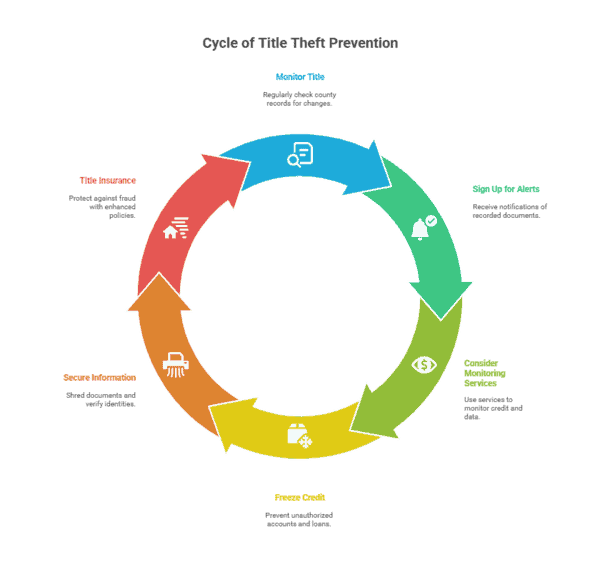
You do not need seven subscriptions and a bunker. You need a few boring controls that make a quiet asset less quiet.
- Enroll in your official property-recording alert. Search your county recorder, clerk, register of deeds, or land-records site. Use a government source, not an ad that happens to rank first.
- Know where the real ownership record lives. Bookmark the official portal or save the recorder’s phone number. If an alert fires, you should not be Googling from scratch while your heart rate is doing the Samba.
- Protect the identity layer. Use strong unique passwords, protect email accounts with multi-factor authentication, secure mail, and review your credit reports. A credit freeze can make it harder for an identity thief to open new credit in your name, although it does not block someone from filing a forged deed.
- Review your owner’s title policy. Do not assume what it covers. Ask specifically about post-policy deed or mortgage forgery and any available ALTA 49/49.1 or comparable coverage.
- Pay extra attention to quiet property. Vacant homes, rentals, inherited property, lots, and second homes deserve a deliberate check-in routine because the owner may not see daily warning signs.
- Keep ownership and estate records current. If an owner dies, handle the estate and title work instead of letting property sit for years in a deceased person’s name.
- Investigate strange mail immediately. A tax notice, mortgage letter, lender call, or ownership alert you do not recognize is a reason to verify the official record now, not next month.
Notice what is not on that list: “buy one product and forget about it.” Fraud protection works better as layers because no single alert, credit freeze, insurance policy, or monitoring service does every job.
What to Do If You Suspect Deed Fraud
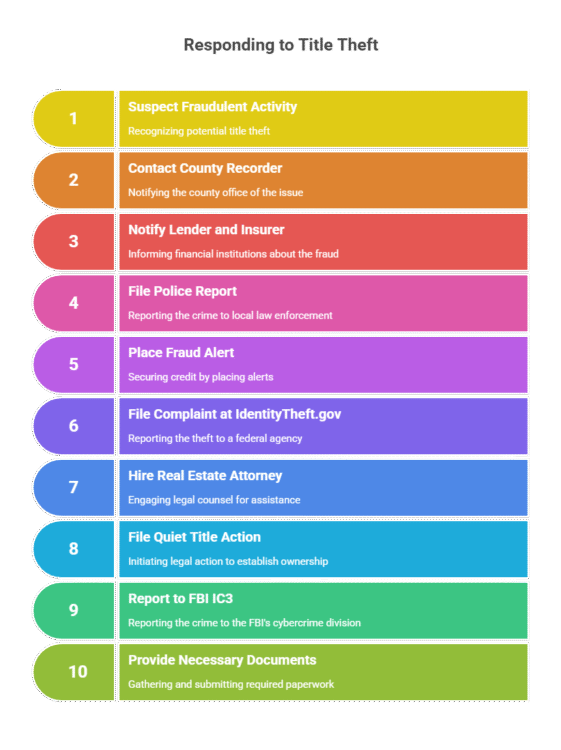
If a property alert, deed search, lender notice, or stranger at the door suggests someone has tampered with your title, treat it as both a property-record problem and an identity-fraud problem.
1. Get the actual recorded document
Contact your county recorder, clerk, register of deeds, or equivalent office. Confirm what was recorded and request a copy. Ask what local fraud-reporting or document-challenge procedure exists. Procedures vary by state and county.
2. Call the professionals tied to the property
Notify your mortgage servicer or lender if there is one, your title insurer or title agent, and a real-estate attorney licensed in your state. A lawsuit such as a quiet-title action may be part of the remedy in some cases, but that is a legal decision, not a universal DIY step.
3. Report the fraud
- File a local police report.
- Report identity theft through the FTC’s IdentityTheft.gov recovery system.
- Report internet-enabled or wire-related fraud to the FBI’s Internet Crime Complaint Center at IC3.gov.
- Notify your state attorney general or relevant state real-estate regulator when appropriate.
4. Shut down the identity spillover
Review your credit reports, consider a fraud alert or freeze, change compromised passwords, secure email accounts, and contact any lender or bank tied to unfamiliar activity. Deed fraud can be one branch of a larger identity-theft event.
5. Build an evidence folder
Save the original deed, the suspicious recorded document, alerts, envelopes, emails, texts, call logs, lender notices, police-report information, screenshots, title-policy documents, and notes of whom you spoke with and when. Fraud cleanup gets harder when the evidence is scattered across six inboxes and a kitchen drawer.
Professor Saquella’s investigator rule applies here: preserve first, explain second.
Do not delete the weird email, shred the suspicious letter, or tidy away the document because it makes you angry. The thing that looks like junk today may be the piece that shows how the impersonation happened.
Frequently Asked Questions About Home Title Fraud
Can someone really steal your house without you knowing?
A criminal can file forged documents, impersonate an owner, and in some cases sell or borrow against property without the real owner knowing immediately. But a fraudulent filing is still fraudulent; recording it does not transform forgery into lawful ownership. The practical danger is that the false record can trigger transactions and a costly legal cleanup before the owner discovers it.
Is a home title lock service worth the money?
Sometimes, but know what you are buying. The FTC warns that “title lock” services are generally monitoring services, not literal locks and not title insurance. Start by checking whether your county offers a free alert. A paid service may still be worthwhile for convenience, multi-property monitoring, identity features, or recovery support, but compare those benefits with the actual fee and contract.
Does title insurance cover deed fraud after you buy the home?
It depends on the policy. Some homeowner policies have post-policy protections, and ALTA’s newer 49 and 49.1 endorsements are specifically designed to add coverage for certain forged deeds or mortgages recorded after the policy or endorsement date. Availability and terms vary, so ask the title insurer or agent about your exact policy rather than relying on a generic internet answer.
Can putting a house in a trust prevent title fraud?
A trust can change how ownership is titled and may improve estate administration, but it is not a universal anti-forgery device. A criminal can still attempt to impersonate an authorized person or fabricate documents. Keep trust and ownership records current, monitor the property, and ask a local attorney or title professional about protections available in your jurisdiction.
How often should you check your home title?
There is no evidence-based national rule that says every homeowner should manually run a title search every 30, 90, or 180 days. If a free official alert is available, enroll so you do not have to rely on memory. If no alert exists, use a reasonable recurring check based on how exposed or unattended the property is.
Are mortgage-free homes more vulnerable?
They can be attractive targets because they may have substantial equity and no active mortgage relationship creating routine lender touchpoints. But having a mortgage does not make title fraud impossible, and being mortgage-free does not mean you are destined to be targeted. Think in terms of layers: identity security, record alerts, current ownership documents, and insurance coverage.
The Best Defense Is a Tripwire, Not a Panic Button
Home title fraud deserves attention. It does not deserve mythology.
You do not need to live in fear that one forged piece of paper instantly and lawfully erases a lifetime of homeownership. You do need to recognize that criminals can create false records, impersonate owners, and use the delay between filing and discovery to cause expensive damage.
Saquella’s fraud-investigation lens and my risk-planning lens land in the same place: make the quiet asset noisy. Turn on the free alert. Know where the official record is. Protect the identity behind the deed. Know what your title policy covers. And if something looks wrong, move quickly enough that the fraudster does not get the one thing every good scam needs: more time.
How We Verified This
These are the authorities and references used to verify the material facts in this article.
