

Your annual income is the amount you earn over a year, but the number you should use depends on what you are trying to do. For an hourly job, start with hourly pay × paid hours per week × paid weeks per year.
Then add recurring overtime, bonuses, commissions, tips, or other expected employment income. For a salary, your stated annual salary is usually the starting point.
The important part comes next. Gross annual income, take-home pay, taxable wages, and household income are not interchangeable. A mortgage application may care about gross income. Your spending plan should care about the money that actually reaches you. A benefits program may use its own household and income rules.
The calculator below handles the math. This guide helps you choose the right number.
Annual income calculator
On This Page
- Turn Your Pay Into One Annual Income Number
- How to Calculate Annual Income
- Which Annual Income Number Should You Use?
- The Biweekly Pay Trap: 26 Checks Is Not 24
- How to Count Overtime, Bonuses, Commissions and Irregular Income
- Can You Find Your Annual Income on a W-2?
- How to Calculate Annual Household Income
- What to Do With Your Annual Income Number
- Sources
Turn Your Pay Into One Annual Income Number
Enter salary or hourly pay. The result updates instantly as you change hours, paid weeks, overtime, bonuses, pay frequency, or household income.
Estimated annual gross income
$60,000
Your personal employment income annualized from the inputs at left.
Where that annual income comes from
Biweekly reality: 26 checks is not 24
Most months have two checks. Two months usually have three.
Household planning total
$0
This combines your calculated gross income with the other household income you entered. It is a planning number, not a universal legal, tax, lending or benefits definition of household income.
Estimated take-home from your real paycheck ratio
How this was calculated
Which number should you use?
Educational estimate only. This calculator standardizes employment pay. It does not calculate federal, state or local taxes, determine overtime eligibility, verify lender income, or decide what a benefits program counts as household income.
Use the result as an estimate, not a universal definition. The calculator can annualize salary or hourly pay, add overtime and other compensation, and estimate take-home pay. It is not a payroll, tax, lending, or benefits eligibility engine. When a form gives its own definition of income, that definition wins.
On this page
- How to calculate annual income
- Which annual income number should you use?
- The biweekly pay trap
- Overtime, bonuses, commissions, and irregular income
- Annual income on a W-2
- Annual household income
- What to do with your annual income number
How to Calculate Annual Income
The basic formula is simple. The trick is matching the formula to how you are actually paid.
| How you are paid | Annual income formula |
|---|---|
| Annual salary | Use your stated gross annual salary |
| Hourly | Hourly rate × regular hours per week × paid weeks per year, plus expected overtime and other pay |
| Weekly | Gross weekly pay × paid weeks per year |
| Biweekly | Gross paycheck × 26 pay periods in a typical full year |
| Semi-monthly | Gross paycheck × 24 pay periods |
| Monthly | Gross monthly pay × 12 |
If you earn $25 an hour, work 40 paid hours a week, and are paid for 52 weeks, the base calculation is $25 × 40 × 52 = $52,000 a year before deductions. If you regularly earn overtime or commissions, add a reasonable estimate of that income rather than pretending the base wage is the whole picture.
Paid vacation does not reduce a fixed annual salary. For an hourly worker, use the weeks or hours you are actually paid. If you have seasonal layoffs or several weeks of unpaid leave, blindly multiplying by 52 will overstate what you earn.
If your only question is a one-direction conversion, use the dedicated Hourly to Salary Calculator or Salary to Hourly Calculator. This page is the better fit when several kinds of pay need to become one annual income number.
Which Annual Income Number Should You Use?
This is where most of the confusion comes from. Two people can ask, “What is my annual income?” and need different answers.
- Building a household spending plan: Start with take-home cash flow. Use what actually arrives after payroll deductions, then account for irregular months.
- Mortgage or debt-to-income calculation: Gross income usually matters. Lenders verify income and may use specific rules for variable pay.
- Credit card application: Use the income the application allows you to report. Current or reasonably expected income may include wages, bonuses, tips, and commissions, but issuer instructions control.
- Tax question: Use the tax form’s specific income measure. Taxable wages, adjusted gross income, and gross pay are different measures.
- Marketplace health coverage or some benefits: Use the program-defined household income measure. Household composition and MAGI rules can differ from ordinary household budgeting.
- Comparing compensation or job offers: Compare gross base pay plus expected recurring compensation, while keeping guaranteed pay separate from uncertain upside.
The Consumer Financial Protection Bureau defines debt-to-income ratio using monthly debt payments divided by gross monthly income. That makes gross pay useful for a lender’s standardized comparison. It does not make gross pay the best number for deciding what you can comfortably spend each month.
That distinction is the real shortcut. The number on an application and the number that pays the electric bill can both be correct. They are doing different jobs.
Why Do Forms Use Gross Income If You Live on Net?
Gross employment income is your compensation before payroll deductions. Take-home pay is what remains after withholding and deductions such as taxes, insurance premiums, retirement contributions, and other payroll items.
Gross pay gives an application a pre-deduction income measure. Your take-home pay reflects your own taxes, benefits, retirement contributions, and other deductions. That is why both numbers can be useful without meaning the same thing.
For a spending plan, take-home pay is usually the more useful starting point because that is the cash available for bills, saving, debt payments, and spending. The calculator’s optional take-home output is deliberately an estimate. If you use a recent gross-to-net paycheck ratio, choose a normal paycheck without a one-time bonus, reimbursement, or unusual deduction.
Make the next paycheck question easier too.
Financial Clarity turns confusing paycheck math, tax rules, and money forms into one practical decision at a time, including which number matters and the catch a basic calculator can miss.
The Biweekly Pay Trap: 26 Checks Is Not 24
Biweekly and semi-monthly sound almost interchangeable. They are not.
- Biweekly means every two weeks, which normally creates 26 pay periods in a full year.
- Semi-monthly means twice a month, which creates 24 pay periods.
Suppose your gross biweekly paycheck is $2,000. Your annualized income is $2,000 × 26 = $52,000. Divide $52,000 by 12 and the average is about $4,333 a month.
But $4,333 is an average, not your normal monthly deposit pattern. Most months have two paychecks, or $4,000 gross in this example. Two months typically have three paychecks, or $6,000 gross. That is why a budget built on annual income ÷ 12 can look fine on paper while feeling short in a two-paycheck month.
For annual comparisons, use all 26 checks. For monthly bill-paying, use your actual paycheck calendar or a conservative two-check baseline and decide in advance what the extra-paycheck months will do.
How to Count Overtime, Bonuses, Commissions and Irregular Income
Variable income is where annualizing can turn into wishful thinking. One unusually strong month multiplied by 12 is not a forecast. It is your best month wearing a fake mustache.
A cleaner approach is to separate your income into two buckets:
- Base annual pay. Salary, or your normal hourly rate × normal paid hours × paid weeks.
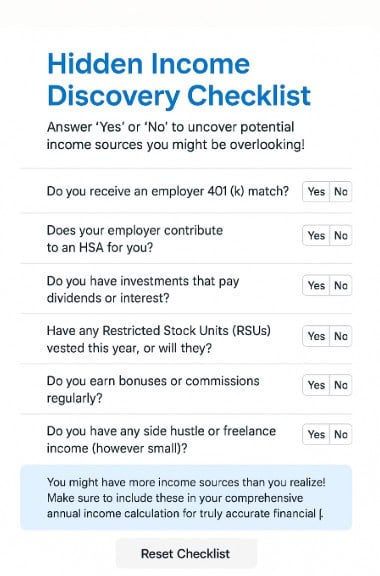
- Variable annual pay. Overtime, commissions, bonuses, tips, or other compensation you reasonably expect.
For your own planning, use actual variable pay from a period that captures the normal ups and downs. A simple annualized estimate is:
Variable pay received ÷ months in the look-back period × 12
Example: if you received $18,000 of commissions over six complete months, that averages $3,000 a month, or a projected $36,000 a year of variable pay. Add that to your base annual pay for a planning estimate. If the income is seasonal, declining, or unusually lumpy, a full 12-month history is usually more representative than a short recent stretch. If you have less history, treat the result as a projection, not a proven annual run rate.
For a cautious household spending plan, you can build recurring bills around base income and assign variable income only after it arrives. That keeps one unusually strong month from quietly becoming twelve imaginary strong months.
Formal applications may use stricter rules. For example, Fannie Mae’s 2026 guidance for mortgage lenders says bonus, commission, overtime, and tip income is analyzed using history, pay frequency, year-to-date earnings, prior earnings, and whether the trend is stable, increasing, or declining. A lender may therefore use a different qualifying amount than your personal annual estimate.
For overtime, enter the multiplier that actually applies to your job. Federal law generally requires at least time-and-a-half after 40 hours for covered nonexempt employees, but classification and other rules matter. The U.S. Department of Labor’s overtime guidance is the better source for legal eligibility questions.
If You Are Self-Employed, Revenue Is Not Automatically Your Income
A business can collect $100,000 and still leave its owner with far less than $100,000 of business profit. The IRS Schedule C instructions distinguish gross receipts from net profit after business expenses. If a form asks for self-employment income, follow that form’s definition rather than dropping business revenue into a personal-income box.
Can You Find Your Annual Income on a W-2?
Not reliably if the question asks for gross annual pay. W-2 Box 1 reports taxable wages, tips, and other compensation for federal income tax purposes. It can be lower than your gross employment pay because certain pre-tax salary deferrals are excluded from Box 1.
The IRS instructions for the 2026 Form W-2 specifically note that Box 1 does not include certain elective deferrals such as traditional 401(k) and 403(b) contributions. So a $70,000 salary does not guarantee $70,000 will appear in Box 1.
If you need gross annual employment income, your stated salary, paystub gross earnings, year-to-date gross pay, and employer records may be more useful starting points. If the question is a tax question, the tax form’s measure may be exactly what you need. Read the label before choosing the number.
How to Calculate Annual Household Income

For your own household planning, the arithmetic is straightforward. Calculate the relevant annual income for each person you intend to include, then add those amounts together.
The word household, however, changes meaning depending on who is asking.
Do not assume it always means everyone living at the same address.
| Context | What “household income” can mean |
|---|---|
| Your own household spending plan | The income of the people whose money you actually combine or rely on for shared expenses |
| U.S. Census household statistics | Pretax cash income of the householder and other people age 15 or older living in the household, whether related or not |
| Health Insurance Marketplace | Generally the tax filer, spouse, and tax dependents, with income based on Marketplace MAGI rules |
| Loan, benefit, financial-aid, housing, or other application | Whatever that program or institution specifically defines and allows |
The Census Bureau’s household-income definition includes people age 15 and older in the household. In contrast, HealthCare.gov explains Marketplace household income around the tax filer, spouse, dependents, and modified adjusted gross income. Both are legitimate definitions for their own purpose. Neither should be copied blindly into a different form.
What to Do With Your Annual Income Number
Once you have the number, give it a job.
- Use gross income when a lender, application, or comparison specifically calls for pre-tax earnings.
- Use take-home cash flow to build a realistic monthly spending plan. If that is your next step, use the spending plan guide.
- Use the requesting program’s definition for taxes, benefits, financial aid, housing, insurance, or other formal applications.
- Recalculate when compensation changes materially. A raise, new schedule, new commission structure, benefit change, or lost overtime can make an old annual estimate stale. The Pay Raise Calculator can help when the change is specifically a raise.
- Then zoom out. Income tells you what is flowing in. Your net worth tells you what you own minus what you owe.
If you remember one thing, make it this: annual income is not one magic number. It is a way to standardize what you earn over a year. The correct version depends on what you are deciding. Calculate the number accurately, then use the version that matches the job.
Sources
- Consumer Financial Protection Bureau: What is a debt-to-income ratio?
- Consumer Financial Protection Bureau: Regulation Z § 1026.51 Ability to Pay
- Internal Revenue Service: 2026 Instructions for Forms W-2 and W-3
- Fannie Mae: Bonus, Commission, Overtime, and Tip Income
- U.S. Census Bureau: Median Household Income definition notes
- HealthCare.gov: What’s included as income
- U.S. Department of Labor: Overtime Pay Requirements of the FLSA
- Internal Revenue Service: Instructions for Schedule C
