
If you just received inheritance money and have no idea what to do with it, the first move is not investing. It is not buying a house. It is not paying off every debt you have.
Put the money somewhere safe. Then slow the decisions down.
I spent decades helping people make financial decisions, and sudden money creates a strange problem. Some people feel an almost physical urge to spend it, invest it, give it away, quit the job, buy the house, do something. Others are scared to touch a penny because every choice feels permanent.
Those reactions look opposite. They have the same problem. Emotion is choosing the speed of the decision.
My First Rule for a Large Inheritance
Freeze irreversible decisions. Do the reversible work immediately. Secure the money. Preserve the records. Meet the right professionals. Learn what you actually inherited. Make your wants-versus-needs list. What can wait is the new house, resignation letter, giant family gift, speculative investment, or other decision that is hard to undo.
Two opposite reactions. One safer middle.
“I need to do something with it.”
Spend it. Invest it. Quit. Buy. Give. Fix everything today.
“I am scared to touch it.”
Leave everything frozen because making the wrong move feels worse than making no move.
The better middle: Protect cash and records now. Handle real deadlines now. Build the professional team now. Delay major irreversible choices until you have a plan.
On This Page
- Before You Make a Big Move, Run It Through the Inheritance Decision Shield
- What Is the First Thing to Do With Inheritance Money?
- Build Your Inheritance Team Before You Build the Portfolio
- Before You Invest the Inheritance, Make a Wants vs. Needs List
- Do Not Make a Plan Until You Know What You Actually Inherited
- What Should You Not Do With Inheritance Money?
- After the Pause, Give the Inheritance a Job
- Is It Okay to Spend Some of an Inheritance and Enjoy It?
- If Part of the Inheritance Is a House, Do Not Let the Memories Make the Math for You
- What to Do With Inheritance Money FAQ
- The Money Arrived. The Plan Did Not.
- Sources
- How We Verified This
Before You Make a Big Move, Run It Through the Inheritance Decision Shield
The hardest inheritance question is rarely “What investment is best?” It is usually “Which decisions actually need an answer now?” Use this quick check before you sell, invest, pay off debt, buy property, give money away, quit work, or make another decision that may be difficult to undo.
Inheritance Decision Shield
Four questions sort the decision into the right bucket: protect now, verify first, or give yourself permission to wait.
Question 1 of 4
Question 2 of 4
Question 3 of 4
Question 4 of 4
Your answers stay in your browser. This tool is educational triage, not tax, legal, or individualized investment advice.
The point of the tool is not to tell you what to buy. It separates a real deadline from emotional urgency. That is the distinction most windfall advice skips.
What Is the First Thing to Do With Inheritance Money?
Start with the question in your head right now
Protect it before you optimize it.
If the inheritance arrived as cash, move money you are not immediately using into an appropriate safe, liquid account while you make the larger decisions. If you use bank deposits, confirm your insurance coverage instead of assuming every dollar in one account is protected.
The FDIC’s standard insurance amount is $250,000 per depositor, per insured bank, for each account ownership category. Different ownership categories can qualify for separate coverage, and deposits at separately chartered insured banks are insured separately.
Do Not Translate “Keep It Safe” Into “Sell Everything”
Cash can be parked. An inherited IRA, stock portfolio, house, business, or trust interest is different. If the inheritance is already invested, “do nothing yet” may literally mean leaving the investments alone while you gather the facts. Selling or moving an inherited asset before you understand its tax basis, beneficiary rules, ownership, and deadlines can create a problem you did not have five minutes earlier.
This is why I like the idea of a decision shield after a large inheritance. I do not mean ignore tax forms, probate notices, RMDs, insurance, property bills, or other real deadlines for 90 days. I mean give yourself permission not to make the decisions nobody is forcing you to make yet.
Would waiting 30 days ruin the decision? Or would acting today make the decision hard to reverse?
That is a much better question than “What stock should I buy?”
Secure cash, preserve records, confirm ownership, insurance, beneficiary status, and real deadlines.
Learn what you inherited, map taxes and account rules, and get the right professionals working from the same facts.
Invest, buy, gift, pay off low-rate debt, change jobs, or upgrade the lifestyle only after the first two layers are clear.
Keep the First Steps Handy
My Inheritance Timeline Checklist turns the first weeks and months into a practical sequence so you are not trying to remember everything while also dealing with the rest of life.
Build Your Inheritance Team Before You Build the Portfolio
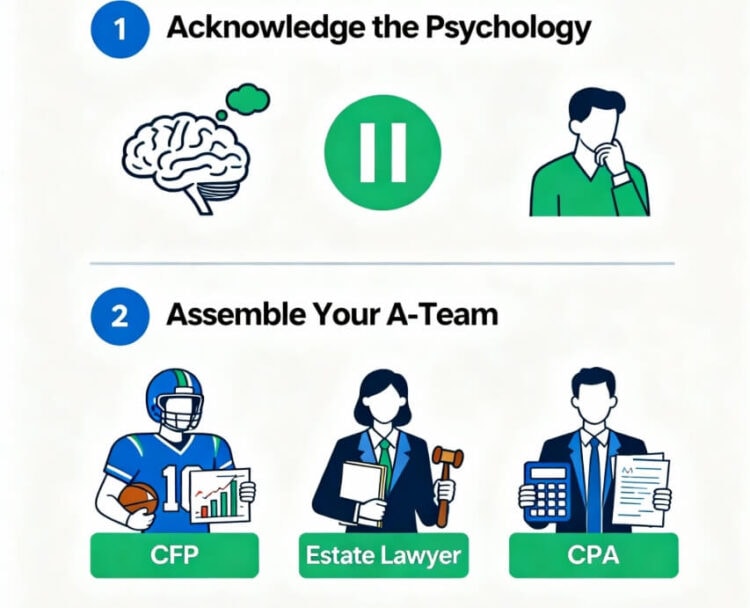
If this is a genuinely life-changing amount of money, I want three disciplines represented: a good tax professional, a good financial planner, and a good estate attorney.
And this part matters just as much: they need to talk to each other.
Three professionals. One plan.
CPA or tax professional
Maps tax consequences, basis records, inherited retirement accounts, estate income, and filing issues.
Financial planner
Connects the inheritance to cash flow, debt, retirement, investing, insurance, work, housing, and the life you actually want.
Estate attorney
Handles ownership, probate or trust questions, legal deadlines, beneficiary issues, and what the inheritance changes in your own estate plan.
The value is not three separate opinions. It is one coordinated plan where the tax answer, investment answer, and legal answer do not contradict each other.
I have seen how much cleaner decisions become when everybody is working from the same facts. If the planner wants to sell an inherited position, the CPA should know the tax consequences before the trade. If the attorney changes ownership or beneficiary arrangements, the planner needs to understand what that does to the financial plan.
You do not necessarily need three expensive ongoing retainers. A one-time planning engagement, a tax consultation, and an estate-law review may be enough for a simpler inheritance. The complexity of the problem should drive the complexity of the team.
How I would choose the planner
Reddit arguments usually go straight to “never pay an advisor” versus “hire a fiduciary immediately.” That misses the point. For a large inheritance, a planner’s job is not simply to pick an index fund. It is to coordinate decisions that touch taxes, cash flow, retirement, insurance, estate planning, family requests, and major life changes.
A CFP® professional must act as a fiduciary at all times when providing financial advice to a client under CFP Board’s standards. If someone will manage investments or give securities advice, use Investor.gov to check the professional and firm. Read the relationship summary and Form ADV where applicable so you understand services, fees, conflicts, and disciplinary history.
The Team Question I Would Ask
“Will you coordinate directly with my CPA and estate attorney before we make a major tax, investment, gifting, retirement-account, or estate-planning decision?” If the answer is basically, “That’s not our problem,” you do not have much of a team.
Before You Invest the Inheritance, Make a Wants vs. Needs List
This is the step I think most inheritance advice skips.
Before allocating the money, write down everything you are thinking about doing with it. The sensible things. The fun things. The guilty things. The things you would never say out loud because they sound ridiculous.
Then put four labels next to every item:
- Need or want?
- How important is it?
- How urgent is it?
- What does it really cost? Include the ongoing cost, not just the purchase price.
| Question | What to write down |
|---|---|
| Need or want? | Be honest. A want is not bad. It just should not disguise itself as an emergency. |
| Importance | High, medium, or low. What materially improves your life or protects your finances? |
| Urgency | Now, soon, or later. What actually gets worse if you wait? |
| True cost | Purchase price plus taxes, maintenance, insurance, financing, or lost investment flexibility. |
My default pause: A high-cost want with low urgency does not need an answer this week. A genuine high-importance need may.
What would your list say about the new car? The bigger house? Paying off a 3% mortgage? Helping your brother’s business? Quitting work? Taking the family on a once-in-a-lifetime trip?
The point is not to shame the wants. You are allowed to enjoy some of the money. The point is to stop every want from arriving dressed as an urgent need just because the money is sitting there.
Michael’s Take
A large inheritance should buy you more choices, not force you to make them faster.
Do Not Make a Plan Until You Know What You Actually Inherited
“I inherited $500,000” can describe very different financial situations.
| What you inherited | First thing to protect | First lens |
|---|---|---|
| Cash | Liquidity and deposit-insurance coverage | Safety first |
| Stocks, funds, or real estate | Date-of-death value and basis records | Tax basis first |
| Inherited IRA or retirement account | Beneficiary status and distribution deadlines | Distribution rules first |
| House, business, trust interest, or collectible | Ownership, valuation, liquidity, insurance, and family rights | Legal and valuation facts first |
Same dollar amount. Completely different first move.
The inheritance itself is usually not federal taxable income
The IRS generally does not include property received by inheritance in your gross income. But income the inherited property later produces, such as interest, dividends, or rent, can be taxable. Distributions from an inherited traditional IRA may also be taxable.
Federal estate tax is a separate issue generally paid by the estate. For decedents dying in 2026, the federal basic exclusion amount is $15 million. State estate and inheritance taxes can follow different rules, which is one reason the CPA and estate attorney belong in the conversation.
Preserve date-of-death values before you sell inherited property
For many inherited assets, IRS basis rules generally start with fair market value at the date of death, subject to important exceptions and alternate valuation rules. That date-of-death record can become critical when inherited stock, funds, or real estate are later sold.
Do not throw away brokerage statements, appraisals, estate schedules, or valuation records because the account has already transferred.
An inherited IRA deserves its own decision before you take money out
The popular shortcut is “non-spouse heirs have 10 years.” That is incomplete. The IRS inherited-IRA rules depend on the beneficiary category and whether the original owner died before or after the required beginning date. Some beneficiaries subject to the 10-year rule can also have annual distribution requirements during that period.
If an IRA is part of the inheritance, use my dedicated guide to inherited IRA RMD and 10-year rules before deciding how quickly to withdraw it.
What Should You Not Do With Inheritance Money?
The internet loves a universal order of operations. Pay off every debt. Buy VTI. Buy the house. Never buy the house. Fire the advisor. Hire the advisor. Retire tomorrow.
That is exactly why a windfall can feel harder than having less money.
- Do not broadcast the amount. Privacy buys you time to make decisions before other people’s ideas become your problem.
- Do not quit your job because the bank balance suddenly looks large. First decide what work, health insurance, retirement saving, purpose, and long-term spending look like without the job.
- Do not immediately become the family bank. Gifts and loans change relationships as well as account balances. Decide your giving policy before the first request decides it for you.
- Do not automatically pay off every low-rate debt. Debt payoff can be smart, especially for expensive consumer debt, but liquidity, taxes, goals, and the interest rate matter.
- Do not invest money you may need soon as if it has a 20-year time horizon. A home down payment next year and retirement money decades from now should not automatically have the same risk.
- Do not let Reddit, your brother-in-law, your banker, or one professional make the whole plan alone. Each may see one piece of the problem.
The Question Behind the Question
When someone asks, “Should I invest the $400,000 or use it to buy a house?” I do not think the first question is stocks versus real estate. I want to know: Do you want to stay in that city? Is a house actually a goal? When might you need the money? What does the house cost every year after closing? What other problems could this money solve?
The investment answer comes after the life answer.
After the Pause, Give the Inheritance a Job
Once the facts are clear and the initial emotion has cooled, start assigning the money to jobs.
- Safety: cash reserves, upcoming taxes, estate expenses, insurance, and real near-term obligations.
- Repair: expensive debt, overdue financial problems, or gaps in your emergency reserves.
- Near-term goals: housing, education, a planned career change, or another goal likely to use the money within a few years.
- Long-term freedom: retirement, financial independence, diversified investing, or reducing how much future income you need to earn.
- Enjoyment: a deliberate amount you can spend without sabotaging the larger plan.
- Giving and legacy: family help, charity, or the next generation, with tax and estate consequences reviewed first when the amounts are meaningful.
I do not love rigid percentages for this because the person who inherited $75,000 with credit-card debt and no emergency fund has a different problem from the person who inherited $2 million at age 60 with no debt and a funded retirement.
“Large” is relative. If the inheritance can materially change where you live, when you work, how you retire, what debt you carry, how you help family, or how secure you feel, it is large enough to deserve a plan.
Is It Okay to Spend Some of an Inheritance and Enjoy It?
Yes. The problem is not enjoying inherited money. The problem is letting grief, guilt, or sudden abundance decide the amount.
One of the quieter inheritance problems is feeling that spending any of the money somehow disrespects the person who earned it. I have seen the opposite problem too. A windfall can make a new car, trip, renovation, or lifestyle upgrade feel almost free because the money did not come out of the normal paycheck.
A better question than “Am I allowed to spend it?”
After taxes, reserves, deadlines, and near-term obligations are accounted for, what amount could you spend once without turning it into a permanently higher cost of living?
A one-time family trip and a permanently more expensive house are not the same decision. One has a known finish line. The other may add property taxes, insurance, maintenance, utilities, furnishing, and opportunity cost every year.
Enjoyment belongs in the plan. It just should not quietly become the plan.
If Part of the Inheritance Is a House, Do Not Let the Memories Make the Math for You

The family home is rarely just a property. It can be grief, childhood, guilt, identity, siblings, repairs, taxes, insurance, and a roof all sitting in the same decision.
You generally have three broad paths: keep it, rent it, or sell it. None is automatically more respectful. The right answer depends on what the property costs, what you would choose if it were not inherited, what other beneficiaries are involved, and what the tax basis looks like.
For the tax and decision details, use my guide to capital gains and an inherited home.
What to Do With Inheritance Money FAQ
Where is the best place to put inheritance money at first?
For cash that you are not ready to invest or spend, the first priority is safety and liquidity. FDIC-insured deposit accounts can be appropriate while you build the plan, but verify coverage when the balance is above the standard $250,000 limit for one depositor at one insured bank in one ownership category. Inherited securities, retirement accounts, trusts, and property need a different first-step analysis before you sell or transfer them.
Is $500,000 considered a large inheritance?
There is no useful universal cutoff. I would call an inheritance “large” when it can materially change your major financial decisions. For one household that may be $50,000. For another it may take $500,000 or several million. The decision process matters more than the label.
Should I pay off my mortgage with inheritance money?
Not automatically. Compare the mortgage rate, liquidity you would give up, taxes, other debts, emergency reserves, retirement security, and how much being debt-free matters to you. A mortgage payoff is a planning decision, not a moral requirement.
Do I have to pay federal income tax on inheritance money?
Usually, the inheritance itself is not included in federal gross income. But inherited assets can produce taxable income later, inherited retirement-account distributions can be taxable, sales can create capital gains or losses, and state inheritance or estate taxes can apply in some situations.
Should I tell family and friends how much I inherited?
I would keep the exact amount private unless someone genuinely needs to know. The moment a windfall becomes public, it can attract advice, requests, business ideas, loans, guilt, and scams. You can always share later. You cannot unshare it.
Should I invest inheritance money immediately?
Not just because it is sitting in cash. First separate money needed for real deadlines, taxes, emergency reserves, and near-term goals from money with a genuinely long time horizon. If the inheritance arrived as securities, selling everything simply to “start investing” can be exactly backwards. Understand the assets and tax basis first.
How much of an inheritance is okay to spend?
There is no responsible universal percentage. A better boundary is to protect known taxes and deadlines, restore any emergency reserve you actually need, identify near-term obligations, and distinguish one-time enjoyment from a permanent increase in lifestyle costs. Then the amount left for spending is a planning decision rather than a guess.
What if I feel guilty using the inheritance?
That reaction is common enough that it deserves to be treated as part of the decision, not ignored. Give the money explicit jobs. Safety, long-term freedom, family, and enjoyment can all coexist. A written plan can make spending a deliberate choice instead of feeling like you are taking something away from the person who left it to you.
The Money Arrived. The Plan Did Not.
That is the part I want you to remember.
You do not owe the inheritance an immediate investment decision. You do not owe your family an immediate gift. You do not owe yourself an immediate lifestyle upgrade.
First, make the money safe. Then get the CPA, planner, and estate attorney working from the same facts. Make the wants-versus-needs list. Rank each idea by importance, urgency, and true cost. Learn what kind of assets you inherited before you move them.
Then make the decisions.
The inheritance should expand your choices. It should not rush you into choosing.
Sources
- Federal Deposit Insurance Corporation: Deposit Insurance at a Glance
- Internal Revenue Service: Publication 525, Taxable and Nontaxable Income
- Internal Revenue Service: Publication 551, Basis of Assets
- Internal Revenue Service: Publication 590-B, Inherited IRA Distribution Rules
- Internal Revenue Service: 2026 Form 706 Instructions
- CFP Board: Code of Ethics and Standards of Conduct
- Investor.gov: Working With an Investment Professional
How We Verified This
These are the authorities and references used to verify the material facts in this article.
This guide was checked against current FDIC deposit-insurance rules, IRS inheritance-income and basis guidance, current inherited-IRA distribution rules, CFP Board fiduciary standards, SEC/Investor.gov professional-vetting guidance, current 2026 search results, and recent inheritance discussions about grief, decision paralysis, housing, family pressure, advisor selection, and spending guilt.
