
Want to know where you actually stand financially? Not what you think you’re worth, but what the math says? Use the free net worth calculator below.

After 30 years as a financial planner, I’ve watched hundreds of clients turn their finances around just by tracking their net worth every quarter. It’s the one number that actually matters. So I built this free calculator to help you do the same thing.
Your net worth is the single best indicator of your financial health. Not your salary. Not your credit score. Just what you own minus what you owe. Here’s everything you need to know:
- Accessing a free, online Net Worth Calculator
- Step By Step Directions on how to use the Personal Net Worth Calculator
- Understanding Your Net Worth Calculation
- Common Net Worth Mistakes to Avoid
- Tips For Interpretting Your Net Worth
With just a few simple inputs, you can unlock a wealth of information about your financial health and future prospects.
If you want to learn more, read my recent article on how to calculate your net worth here. Or this article if you want to learn how to create a net worth statement.
On This Page
- Key Takeaways: Free Net Worth Calculator
- How To Calculate Your Net Worth For Free – Online Net Worth Calculator
- Net Worth Reality Check
- Understanding Net Worth
- Benefits of Using a Calculator To Figure Your Net Worth
- Common Mistakes People Make By NOT Using a personal Net Worth Calculator
- Regularly Calculate and Track Your Net Worth
- Practical Tips for Interpreting Your Net Worth
- Next Steps to Calculating your Net Worth With Our Free Online Tool
Key Takeaways: Free Net Worth Calculator
- The calculator does one simple thing: it shows you what you own minus what you owe. But here’s why that matters. This number tells you more about your financial health than anything else. It forces you to look at the complete picture, not just your checking account balance.
- You’ll See Where Your Money Actually Is: The calculator breaks down your assets (cash, investments, real estate) and liabilities (mortgages, loans, credit cards). Once you see this, you can actually do something about it.
- Track Your Progress Over Time: Check your net worth every quarter. You’ll see if you’re actually moving forward or just treading water. This is how you know if your financial strategy is working or if you need to change course.
- Make Smarter Money Decisions: When you know your real net worth, you make better decisions about debt, investments, and retirement. You’re not guessing anymore. You’re looking at actual numbers.
How To Calculate Your Net Worth For Free – Online Net Worth Calculator
It’s simple to use our free online net worth calculator below.
- Start by entering in your assets, then your liabilities.
- Let the calculator figure out your assets minus liabilities and your total net worth for you.
- Then see how your net worth compares to others by age, income and education levels.
Play around first, then continue to the rest of the article and learn more about how to use the calculator, tips to interpret your net worth, real world examples, etc. It will literally take you no more than a minute to complete.
Take Control of Your Financial Future With A Free Online Net Worth Calculator
Net Worth Reality Check
See what you own, what you owe, where your wealth actually lives, and how much is liquid or investable.
What you own
What you owe
Enter a few balances to see your financial snapshot.
Understanding Net Worth
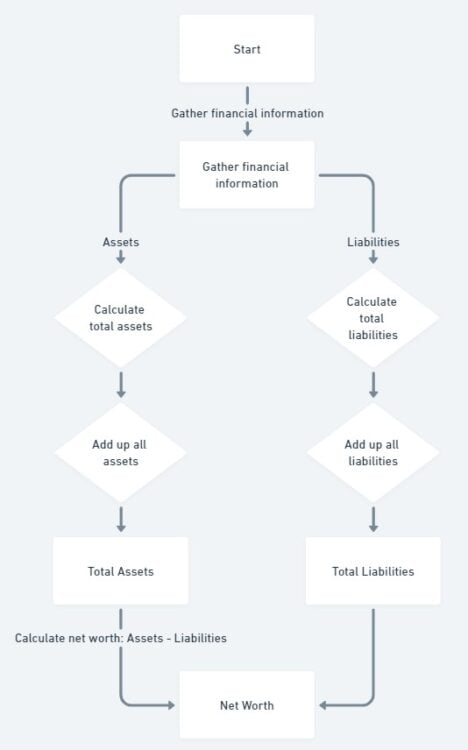
Net worth is simple math: what you own minus what you owe. That’s it. Everything you’ve got (cash, investments, retirement accounts, house, car) minus everything you owe (mortgage, student loans, credit cards, car loans). The number you get is your financial snapshot right now.
It includes everything from the equity in your home, your investment portfolios, to your interests in real estate, balanced against any loans, credit obligations, and other liabilities like a mortgage. This figure is a snapshot of your financial health, offering a clear perspective on where you stand. It is like going to your doctor for an annual physical.
Consider your Net Worth calculation to be like an annual physical, but a yearly check up for your finances.
Monitoring fluctuations in your net worth over time provides tremendous insight into the financial impact of both big and subtle money moves so you can course correct.
Using a Net Worth Calculation Worksheet
Using a quick and Easy Liquid Net Worth Calculator

What is the difference between your liquid net worth and regular net worth? In simplest terms – liquid net worth is your networth that you can quickly and easily access. For example, how long would it take for you to get proceeds from selling your house or business vs accessing your checking or savings account?
For more, read my article all about understanding liquid networth and calculating your liquid net worth here.
Benefits of Using a Calculator To Figure Your Net Worth
A calculator takes something that feels overwhelming and makes it stupid simple. You plug in your assets (checking, savings, investments, house value) and your debts (credit cards, mortgage, car loans), and boom. You’ve got your number. But you need to be honest with the inputs. Garbage in, garbage out.
Most people check their checking account balance obsessively. But that’s meaningless. You could have $5,000 in checking and still be broke if you’ve got $50,000 in credit card debt. Net worth shows you the real picture. That’s why I had my clients calculate it every three months without fail.
The free online calculator makes it simple and convenient. Just input all your current assets, debts and account balances to generate your up-to-date net worth assessment.
Once you know your actual net worth, you can set real goals. Want to buy a house in three years? You need to hit a specific net worth number. Want to retire early? There’s a net worth target for that too. Without knowing where you are now, you’re just guessing.
Here’s something most people don’t realize: paying off debt increases your net worth faster than saving money. If you’ve got a credit card charging 22% interest, every dollar you put toward that debt is like earning a guaranteed 22% return. You can’t get that anywhere else. I’ve seen clients boost their net worth by $30,000 in a year just by attacking high-interest debt instead of saving in a 0.5% savings account.
What Can Tracking My Net Worth Help Me Find?
Regular net worth tracking safeguards your financial health by revealing concerning trends requiring intervention. See balances creeping up on multiple credit cards? Time to curb spending. Notice a dip in investment returns? Consult your advisor about reallocating funds.
Catch a math error resulting in lower net worth than expected? Investigate account balances and transactions for discrepancies. Like any early warning sign, identifying issues promptly through net worth monitoring enables course correction before long term damage.
Common Mistakes People Make By NOT Using a personal Net Worth Calculator
On the flip side, I’ve watched clients struggle by not regularly checking net worth.
- Missed mortgage refinancing opportunities during market dips.
- Panic investment liquidations based on temporary losses.
- Unnecessary high-interest debt racking up across fragmented accounts.
- Impulsive buys erasing hard-earned asset accumulation.
- Unexpected healthcare or estate planning gaps surfacing too late.
Tracking net worth helps avoid these landmines guaranteeing lasting financial health.
Regularly Calculate and Track Your Net Worth
If you’re not tracking your net worth, start today. Use this free calculator I built. Or grab a spreadsheet. Hell, use a piece of paper. Just start tracking it.
- Put it on your calendar. First day of every quarter. January 1, April 1, July 1, October 1.
- Get all your statements in one place. All of them.
Here’s what nobody tells you: your net worth will jump around. A lot. The stock market crashes? Your net worth drops 20% overnight. House values tank? Down another 15%. This is normal. What matters is the trend over 3-5 years, not what happens in a single quarter. I had clients panic-sell everything in 2008 when their net worth dropped, then miss the entire recovery. Don’t be that person.
Net Worth Percentile Calculator By Age, Income or Education Level
Use our Net Worth Percentile Calculator By Age. income or education level to gain valuable insights into your financial standing and compare it to others in your age group.
Here’s how it works:
- Online Net Worth Calculator: Our tool is easily accessible online, allowing you to calculate your net worth conveniently.
- Financial Literacy: Gain a better understanding of your financial health and improve your financial literacy by analyzing your net worth percentile.
- Asset Valuation: The calculator takes into account the value of your assets, including investments, real estate, and savings, to determine your net worth.
- Retirement Planning: Assess your progress towards retirement goals by evaluating your net worth percentile in relation to your age group.
- Emergency Funds and Financial Stability: Discover if you have enough emergency funds and assess your overall financial stability by comparing your net worth percentile with others in your age range. Read our article about How To Start & Build An Emergency Fund.
Our Net Worth Percentile Calculator offers a comprehensive analysis of your financial situation, guiding you towards better wealth building strategies.
If you want to see more stats and data about how you compare:
Federal Reserve’s Survey of Consumer Finances or Bureau of Labor Statistic’s Consumer Expenditure
Real Life Examples Of How Clients Benefited From The Net Worth Calculator

Let me show you three real clients and what happened when they finally looked at their net worth.
- Sarah, 30, marketing manager. She thought she was doing okay. $8,000 in savings, making $65,000 a year. Then she calculated her net worth: negative $42,000. Turned out she had $23,000 in credit card debt she’d been ignoring, $22,000 in student loans, and a $5,000 car loan. Seeing that negative number shocked her into action. She paid off all her credit cards in 18 months. Her net worth is now positive $31,000.
- John and Linda, both 58. Combined income $180,000. They thought they were set for retirement. Their net worth calculation showed $640,000 (house paid off worth $420,000, retirement accounts $340,000, but still had a $120,000 HELOC they forgot about). Sounds good, right? Wrong. When we dug deeper, 70% of their net worth was tied up in their house. They couldn’t eat their house in retirement. They shifted their strategy, started maxing out their 401(k)s. Three years later, their total net worth is $890,000, but now only 50% is in the house.
- Alex, 41, owns a landscaping company. He avoided calculating his net worth for years because he was scared of what he’d find. Finally did it: $215,000 positive. Wait, what? His business equipment was worth $80,000 (he thought it was worthless), his house had $140,000 in equity, and he only had $5,000 in debt. Knowing he had that cushion gave him the confidence to hire two more employees and buy a second truck. Revenue jumped 40% the next year.
These examples demonstrate how our Net Worth Calculator can assist with managing personal finances, debt-to-income ratio, and asset management. It’s a valuable tool for financial planning and wealth assessment.
Practical Tips for Interpreting Your Net Worth

To effectively interpret your net worth, focus on analyzing the composition of your assets and liabilities. Here are some practical tips to help you make the most of your net worth analysis:
- Focus on Trends, Not Comparisons: Instead of comparing your net worth to others, track your own progress over time to gauge personal growth.
- Understand the Composition of Your Net Worth: Dive deeper into the breakdown of your assets and liabilities to identify areas for improvement.
- Consider Context and Goals: Interpret your net worth within the context of your age, income, dependents, and financial goals.
- Acknowledge the Limitations: Remember that net worth isn’t the complete picture and should be used as a starting point for further analysis and planning.
- Use Net Worth as a Motivator: Regularly tracking your net worth can inspire you to manage your finances better and celebrate milestones.
RELATED READING:
- How to Calculate Adjusted Net Worth
- How much are you worth?
- Household inventory and personal net worth
Next Steps to Calculating your Net Worth With Our Free Online Tool
Look, your net worth is the single most important financial number you need to know. Not your credit score. Not your salary. Your net worth.
