

Build the right MAGI number before you test the threshold.
Most IRMAA calculators start with a box that says Enter your MAGI. That is fine if you already know the number. It is not much help if your actual question is whether an IRA withdrawal, Roth conversion, stock sale, Social Security benefit, or municipal bond interest belongs in that number in the first place.
IRMAA MAGI is a tax-return number, not a cash-flow number. Social Security defines the MAGI used for Medicare’s income-related monthly adjustment amount as your adjusted gross income (AGI) plus tax-exempt interest. The hard part is often figuring out what reaches AGI, and in what amount.
This IRMAA Income Checker starts there. Choose the income source or financial event, see whether it generally counts, and then use the amount section only if you want to estimate whether the move could change your IRMAA tier.
Quick Answer
IRMAA uses a Medicare-specific MAGI: adjusted gross income plus tax-exempt interest. That means the amount affecting IRMAA is often the taxable amount that reaches your tax return, not the cash you received. A qualified Roth distribution may add nothing to AGI, while tax-exempt municipal bond interest is added back for IRMAA. Use the checker to classify the event first, then test the threshold using only amounts that are not already included in your base AGI.
Medicare income tool
IRMAA Income Checker
Select the income or financial events that apply to you. Get the fast answer first, then add amounts only if you want to test an IRMAA threshold.
Step 1
What income are you concerned about?
Popular choices
Retirement Income 9 choices
Investments and Savings 7 choices
Work and Business Income 4 choices
Home and Real Estate 5 choices
Other Money Received 6 choices
No matching income type found. Try a broader word such as "retirement," "property," or "interest."
Please select at least one income source.
Your quick answer
What generally counts toward IRMAA MAGI
Could these amounts push you into a higher Medicare tier?
Add your base AGI and only the proposed amounts not already included in it. The estimator compares your IRMAA cost before and after the selected income.
Step 2 - optional
Estimate the threshold impact
Selected proposed income not already in base AGI
Enter the amount described for each item. Excluded items stay visible so you can see why they add $0.
Please enter a valid base AGI of $0 or more.
Your estimated result
IRMAA threshold comparison
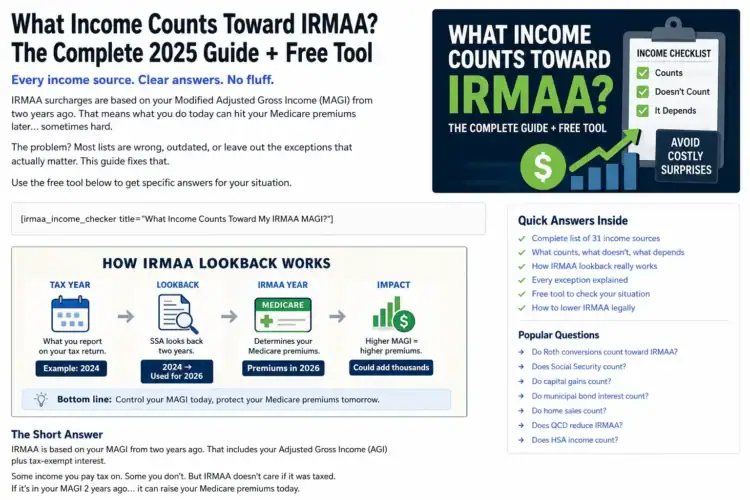
One timing point before you use the results: IRMAA generally looks back two years. Social Security says 2026 Medicare premiums are generally based on 2024 tax-return information. So the tool shows both the tax year and the Medicare premium year instead of making you keep doing that mental translation yourself.
Key Takeaways Ahead
How to Calculate MAGI for IRMAA
The formula itself is short:
IRMAA MAGI = adjusted gross income + tax-exempt interest
The Social Security Administration’s IRMAA policy points to Form 1040 line 11 for AGI and line 2a for tax-exempt interest. For 2026 premiums, Social Security generally uses 2024 tax information.
The important word is adjusted.
Your AGI is not every deposit into your checking account. It is the income that reaches the tax return after the tax rules determine what is taxable, what is partly taxable, what is excluded, and what is offset elsewhere on the return.
That is why two people can receive the same amount of cash and have different IRMAA results. One traditional IRA distribution may be fully taxable. Another may include a nontaxable return of basis from prior nondeductible IRA contributions. A stock sale may produce a gain far smaller than the sale proceeds. A qualified Roth IRA distribution may not enter income at all.
There is one especially important add-back: tax-exempt interest. Municipal bond interest can be exempt from federal income tax and still increase the MAGI Social Security uses for IRMAA.
If you want the line-by-line tax treatment rather than the checker, use my guide to what counts toward IRMAA MAGI. This page has a narrower job: help you classify the item and use the checker correctly.
Quick IRMAA Income Reference
The table below is the scan-it-first version. It is not a substitute for the tax return when an item has basis, exclusions, losses, or other special rules.
| Income or financial event | Usually affects IRMAA MAGI? | Amount that usually matters |
|---|---|---|
| Traditional IRA distribution | Yes, generally | The taxable portion included in AGI |
| Roth conversion | Yes, generally | The converted amount included in gross income |
| Qualified Roth IRA distribution | Generally no | No amount is included in gross income if the distribution is qualified |
| Social Security benefits | It depends | The taxable portion included in AGI |
| Stock or fund sale | Yes, if there is taxable gain | Net taxable capital gain, not total sale proceeds |
| Sale of a main home | It depends | Any taxable gain remaining after basis, selling costs, exclusions, and other applicable rules |
| Municipal bond interest | Yes | Tax-exempt interest is added to AGI for IRMAA |
| Qualified charitable distribution (QCD) | Generally no | The qualifying amount excluded from income |
| HSA distribution | It depends | The amount included in income if the distribution is not for qualified medical expenses |
| Pension or annuity payment | It depends | The taxable portion after any tax-free recovery of cost |
A simple yes can still hide an important detail. If $50,000 hits your bank account but only $18,000 is taxable, the IRMAA question is usually about the $18,000 that reaches AGI, not the $50,000 cash receipt.
That distinction is the reason the checker asks follow-up questions only when the answer can change.
The Cash You Receive Is Often Not the IRMAA Number
This is where most of the mistakes happen.
A stock sale is not the same as a capital gain
Suppose you sell $150,000 of stock that has a $120,000 cost basis. You did not create $150,000 of capital gain. You created a $30,000 gain before considering capital losses and other adjustments.
If someone types the full $150,000 of proceeds into an IRMAA calculator as new income, the calculator can be perfectly programmed and still produce a useless answer. The input was wrong.
A traditional IRA distribution may not be fully taxable
The IRS instructions for Form 8606 apply when a traditional IRA contains basis from nondeductible contributions. That basis can make part of a distribution nontaxable.
So “I withdrew $40,000 from my IRA” does not always tell me that $40,000 increased AGI. The taxable amount is what matters for the IRMAA calculation.
A Roth withdrawal and a Roth conversion are different transactions
A qualified Roth IRA distribution is not included in gross income. A Roth conversion from a traditional IRA is different. The conversion generally creates income to the extent the converted amount has not already been taxed.
That distinction matters because the words sound similar while the MAGI result can be completely different.
Social Security can be partly taxable
The IRS rules for Social Security benefits say up to 85% of benefits can be taxable under the federal rules. That does not mean Social Security is taxed at an 85% rate, and it does not mean 85% is always included in income.
For IRMAA, the taxable portion that reaches AGI matters. The nontaxable portion of the benefit is not a separate IRMAA add-back.
A home sale can create a much smaller taxable number than the closing check
When you sell a home, the sale price is not automatically IRMAA income. The tax calculation starts with gain, which depends on basis and selling costs. For a qualifying sale of a main home, federal law may also exclude some or all of that gain from income.
The IRS guide to selling your home is the right place to work through those rules. The checker can flag that a home sale depends. It cannot know your basis or whether you qualify for an exclusion unless you supply the tax result.
Municipal bond interest is the odd one out
This is the one that earns the phrase “tax-free does not mean IRMAA-free.”
Tax-exempt interest is not buried somewhere inside AGI. Social Security explicitly adds it to AGI when it calculates IRMAA MAGI. That is why municipal bond interest can increase Medicare premiums even when it is exempt from federal income tax.
Michael’s Take
The threshold is the easy part. Feeding it the right income number is the work. Before you worry about being $1 over an IRMAA threshold, make sure the number you are comparing with that threshold is actually the number the tax return will produce.
Avoid the Next Retirement-Income Surprise
IRMAA is a good example of how one small tax detail can change a much bigger retirement decision. I send out practical checks like this each week so you know what number, rule, or tradeoff to look at before you make the move.
- Spot retirement-income traps before they hit your tax return
- See how Roth conversions, capital gains, and Medicare costs connect
- Get plain-English checks for decisions that don’t fit neatly into a calculator
Get the next retirement-planning check in your inbox.
How to Use the Checker Without Double Counting Income
The detailed estimator has two different jobs. Your base AGI describes the tax return before the proposed items you are testing. The income items below it describe the proposed moves you want the checker to add.
Those jobs need to stay separate.
- Start with base AGI before the proposed items. If you are testing a $30,000 Roth conversion, do not start with an AGI number that already includes that same $30,000 conversion.
- Enter base tax-exempt interest separately. If you are testing a new municipal bond interest amount below, leave that proposed interest out of the base tax-exempt-interest field.
- Add only the income or events you are testing. Use the taxable or IRMAA-relevant amount when the tool asks for it, not automatically the gross cash received.
- Compare the before-and-after MAGI. The useful result is not just the final tier. It is whether the proposed item changed the MAGI enough to move you into another tier.
Watch Out
If a Roth conversion is already included in your base AGI and you enter the same conversion again as a proposed item, you have counted it twice. The checker cannot fix a number that was intentionally handed to it twice. The same problem can happen with capital gains or new tax-exempt interest.
This is not a theoretical little spreadsheet problem. Retirement-planning software users regularly run into confusion about which Social Security amounts, conversions, and other items are already inside a modeled MAGI number. The cure is not a more dramatic threshold warning. It is a clean before-and-after input design.
Why IRMAA Can Show Up Two Years Later
IRMAA has a delay built into it.
A transaction that changes your 2024 tax return can change your 2026 Medicare premiums. A transaction that changes your 2026 return can generally affect your 2028 premiums.
That lag is easy to forget because the financial decision and the Medicare bill do not happen at the same time.
For 2026, the standard Medicare Part B premium is $202.90 per month. CMS says the first 2026 IRMAA tier begins above $109,000 of MAGI for most individual filers and above $218,000 for married couples filing jointly. Those thresholds apply to the tax information used for the 2026 premium determination, generally 2024 tax information.
If you want the mechanics behind the lookback, tax-year substitution, and premium determination, read how Medicare calculates the IRMAA surcharge.
The practical point here is simpler: label the tax year and the premium year separately. Otherwise it is very easy to optimize the wrong year.
If your income later drops because of retirement, work stoppage, marriage, divorce, death of a spouse, or another qualifying event, a separate Social Security relief process may apply. That is an appeal/new-determination question, not an income-classification question, so I keep it out of this checker.
What the IRMAA Income Checker Cannot Know
A useful calculator should tell you where its confidence ends.
The checker cannot automatically know:
- your cost basis in stock, funds, or a home;
- your traditional IRA basis from nondeductible contributions;
- the exact taxable portion of your Social Security benefits;
- the tax-free portion of a pension or annuity payment;
- whether a home sale qualifies for a gain exclusion;
- capital-loss carryovers or other tax-return offsets;
- passive-activity losses and other items that can change AGI;
- whether a legal settlement is taxable;
- whether a Roth distribution meets the requirements for a qualified distribution; or
- what the IRS or Social Security will ultimately accept on your return or IRMAA determination.
When one of those facts controls the answer, the checker should say it depends rather than manufacture precision.
The best input is usually the amount you reasonably expect to be included on the applicable line of your federal tax return. If you are not sure what that amount will be, use the checker for classification first and verify the tax treatment before relying on the threshold estimate.
What to Do After the Checker Gives You an Answer
The result should narrow your next question, not create ten new ones.
- If the checker says the item generally does not count: confirm that you meet the conditions, then stop treating the gross cash receipt as IRMAA income.
- If it says the item generally counts: use the taxable or IRMAA-relevant amount and see whether it materially changes your estimated tier.
- If it says it depends: identify the one missing fact, such as basis, taxable Social Security, or home-sale gain, before you make a threshold decision.
- If you are close to a tier: use the full Medicare IRMAA surcharge calculator to see the current premium effect for your filing status and household.
- If you are deciding whether to change a transaction just to avoid IRMAA: step back and compare the full tax, investment, charitable, and retirement-planning tradeoff. My guide to avoiding or reducing IRMAA covers those planning choices.
That last point matters. Paying more Medicare premium for a year can be annoying, but IRMAA is still one cost inside a larger financial decision. A Roth conversion may still make sense. A stock sale may still reduce a concentration risk you should not keep. A home sale may still fund the retirement you actually want.
IRMAA is a threshold cost, not a tax rate. Include it in the comparison. Do not let it make the comparison for you.
Build the Right MAGI Before You Plan Around the Threshold
Start in the right order:
- Identify the income source or transaction.
- Determine what portion actually reaches AGI.
- Add tax-exempt interest for IRMAA.
- Keep proposed items out of the base AGI if the checker is going to add them separately.
- Then compare the resulting MAGI with the applicable IRMAA threshold.
That sequence sounds almost too simple. It is also the difference between testing a real Medicare-income question and asking a calculator to do precise math on the wrong number.
The IRMAA Income Checker is built for that first job. Classify the income correctly. Build the MAGI correctly. Then decide whether the threshold is worth planning around.
Sources
- Social Security Administration, Modified Adjusted Gross Income (MAGI)
- Centers for Medicare & Medicaid Services, 2026 Medicare Parts A & B Premiums and Deductibles
- IRS, Instructions for Form 8606
- IRS, Publication 915, Social Security and Equivalent Railroad Retirement Benefits
- IRS, Publication 590-B, Distributions from Individual Retirement Arrangements (IRAs)
- IRS, Publication 523, Selling Your Home
- IRS, Instructions for Form 8889
- IRS, Publication 575, Pension and Annuity Income
Know Which Income Counts Before You Move It
IRMAA planning gets expensive when a Roth conversion, stock sale, or supposedly tax-free interest payment changes the MAGI you thought you had.
Get Michael’s weekly retirement tax and Medicare planning notes to help you spot the income that changes IRMAA MAGI, understand the two-year Medicare effect, and compare the tax and premium tradeoff before you act.
