

An A/B trust, also called a bypass trust or credit shelter trust, can still be useful as 2026 gives way to 2027. But the reason to use one has changed. The federal estate-tax basic exclusion is $15 million per person in 2026, and current law calls for inflation adjustments after 2026. That means many married couples no longer need an automatic bypass trust simply to preserve two federal estate-tax exemptions. Understanding living trust costs in 2026 will be crucial for those looking to navigate estate planning effectively.
The decision is now more nuanced. Portability can preserve a deceased spouse’s unused federal estate-tax exclusion, but it does not replace every job a trust can do. Control over heirs, remarriage risk, creditor protection, state estate taxes, generation-skipping transfer planning, and future basis treatment can all change the answer. And if you are reviewing an older trust before 2027, the funding formula matters just as much as the trust label.
That is the part I would focus on. Do not ask, “Is an A/B trust obsolete?” Ask, “What problem is this trust solving for our family now?”
Michael’s Take
The old planning reflex was “use both exemptions.” The better 2026 question is “which tradeoff are we buying?” Portability usually buys simplicity. A bypass trust can buy control and protection. Neither is automatically better.
Quick answer. If your estate is comfortably below federal and applicable state estate-tax thresholds and you do not need special control or protection, portability may make a mandatory A/B structure unnecessary. If you have a blended family, creditor concerns, significant expected appreciation, GST planning needs, state estate-tax exposure, or a strong reason to lock in where assets ultimately go, a bypass trust may still deserve serious consideration.
Show the key tradeoffs
- 2026 federal exclusion: $15 million per person; future years are inflation-adjusted under current law.
- Portability: Can preserve a deceased spouse's unused federal estate-tax exclusion when Form 706 is properly filed.
- What portability does not do: It does not port GST exemption or replace trust control, creditor, remarriage, or state-tax planning.
- Basis tradeoff: Assets kept outside the survivor's estate may miss a later basis adjustment at the second death.
- Late-2026 planning: Review old funding formulas now, but do not hard-code an unofficial 2027 exemption amount into planning decisions.
On this page
- What Changed for A/B Trusts in 2026?
- How Does an A/B Trust Work?
- A/B Trust vs. Portability
- What to Review Before 2027
- The Basis Tradeoff
- When an A/B Trust Still Makes Sense
- Year-End A/B Trust Review Checklist
- What a Surviving Spouse Should Do
- A/B Trust FAQs
On This Page
- What Changed for A/B Trusts in 2026?
- How Does an A/B Trust Work?
- A/B Trust vs. Portability: What Are You Actually Trading?
- What Should You Review Before 2027?
- The Basis Tradeoff: Where an Old A/B Trust Can Become Expensive
- When Does an A/B Trust Still Make Sense?
- A Year-End A/B Trust Review Checklist for 2027 Planning
- What Should a Surviving Spouse Do With an Existing A/B Trust?
- A/B Trust Frequently Asked Questions
- The Bottom Line
- How We Verified This
What Changed for A/B Trusts in 2026?
The federal estate-tax landscape changed materially after Public Law 119-21, commonly referred to as the One Big Beautiful Bill Act. The law increased the basic estate and gift tax exclusion to $15 million for 2026, with inflation adjustments after 2026. The IRS confirms the $15 million amount for people who die in 2026.
Current IRS Form 706 instructions also confirm that a surviving spouse can receive a deceased spouse’s unused exclusion, known as the DSUE amount, when the deceased spouse’s executor makes a portability election on Form 706.
What “permanent” really means
The old scheduled 2026 sunset is gone under current law. That does not mean Congress can never change the estate-tax rules again. Estate plans still need periodic review when tax law, family circumstances, asset values, or state residency changes.
Portability is powerful, but it is not automatic. A complete Form 706 normally must be filed to elect it. The IRS generally requires filing within nine months after death, with the usual extension rules. For certain estates that were not otherwise required to file Form 706, current IRS relief can allow a portability election as late as the fifth anniversary of death.
One other limitation matters for wealthy multigenerational families. Portability does not transfer the deceased spouse’s generation-skipping transfer tax exemption. That is one reason bypass and dynasty-trust planning can still matter even when federal estate-tax portability looks sufficient.
How Does an A/B Trust Work?

“A/B trust” is a planning shorthand, not one single required form. In a common married-couple plan, documents create two shares after the first spouse dies.
Trust A, often the survivor’s or marital share
This portion is generally for the surviving spouse and may remain revocable or otherwise under the survivor’s control, depending on the documents and planning design.
Trust B, the bypass or credit shelter trust
This portion is generally funded with assets intended to remain outside the surviving spouse’s taxable estate. The surviving spouse can often receive income and, depending on the drafting, principal under specified standards. The deceased spouse can also lock in who receives the remaining assets later.
Think of it as two jobs, not two buckets
The survivor’s share is designed around the surviving spouse’s ownership and flexibility. The bypass share is designed around keeping selected assets outside the survivor’s taxable estate while following the first spouse’s instructions. The exact rights, funding formula, tax elections, and beneficiaries come from the estate documents and state law.
That last sentence is important. Not every A/B trust funds Trust B with the full federal exemption. Some plans use formulas, disclaimers, QTIP elections, state-only bypass trusts, or other flexible provisions. If your documents were drafted when exemptions were much lower, do not assume the old funding formula still produces the result you want.
A/B Trust vs. Portability: What Are You Actually Trading?

| Decision factor | A/B or bypass trust | Portability-focused plan |
|---|---|---|
| Federal estate exclusion | Can shelter selected assets and future appreciation outside the survivor’s estate, depending on funding and drafting. | Can preserve a deceased spouse’s unused federal estate-tax exclusion through a valid Form 706 election. |
| Control after first death | Can preserve the first spouse’s beneficiary and distribution instructions. | Assets left outright to the survivor generally remain under the survivor’s control. |
| Administration | More moving parts. A separate irrevocable trust may need its own records, tax reporting, investment management, and trustee administration. | Usually simpler after the first death, although Form 706 preparation can still be substantial. |
| Basis at second death | Assets outside the survivor’s gross estate may not receive a new basis adjustment at the survivor’s death. | Assets still included in the survivor’s gross estate generally may receive a basis adjustment at the survivor’s death, subject to the tax rules then in effect. |
| GST exemption | Can be coordinated with the deceased spouse’s GST exemption when properly planned. | DSUE portability does not transfer GST exemption. |
| State estate tax | May help where a state imposes its own estate tax or has different portability rules. | Federal portability does not by itself solve state estate-tax exposure. |
Notice what is missing from that table: a universal winner. The correct comparison depends on what your estate plan is trying to protect.
What Should You Review Before 2027?
2027 estate-tax update
As of September 22, 2026, the IRS has not published the official 2027 basic exclusion amount. Current law starts with a $15 million 2026 base and provides inflation adjustments after 2026. The IRS says future amounts will be published in annual revenue procedures.
That makes late 2026 a good time to review the plan, but a bad time to treat a projected 2027 number as final. Your attorney can review the document mechanics now without pretending the next inflation-adjusted threshold has already been announced.
| Year | Federal basic exclusion | Planning status |
|---|---|---|
| 2026 | $15 million per person | Official IRS amount. |
| 2027 | $15 million base, adjusted for inflation | Official inflation-adjusted amount not yet published as of Sept. 22, 2026. |
The planning question is not simply whether the 2027 number will be a little higher. It is whether your existing documents still make sense under a permanently higher federal baseline, your state’s rules, your family structure, and the assets most likely to appreciate before the second death.
Late-2026 planning rule
Review the formula now. Update the dollar assumptions when the IRS publishes the official 2027 inflation adjustment. Do not wait for the new number before asking whether the old A/B formula is solving the right problem.
The Basis Tradeoff: Where an Old A/B Trust Can Become Expensive
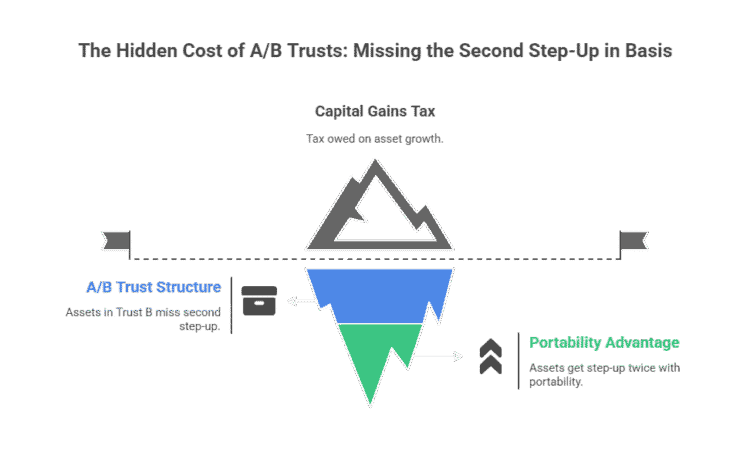
This is the tradeoff I would want quantified before automatically funding an old bypass formula.
Property inherited from a decedent generally receives a basis tied to fair market value at death, subject to important exceptions and alternative valuation rules. IRS Publication 551 explains the general inherited-property basis rules.
If appreciated assets are placed in a bypass trust at the first death, they can receive the first basis adjustment. But because those assets are commonly structured to stay outside the surviving spouse’s gross estate, they may not receive another basis adjustment when the surviving spouse later dies.
By contrast, assets owned outright by the surviving spouse are generally included in that spouse’s gross estate and may receive another basis adjustment at the second death. That can make simplicity and basis planning more valuable than estate-tax exclusion planning for some families.
Simple hypothetical
Assume $5 million of stock receives a basis adjustment at the first spouse’s death and later grows to $9 million. If the stock stays outside the survivor’s gross estate in a bypass trust, the additional $4 million of appreciation may remain built-in gain. If the same stock were includible in the survivor’s estate and qualified for a new basis adjustment at the second death, that built-in gain could be reduced or eliminated at that point.
This is an illustration, not a promise. Trust powers, inclusion rules, state law, tax elections, asset type, and future law can change the result.
Modern estate plans can also include flexibility designed to manage basis later. That is another reason I would not assume “old bypass trust equals bad” or “portability equals better.” The document language matters.
When Does an A/B Trust Still Make Sense?
1. You want to protect children from a prior relationship
In a blended family, the first spouse may want the surviving spouse to benefit from assets without giving the survivor unrestricted power to redirect everything later. A properly drafted bypass or marital trust can separate lifetime access from ultimate ownership.
2. You want creditor or remarriage protection
A trust can provide protection that outright ownership does not, but the result depends heavily on state law, trust terms, beneficiary rights, and trustee structure. Treat “asset protection” as a drafting question, not an automatic feature of every Trust B.
3. Your estate may grow far beyond today’s value
Portability preserves unused exclusion measured at the first death. A bypass trust can also move post-death appreciation on properly funded assets outside the survivor’s estate. For families with rapidly appreciating businesses, concentrated investments, or unusually long time horizons, that difference can matter.
4. State estate-tax rules matter
Federal portability does not automatically preserve a state estate-tax exemption. State thresholds and portability rules vary, so the right design can change when you move or own property in another state.
5. You need GST planning
The IRS specifically cautions that DSUE portability does not apply to the generation-skipping transfer tax exemption. Families planning for grandchildren or longer-term dynasty trusts may therefore have a different decision than a couple focused only on estate tax at the surviving spouse’s death.
The review question I would bring to your attorney
“If one of us died this year, exactly how would this document fund each trust, which assets would go where, what would be included in the survivor’s estate later, and what tax or control problem is each piece solving?”
A Year-End A/B Trust Review Checklist for 2027 Planning
If both spouses are living and you already have an A/B trust, I would use the rest of 2026 to answer these questions before another tax year begins.
- What exactly causes Trust B to fund? A mandatory formula, a disclaimer, a QTIP election, a state-only amount, or something else?
- What problem is Trust B solving today? Federal estate tax, state estate tax, blended-family control, creditor protection, GST planning, appreciation, or a combination?
- Which assets would actually fund it? Highly appreciated stock, a business, real estate, cash, or retirement assets can create very different tax consequences.
- What basis result are you buying? Quantify the potential estate-tax benefit and the potential capital-gains cost instead of comparing labels.
- Would portability still be filed? A bypass trust and a portability election are not mutually exclusive in every plan.
- Have you moved or changed family circumstances? State law, remarriage, births, deaths, beneficiary changes, and major asset growth can change the planning job.
- What changes when the official 2027 exclusion is released? Ideally, the answer is a number update, not discovering for the first time that the entire formula is wrong for your family.
Michael’s Take
The best year-end estate review is not “Do we still have a trust?” It is “If one of us died on January 2, 2027, what would happen automatically, and would we still choose that result on purpose?”
What Should a Surviving Spouse Do With an Existing A/B Trust?
If your spouse has died and the estate plan contains A/B or bypass-trust provisions, do not start retitling assets from an old checklist before someone reads the actual documents.
- Find the signed trust, will, amendments, and beneficiary designations. The funding formula and trustee powers control the next steps.
- Have an estate-planning attorney identify the required and optional trust funding. Old documents can contain formulas that behave very differently under today’s exemption amounts.
- Coordinate the portability decision before the Form 706 window closes. Even an estate below the filing threshold may choose to file Form 706 to preserve DSUE.
- Inventory basis and unrealized gains before funding. Which assets go into a bypass trust can affect future capital-gains exposure.
- Set up separate trust administration when required. An irrevocable bypass trust may need its own EIN, accounts, records, trustee accounting, and Form 1041 filings depending on its tax status and activity.
If you are still at the planning stage rather than administering an estate, my estate-planning basics guide covers the broader documents and beneficiary decisions that sit around this trust choice.
A/B Trust Frequently Asked Questions
What is the federal estate-tax exemption for 2026?
The IRS lists the 2026 basic exclusion amount at $15 million per individual. A married couple does not automatically receive a single $30 million exemption. Each spouse has an individual exclusion, and preserving a deceased spouse’s unused amount generally requires a valid portability election.
What is the federal estate-tax exemption for 2027?
As of September 22, 2026, the IRS has not published the official 2027 basic exclusion amount. Current law sets a $15 million base for 2026 and provides inflation adjustments after 2026. Use the IRS amount when it is officially released rather than a private projection.
Is an A/B trust the same as a bypass trust?
A/B trust is a common label for a married-couple estate plan that creates separate shares after the first death. The “B” share is commonly called a bypass trust, credit shelter trust, family trust, or decedent’s trust. The exact structure varies by document and state law.
Does portability eliminate the need for a bypass trust?
No. Portability solves one specific federal estate-tax problem by transferring DSUE. It does not transfer GST exemption and does not by itself provide beneficiary control, creditor protection, state estate-tax planning, or insulation of future appreciation from the survivor’s estate.
Does every bypass trust lose a second step-up in basis?
No. The concern is that assets excluded from the surviving spouse’s gross estate generally do not receive a new basis adjustment merely because the survivor dies. But trust drafting, powers, tax elections, and inclusion strategies can change the analysis. This is one of the places where the document needs to be reviewed rather than diagnosed from the trust’s nickname.
Can an IRA or 401(k) be payable to a trust?
Yes, a trust can be named as a retirement-account beneficiary, but the income-tax and beneficiary rules are separate from the A/B trust decision. Do not assume retirement accounts should be retitled into the trust during life or that a trust beneficiary designation produces the same result as taxable investment assets. Have the beneficiary designation reviewed specifically under current retirement-distribution rules.
The Bottom Line
The 2026 estate-tax changes did not make A/B trusts obsolete. They changed the hurdle a bypass trust has to clear.
If the trust is there only because someone once feared a lower federal exemption, it deserves a fresh review. If it is solving a real control, protection, GST, state-tax, or appreciation problem, it may still be doing valuable work.
The goal is not to use the fanciest estate plan. It is to know why every moving part is there.
How We Verified This
I checked the current federal estate-tax, portability, GST, and inherited-basis rules against IRS guidance before updating this article.
